

The upgrade that matters most in the children's tier is documentary, not electronic. Kids eye protection glasses technology smart glasses upgrade considerations has a conclusion that surprises people who arrive expecting a hardware conversation: the published hardware in this category has already reached the point where the feature set is settled, and what is not settled is everything that sits around the hardware. A lens-based electronic fogging arrangement, a posture sensor, a viewing-distance sensor and a rated runtime of roughly twenty hours on a 40 mAh cell — that is not a specification that needs improving. It is a specification that needs proving.
So the first question of any upgrade conversation in this tier is not "what is the next model". It is "which dimension is actually limiting the product right now". Most buyers answer that question wrongly, because the limitation feels like a product problem and the visible symptom arrives as a sales problem.
A buyer considering an upgrade is usually reacting to something concrete: a competitor's listing, a retailer's new technical requirement, a parent's question that support could not answer, or a return trend that nobody can explain from the data. They will hold the current product, a target price, a channel plan and a market list. What they will not hold is a view of which dimension is binding — and in this tier it is almost never the electronics.
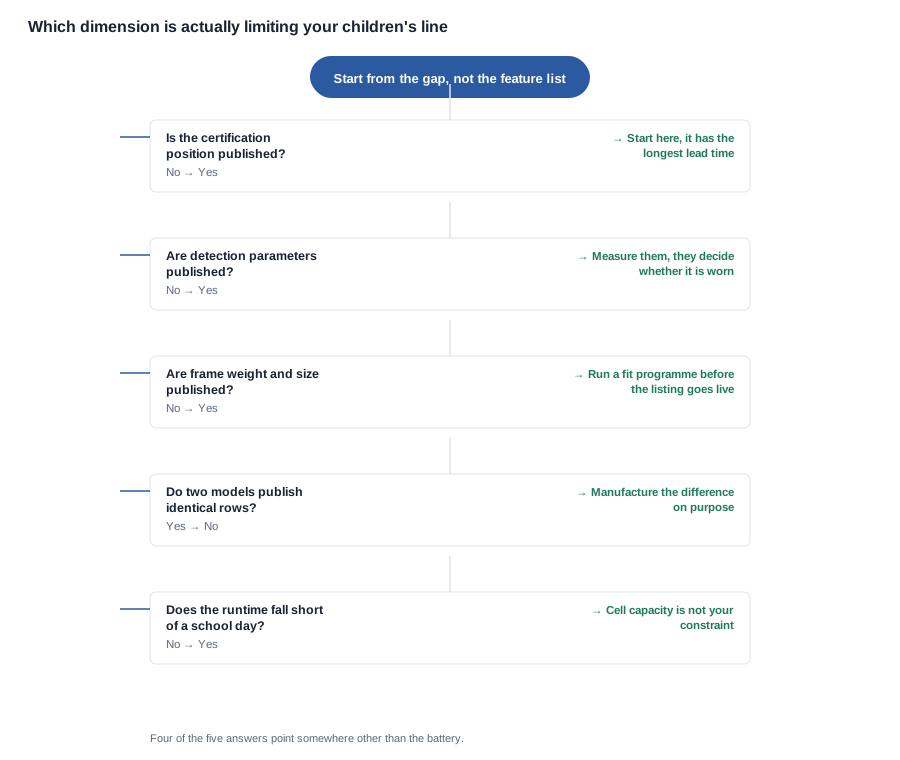
Kids eye protection glasses technology: naming the dimension
There are five dimensions a buyer can move in a children's smart glasses line, and they are not interchangeable. Sorting them by how the money is spent gives you a much clearer ordering than sorting them by how visible they are to a customer.
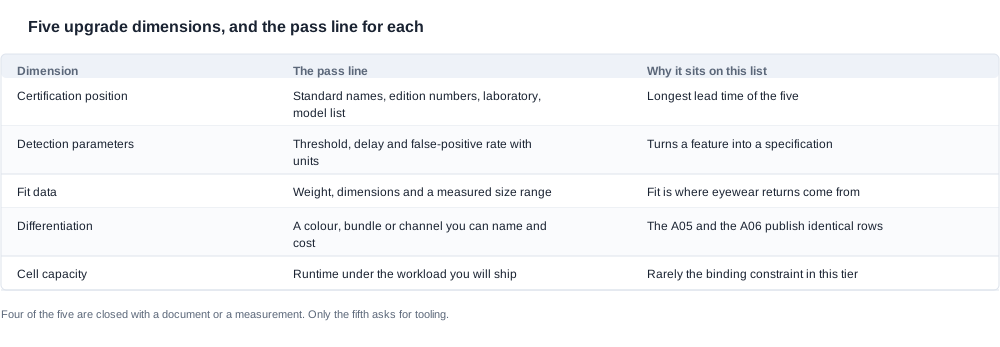
| Dimension | The pass line | Why it sits on this list |
|---|---|---|
| Certification position | Standard names, edition numbers, laboratory and model list, per market | The longest lead time of the five |
| Detection parameters | Threshold, delay and false-positive rate, each with a unit | Turns a published function into a specification |
| Fit data | Frame weight, dimensions and a measured size range | Fit is where eyewear returns come from |
| Differentiation | A colour, bundle, packaging treatment or channel you can name and cost | The A05 and the A06 publish identical rows |
| Cell capacity | Runtime under the workload you intend to ship | Rarely the binding constraint in this tier |
The ordering that matters is the one at the bottom of that table. Cell capacity is the dimension buyers reach for first and it is the one that most often adds cost the customer cannot feel. A runtime of roughly twenty hours is already longer than a school day. A family that removes the device for charging at lunch and puts it back on has a product that is effectively all-day, and a family that does not has a product that is close to all-day on paper. Adding capacity to that position changes the bill of materials, the tooling and the shipping profile without changing what the child experiences.
Why a capacity upgrade adds cost the customer cannot feel
There is a second reason capacity is the wrong place to start, and it is a cost-structure reason rather than an experience reason. Cell capacity propagates into the frame. A larger cell is a larger volume, and in a product that is worn on a face all day, volume is weight, and weight is fit. The A05 and the A06 publish a 40 mAh cell and a rated use of roughly twenty hours, which means the published figure is already describing a duty cycle rather than a continuous discharge. Before anyone spends money on capacity, the buyer should find out what that duty cycle actually is, because the answer may be that the constraint is how often the reminder fires rather than how much energy the cell holds.
That question is cheap to answer and expensive to skip. Run the published configuration across a full day at the reminder setting you intend to ship, and record where the charge actually ends. If the answer is "the afternoon", the constraint is the reminder frequency, and the remedy is a setting the buyer controls rather than a cell the factory quotes. If the answer is "the cell", then capacity is a real constraint and it is worth talking about.

The five upgrade dimensions and the pass line for each
The table above gives the pass line for each dimension. What a pass line is for is comparison, and the detail that matters is the word "with" in several of them.
Certification position, with the market and the edition named. "We are certified" is not a position. A position names the standard, its edition number, the laboratory, the model list and the market. A file prepared against a superseded edition is a retest waiting to happen, and the buyer who discovers that in the second year of a programme pays for it at the worst possible moment.
Detection parameters, with units. A threshold expressed as a number with a unit can be tested on a sample, compared across suppliers and written into an acceptance criterion. A threshold expressed as a quality cannot be tested at all. Our catalogue publishes posture and viewing-distance detection on the A05 and the A06 and publishes no threshold, no delay, no false-positive rate and no alert format — which means the specification does not exist yet anywhere in this programme, and it is the specification that decides whether the product is worn in week three.
Fit data, with the measurement method. Nobody publishes the frame weight or the dimensions for these three models. Fit is therefore established by sampling across a size range with real children, and the numbers are a by-product of that programme rather than an input to it. The measurement method matters because temple length and lens size are cheap to state and worthless to compare if two suppliers measured them differently.
Differentiation, with the cost attached. A differentiator you cannot cost is an aspiration. Each visual option carries its own minimum quantity, its own artwork round and its own lead time, and a range plan built on options nobody priced is a range plan that discovers its cost at the artwork stage.
Cell capacity, with the workload behind it. This is the only dimension where the published figure and the experienced figure can differ by a factor, and it differs because the workloads differ.
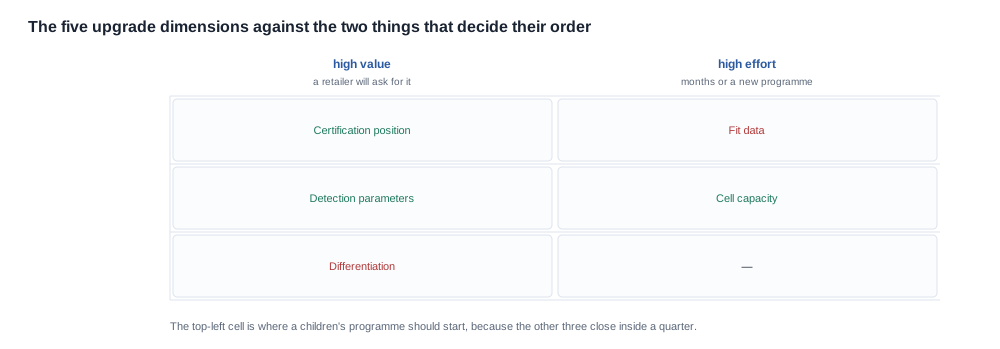
The certification position as the longest-lead increment
Among the five dimensions, the certification position is the one that has to be started first and cannot be accelerated later, and it deserves a separate paragraph because buyers frequently reverse the order. The elapsed time inside a test laboratory is not the buyer's to compress, and neither is the review queue in front of it. Every week of delay in starting that work is a week added directly to the launch date, and no amount of negotiation with the factory will recover it.
This is also the dimension where the category's suppliers are weakest, and where the gap between a claim and a document is widest. Our own catalogue carries an export certification page and publishes no per-model certificate numbers for the A05, the A06 or the A07. We would rather say that plainly than let a buyer find it during a compliance review. The supplier-side detail is in kids supplier verification and the certification side is in kids certification requirements.
The reason to start with certification rather than with detection parameters is not that it is more valuable. It is that the two can run in parallel and only one of them has a queue you cannot shorten.
Where the A05, the A06 and the A07 sit against each other
The three published children's models divide into two products, and the division is functional rather than generational.
The A05 and the A06 publish identical rows: a 40 mAh cell, a charge time of two hours or less, a rated use of roughly twenty hours, magnetic charging, a lens-based electronic fogging arrangement, and posture and viewing-distance detection. Our catalogue records the difference between them as unconfirmed, and we will not pretend to a difference we cannot name. That is not an inconvenience to be worked around; it is the central fact of any upgrade decision involving these two, because it means the specification sheet cannot carry any part of the product proposition.
The A07 is a different shape of product rather than a different generation of the same one. It publishes a 70 mAh cell, a charge time of two hours or less, a rated use of roughly twenty hours, magnetic charging and Bluetooth V5.4 — and it publishes no atomiser and no sensors. If your customer is buying a connected, simpler device, the A07 is that product. If they are buying the reminder behaviour, it is the A05 or the A06. That is the largest product decision in the tier and it is a functional one, and it is made before any upgrade discussion begins.
The three-sentence version of the whole article is this: if the constraint is battery, the constraint is not real, because the published runtime already exceeds a school day; if the constraint is the certification position or the detection parameters, then the increment is large and it is where the money goes; and if the constraint is differentiation, the specification sheet cannot supply it and it has to be manufactured deliberately.


Scoping an upgrade before you price the tooling
The scoping sequence has six steps, and the order is the content. Naming the dimension first is what stops the conversation from drifting into a model discussion that will be closed by a discount rather than by an answer.
- Name the dimension you are trying to move. Hardware, documentation, parameters, fit or differentiation. Four of the five cost less than the fifth and take less time.
- Establish what is published and what is not. For our children's models the published set is the electrical rows and the two published functions on the A05 and the A06. Everything else in the table at the top of this article is a gap, and a gap is a request rather than an argument.
- Take the gap to the supplier in writing. A written gap produces a written answer. A verbal gap produces a verbal answer that disappears when the quotation is revised.
- Turn the answer into an acceptance criterion. If the answer is "the reminder fires when the child is within 35 centimetres for longer than five seconds", that sentence goes into the purchase order as a criterion with a unit. If it is "it detects well", it stays a marketing line and it will not survive the pilot.
- Price the tooling against the volume that carries it. Tooling is a one-off cost amortised across the order, and the useful questions are over what volume it is amortised and what happens to it if the programme is discontinued. That is a different conversation from the unit price, and it should be had separately.
- Schedule the work against the launch date, not against the order date. The certification increment has the longest lead time, so it starts first and finishes last. The fit programme needs a week in real households, and a week in real households cannot be compressed.
Two questions belong at the end of the scoping conversation rather than the beginning, because they are the ones that need the most time to answer usefully: what is not published and when will it be, and can we hold a sample and measure it. Everything else in this article is a document request. Those two are where the actual specification is created.
The checklist to run before you order an upgrade
The six scoping steps produce a decision only if the answers are written down somewhere they can be checked later. A shortlist of children's models is easy to build and easy to lose; a set of named gaps with an owner against each one is neither. Before you order, this is the checklist we would expect a buyer to have completed:
- The dimension is named in one sentence, and it is one of the five in the table at the top of this article. If the sentence contains the word "better", the dimension has not been named yet.
- Every gap in the published rows has an owner and a date — the supplier, the compliance function, the fit programme, or the campaign team. An unowned gap is the one that will still be open at launch.
- The detection parameters exist as criteria with units, or the programme has a dated plan to create them. "It detects well" is not a criterion and cannot be turned into one later without a sample.
- The fit programme has a size range and a day-six record, and the number of wearers is agreed. A fit check with one wearer establishes nothing.
- The differentiation route is chosen with its cost and its minimum quantity attached. A differentiation that is still a list of options is not scoped.
- The acceptance criteria are written into the purchase order, not into an email. A criterion that lives in a message thread is not binding on anyone.
Two of these six are worth more than the other four, and they are the ones that decide whether the upgrade actually improves anything. The third is what turns a published function into a specification, and the sixth is what makes the specification enforceable when the sample arrives and does not meet it. If you only have time for two items before you order, those are the two.
The questions to ask the supplier about each item are deliberately narrow, because narrow questions get narrow answers. "How do you improve detection?" gets a paragraph. "What is the trigger distance in centimetres, what is the delay in seconds, and what is the false-alert rate over ten interruptions in a room with people talking?" gets a number you can put in a purchase order.

The differentiation an identical specification sheet cannot supply
If a buyer wants to differentiate a children's line, the A05 and the A06 make it structurally harder than it looks. Two models, identical published rows, and a buyer who needs a reason for a customer to choose one. The reason cannot come from the catalogue, because the catalogue says the same thing about both.
That leaves four routes, and each has a cost and a lead time that belong in the range plan:
- Colour and finish. A visual difference the customer sees in the photograph. It carries a per-SKU minimum, an artwork round, and possibly a different certification position if the finish touches the enclosure.
- Bundle. What ships in the box alongside the device. It is the cheapest differentiator to add and the easiest to copy, and it changes the shipping profile rather than the hardware.
- Packaging treatment. Usually a print and material change, low tooling risk, and the difference the customer sees at the shelf.
- Channel. A different bundle of software, documentation or service for a different market. It carries the most operational weight and the least hardware risk.
A differentiation the buyer has to manufacture on purpose
The point worth pressing is procedural. A differentiation that was assumed to exist and turned out not to exist is discovered at the artwork stage, when the cost of changing direction is highest and the schedule is already committed. A differentiation that was chosen deliberately has a name, a cost, a minimum quantity and a date attached to it, and it can be defended in a review because it was decided rather than discovered.
This is the same reasoning that applies to the detection parameters, and it is why the two dimensions belong on the same page of the upgrade plan even though one is a factory question and the other is a campaign question. Both of them are things a brand has to create rather than find.
The trade-offs between the four routes are worth naming before you commit to one, because they are not equivalent and the mistakes are asymmetric. Colour and finish is the fastest to launch and the easiest for a competitor to copy, because a colour is visible in a photograph and takes a season to replicate. A bundle is the cheapest to change and the hardest to defend, because it is a list of things in a box. A packaging treatment sits in the middle: it is visible at the shelf, it carries a print and material cost rather than a tooling cost, and it disappears entirely the moment the product is sold as a second listing with different photography. A channel route carries the most operational weight and the most control, because the service and documentation commitments stay with the brand.
Two questions to ask before choosing. The first is what happens to the differentiation when the product is returned — a bundle does not come back, so a bundle-led proposition changes what a return looks like and what it costs. The second is which route survives a re-order from a different factory, because a colour or a bundle is portable between suppliers and a packaging treatment sometimes is not, and portability is worth more to a buyer with two approved factories than a buyer with one.
We are also direct about one boundary that applies to any differentiation in this category. Whatever route is chosen, the proposition may not become a vision, health or eye-protection claim. A device that detects a position or a distance and reminds is not a clinical device, and a differentiation that rests on an eyesight claim is not a differentiation — it is a regulatory exposure with a marketing budget attached. That boundary is not a preference; it is the reason the product is legally sellable in the channels it is sold into. The claims to be careful about are collected in kids myths, and the child-product side of the boundary is under child product compliance.
Where the published children's rows stop and the upgrade begins
What our published rows settle is narrower than most buyers assume, and it is worth stating as a boundary rather than as a limitation.
We publish, for the A05 and the A06: a 40 mAh cell, a charge time of two hours or less, a rated use of roughly twenty hours, magnetic charging, a lens-based electronic fogging arrangement, and posture and viewing-distance detection. For the A07 we publish a 70 mAh cell, the same charge time and rated use, magnetic charging and Bluetooth V5.4. We publish that the A05 and the A06 are identical in their published rows and that the difference between them is not published to us.
We do not publish, and will not estimate: detection thresholds, delays, false-positive rates, the alert format, the behaviour of the fogging arrangement, the certification status, the frame weight, the frame dimensions, the ingress marking or the size range. We publish no ageing data for the seal or the battery, and we will not estimate a service life for something we have not tested.
The reason this matters for an upgrade decision is that it tells you where the increment has to come from. Every item on that unpublished list is an increment that a buyer can create with a document request, a measurement programme or a written position — none of them requires a new mould, and all of them are cheaper than a hardware change. The published rows are the part of the product that is already settled.
What the negotiation can move, and what it cannot
The commercial conversation around an upgrade in this tier has a fairly predictable shape, and the useful discipline is to separate the part where a supplier has discretion from the part where it has none.
A supplier has real discretion over the number of models and colours committed, the artwork round count, the per-market label scope, the fit programme scope, and the market list itself. Those are the buyer's own decisions being priced, and they move more easily than a unit price. The customisation scope — the visual differentiation above — is also negotiable, and a colour or a packaging variant is frequently a better way to buy a smaller commitment than a discount on a larger one.
A supplier has no discretion over the certification fee or the elapsed certification time. The fee is charged per market and per model, and the elapsed time is set by the test laboratory and its review queue rather than by anything the factory can promise. The same is true of the battery transport documentation and of the classification determination, and a supplier prepared to move either of those is telling the buyer that the compliance position was never established in the first place. Tooling sits in a third category: it is a one-off cost usually amortised across the first order, and the useful negotiation is not the price but the amortisation volume and what happens to the tool if the programme is discontinued.
What we can do is take the five dimensions, mark which ones our documentation answers today, which ones have to come from the platform owner, and which ones need a week in real households — and then tell you which of them is worth starting first given the launch date you are working to. The range is on the kids smart glasses page, and the technical background sits under kids eye care technology.
Where the upgrade method comes from
Send us the dimension you are trying to move and we will tell you whether the hardware is the constraint.


