

Kids eye protection glasses technology: three documentation burdens
Regulations affect the kids category more than any other in our range, and they affect it through the channel rather than through the hardware. The same three products — the A05, the A06 and the A07 — face a materially different documentation burden depending on whether they arrive at a general retail listing, an optician, or a school procurement process. Kids eye protection glasses technology smart glasses how regulations affect this is about that difference, and about which question to answer first.
The first question is the channel, and it belongs at the start of the programme rather than at the end. It is not a detail of distribution; it is the input that determines the size of the file, the length of the schedule and the artwork scope, and every one of those three is expensive to change after approval. How to choose a channel sequence is a question the buyer's compliance team answers with a checklist rather than an opinion, and the checklist is one line per reviewer.
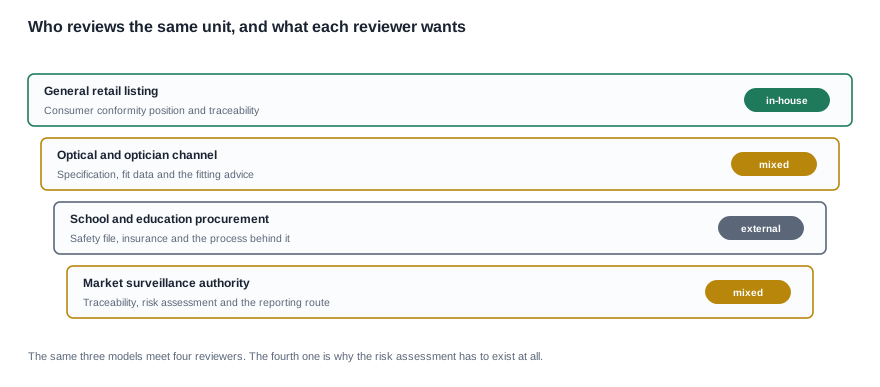
The channel answer, in three sentences
Name the channel before the product, because the channel determines the documentation burden and the documentation burden determines the cost and the lead time. A general retail listing, an optician and a school procurement process ask three different things of the same unit, and the difference between them is larger than any difference between the three models. Which channel you are selling into determines what you have to produce, and a buyer who answers that question in week one has a schedule; a buyer who answers it in week nine has a relisting.
What the buyer is holding when the channel question arrives
A buyer working through the regulatory question is usually holding a market list, a channel plan and a target price, and often a draft listing that has already been written. What they are not holding is the channel question in a form the compliance team can act on, because "we sell online and also to schools" is not a specification. It is a statement of intent that contains two different evidence packs, two different label sets and one artwork.
The three channels are genuinely different, and the difference is not about the product at all. A general retail listing asks for the consumer-facing conformity position and the traceability of the economic operator. An optician asks for the specification, because the professional is going to fit it and advise on it, and a frame with no published dimension cannot be advised on. A school procurement process asks for the safety file, the supplier's insurance and the process behind the product, because the institution is the customer and the liability runs through them.

What each reviewer asks for before it will take the product
The channel is a list of reviewers, and each reviewer has a first question. The list below is the one worth writing down before the RFQ, because a request written as a general folder of documents is answered with a general folder, and the specific question is the one that gets answered with a usable answer.
| Reviewer | Evidence it asks for | Lead-time driver |
|---|---|---|
| General retail listing | Conformity position, traceability, label set | Market list fixed |
| Optician channel | Specification, fit dimensions, lens options | Sample availability |
| School procurement | Safety file, insurance, process documents | Laboratory queue |
| Freight forwarder | UN 38.3 summary for the cell | Cell type confirmed |
| Marketplace review | Model-level certificate numbers | Model list frozen |
The lead-time column is the one most buyers misread, and the trade-offs behind it are what a total cost comparison in this category actually turns on. A retail listing is gated by the market list being fixed, which is a decision the buyer controls. A school procurement process is gated by the laboratory queue, which the buyer does not control and cannot shorten. The same three models, sold into the same market, on the same day, with the same unit price, can be eight weeks apart depending on which reviewer is involved.
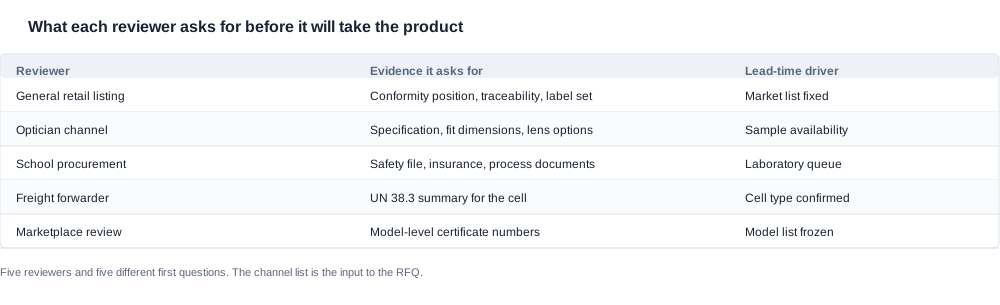
The five reviewers and their first question
What to ask each of them, in one line, is worth writing down before the RFQ rather than after it. The questions below are the ones that decide the answer, and they are deliberately phrased so that a supplier can respond with a document reference rather than with a paragraph.
A general retail listing asks whether the product may lawfully be placed on the market in that market, and who is identifiable as the party responsible. The answer is a role and a file, and neither is visible on a product page.
An optician asks what the product is, dimensionally and electrically, because a practice that fits a frame and advises a parent needs numbers rather than a brochure. For the A05, the A06 and the A07, the electrical numbers exist in the catalogue and the fit numbers do not, so this reviewer is asking for the thing the buyer has to measure.
A school procurement process asks for the safety file, the insurance, the process documentation and a commitment on the continuing availability of firmware and app support, because a school cannot deploy a device whose support ends mid-term. It is the largest of the three asks and it is a different order of work, not a bigger version of the same work.
A freight forwarder asks for the UN 38.3 test summary for the cell. It arrives as a question during a booking, which is the worst possible moment to discover it, and it is one of the most routine documents in the whole programme.
A marketplace review asks for certificate numbers that name the exact model. This is the reviewer that catches a family-level report before a stock position is built on it, and it is the cheapest check in the list.
The obligations that sit with whoever places the product on the market
The General Product Safety Regulation applies to consumer products placed on the European market. Regulation (EU) 2023/988 replaced the older directive framework and raised the evidentiary expectation on the economic operator: a documented risk assessment, traceability of the product, published contact details, and an accident and near-miss reporting obligation. The documentation is not the same for every role in the chain, and the question "which role am I" has to be answered before the file can be assembled.
A documented risk assessment, written for the children's use case. A risk assessment written for an adult product is not the same document. A pair of glasses worn by a child, on a school day, by a child who may not read the instructions, is a different risk profile from the same electronics worn by an adult, and this is the one document in the list that is most often inherited rather than written.
Traceability of the product and its batch. A method for identifying what was shipped and when, and a clear statement of what the buyer must do with it. In a children's category the batch question is not theoretical, because a complaint about a specific unit has to be traceable to a production run for the complaint to mean anything.
Published contact details and a named route. A general product safety regime expects the responsible party to be identifiable and reachable, and it expects accidents and near misses to have a reporting route with a name against it, not a policy statement. This is a process question, and a supplier who cannot describe the route has not established the role.
The claim boundary, as part of the regulatory position. We make no vision, health or eye-protection efficacy claim for any of our products, in any market, and the copy has to survive a school procurement review, where the reader is a parent and an institution at the same time. A claim that is refused by a retailer is cheap to remove; a claim that is refused in a school review is a supplier disqualification.
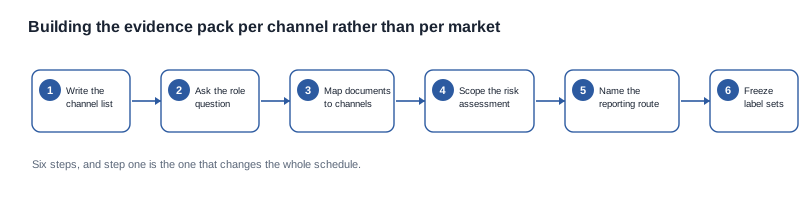

Building the evidence pack per channel rather than per market
The reason most children's programmes overrun is that the evidence pack is assembled by document type — all the certificates in one folder, all the declarations in another — and then applied uniformly to every channel and every market. That produces a pack that is not wrong in any particular and is insufficient in all of them.
Six steps, and the one that changes the schedule
- Write the channel list, one line per channel, with the buyer type, the review process and the deadline. The same unit may need three different evidence packs, and the cost of that is a planning item rather than a surprise.
- Ask which role the factory plays in each market, and what that obliges it to do. The economic operator role carries duties, and the answer determines who writes the risk assessment and who holds the traceability.
- Ask for the documented risk assessment for the children's use case specifically. Not the adult one, and not a summary of one.
- Map every document to a channel rather than to a market. A document that supports a retail listing and a document that supports a school review are not the same document, and the mapping is what stops the school file being assembled in the last fortnight.
- Name the accident and near-miss reporting route and the responsible party. And write it into the agreement, because a process nobody has been told about is not a process.
- Freeze the label set per channel, and the instructions for the parent per market. The label artwork is the expensive part to change, and a label that satisfies a retail listing will not satisfy a school procurement review.
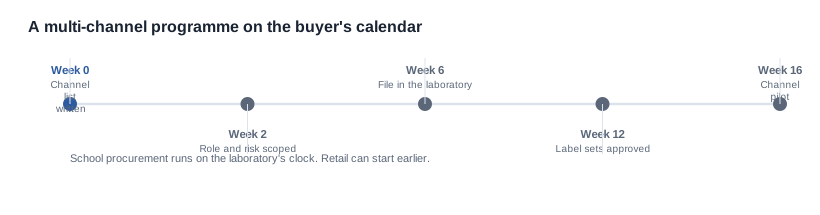

What a channel mismatch costs after the artwork is approved
Five failures a channel mismatch produces
A product is designed for retail and a school buyer asks for a safety file that does not exist. The symptom is an order that cannot be taken. The root cause is that the channel list was not separated before the product work. The prevention is to write the channel list first and treat the school file as its own workstream with its own owner.
A retailer or a marketplace asks for the risk assessment and nobody owns it. The symptom is a listing held pending a document that exists somewhere but has no name attached. The root cause is that the economic operator role was never established. The prevention is to ask the role question at the RFQ and to name the owner of the document in the agreement.
A near miss happens and there is no route to report it. The symptom is a delay in handling a small incident that turns into a large one. The root cause is that the reporting obligation was inherited without the process. The prevention is to ask for the route and the responsible party and to write both into the agreement.
The listing makes a claim the school review rejects. The symptom is a relisting. The root cause is that the copy was written for a consumer audience without the file behind it. The prevention is to review the copy against the documentation, and to keep the claim set to functions.
A school customer cannot get support in the language of the parent. The symptom is a complaint that arrives in a language the support team cannot read, at a volume the team cannot absorb. The root cause is that the support commitment was not part of the channel requirement. The prevention is to name the languages at the RFQ, when they are still a list, rather than after they are a ticket queue.
A worked case: a brand asked to supply a school group it did not plan for
This is a hypothetical case rather than a client project, and it is here to show the channel map applied.
Assume a brand has been selling a children's model through a general retail listing for two seasons, with a conformity file, a label set and a copy that has been approved once. A school group asks whether the same product can be supplied to them. The buyer's instinct is to say yes, because the product is the same product, and the answer turns out to be no in four separate places, none of which is about the hardware.
The first place is the safety file. A school procurement process asks for the children's safety file, the supplier's insurance and the process documentation behind the product, and the brand's existing retail file contains none of them, because a retail file answers a different question. The work is not a bigger version of what already exists; it is a separate workstream with a separate owner and a separate schedule, and the laboratory queue sets that schedule rather than the brand.
The second place is the risk assessment. The brand's file is for the retail presentation of a children's product. The school review asks for a documented risk assessment covering the children's use case specifically, and the honest answer is that the existing document was written for the retail channel and does not address a supervised school deployment, a class set and a single parent. It has to be rewritten, not reissued.
The third place is the support commitment. A school cannot deploy a device whose support ends mid-term, and the brand's existing position is per-enquiry with no stated term. That position is acceptable to a retail customer and unacceptable to an institution, so it has to become a term with a duration attached, which is a commercial change as well as a documentation change.
The fourth place is the label. A label that satisfies a retail listing will not satisfy a school procurement review, because the warnings, the instructions for the parent and the languages differ. The artwork is therefore re-scoped, and because the label artwork is the expensive part to change, the scope is set once across the channels rather than twice in sequence.
The decision the brand actually has to make is earlier than any of the four, and it is a range decision rather than a compliance one. The school group asked for a quantity that makes a dedicated configuration sensible, and a configuration is a documentation event. So the buyer asks the model question again under the new channel, and the answer this time is two configurations rather than one, because the school deployment needs a different model designation in the file than the retail listing does.
The outcome is a school programme that is scheduled separately from the retail programme, with its own file, its own artwork scope, its own support term and its own model designation in the documentation. The decisive decision was writing the channel line down at the start, because the buyer who had a written channel list could have cost the school workstream from the quotation; the buyer who had not had to explain a change to a school group that had already planned around a delivery date.
The commercial lines a multi-channel programme gives you leverage on
Minimum order quantity is negotiable, and a multi-channel programme is the place where a supplier has the most incentive to be flexible on the split, because the buyer's volume is spread across channels rather than concentrated in one. Packaging and insert design, including the market labels, the language of the documentation pack, the required warnings and the channel-specific variants, is a low-cost negotiation but a real one, because each channel is a separate artwork and each artwork is a separate approval. Delivery splitting against a documentation-review milestone is often granted more easily than a price concession. Payment due dates are a standard area: a deposit placed with the order, a balance payable after the inspection before the goods leave, and a holdback released once the file is complete, which protects the buyer against the failure that costs most in this category, a product that arrives with paperwork that does not cover it.
Certification cost and certification time are not a commercial lever, because the fee is per market and per model and the elapsed time belongs to the test laboratory and its review queue. The tooling cost is a one-off item usually amortised across the first order, so the useful questions are over what volume it is amortised and what happens to it if the programme is discontinued. The risk assessment and the reporting process are obligations rather than features, and a supplier who will not produce them is telling you the role has not been established.
What we will tell you about a channel before you commit to it
The boundary of what we publish on channels
The boundary we hold: we will tell you the compliance scope your channel and market require, and we will not claim our children's models meet it, because certification status for the A05, the A06 and the A07 is not published to us. The front of our catalogue shows export certification as a company capability, and we will not convert that into a model-level children's position, because the two are different things. We publish the electrical rows and the published functions — the 40 mAh and 70 mAh cells, the two-hour-or-less charge time, the roughly twenty-hour rated use, magnetic charging, Bluetooth V5.4 on the A07, the lens-type electronic atomiser and the posture and viewing-distance detection on the A05 and the A06 — and we publish the absence of the certification position, the detection parameters and the fit dimensions with the same prominence.
We also make no vision, health or eye-protection efficacy claim for any of our products, in any market, and we would advise anyone building a listing in this category to run the copy past someone qualified for the target market and the target channel before it goes live. A school review is not a retail review with extra paperwork, and the reader is a parent and an institution at the same time.
What to send us about the channel
Send the channel list, one line per channel with the buyer type and the deadline, and we will tell you which evidence pack each one needs. That single list is worth more than a general compliance question, because it changes what you ask for.
Send the role question for each market, and ask the factory to state which role it plays and what that obliges it to do. The role determines who writes the risk assessment, and the risk assessment is the document that cannot be inherited from an adult product.
Send the label scope per channel, and have it scoped once rather than per revision. In a multi-channel programme the artwork is the cost that compounds, because each channel is a separate file and a separate approval.
We can build the channel-to-requirement map with you, so that the RFQ asks for the right documents rather than a general folder, and so that the label artwork is scoped once. The background is under kids eye care technology, the wider compliance picture is under compliance, the claim boundary is under medical device boundary, the spec sheet is in kids spec sheet explained, and the audit route is in factory audit and supplier verification.
Where the channel map comes from
Send us the channel list and we will tell you which evidence pack each one needs.


