
Kids eye protection glasses technology: four half-true statements
The four myths, and the true half of each
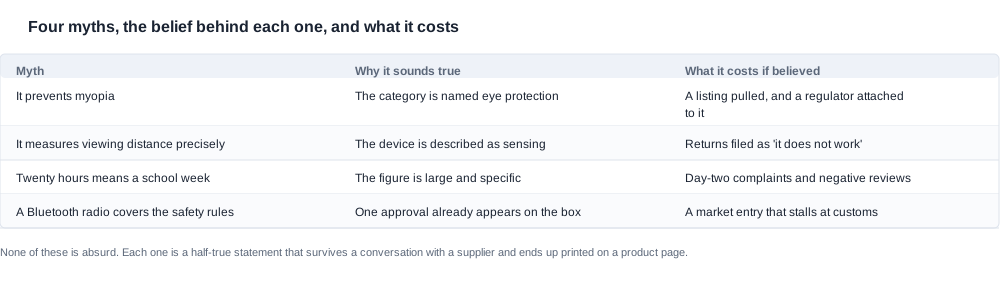
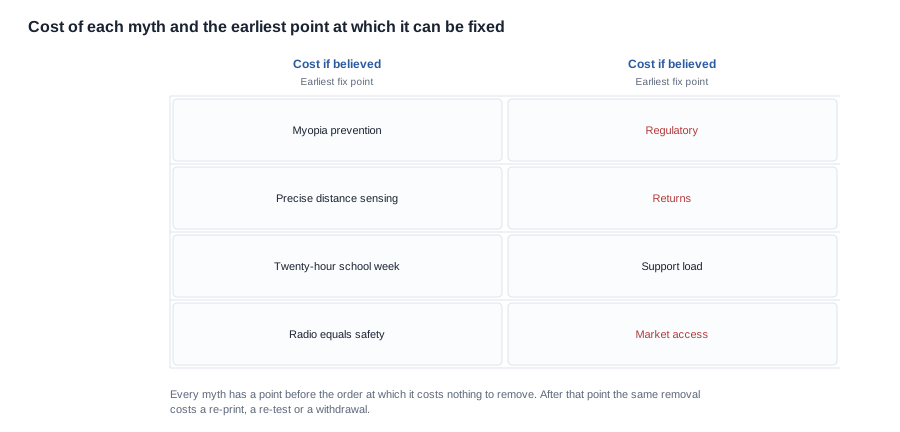
The expensive misunderstandings in this category are not the obviously false statements. They are the half-true ones — the statements that contain a published fact and attach an implication to it that no document supports. Kids eye protection glasses technology smart glasses myths takes four of them apart, and for each one it names the cost in a currency the buyer recognises: a regulatory exposure, a returns rate, a support load, or a market that cannot be entered.
The products themselves are simple. The A05 and the A06 publish a 40 mAh cell, charging in two hours or less, roughly twenty hours of rated use, magnetic charging, three lens options, a lens-type electronic fogging device and posture and viewing-distance detection. The A07 publishes a 70 mAh cell, Bluetooth V5.4, the same charging and runtime figures and magnetic charging. The complexity in this category is entirely in what gets said about them.
The cost model: regulatory, returns, support load, market access
The myth that the device prevents myopia. The true half is that the A05 and the A06 publish posture and viewing-distance detection. The false half is the word "prevents", which turns a reminder into a clinical intervention and moves the conversation from marketing to regulation. The cost of believing this myth is a listing that can be withdrawn, an enquiry from a regulator, and in some channels a suspension that reaches beyond the one product page.
The myth that the device measures viewing distance precisely. The true half is that a distance-sensing function exists. The false half is "precisely", which implies a continuous measurement rather than a threshold-triggered prompt. A buyer who markets "detects when your child is within 20 cm" has set an expectation a binary prompt cannot meet, and the returns arrive as "it does not work" when the reality is "it prompted at a distance the parent did not expect". The cost is a returns rate and a support load that looks like a hardware defect.
The myth that twenty hours means a school week. The true half is the published figure: roughly twenty hours of rated use, charging in two hours or less, on a 40 mAh or a 70 mAh cell depending on the model. The false half is the assumption that the figure is a continuous working week. The condition behind the twenty hours is not published, so the figure is a ceiling under favourable conditions. The cost of believing it is that day two becomes a fault, and a parent who was sold a week and received an afternoon treats the difference as a broken product.
The myth that a Bluetooth radio covers the safety rules. The true half is that the A07 publishes Bluetooth V5.4. The false half is that connectivity implies compliance. Wireless connectivity is one attribute, and a device aimed at children may fall under toy safety regimes — EN 71 in the European Union, ASTM F963 and related requirements in the United States — depending on classification, intended age and destination market. Those regimes are additional to radio and product requirements, and they are not satisfied by having a radio. The cost is a market entry that stalls at customs, which is the most expensive of the four because it happens after the inventory is committed.
Why a half-true statement is harder to catch than a false one
Why the myths survive a conversation with a supplier
A supplier repeating a myth is not lying. A supplier repeating "prevents myopia" is usually repeating what the buyer said in the first email, or what the category has always been called, or what a previous buyer wrote in a brief. Half-true statements are unusually durable because each one contains a real published row, and a person checking for accuracy checks the real part and stops.
That is the mechanism that makes them dangerous. The check that almost everybody runs is a consistency check: does the catalogue say this? For the myopia claim the answer is no, so the check passes the claim through in a different form. For the distance claim the answer is yes, the function exists, so the precision is not questioned. For the runtime the answer is yes, the figure is published, so the condition is not looked for. For the radio claim the answer is yes, Bluetooth V5.4 is published, so the safety framework is not raised at all.
The second reason these myths survive is that each one is locally reasonable. A parent in a marketing meeting hears "detects viewing distance" and imagines a readout; a purchasing manager hears "20 hours" and compares it to a shift; a compliance reader sees "CE" and a Bluetooth badge and concludes the box is sorted. The myth is not stupid. It is an inference that is reasonable from the fragment each listener holds.
The screen as a sequence of questions to ask
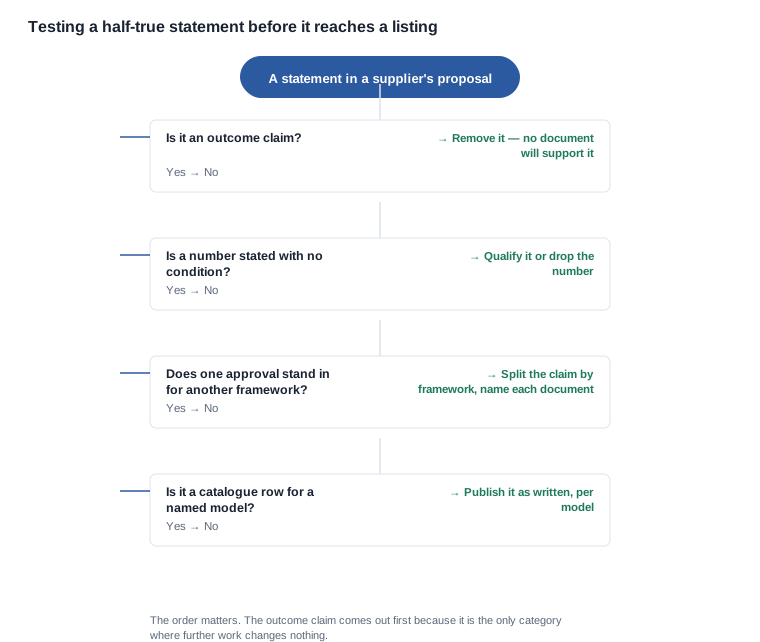
The screen that catches them is not a proofreading exercise. It is four questions, asked in a fixed order, and the order is what makes it cheap.
Question one asks whether the statement is about an outcome or about a function. Outcome statements come out first, because they are the only ones where further work changes nothing: no document can be obtained for them, because the device is not a clinical device and cannot become one through paperwork. Functions stay in.
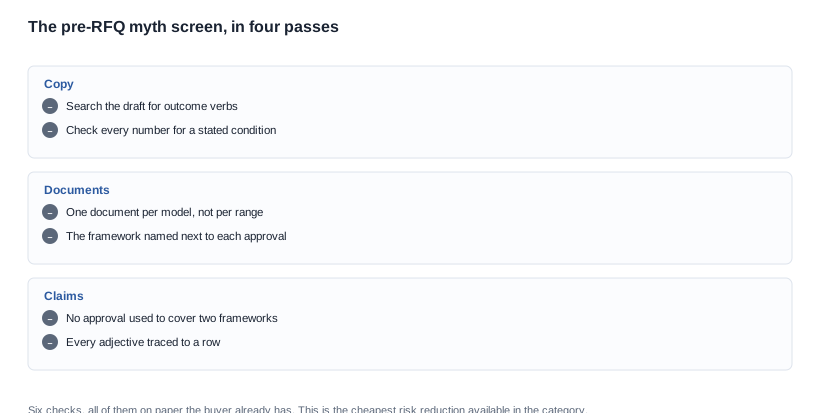
Question two asks whether a number is stated without a condition. If it is, the condition is requested, and if the supplier will not state it, the number comes out rather than the condition being invented by the buyer. This is the rule that protects the buyer's own listing from a figure it cannot defend.
Question three asks whether one approval is being used to cover a second framework. This is where the radio approval is stopped from standing in for the children's safety file, and where a declaration of conformity is stopped from standing in for either. Each framework is named separately, with its own document reference.
Question four asks whether the statement is a catalogue row for a named model. If it is, it is publishable as written, per model designation. If it is close to a row but not exactly it — "latest Bluetooth" where only one model publishes a version, "fog-free lens" where the catalogue publishes a lens-type device — it goes back to question two and three, because the gap between the row and the phrase is where the exposure lives.
What the screen cannot settle
The screen settles claims. It does not settle the underlying evidence, and the distinction matters because a clean listing built on an unverified basis is still an unverified basis.
Three items stay open after the screen. The detection thresholds, the delay and the false-positive rate remain a request to a supplier, because the published data for the A05 and the A06 confirms the function exists and nothing else about it. The certification position per market remains a request, because the compliance frameworks that apply to a product intended for children — EN 71, ASTM F963 and the Consumer Product Safety Improvement Act — are separate from the radio approval and are not published for our own models. And the difference between the A05 and the A06 remains a request, because the two publish identical rows and the catalogue records the difference as unconfirmed.
The screen also cannot settle the classification question on its own. Whether a device falls under a toy safety regime depends on classification, intended age and destination market, and that decision is often made by a marketing position rather than by a compliance one. The screen flags the question; it does not answer it.

Proving the correction on a sample, not on a spreadsheet
Testing the distance and posture functions on a sample
The distance and posture myth is closed by measurement, and the measurement has to be written before it is run. The protocol is a fixed trigger distance, a fixed delay, a fixed number of repeated triggers, a stated room, and a stated pass condition. Three observations come out of it: where the device actually triggers, how long after the trigger it responds, and what it does when the condition is triggered again immediately.
Those three observations become the acceptance criteria, and they become the copy. A listing that says the device prompts when the viewing distance falls below the tested distance is a listing a parent can use, and a listing that says it "detects precisely" is a listing that generates returns.
The false-positive rate is measured the same way, over a stated number of attempts in the room the product will actually be used in. This is the number that decides whether the shipped default is aggressive enough to be useful and gentle enough to survive a household, and it is the number that most often explains a feature that gets switched off in the second week.
Publishing the runtime condition without losing the claim
The runtime myth is closed by adding a condition rather than by deleting the number. A figure with its workload attached is more defensible than a figure without one, and in most cases it is also more persuasive, because the condition tells the reader something about how the product behaves that a bare number never could.
The form that works is short: the figure, the reminder interval, the ambient condition and whether the sensing function was active. Published that way, the twenty hours becomes a usable claim, and the copy that cites it cannot be challenged by a parent who ran a heavier setting. The same discipline applies to the charging figure, where the condition that matters is the starting state.
The classification question and who made the call
The classification question should be asked at the RFQ stage and the answer should be recorded with the name of the person who gave it, because the classification of a device aimed at children is a decision that gets revisited. If the answer is that the product is not a toy, the reasoning should be recorded alongside it; if the answer is that it is, the file size changes and the schedule has to change with it.
There is one further myth that belongs in the same family even though it is not one of the four, because it survives the screen without being caught by any of its questions. It is the belief that the published twenty hours describes a house with a parent who charges the device when it is flat. The published figure describes a cell under a light duty cycle, and the household's charging habit decides the real runtime. A screen that asks for the condition still leaves the habit unmeasured, and the habit is what a household week is for.

The commercial terms that follow once the myths are out
Where the negotiating room sits once the copy is clean
Once the claims are reduced to what the file supports, the commercial conversation gets easier rather than harder, because the remaining arguments are about numbers rather than about adjectives. The negotiating room sits in the number of models and colours committed, the artwork round count, the per-market label scope, the fit programme scope and the market list itself. Every additional model and every additional lens combination carries its own compliance cost, so narrowing the range before the first order is worth more than any percentage point on the unit price.
Minimum order quantity is negotiable, and a children's line is often a brand's first order in a new category, which is where a supplier has the most incentive to be flexible. Packaging and insert design, including the market labels, the language of the documentation pack and the required warnings, is a low-cost negotiation that carries no tooling implication. Delivery splitting against a sample-approval milestone is often granted more easily than a price concession, because it moves the approval risk onto the point where the evidence is. Payment node structure is a standard area, and a retention held against the documentation package protects the buyer on the failure that costs most in this category, which is a product that arrives with paperwork that does not cover it.
The items that cannot be moved are the compliance cost and the elapsed time of testing, which are per model and per market and are set by the laboratory's queue, and the tooling, which is a one-off usually amortised across a first order — so the useful questions are over what volume it is amortised and what happens to it if the programme is discontinued.
The trade-off worth naming is between breadth and depth: two models with a complete evidence file beat four models with a partial one in any channel where the buyer is a retailer's technical team. That criterion is the same one the supplier verification questions in this set are built around, and the standards side is covered in kids industry standards.
The cost of a myth in the buyer's own reporting
The four costs land in four different places on a buyer's own reporting, and a programme that understands where each one lands can argue for the copy review in the language the business already uses.
The myopia myth lands in compliance, which is the most expensive place because it is the least predictable. It surfaces as a listing suspension, a customs query, a retailer's technical review, or an enquiry from a regulator, and none of those can be scheduled or forecast, which is why they are hard to defend internally when the copy was approved by a marketing meeting.
The distance precision myth lands in returns, which is the most measurable place. It arrives as a specific and recognisable return reason — the product prompted at a distance the parent did not expect — and because it is recognisable it can be counted against the SKU rather than dismissed as noise. A returns rate for a children's line is the number a channel looks at when it decides whether to reorder, so the myth does not stay a marketing problem for long.
The runtime myth lands in support, which is the cost that never appears on a quotation. A parent's query about a device their child wears is a longer conversation with more context and a higher expectation than a distributor's stock query, and it is usually handled by the same team. It is invisible in the unit price and permanent in the business, and it is the reason support cost belongs in the total cost of a children's programme rather than in an overhead line.
The radio myth lands in logistics, where it is the most expensive in absolute terms because the inventory is already committed. A consignment held at customs is a stock problem, a delivery-date problem, a channel-relationship problem and a documentation problem at the same time.
A scenario: a copy rewrite that takes one afternoon
This is a worked case rather than a live order. One reason is to show the order.
Assume a distributor is about to publish a listing for a children's range. The draft reads: "protects your child's eyesight, detects viewing distance within 20 cm, with 20 hours of battery life, fully certified for children, and Bluetooth 5.4."
The screen runs in the order above. The first question removes "protects your child's eyesight" and the "fully certified for children" phrase, because both are outcome and range claims. The second question turns "within 20 cm" into a request for the tested trigger distance, and turns "20 hours of battery life" into a request for the workload condition. The third question separates "Bluetooth 5.4" from the safety frameworks, and asks which model it applies to. The fourth question finds that the Bluetooth version is published for one model only, so the phrase moves to that model.
What is left on the page is short: the device detects posture and viewing distance and reminds, the runtime figure with its condition, the charging method, and the rows that are published per model. The distributor then sends four requests — the thresholds and the delay, the false-positive rate, the certification position per market, and the A05 and A06 difference — and treats the responses as the criteria for the first order.
The programme that resulted from one afternoon of copy work is smaller in its claims and larger in its evidence. The retailer's technical team accepts the listing, and the buyer's file now has four things in it that it did not have before the screen ran.
The four sentences to change, and where to change them
What our catalogue supports and what it does not
The claims that survive the screen without any further work are the published rows: the 40 mAh and 70 mAh cells, the two-hour-or-less charge time, roughly twenty hours of rated use, magnetic charging, three lens options on the two protection models, the lens-type electronic fogging device, posture and viewing-distance detection, and Bluetooth V5.4 on the A07. We publish no detection threshold, no delay, no false-positive rate, no frame weight, no dimension and no certification position for the A05, the A06 or the A07, and we will not estimate them.
We also make no claim of health, vision or eye-protection outcomes for any of our products in any market. The myths in this article are not marketing observations: three of the four are regulatory positions and the fourth is a specification discipline, and a buyer's exposure in this category is generated by the copy, which makes the copy the cheapest thing to fix.
The draft listing to send for a myth check
Send the draft listing and the model list. We will return the four myths the draft repeats, the sentence to replace each one with, and the request list for the evidence behind the ones that need it. The wider category argument is in kids eye protection glasses technology, the supplier questions are in kids supplier verification, and the background is under kids eye care technology.
Where the myth list comes from
Send us your draft listing and we will tell you which of these four myths it repeats.


