
Kids eye protection glasses technology: identical published rows
What the catalogue settles, and what it leaves open
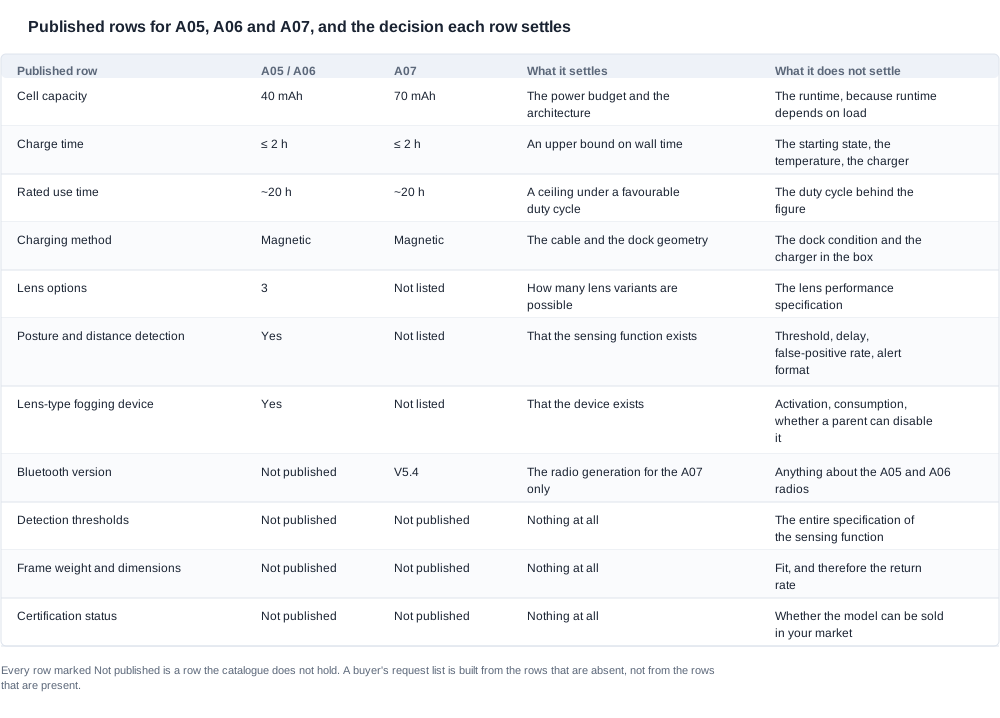
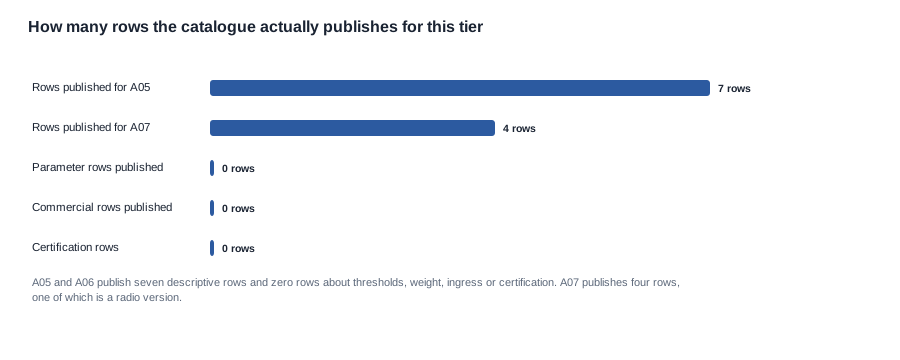
Three children's models sit in our catalogue: the A05, the A06 and the A07. The published rows are few and they are exact. The A05 and the A06 both publish a 40 mAh cell, charging in two hours or less, roughly twenty hours of rated use, magnetic charging, three lens options, a lens-type electronic fogging device, and posture and viewing-distance detection. The A07 publishes a 70 mAh cell, charging in two hours or less, roughly twenty hours of rated use, magnetic charging and Bluetooth V5.4. For none of the three do we publish detection thresholds, frame weight, frame dimensions, an ingress marking, a Bluetooth version on the A05 and the A06, or a certification position.
That is an unusual place to start a buying decision. In most categories the buyer arrives holding too much data and not enough signal. Here the buyer arrives with a very small set of published numbers and two candidate products that cannot be separated by them at all. Kids eye protection glasses technology smart glasses key specifications is therefore a triage rather than a feature list: which published row settles a purchasing decision, which published row only describes the product, and which absent row has to be bought from a supplier before any decision is possible.
Who is making the call, and with what in hand
The person making this call is usually a brand-side sourcing or product manager, or a channel buyer assembling a private-label line, and they are holding a customer profile, a market list, a target landed price and a channel plan. What they are not holding is a ranking method. Two of the three models publish identical rows, and the catalogue does not state what differs between them, so a buyer who tries to choose from the published data alone ends up ordering whichever row they happened to read first.
Two risks define this category and both of them are specific to it. The first is regulatory. A children's product attracts safety frameworks that an adult product with identical electronics does not: EN 71 in the European Union, ASTM F963 and the Consumer Product Safety Improvement Act in the United States, and neither of those is satisfied by a radio approval or by a declaration of conformity. The second is claim risk. A device that senses a position or a distance and reminds sits one step away from a product that claims to change eyesight, and in several jurisdictions that step is regulated rather than editorial.
The four ways a specification read goes wrong in this tier
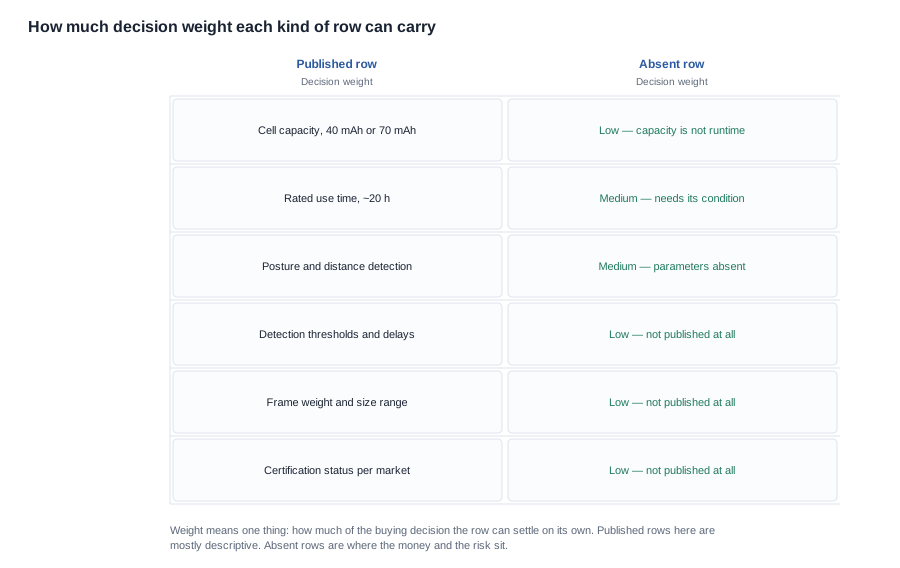
Reading the runtime as a working week. Roughly twenty hours is published for all three models and no test condition is published with it. A figure outside the pattern of the rest of the range deserves a question about the load behind it, because a duty-cycle number and a continuous number differ by a factor nobody can guess.
Reading the A05 and the A06 as two different products. They publish the same cell, the same charging method, the same rated use and the same function list. A buyer cannot rank two products on identical data, and the honest answer is that the difference is a question for the manufacturer rather than an inference from the model number.
Reading the presence of a function as the specification of a function. Posture and viewing-distance detection is published as existing on the A05 and the A06. The threshold, the delay, the behaviour on a repeated trigger and the false-positive rate are not published. A threshold expressed as a number with a unit can be tested on a sample and written into an acceptance criterion; a threshold expressed as a quality cannot be tested at all.
Reading the certification row as a formality. It is the row with the longest lead time in the whole programme, it is the only one that can end the programme outright, and for the A05, the A06 and the A07 it is not published to us.
Turning each published row into a buy, a hold or a drop
The routing logic for a three-model shortlist
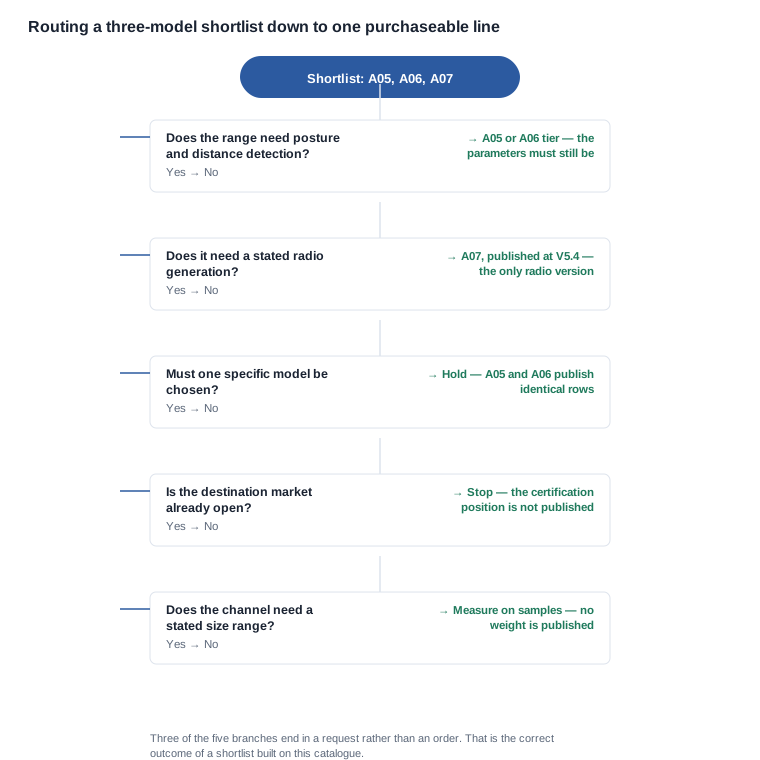
A shortlist of three models is not a selection exercise, it is a routing exercise. Five questions sort it, and three of the five end in a request rather than an order.
The first question is whether the range needs posture and viewing-distance detection at all. If it does, the A05 and the A06 are the candidates and the A07 is out of the running, because the A07 does not list that function. If it does not, the A07 becomes the candidate and the remaining question becomes whether a published radio version matters to the channel. The second question is whether a specific model has been named already by a customer or a retailer, because if it has, the identical-rows problem becomes a blocking question rather than an interesting one. The third is whether the destination market is already open, and this is where the certification row stops everything until it is answered.
The thresholds a supplier has to hit, row by row
The table below is the request list, and the right-hand column separates a supplier who has measured the product from one who is describing a feature. It is built so that each line can become a line in a purchase order.
| Row to request from the supplier | The pass line | What a soft answer sounds like |
|---|---|---|
| The certification position for your market | Standards, editions, laboratory and document references naming your exact model | "Fully certified" |
| The written difference between the A05 and the A06 | A statement of what differs, on the supplier's letterhead | "The newer one" |
| The detection thresholds and whether they are configurable | A measurable value with its unit | "Adjustable sensitivity" |
| The detection delay and the false-positive rate | Both figures, with the room condition and the number of attempts | "Real-time alerts" |
| The alert format, and the behaviour when detection is not working | Visual, audible or both, and a written statement of the failure behaviour | "It notifies you" |
| Whether the lens-type device can be disabled, and how | A yes or no, and the mechanism | Silence on the subject |
| The frame material, the weight and the dimensions | All three as numbers, with the measurement method | "Lightweight" |
| The runtime measurement condition | The load, the interval and the ambient condition | A bare figure |
| The cell and its mechanical retention method | The cell, and how it is held in the frame | Not offered |
| The lens specification for the three published lens options | Transmittance, tint, impact rating and coating | "Standard lens" |
| The model designation for the exact configuration | A published designation, not a series name | A series name only |
Why the identical twenty-hour figure on two different cells is informative rather than odd
The A05 and the A06 publish a 40 mAh cell and roughly twenty hours of rated use. The A07 publishes a 70 mAh cell and the same twenty hours. A cell that is nearly twice the size producing the same runtime implies a materially different load profile, and the difference has to be somewhere. The most likely place is the reminder duty cycle: the published figure describes a use pattern that is not published, and the reminder frequency is a setting the brand or the parent controls.
That reading matters commercially in three ways. It means the runtime has to be treated as a duty-cycle figure rather than a continuous one, so a household running a high reminder setting will reach the end of the day sooner than the published number suggests on the 40 mAh models. It means the A07's larger cell is not simply a longer-running version of the same product, because the A07 does not list the sensing function at all, so the cell is carrying a different workload. And it means the cell capacity column is the wrong column to optimise in this tier: it reflects the workload rather than the quality of the design.
The rows that cannot be compared across suppliers
Two numbers in the same row of two different suppliers' sheets are two different measurements until the conditions are stated. A runtime measured at a low reminder frequency is not the same measurement as one measured at a high frequency. A detection threshold measured with a fixed trigger distance in a lit room is not the same measurement as one taken with a moving subject. A weight quoted without the method, and without the temple length it was taken on, cannot be compared with a weight quoted with them.
This is the single most common reason a children's shortlist collapses at the second round of quotations. The buyer has ranked two products by their published rows, and then a supplier's sample does not behave like the row did. The remedy is procedural rather than technical: ask for the condition at the same time as the figure, in the same message, and treat a supplier who gives the figure without the condition as having given you nothing comparable.
Proving a supplier's row: a seven-step evidence trail
Step one to step four, from the RFQ to the sample
Establish the classification before requesting any document. Identify the destination markets and establish which frameworks apply to a children's product in each of them, separately from the radio approval and separately from the declaration of conformity. Everything downstream, including the size of the file, the label set and the lead time, follows from this answer, and it is the step most often skipped.
Request the certificate numbers per model, not per family. A number with an issuing body and a validity date is the only part of a document a procurement officer or a marketplace reviewer can check later. Ask for the list in the body of the email, against the exact model designations that will appear on the purchase order.
Check the edition dates. The frameworks work on an edition cycle. A file prepared against a superseded edition is a retest waiting to happen, and finding that in the second year of a programme is far more expensive than finding it now.
Measure the parameters on a sample, on a written protocol. For the sensing function the protocol is a fixed trigger distance, a fixed delay, a fixed number of repeated triggers, a stated room and a stated pass condition. For the lens-type device the protocol is what happens when it is switched on, how it is replenished, what it consumes and whether a parent can turn it off. Write the protocol before the first reading, not after the first disappointing one.
Step five to step seven, from the sample to the order
Ask for the A05 and A06 difference in writing, with a date. It costs one email and it can cost a programme a month if it is asked late. A written answer with a date is a schedule item; a verbal assurance at a trade show is not.
Run the fit programme. Nobody publishes the weight or the dimensions for these models, so fit has to be established by sampling across a size range with real children, and it is the single largest driver of returns in any eyewear category. Record day six rather than day one.
Put the criteria into the purchase order. A criterion that lives in an email is not binding. The exact model designations covered by each document, the acceptance criteria from the sample, and the runtime condition should all be attached to the order, because in this tier the supplier's own documentation is often thinner than the buyer's own standard.

Where children's programmes lose money and where the negotiating room actually is
Six failures that arrive in the first three months
The A06 is ordered over the A05 because it is newer. Root cause: the difference was assumed rather than established. Prevention: ask for it in writing before the purchase order is raised, and hold both models out of the first order until the answer exists.
A parent cannot switch the lens-type device off and returns the product. Root cause: the disablement question was never asked, and a function that cannot be turned off cannot be turned off by a parent. Prevention: ask it, then test it on the sample by switching it off and observing both the lens and the child's willingness to keep wearing the frame.
The product is bought and the certification file does not name the model. Root cause: family-level coverage was assumed to cover a branded unit. Prevention: make the exact model designation a condition of the purchase order, and check the string on the cartons as they arrive.
The product runs flat by the afternoon. Root cause: the twenty-hour figure was published without a condition and was read as a continuous figure. Prevention: run a full day at the reminder setting you intend to ship, on both cell configurations, and publish the condition with the figure.
The child removes the product in an hour. Root cause: the fit was never measured, because no weight or dimension is published for these models. Prevention: a wearing trial across a size range with the actual age group, recording day six.
The cell is removed by a child and swallowed. Root cause: the retention mechanism was never specified. Prevention: ask for the retention method, confirm it on the sample, and treat it as a safety row rather than an engineering detail.
What can be traded, and what cannot be moved
The negotiating room in a children's programme sits in the number of models and colours committed, the artwork round count, the per-market label scope, the fit programme scope, and the market list itself. Every additional model and every additional lens combination carries its own per-model compliance cost, so narrowing the range before the first order is worth more than any unit price discussion that follows it. The unit price of a forty milliamp-hour cell is not where the money is, and it is the number most often negotiated first.
Certain items cannot be traded at all. The compliance cost and the elapsed time of testing are per model and per market, and the elapsed time is set by the laboratory's queue rather than by the buyer's urgency. Tooling is a one-off that is usually amortised across a first order, so the useful questions are over what volume it is amortised and what happens to it if the programme is discontinued. The safety-relevant design decisions, including the cell retention method, the small-parts policy and the material choices, are design decisions rather than commercial variables, and no price moves them.
The clauses worth writing into the purchase order are equally specific: the exact model designations covered by each document, the acceptance criteria from the sample, the runtime measurement condition, a requirement for notice before any change of firmware, detection threshold default, frame material, lens or safety-relevant component supplier, and a clause on who bears the cost when a lot fails the acceptance criteria.

A shortlist walked through one programme
The scenario and the constraint
This is a hypothetical scenario rather than a client project, and it is here to show the sequence rather than the outcome.
Assume a European distributor already stocking an audio line wants to add a children's range under its own label, with a school channel alongside the consumer channel. The constraint is not price. It is that the retailer's technical team asks for the file before accepting delivery, and the distributor has already had a listing suspended in another category for a documentation gap.
The sequence, and what each step settles
The distributor's first question to the brand is whether the copy can say anything about eyesight. It cannot, and the brand confirms that in one line before anything is designed. That single answer determines what the rest of the programme is for, and it costs nothing to establish.
The three destination markets are then identified and the applicable frameworks established per market. Two of them turn out to need a children's safety file that the brand's adult product does not have, and one needs only the radio approval plus the battery transport documentation. The distributor now knows the size of the file, which is the number the retailer's technical team actually wanted.
The model selection then exposes the identical-rows problem. The distributor looks at three models and finds that the A05 and the A06 publish the same rows, so the choice between them cannot be made from the catalogue. The brand supplies a written statement of the difference, and the distributor narrows to two models rather than three, because the compliance cost is per model and the difference is now known.
Because no weight or dimension is published, the distributor commissions a fit sample across a size range before committing to the first order and treats the result as the first acceptance criterion rather than as a formality. The certificate numbers are then requested per model and resolved against the units, and one model comes back with a file that does not name it, so that model is held back from the first shipment rather than carried as an open risk.
Finally the listing is written to match the width of the evidence: it says the product detects posture and viewing distance and reminds, it does not say anything about eyesight, and the retailer's technical team accepts the file because the claim and the evidence are the same width.
What actually decided the outcome
The decisive decisions were the claim boundary, the market classification and the narrowing of the range. Three of them were made before a single sample was ordered, and none of them was about the electronics. That is the general pattern in this tier, and it is why a specification read is worth doing properly: the rows that decide a children's purchase are mostly not on the sheet.
What we can evidence, what we will not estimate, and what to send next
The published position, and the rows we will not estimate
The boundary we hold: we publish the rows we hold for the A05, the A06 and the A07 — the 40 mAh and 70 mAh cells, the two-hour-or-less charge time, the roughly twenty-hour rated use, magnetic charging, three lens options on the two protection models, the lens-type electronic fogging device, posture and viewing-distance detection, and Bluetooth V5.4 on the A07 — and we mark the rest as open rather than filling it with values from elsewhere in the industry.
We publish no detection threshold, no delay, no false-positive rate, no alert format, no frame weight, no frame dimension, no size range, no ingress marking and no certification position for this tier. We also record that the difference between the A05 and the A06 is unconfirmed, and we would rather say that in the catalogue than invent a distinction that a buyer's acceptance criteria might later depend on.
We make no claim of eye-protection, vision or health outcomes for any of our products in any market, and we will not write a claim about a child's eyesight for a device whose function is to detect a position or a distance and to remind. The boundary is set out in kids limitations and drawbacks and in kids myths.
What we can do is tell you which of the rows above our documentation answers today and which have to come from a supplier or from a test on your own units, and we will put them in that order rather than in the order that flatters the product. The background is under kids eye care technology, the compliance scope is in kids certification requirements, and the range is kids smart glasses.
The five requests to send this week
Send the model-selection question first, in one line, and ask for the difference between the A05 and the A06 on the supplier's own letterhead. Then send the document request as a list — standards, editions, model designations, certificate numbers, issuing bodies and validity dates — because a supplier who answers per model has a documentation habit, and one who answers per family is telling you the file does not exist yet.
Send the sample request with the protocol attached: a size range, real children, a day-six record, and the weight and dimensions measured rather than assumed. And send us the two models, the three markets and the customer profile, and we will tell you which of the ten rows we can answer today and which you have to go and get.
Where the specification read comes from
Send us the two models and the market and we will tell you which of the ten rows we can answer and which you have to go and get.


