

Kids eye protection glasses technology: measurement, not demonstration
Four questions a week answers and three it does not
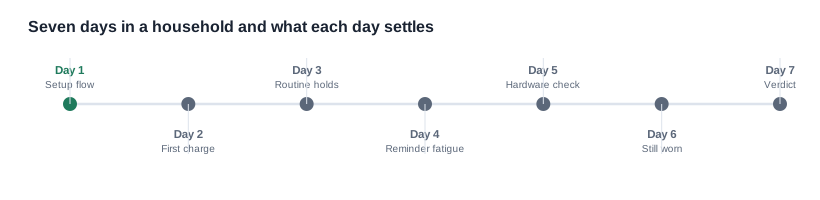
A week in a household settles four things that a specification sheet cannot: whether the first hour works, whether the routine holds, whether the hardware survives a child's handling, and what the parents actually say. Kids eye protection glasses technology smart glasses real world performance is a description of that week written as a protocol a buyer can run, and as a list of the things a week cannot settle.
The published specification for the children's range is a lens-type electronic fogging device, posture and viewing-distance sensing with a reminder function, low-power Bluetooth connectivity and long endurance, with a 40 mAh cell on the A05 and the A06, a 70 mAh cell on the A07, magnetic charging at up to two hours and approximately twenty hours of rated runtime on all three.
The week has to be run before the order rather than after it, and that single point of timing is what separates it from a demonstration. A demonstration is run by someone who has already set the device up, who knows the sequence, and who is looking at a product they are about to buy. A trial is run by someone who has never touched it, who will not be coached, and who has no reason to be positive. The second produces information; the first produces reassurance.
The first hour is a documentation test
The first hour is setup, and setup is where most of the failures live, because setup is a parent doing something they have never done before with a device their child will wear. A parent who cannot get from the box to a working device in one sitting, unassisted, has a problem that no product page will fix.
What makes it a documentation problem rather than a product problem is that the fix is a rewrite of the quick start guide. The guide that ships with the first order is the same artefact the first parent used, so every hour lost in setup is an hour of support contact for every subsequent household, and the cost of that contact is invisible in the unit price.
The charging routine and the habit that replaces it
The published roughly twenty-hour runtime only means something if the device is charged when the child puts it on at the end of the day, and the only way to know what a household will actually do is to watch it happen. Days two to four are where the charging point, the dock's location and the habit establish themselves, and where it becomes visible whether the routine works in a hallway or was designed for a laboratory.
Note what the charging behaviour also settles. A charging arrangement that a household leaves unattended overnight has to be observed rather than assumed, because the published rows state magnetic charging and roughly twenty hours of rated use and say nothing at all about the charger, the dock or the behaviour on a long unattended charge. The endurance context is set out under battery life for kids.
The hardware inspection on day five
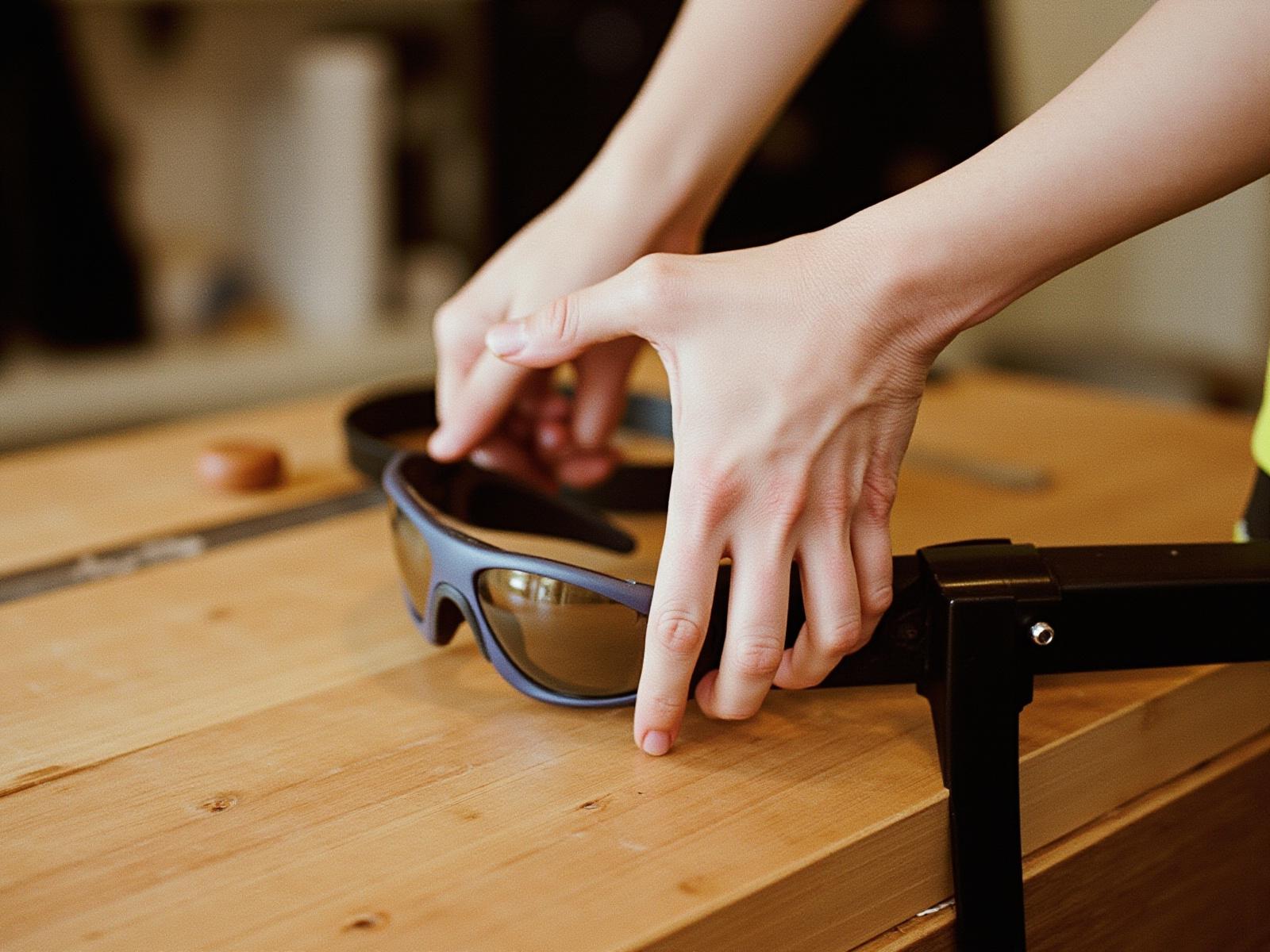
The scratches, the hinge and the lens are inspected on day five, because a child handles a frame differently from an adult and the failures are rarely the ones a drop rating predicts. A temple is used as a lever, a hinge is twisted rather than dropped, and a lens is scratched from the inside of a pocket rather than from a table.
This is also where the fit question resolves itself, because a frame that is going to be taken off in an hour produces a visible pattern of handling around the temple. The hardware side of the category is covered in more detail under durability for children.
The parent's own words against your listing
The parents are the only people who will say plainly whether the product is worth putting on a child, and their language is the best test of whether the listing's language is honest. A parent who says "it nags" is describing a false-positive rate. A parent who says "we forget to charge it" is describing a routine that failed, not a battery that did. A parent who says "she takes it off after an hour" is describing fit.
The criterion is simple and it is the most valuable output of the week: if the parents' own words do not appear on the product page, the page is wrong. A test of the claim boundary is set out under medical device boundary.
What a household week cannot settle
The three things only a supplier can answer
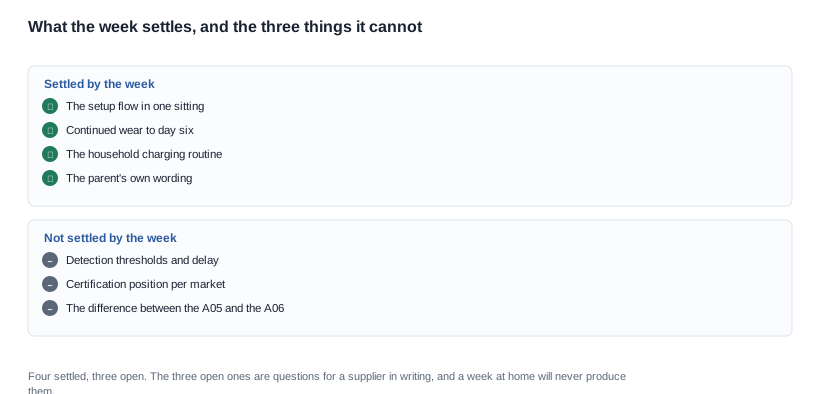
A week at home produces no information about three things, and a buyer who treats the week as a complete evaluation ends up with a product that works well and cannot be listed or shipped.
The detection thresholds. The threshold, the delay, the behaviour on a repeated trigger and the false-positive rate are not published for the A05, the A06 or the A07. A week will show that the reminder is too aggressive or that it never fires, and that is genuinely useful, but it cannot produce a number with a unit, and a number with a unit is what goes into an acceptance criterion and into the copy.
The certification position. The frameworks that apply to a product intended for children — EN 71 in the European Union, ASTM F963 and the Consumer Product Safety Improvement Act in the United States — are separate from the radio approval, and the certification status for our own models is not published to us. No amount of observation at home will produce a compliance file.
The difference between the A05 and the A06. The two models publish identical rows, and the catalogue records the difference between them as unconfirmed. A week of observation on one unit of each cannot establish a product difference either, because the units in a household are not a controlled comparison.
Where the week's findings need a supplier behind them
The distinction is not academic, because the week and the supplier answer different questions about the same product. The week answers whether the product behaves acceptably in a real household. The supplier answers whether the behaviour is repeatable, and whether the specification that describes it exists in a form another unit can be judged against.
A programme that has only the week's answers has a product that worked once. A programme that has both has a criterion it can apply to the next lot. That is why the week's outputs are written as acceptance criteria rather than as a report, because a report describes one household and a criterion describes the product.
There is a commercial consequence to that distinction which is worth stating explicitly, because it is where the week's cost justifies itself. A supplier who has run a household trial on this product knows more about it than any specification sheet carries, and that knowledge shows up as the supplier being able to answer the parameter requests with numbers rather than with descriptions. The buyer who skipped the week is negotiating for those numbers blind, and the supplier's willingness to produce them is one of the things the week reveals.

Running the week: cohort, protocol and record sheet
Choosing the household and the cohort
The cohort choice determines what the week can tell you, and it is the part of a trial that is usually left to whoever is nearest to the product. Three questions narrow it.
The first is whether the parent has seen the product before. A parent who has seen a demonstration is not a valid observation for the first hour, because they already know the sequence. The second is whether the child is in the intended age range, because fit is one of the things the week is meant to test and a child outside the range tells you about a different product. The third is whether the household has the routine the product assumes — a desk, a charging point, an evening charging habit — because a household without that routine will produce a charging failure that is really a household mismatch.
Two or three households are enough for a first read, and more is better than one because the false-positive rate is a rate and a rate needs more than one sample of ordinary behaviour. The trial's cost is small; the cost of not running it is a returns rate measured over months.
One more design point is worth deciding before the week starts rather than after it: whether the trial households are told that their observations will be used to set an acceptance criterion. Telling them changes their behaviour slightly, and it changes it in a useful direction, because a household that knows its notes will determine the shipped default will report the problems it is actually living with rather than the ones it thinks the trial wants to hear.
The day-by-day protocol
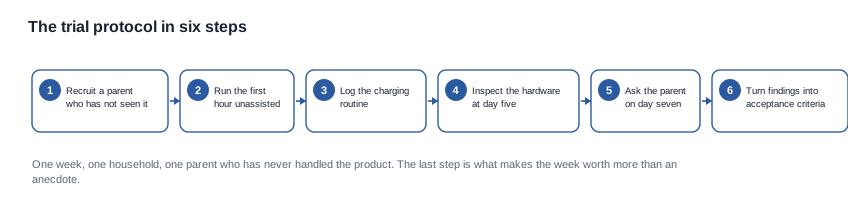
The protocol has six steps and each of them has a completion condition rather than a purpose. Recruit a parent who has not seen the device and has not been coached. Run the first hour unassisted, recording where they stop and what they ask. Log the charging routine from day two, including what happens on a long unattended charge. Inspect the hardware on day five. Ask the parent on day seven and record the words. Turn the findings into acceptance criteria.
What to record, and in what form
The record sheet has one row per day and one column per observation, and it is deliberately short. A long form is a form that will not be filled in, and an unfilled form is the same as no form.
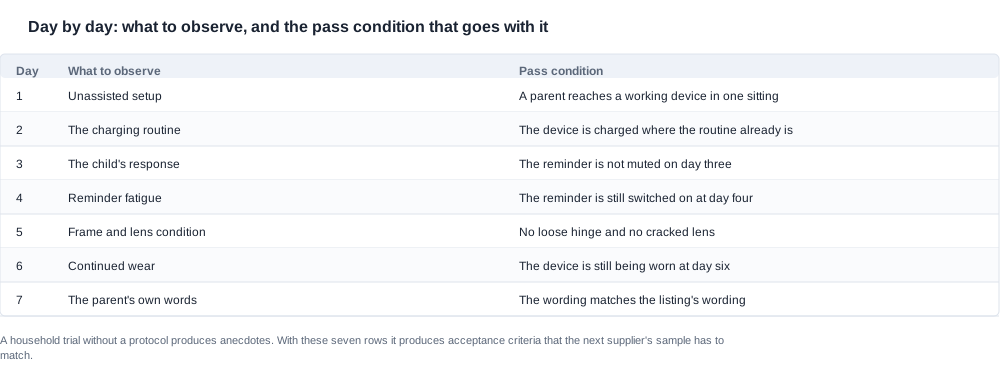
The pass conditions are written before the week starts, which is what makes the output usable. A pass condition that is written afterwards is a description of what happened, and a description of what happened cannot be applied to a different unit.

Turning a week's observations into acceptance criteria
From observation to criterion
The conversion is mechanical, and that is the point. "She takes it off after an hour" becomes a wear criterion: the device is worn for a full study session, with a stated minimum duration. "It nags" becomes a false-positive criterion: no more than a stated number of prompts in a stated session. "We forget to charge it" becomes a routine criterion: the device is charged at a stated point in the day, with the dock in the location where the household already keeps things. "The hinge feels loose" becomes a hardware criterion: no visible play at the hinge after a stated period of use.
Each of these is now a number, and a number is what can be attached to a purchase order and applied to the next lot. That conversion is the whole commercial value of the week: it converts four anecdotes into four acceptance criteria, at a cost of a small number of units and a week of calendar time.
The pilot a distributor runs before the order
This is a worked case rather than a customer case. Its purpose is to show the order.
Assume a distributor has a channel that already sells adult smart glasses and wants to test whether a children's line is viable with its existing customers. The distributor's constraint is not price. It is that its retailer's technical team will ask for evidence rather than for a demonstration, and the distributor does not want to discover a problem in a retailer's meeting.
The distributor runs the week before the order with three households, chosen so that the parents have not seen the product and the children are in the intended age range. The three questions it is trying to answer are whether the setup survives an unassisted parent, whether the reminder survives a week, and whether the child keeps the frame on.
The first household's setup stalls twice, which produces a rewording of the quick start guide rather than a product change. The second household's reminder proves too aggressive at the default, which produces a request to the supplier for the false-positive rate and a default to be set from the measurement. The third household reveals that the dock ends up on a landing surface out of reach of the child, which produces a packaging instruction rather than a hardware change.
At the end of the week the distributor has four criteria instead of a story, and the story had been the expensive artefact, because a story cannot be attached to an order. The measurement method behind the parameter requests that the week triggers is set out in how to measure kids eye protection glasses.
What the week is worth compared with the returns it prevents
The week is cheap and the alternative is not, but the comparison has to be made carefully because the two are not the same kind of cost. A week costs a small number of units, some coordinator time and seven calendar days. A returns problem costs a percentage of every unit sold, forever, in a channel where the reorder decision is made on the returns number and where the reason a parent gives is the reason the buyer hears.
The useful way to express it is per unit at risk. If a product is going into a channel that will sell thousands of units, then the question is not whether the week costs money — it does — but what a one-point change in the returns rate is worth across the programme. One point is usually more than the entire cost of the trial, and one point is usually produced by exactly one of the four failures the week detects.
The four detections also have very different multipliers. A setup failure that is fixed by rewording the guide is a one-time cost with a permanent benefit and no effect on the returns rate. A false-positive default that is not measured costs a percentage point on every unit. A fit problem that is not established costs more than a percentage point, because the fit complaint takes the channel's reorder decision with it. And an unlubricated reminder that is switched off in week two is worse than a returns rate, because the product still sells and the channel still reorders, and the only symptom is a review score that slowly declines.
The commercial terms a trial-backed programme should carry
A programme that has run a week has something a programme that has not, and the terms should use it. The acceptance criteria from the week are attached to the purchase order, which is what stops the next lot from being judged against a description rather than against an observation. The quick start guide and the documentation pack are required in the market languages, because the guide is the artefact the week identified as a failure point. A clause requires notice before any change of firmware, detection threshold default, frame material, lens or supplier of a safety-relevant component, because each of those can invalidate a criterion the buyer has already measured against. A clause sets out who bears the cost when a sample does not meet the acceptance criteria.
The negotiable numbers are unchanged by the trial, and the trial actually strengthens the buyer's position on them. Minimum order quantity is negotiable, and a first order in a new category is where a supplier is most flexible. Packaging and insert design, including the quick start guide, the size guidance, the market labels and the required warnings, is a low-cost negotiation with no tooling implication, and the week has just told the buyer exactly what that insert has to achieve. Delivery splitting against a trial milestone is usually granted more easily than a price concession, because it puts the approval risk where the evidence is. Payment node structure is a standard area, with a retention held against the documentation package.
The compliance cost and the elapsed time of testing are per model and per market and cannot be moved commercially. Tooling is a one-off usually amortised across a first order, and the useful questions are over what volume it is amortised and what happens to it if the programme is discontinued. And the parent-disablement position is not a price negotiation, because a function a parent cannot turn off is a function that generates returns, and the week measures that directly.
The published rows, and what the week cannot produce
The rows the week is testing against
We publish the electrical rows and the published functions for this tier, and we mark the rest as open rather than filling them with typical values. The A05 and the A06 publish a 40 mAh cell, two hours or less of charging, roughly twenty hours of rated use, magnetic charging, three lens options, a lens-type electronic fogging device and posture and viewing-distance detection. The A07 publishes Bluetooth V5.4, a 70 mAh cell, the same charge and runtime figures and magnetic charging. We publish no detection threshold, no delay, no false-positive rate, no frame weight, no dimension and no certification position for the A05, the A06 or the A07, and we will not estimate them from typical values.
We also make no effect claim about vision, health or eye protection for any of our products in any market. The parents' own verdict in a household trial is the most reliable test of that boundary, because a product whose copy promises an outcome the parents do not describe in the first week is a product whose copy is wrong.
The protocol to run with us
Send us the model, the household profile and the questions you want the week to answer, and we will write the protocol with you, supply the units, and report what the week produced — including the parts that are unflattering. The background is under kids eye care technology.
Where the trial protocol comes from
Send us the model and the household and we will write the week protocol with you.


