
Kids eye protection glasses technology: eight signals before price discussion
The eight signals and the question behind each
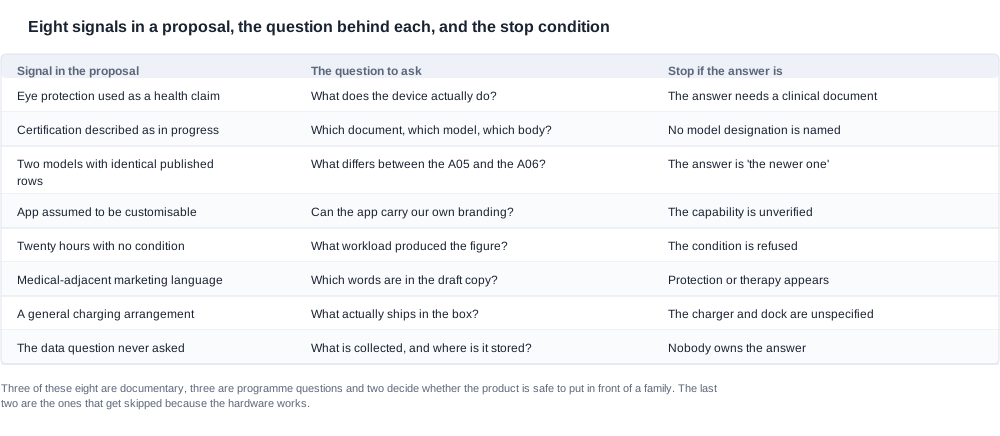
Red flags in this category are more serious than the equivalent list in an adult category, and the reason is structural rather than emotional. A product for children sits under a stricter regulatory regime, the people who use it are not the people who decide on the purchase, and the phrase in the category name is a phrase that sounds like a health claim. Kids eye protection glasses technology smart glasses red flags is a list of eight signals that show up in a supplier's proposal, each with the question that tests it and the condition that should stop the evaluation.
Our records state the certification position for the children's range as not provided, and they name the additional requirements that apply to products intended for children in Europe and the United States as matters to be confirmed. We publish no certification claim for this range at all.
A health claim written into the category name
These are habit-reminder devices. The A05 and the A06 publish a lens-type electronic fogging device, posture detection and viewing-distance detection, and the A07 publishes Bluetooth V5.4, a 70 mAh cell and roughly twenty hours of rated use, and the catalogue lists nothing else for it. A device that senses posture and distance and responds is not a device that protects eyesight, and a listing that leans on the category name invites a claim that cannot be supported.
The correction is simple and it is free: describe the reminder function and nothing more. What makes it a red flag rather than a wording preference is the combination — a claim that leans on the category name, in a product category where the safety file is empty, in a market where the words protection and care attract exactly the attention they should not.
A medical-adjacent marketing line and the attention it attracts
Words like protection, care, therapy and prevention in a children's product do not only create a claim risk. They draw the attention of a regulator and of a plaintiff's lawyer in a way the same words in an adult product do not, and they draw it precisely because the category name already contains the word protection. A buyer inherits that vocabulary from the search term and from the competitor's listing, and then repeats it in the copy without noticing that it has become a claim.
The test is whether the line can be read as a promise about an outcome. "Helps your child sit straighter" can be read that way; "reminds when posture changes" cannot. "Supports healthy vision habits" can; "detects posture and viewing distance" cannot. The rewrite is not a downgrade of the product — it is usually a more specific description of a function the buyer is paying for anyway.
In a category where the certification file is empty, this is the risk that matters most, and it is also the cheapest to remove, because it is removed by editing a draft rather than by retesting a product.
Certification described as in progress
This is the hardest signal to detect and the most expensive to discover late. "Certification is being handled" is not a document, and in this range our own position is that there is nothing yet. The question to ask is which document, for which model, from which body, and a supplier who cannot answer that is telling the buyer the programme has a dependency nobody owns.
The distinction to test is between a certification that is underway with a named body and a certification that is in hand for a named model. Only the second one can be attached to a purchase order, and only the second one can be shown to a retailer's technical team.
Two models with identical published rows
The A05 and the A06 publish the same cell, the same charging method, the same rated use and the same feature list, and our catalogue records the difference between them as unconfirmed. A brand building a range on a difference it cannot name is building it on an assumption, and the assumption usually turns out to be "the newer one".
This signal matters more in a children's line than in an adult one, because each model in the range carries its own compliance cost and its own laboratory booking. A shortlist that contains two models that cannot be distinguished is a shortlist that is paying twice for one decision.
The two programme signals that hide inside a plausible answer
An app assumed to be customisable
App and firmware customisation for this range is marked unverified in our own records. A brand planning a parent-facing dashboard on the assumption that the app can carry its own branding is planning against a capability nobody has confirmed.
The reason this hides is that the answer sounds like a yes. "Yes, the app can be customised" is a completely normal thing for a supplier to say, and it is true of many products in this industry. The test is whether the answer comes with a scope and a maintenance obligation, because an unqualified yes and a scoped yes are different products to plan against, and the difference surfaces in year two rather than in the proposal.
A twenty-hour runtime with no condition
The figure is published, and no test condition is published with it. In a category where the product is worn intermittently by a child, the condition behind the twenty hours is the difference between a product that lasts a school day and one that does not.
A supplier quoting a runtime without a condition is usually quoting the catalogue rather than measuring anything, and that is worth establishing early, because it tells the buyer which other figures on the page are also second-hand. The question is narrow: what workload, at what interval, at what ambient condition produced the number.
The three signals that decide whether the product is safe in a home
A general charging arrangement in a children's box
The charging architecture, the adapter, the cable and the case are all part of what a household or a school receives, and in a children's product the arrangement is part of the safety argument rather than a convenience. The A05, the A06 and the A07 publish magnetic charging and about twenty hours of rated use, and they publish nothing at all about the charger.
This is the signal that gets skipped because the hardware is working. A parent's expectation of a charging arrangement for an adult product is a cable in a box; for a product that goes on a child's face every school day, the arrangement that ships has to be specified, has to be documented, and has to say what happens on a long unattended charge.
The data question that nobody has asked
A children's product with a microphone and a cloud-connected app collects data about a child, and the question of what it collects, where it is stored and who can see it is the largest unresolved item in this range. We publish no data-handling detail for any model, and a school or a parent will ask it before a compliance adviser does.
The reason this is a red flag rather than a detail is who asks it. A retailer's technical team asks about documentation. A school's procurement officer asks about data handling, because a school is the party that ends up answering a parent. A proposal that cannot answer this question has a gap that will surface in the channel rather than in the evaluation.
The screening order and why it is fixed
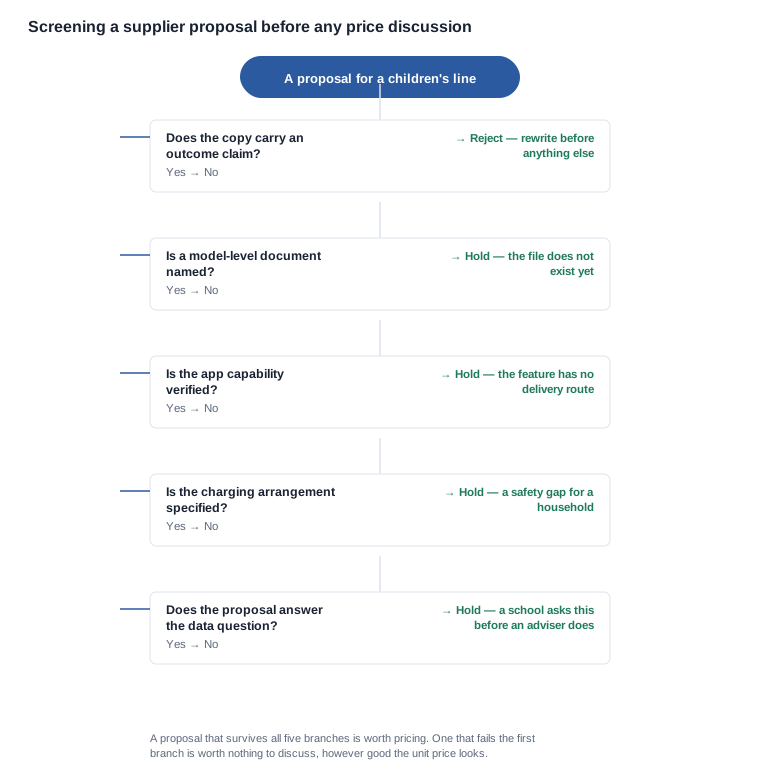
The eight signals are screened in a fixed order, and the order is set by what each failure costs rather than by how obvious the signal is. The three documentary signals come first, because they decide whether the product can be sold in a given market at all and because they are the cheapest to test. The two programme signals come second, because they decide the shape of the programme rather than whether it can proceed. The three household signals come last, because they are the ones most often skipped and they are the ones that decide whether the product is safe to put in front of a family.
A proposal that fails the first signal is not worth discussing on price. A proposal that fails the third group is fixable, but only if the fixes are made before the artwork is approved and before the first shipment is booked.
There is one situation in which the fixed order does not apply, and it is worth naming because it is the most common way a screening process gets abandoned. In a competitive tender with two suppliers, the pressure is to treat the signals as a comparison rather than as a gate, and the comparison is done on price and lead time because those are the two columns that fit on one page. The signals do not fit on one page, so they get deferred. Deferring them is cheap at the start of a tender and expensive at the end of it, because by the end the artwork is approved and the loser of the tender has the buyer's answer on record, which is worth having and which the buyer did not mean to give.
The fix is to run the screen on all proposals before comparing any of them, and to record the answers as the screening output rather than as a judgement about a supplier. A screened proposal produces a list of open rows, and the comparison between two screened proposals is then made on the same basis: which open rows are closeable by a sample, which are closeable by a document, and which are closeable by neither.
The commercial terms a screened proposal should carry
A proposal that has passed the screen should carry terms that match the screening output, because the open rows are exactly what the terms have to cover. Where a row is open on the certification position, the term is a model-level document reference attached to the order. Where a row is open on the detection parameters, the term is an acceptance criterion written in units with a stated measurement protocol. Where a row is open on fit, the term is a fit sample programme with a size range and a recorded day six. Where a row is open on the charging arrangement, the term is a documented specification of what ships in the box.
The negotiable numbers are the familiar ones and they are worth more here than usual, because a screened proposal has already established that the hardware is not the constraint. Minimum order quantity is negotiable. The number of models and colours committed is negotiable, and narrowing the range removes both the duplicated compliance cost of two models that publish identical rows and the per-SKU minimum on every additional combination. The artwork round count, the per-market label scope and the market list are all negotiable numbers. Delivery splitting against a sample-approval milestone is usually granted more easily than a price concession, because it puts the approval risk where the evidence is. Payment node structure is a standard area, and a retention held against the documentation package protects the buyer on the failure that costs most in this category, which is a product that arrives with paperwork that does not cover it.
The compliance cost and the elapsed time of testing are per model and per market and are set by the laboratory rather than by the buyer. A one-off usually amortised across a first order is what tooling is, and the two questions worth putting to a supplier are how much volume carries the charge and what happens to the tool should the programme be discontinued. And the safety-relevant design decisions — the cell retention method, the small-parts policy and the material choices — are design decisions rather than commercial variables, which is exactly why they belong in the screening criteria and not in the negotiation.
The scorecard as a short checklist
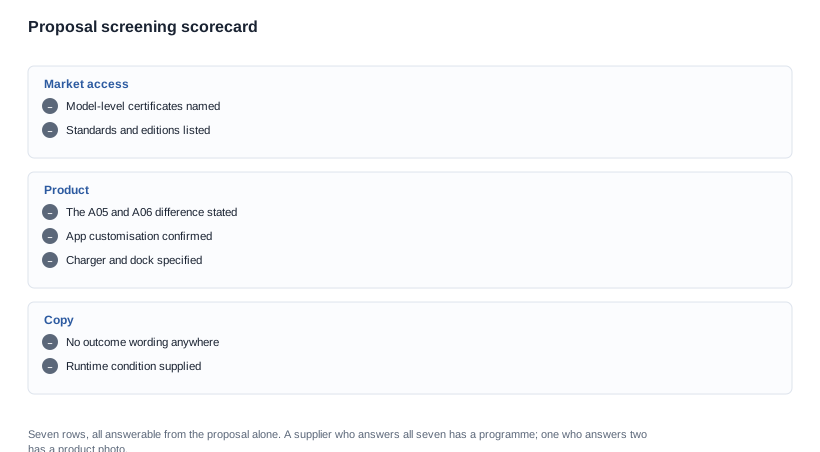
Seven rows, all answerable from the proposal itself, which is what makes the screen cheap enough to run on every quote rather than on the shortlist only. A supplier who answers all seven has a programme; one who answers two has a product photograph.
The scorecard is also the document a buyer attaches to the purchase order later, because the answers to the seven rows become the criteria that the order has to satisfy. Screening and specification are the same activity in this category, done at different times.

Screening a proposal, and what to do when a signal fires
The escalation route when a signal fires
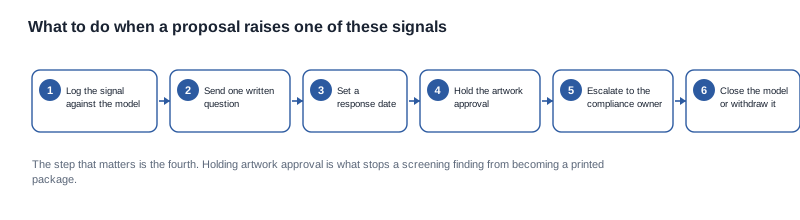
The route is six steps and only one of them is unusual. Log the signal against the specific model, so that the finding stays attached to a product rather than to a supplier in general. Send one written question, because a signal answered in a conversation cannot be traced and will be re-raised by the next person who reads the file. Set a response date. Hold the artwork approval, and this is the step that matters, because holding the artwork is what stops a screening finding from becoming a printed package. Escalate to the compliance owner rather than resolving it inside the buying team. Close the model or withdraw it.
The last step is the one that is usually skipped, and skipping it is how a proposal with an unanswered health claim ends up in production. A model that has failed a signal and has not been closed should be removed from the shortlist explicitly, with a date, rather than left in the list where it is quietly re-introduced at the next quotation round.
The screen also leaves a record that is worth keeping even after the model is closed, because the same supplier will quote again. A screening outcome written as "eight signals raised, six closed with answers, two moved to the sample request" tells the next buyer exactly how this supplier documents, and that is a faster route to a decision than a fresh round of references.
A scenario: a proposal that raises six of the eight
This is a worked case rather than a buyer enquiry. It sets out the decision sequence.
Assume a distributor receives a proposal for a children's range under their own label. The cover document describes the product as protecting children's eyesight, states that certification is being handled, presents the A05 and the A06 as two distinct models without saying what distinguishes them, promises a fully branded parent app, quotes a twenty-hour runtime without a condition, and specifies only "magnetic charging" in the box.
Six of the eight signals fire on the first reading, and none of them is about price. The distributor's screen produces six questions rather than a rejection, because the first signal is fixable by rewriting the copy and the second is fixable by getting a document reference.
The questions go out as a single written list. Two answers arrive quickly. The certification question produces a laboratory name and a booking, which converts a dependency into a dated milestone, and the model question produces a written statement of the difference between the A05 and the A06, which removes the duplicated compliance cost. The app question produces the longest answer, because the answer is that customisation is possible with a scope and a maintenance term attached, and the distributor now knows that the maintenance term is part of the price for the next three years.
The runtime and the charger questions produce less, and those two are the ones that stay open. They stay open because they are, in the distributor's judgement, the two rows that have to be closed by a sample and a document rather than by an answer, so they go onto the sample request rather than into the correspondence.
The outcome is a proposal that has been reduced from six open signals to two, with the two remaining ones attached to the acceptance criteria for the first order. The screening checklist for this category is set out in kids eye protection procurement checklist, and the question of what happens when the range changes later is covered in kids eye protection upgrade considerations.
The published rows behind the screening criteria
The rows that a proposal has to match are few and they are exact: the 40 mAh and 70 mAh cells, the two-hour-or-less charge time, roughly twenty hours of rated use, magnetic charging, three lens options on the two protection models, the lens-type electronic fogging device, posture and viewing-distance detection, and Bluetooth V5.4 on the A07. What we cannot supply for the A05, the A06 or the A07 is a certification status, a detection threshold, a false-positive rate, a frame weight, a dimension, a size range, an ingress marking, an app customisation position or a data-handling position, and we will not estimate any of them.
That absence is itself one of the screening criteria. A proposal that claims to know those values, or that treats them as standard, is describing a different product from the one in the catalogue.
The proposal and the draft listing
Send the proposal and the draft listing. We will return the signals the proposal raises, the question that tests each one, and the order in which we would raise them.
The market-entry rules are under children's product compliance, the models are on the kids smart glasses page, and the background is under kids eye care technology.
Related reading
- The compliance position — children's product compliance
- The programme list — kids eye protection procurement checklist
- The upgrade question — kids eye protection upgrade considerations
Send us a proposal and we will tell you which of these eight signals it raises.


