

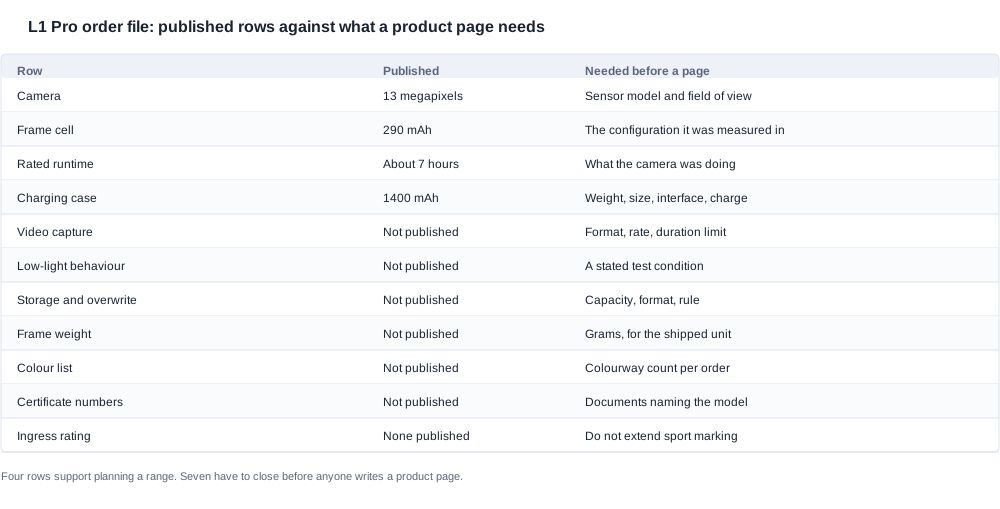
The L1 Pro is the 13-megapixel tier of the widest platform in this range, and it is also the model where the published specification and the commercial proposition diverge most sharply. The camera is published as a resolution and nothing else — no sensor, no field of view, no video format, no frame rate, no low-light figure — and the entire case for paying the premium on this model is image quality. That makes the camera rows the ones that matter most, and it makes every other row easier by comparison.
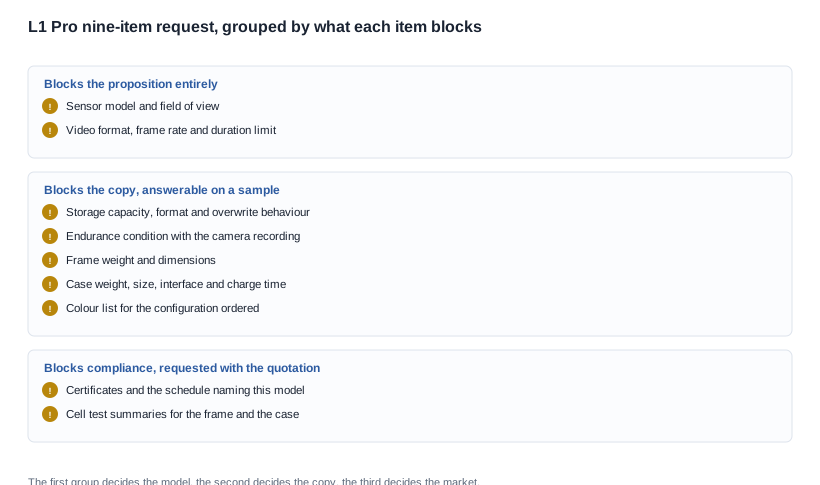
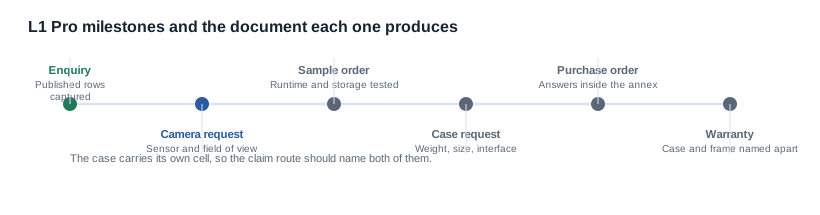
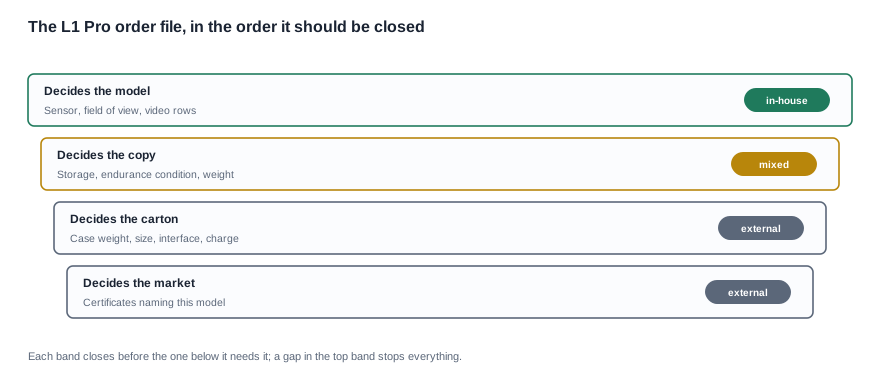
The order matters more than usual on this model. The camera rows decide whether the premium is recoverable at all, so they go first even though they are the hardest to get. The storage and endurance rows decide what you can write on the page, so they follow and are largely answerable on a sample. The case and freight rows decide what the parcel costs, so they are negotiated in parallel with the sample period. The certificate rows decide whether you can ship into your market at all, so they are requested with the quotation rather than after it.
This is the method for turning a thin published file into a defensible order file, in the order the questions are worth asking.
L1 Pro camera specification: why 13 MP alone is not an argument
Thirteen megapixels is published. The sensor model is not, and neither is the field of view, the video format, the frame rate, the low-light behaviour or the storage arrangement. On this model specifically, a 13-megapixel sensor with small pixels produces a worse image than an 8-megapixel sensor with large ones, which means the resolution figure on its own cannot be turned into a quality argument. It is a count of detail the sensor is theoretically capable of, and nothing more.

The field of view is the row buyers underestimate, because it decides whether the product works for first-person video at all rather than whether the resulting file is slightly better. A narrow field of view produces a recording that is technically sharp and compositionally useless, and it is only discoverable by using the product. Ask for the horizontal and vertical figures, and ask whether they are the full sensor or a crop.
The remaining rows follow from the same logic. Ask what the video format is and at what frame rate, and ask whether there is a duration limit imposed by storage or by firmware — a limit that exists and is not published will be discovered by the customer rather than by you. Ask what the low-light behaviour is, and on what basis; an answer of "it performs well in low light" is not a figure, and a figure without a condition is not evidence.
Ask them as four separate questions rather than as one request for camera details. A single question invites a single general paragraph, while four specific questions produce four specific answers, and the difference in reply quality is large enough to change how long the evaluation takes. Record which questions produced numbers and which produced descriptions, because that record is the evidence you will want if the premium is challenged later by somebody who was not in the room.
Turn the request into a checklist rather than a paragraph. The questions to ask are the same for every buyer in this category, and the reason to write them down is that they get forgotten selectively — the camera rows get skipped because they are interesting, and the freight rows get skipped because they are boring, and both skips are expensive. A written checklist with a column for who holds the answer and a column for the date it arrived turns an evaluation into a record you can hand to somebody else.
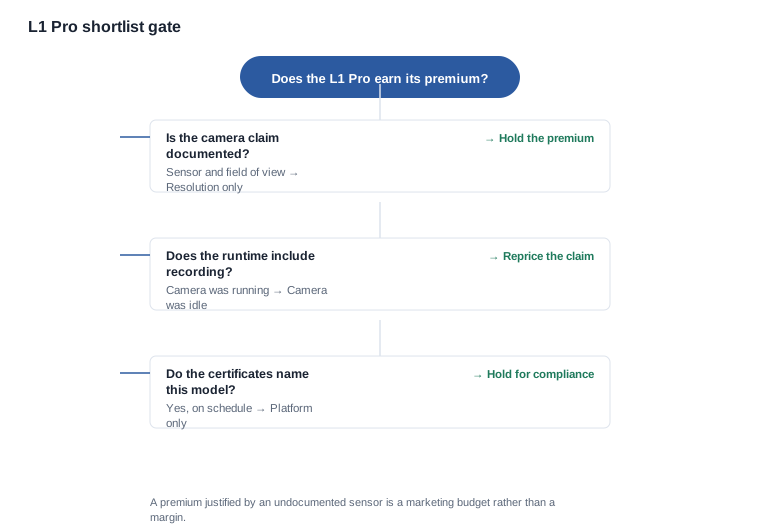
Put the four answers in one request and treat them as a single gate. If the sensor model and the field of view arrive together, the model is worth evaluating as the premium tier. If only the resolution comes back, you are buying a marketing budget rather than an image, and that is a legitimate choice — but it should be made knowingly and priced as marketing rather than as specification.
The storage arrangement, and the return it quietly causes
Capacity, format and overwrite behaviour are not published for any model in this range. For a camera glasses product this is a returns driver rather than a detail, and it is worth being precise about why.
A camera that stops recording because its storage filled presents to the customer in exactly the same way as a camera with a fault: it stops, silently, during the thing they were using it for. The customer cannot distinguish the two cases, so they report a fault, and the fault reaches you as a return rather than as a question. A customer who experiences that once does not buy the product again, and they frequently leave a review that describes the product as unreliable — which is a description of the storage behaviour wearing the product's name.
Ask four things. How much storage does the shipped configuration hold, and is any of it user-accessible? What format is recorded, and does the file play in standard software without proprietary tooling? What happens to a recording in progress when storage fills — does it stop cleanly, does it delete the oldest material automatically, or does it overwrite the file being recorded? And is there any indicator of remaining capacity during a session?
If the answers do arrive, the second question worth asking is whether any of them can be changed in production. Overwrite behaviour in particular is sometimes a firmware setting rather than a hardware constraint, and a supplier who is willing to confirm that in writing has given you a costless improvement to the product.
Each answer is a firmware question, and firmware questions are worth asking precisely because they sometimes have a configuration answer. If overwrite is automatic rather than silent, or if a low-storage indicator exists, that becomes one line in your own documentation and it removes most of the returns attributable to this row.
How to evaluate a supplier on this model is largely a question of what they do with the rows they cannot fill in. There are three acceptable answers: the figure exists and will be supplied, the figure does not exist and here is the written statement saying so, or the question does not apply to this configuration. There is one unacceptable answer, which is a confident description in place of any of the three. That single behaviour is a better due diligence signal than any number in the quotation, because it predicts how an inspection finding will be handled six months from now.
Test it on the sample by filling the storage and starting a recording. That single test takes five minutes and it tells you more than any written answer about how a customer will experience the product.
The 1400 mAh case and the four numbers it does not publish
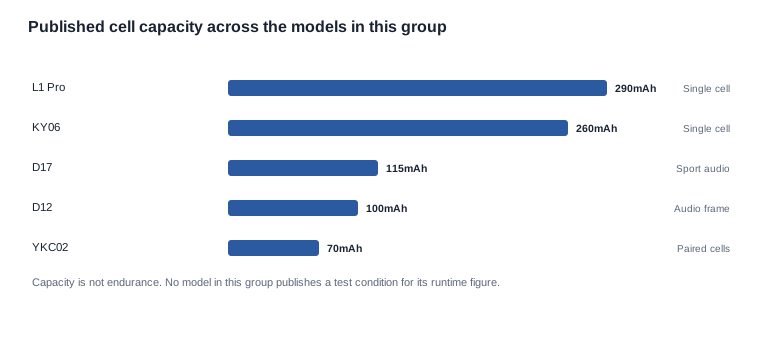
The L1 Pro publishes a 1400 mAh charging case, which is the largest in the range. What is not published is the case's own weight, its dimensions, its charging interface and its charge time.
Those four numbers decide the carton, the parcel weight, the freight class and the customer's weekly routine, and they are all consequences of a decision rather than accidents of it. A case that is itself charged over a separate cable is a different accessory from one that shares the frame's cable; a case with a large cell and a small shell weighs differently from the reverse; and a case that adds half a day to the customer's charging routine will be charged less often than one that does not.
Negotiate the commercial rows while the specification is open rather than after it closes. The reason is structural: a supplier with unanswered specification rows has more reason to hold a price, and a supplier who has answered everything has less leverage left. Asking for the specification and the quotation in the same exchange moves the conversation to the point where both sides have something still to give.
Ask for the case's gross weight and dimensions as shipped, not as bare product — packaging is where a case's shipping profile is really set. Ask which input the case accepts, whether that input is the same as the frame's, and whether a cable is included for both. Ask how long the case takes to charge and whether the frame charges from the case or is replaced by it.
It also changes the total energy that travels with the product, which affects how the parcel is handled by some forwarders and how it is described in your own shipping documentation. Two declared cells in one box is a normal configuration for this category and it is not unusual, but it does mean the packaging designer needs to know it at the outset rather than discovering it when the first carton is built.
The capacity figure has a second consequence that is easy to miss. The case is a second lithium cell travelling in the same box, which means it appears in your transport documentation in its own right. Ask how the case is declared and marked, and whether it is covered by the same cell test summary as the frame or by a separate one — because two cells in one parcel are two declarations, and a buyer who finds out at the port has a long conversation with a freight forwarder.

Endurance on a 290 mAh cell with a camera as the main load
About seven hours is published on a 290 mAh cell, with no stated condition. On a 13-megapixel camera platform the camera is the dominant load, so the difference between a rating measured with the camera running and one measured with it idle is the difference between a product that works for its purpose and a product that returns.
Ask what the camera was doing during the measurement. Ask whether the Bluetooth link was active, at what volume, and whether it was recording or only previewing — those are different loads. Ask how many units were tested and whether the figure is a mean or a best case. Then run your own measurement with the camera actually recording, at a stated resolution, and write the method down beside the number.
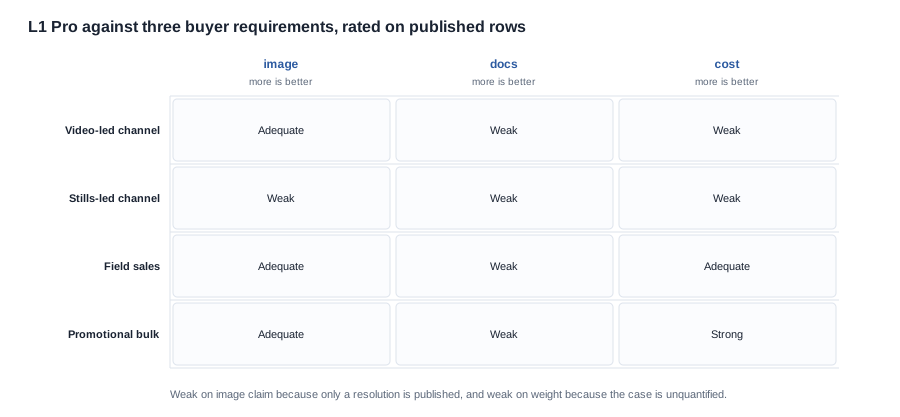
The main trade-off on this model is between premium positioning and documented evidence. The premium is recoverable when your channel compares on image quality and the camera rows arrive; it is largely unrecoverable when your channel compares on specification completeness, because the L1 Pro will lose that comparison to a smaller model with a thicker file until the gaps close. Which of those two channels you are in determines whether this is the right model, and it is a cheaper question to answer than a sample order.
The general principle applies across this whole range. Capacity is not endurance. A larger cell raises the achievable runtime but does not tell you what the product will deliver under the conditions the customer will actually use it in, and a figure with no condition attached is a ceiling rather than an expectation.
Frame weight, dimensions and the proxy you should refuse
Neither the frame weight nor the frame dimensions are published for this model. The only weight figure anywhere in this catalogue is the MT6 at 158 g, on a different model with a smaller cell and a foldable case — which is exactly why it cannot be used as a proxy. A proxy is useful only when the two products share the things that determine the number, and here the cell, the camera module and the case arrangement all differ.
On a 290 mAh frame carrying a 13-megapixel camera module, weight is a real variable rather than a rounding error. It decides whether the product stays on through a working day, and it decides the parcel weight, and therefore the freight class — the same number appearing in a customer-facing decision and in a logistics calculation.
Once the weight and dimensions arrive, check them against the case configuration as shipped, and record both. Where the set is sold together, the parcel figure is the one that sets your freight class, and it is the number most often calculated from the frame alone by mistake.
Ask for the weight in grams, for the specific configuration you will ship, and ask whether it varies by colourway. Ask for temple length in millimetres and the adjustment range if the temples move. Ask whether the dimensions include the case when the product is sold as a set, because that is the configuration your customer will receive.
The broader point generalises. Proxy figures are not forbidden; they are simply a different kind of evidence, and they have to be labelled as proxies on the page where they appear. A buyer who can see that a figure was taken from a related model can plan around it. A buyer who cannot see that has been given a number with a different provenance than they assumed, and the discovery always arrives at the worst moment.
The same refusal applies to any other model in the range. A weight published for one model is not a weight for another, even where the platforms are related, and a buyer who has been given a proxy figure will eventually discover it and will stop trusting every other number on the page.
Who the L1 Pro is for, and where a smaller tier wins
Name the cases. If your proposition is first-person video and your channel compares on image quality, the L1 Pro is the only model in the range whose published camera figure justifies the premium — provided the sensor and field of view arrive. If your proposition is stills capture with audio, the premium may not be recoverable, because a buyer comparing two camera glasses will look for a quality claim and this model cannot currently produce one. If your channel compares on endurance, the seven-hour figure has no stated condition and a smaller model with a documented condition may convert better at a lower price.
If your channel sells on a total cost basis rather than a unit price basis, the 1400 mAh case is the row that decides it. A case that is charged weekly rather than nightly is a different accessory from one that is not, and the difference shows up in returns rather than in reviews. Ask the questions to ask about case charge time early, because the answer changes the total cost calculation more than any other published row on this model.
If your channel needs a sealed or rugged product, there is no published ingress rating for this model. We will not extend the IP54 marking that belongs to the sport-positioned models to this one, because a marking borrowed from another product is a claim with a false provenance attached to it, and that is worse than no claim.
There are two red flags to watch for on the paperwork specifically. The first is a certificate schedule that names the platform rather than the model designation on your purchase order. The second is a runtime figure presented with the word battery life in the heading and no condition in the body. Neither is unusual; both are signs that the specification was assembled for a catalogue rather than for a contract, which tells you how much work the remaining rows will be.
The L1 Pro is a well-specified platform whose specification is complete enough to plan a range with and too thin to write a product page from. We will not present the 13 MP as an image quality claim without a sensor model, we will not present the roughly seven hours as a working day, we will not quote a weight, a colour or a certificate number that the documentation does not contain, and we will not extend the IP54 marking that belongs to the sport models to this one.
Ask for them in one message, with a deadline, before you commit to anything including the sample order. The sample is the cheapest part of this evaluation and it is still wasted if the answer to the first item is a no, which is why the camera request belongs in front of it.
The seven-item first-order list is short: sensor model, field of view, video format and frame rate; the storage arrangement; the case weight, dimensions, interface and charge time; the endurance test condition; frame weight and dimensions; the colour list; and the documents that name this model. If the first item does not arrive, the rest will not change what you should buy.
Send us the target market, the volume and the configuration, and we will tell you which of the seven are already answered and which have to be closed first.
Related reading
- The data published for this model — L1 Pro smart glasses specifications and features
- The range position of this model — which AI camera glasses model to pick
- The accessory numbers — AI camera glasses charging case options
- What an unpublished weight does to freight — weight comparison across the range
Send us the target market, the volume and the configuration, and we will tell you which of the seven checks are already answered and which have to be closed first.


