
The L2 Utral is one of eleven camera glasses models in this catalogue, and the question a channel actually has about it is not whether it is a good model but what its page says that the other ten pages do not. That is a narrower question than it sounds, and it is answerable from the catalogue itself. The L2 Utral page publishes a thirteen megapixel sensor tier, a two hundred and ninety milliamp hour cell, a seven hour endurance figure, a charging case row that carries two capacities, two variant names and a charge interface row. Most of those rows appear on other pages too. Exactly one row on the L2 Utral page is unique among the eleven camera models, and knowing which one it is turns the model from a name in a list into a position in a range that a buyer can actually plan around.
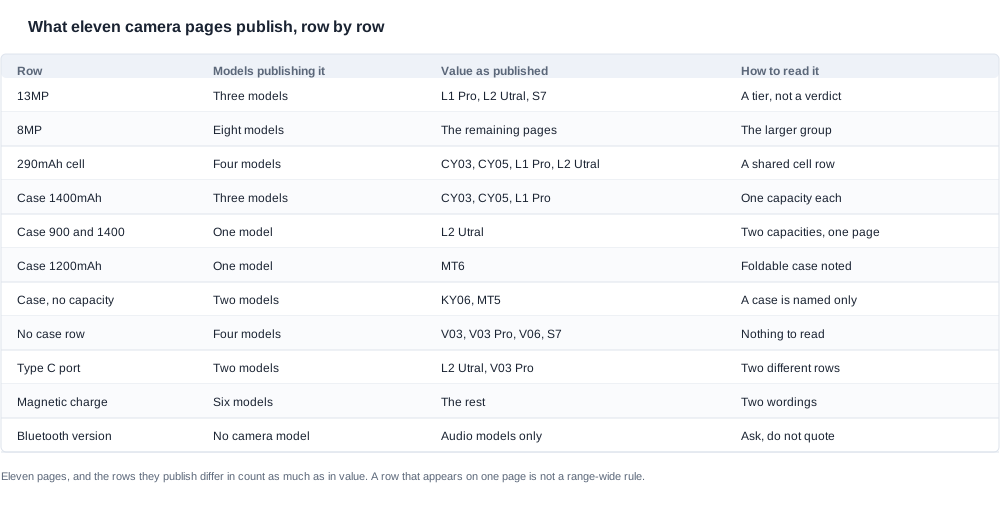
What eleven camera pages publish, row by row
The table below covers all eleven camera models in the catalogue and lists, for each row type, which models publish it and what is published. It is worth reading as a coverage map rather than as a ranking, because the point of it is that a row appearing on one page is not a rule for the range, and a row appearing on four pages is still four separate published statements rather than a shared specification.
| Row | Models publishing it | Value as published | How to read it |
|---|---|---|---|
| 13MP | Three models | L2 Utral and S7, and L1 Pro | A tier, not a verdict |
| 8MP | Eight models | The remaining pages | The larger group |
| 290mAh cell | Four models | L2 Utral and CY05, and L1 Pro and CY03 | A shared cell row |
| Case 1400mAh | Three models | CY05 and L1 Pro, and CY03 | One capacity each |
| Case 900 and 1400 | One model | L2 Utral | Two capacities, one page |
| Case 1200mAh | One model | MT6 | Foldable case noted |
| Case, no capacity | Two models | KY06, MT5 | A case is named only |
| No case row | Four models | V06 and V03, and S7 and V03 Pro | Nothing to read |
| Type C port | Two models | L2 Utral, V03 Pro | Two different rows |
| Magnetic charge | Six models | The rest | Two wordings |
| Bluetooth version | No camera model | Audio models only | Ask, do not quote |
Two things in that table carry the most weight in a range decision, and they are not the pixel tier. The first is the case column, which splits the eleven models four ways: three pages publish a single one thousand four hundred milliamp hour capacity, one page publishes nine hundred and one thousand four hundred, one page publishes one thousand two hundred alongside a note that the case folds, two pages name a charging case without giving a capacity at all, and four pages carry no case row whatsoever. Six different situations, and the difference between a page that states a capacity and a page that says nothing is the difference between a figure that can go on a product listing and a question that has to be asked.
It is worth being concrete about what a case row means in practice, because the six situations do not sit in a line from complete to absent. A page with a single capacity is a fixed configuration: one case ships with the product and its size is known. A page with two capacities is a choice, and the channel decides how many configurations it carries, which is a packaging and stock decision rather than a customer-facing one. A page that names a charging case in the charge method row without giving a capacity is a partial disclosure, because the accessory is confirmed as part of the product but its size is not published, so it cannot be quoted and has to be requested. A page with no case row is not the same as a page that says there is no case. The catalogue simply does not mention one, and that silence covers the V03 and the V06, and the V03 Pro and the S7, four models that include the two sports models with the IP54 marking and the thirteen megapixel S7. A buyer treating the absence of a row as a decision not to ship a case will be wrong on at least one of the four, and there is no way to tell from the catalogue which.
The second is the charge method, which splits the range in a way that is easy to miss because the two wordings look similar on a page. Six camera models state a magnetic charge, and the wording is not the same across them. The V03 page reads magnetic charging mode, while the KY06 and the MT5 pages read magnetic charging with a charging case, which names the accessory in the same row. The V06 and the S7 pages read magnetic charging, with no further wording. And two pages state a Type C port, the L2 Utral and the V03 Pro, but they do it in different rows and with different words: the L2 Utral has a feature line reading Type C charging interface, and the V03 Pro has a charging port line reading Type C together with a feature line reading Type-C charging port. Four wordings across two methods, and the accessory that a magnetic charge mates with is never named on the pages that use that word.
There is a second reason the charge method row matters for a range, and it is the one a catalogue reader is least likely to notice. On four camera pages, the charging method is not stated at all. The CY05 and the MT6, and the L1 Pro and the CY03 have no charge method row and no feature line naming an interface. That is four models with a published case row and no published way of charging the frame, which means the interface for those four is a question, and the answer may be magnetic, may be a port, and may differ between them. The catalogue does not support an inference here, and neither does a product page that quietly assigns one.
The one row that belongs to the L2 Utral alone
The L2 Utral is the only camera page in the catalogue that publishes two charging case capacities in a single row. Every other camera page with a case row publishes one value: the L1 Pro and the CY03, and the CY05 each publish one thousand four hundred milliamp hours, and the MT6 publishes one thousand two hundred. The V06 and the S7, and the V03 and the V03 Pro have no case row at all, and the KY06 and the MT5 name a charging case without publishing a capacity. This is the L2 Utral's structural difference from the rest of the camera range, and it is worth being exact about what it is and is not.
What it is: a range of eleven models in which one page offers two case configurations and ten do not offer more than one. For a brand or a distributor, that is a packaging and planning input, and it is the kind of input that shapes how many configurations a channel carries. What it is not: a specification lead, a quality statement, or a reason to prefer the model on a customer-facing page. The row states a capacity, not a performance, and it says nothing about how long either case takes to charge, how heavy either is, or what interface the case uses.
And the same row has a gap that has to be closed before it can be used. The L2 Utral page prints two capacities, nine hundred and one thousand four hundred milliamp hours, and it prints two variant names, Utral and Pro Max. The catalogue does not state which capacity belongs to which name. It is entirely possible that the pairing is one capacity per name, and it is equally possible that both capacities are available for both names, and the page does not say. A product page that pairs a name with a capacity is making a decision the catalogue has not made, and the decision has to be confirmed in writing first. The L2 Utral smart glasses specifications and features piece sets out the full published row set for this model, and the L2 Utral limitations analysis piece covers the gaps in detail.
Two more rows on the L2 Utral page deserve care rather than scepticism. The first is the two hundred and ninety milliamp hour cell, which is shared by four camera models: the CY03 and the L1 Pro, and the L2 Utral and the CY05. Those four pages publish the same cell figure and the same seven hour endurance figure, and that is a real pattern in the catalogue. What the catalogue does not publish is the relationship between them. It does not state that they share a firmware branch, an app, an accessory family, a production qualification or a supply arrangement, and none of those should appear on a product page as a fact, because the catalogue is silent on every one of them. A shared cell row is a shared cell row. The OEM ready platforms which models are ready piece covers what the catalogue does and does not establish about the camera models, and the OEM ready platforms pricing tiers piece covers how a platform structure is discussed commercially.
The second is the endurance figure. The L2 Utral page states about seven hours on a row labelled endurance, and the endurance label is used on five camera pages: the CY05 and the MT6, and the CY03 and the L1 Pro, and the L2 Utral, all at about seven hours, and all on a two hundred and ninety or two hundred and sixty five milliamp hour cell. The other camera pages use two different labels for the same quantity, and the difference is a trap worth stating plainly. The V03 page publishes five to eight hours on a row labelled charge duration, the V03 Pro page publishes five to eight hours on a row labelled usage duration, the KY06 and the MT5 publish six to eight hours on a row labelled charge duration, and the V06 and the S7 publish their figures on a usage duration row. The same quantity, four different labels, and on three of the camera pages the label that means run time is the label that means charge limit on the L2 Utral page. The AI camera glasses battery comparison piece maps the full grid, and the how to compare smart glasses battery life method piece covers the questions to ask about the condition behind a figure.

Which rows separate the models, and which are shared or absent
A range decision is easier to make when the rows are sorted into three groups, because the three groups behave differently in a purchase.
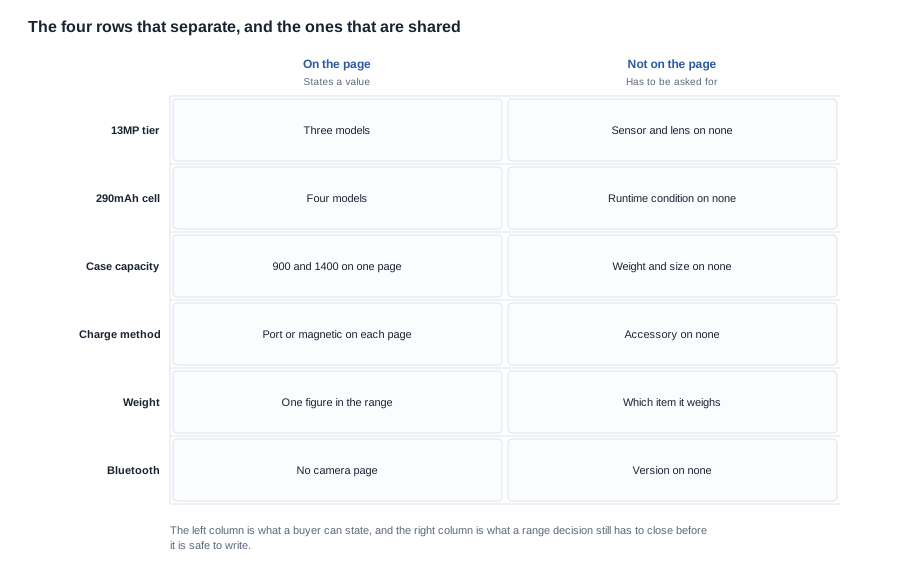
The first group is the rows that genuinely separate models. The criteria for telling the three groups apart are these four:
- The case row. The L2 Utral separates itself here, with two published capacities against one capacity or none on the other ten pages.
- The pixel tier. Thirteen megapixels separates the L2 Utral from eight of the eleven models and joins it to the L1 Pro and the S7.
- The cell row. Two hundred and ninety milliamp hours joins the L2 Utral to the CY03 and the CY05, and the L1 Pro, and separates it from the two hundred and sixty, two hundred and twenty and two hundred and sixty five milliamp hour models.
- The charge interface. The Type C interface separates the L2 Utral from the magnetic models.
The V03 Pro separates itself on a feature line the other ten do not have, a photochromic lens alongside flexible temples, and it is one of only two camera pages with a colour row, listing three colours.
The second group is rows that several models share and that therefore cannot carry a purchase decision. A cell capacity shared by four models is a class attribute. A seven hour endurance figure published by five pages is a range-wide figure, and it is published without a test condition on any of them. The magnetic charge method covers six camera models, so it is a range convention rather than a differentiator.
The third group is the rows nobody publishes, and this is the largest one. No camera model publishes a Bluetooth version, not one of the eleven, while the audio models all publish theirs. Only two camera pages publish a colour row, the V03 Pro with three and the V06 with four. Only two publish an ingress rating, the V06 and the S7 with IP54. Only one publishes a weight, and it is worth being precise about what it says: the MT6 page carries a feature line reading one hundred and fifty-eight grams alongside a foldable charging case, and the catalogue does not state whether that figure is the weight of the glasses or of the case. The MT6 how it compares piece covers that model in full, including what its single weight figure does and does not settle.
None of the eleven camera pages publishes a per-model certification row. The catalogue contains an export certification page at company level whose content is presented as images, and that page carries the company's patent certificates, including eight design patents and two utility model patents. So the certification position for any specific camera model, in any specific market, is a document request. It cannot be read off the catalogue, and it should not appear as a mark on a listing.
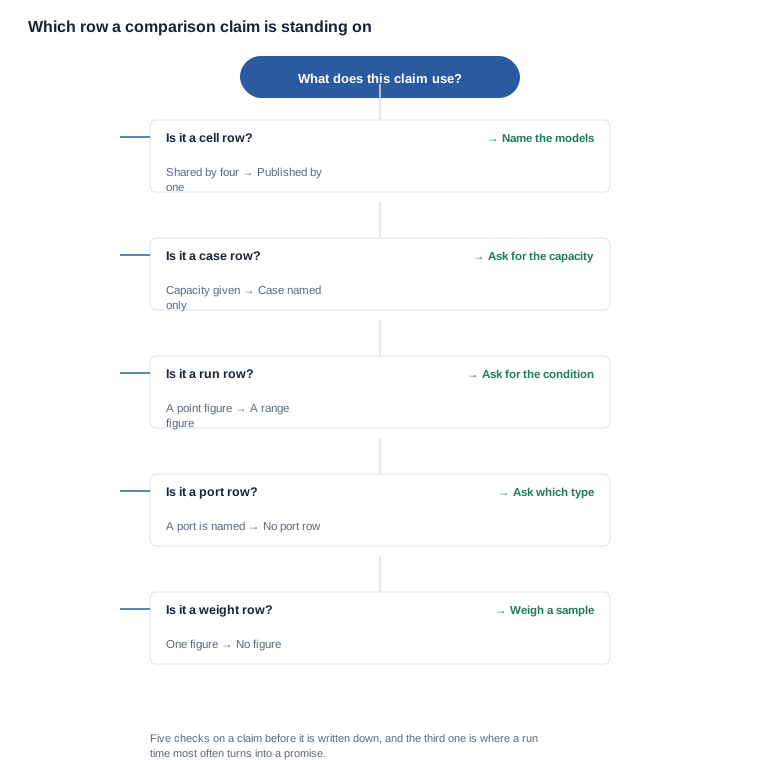
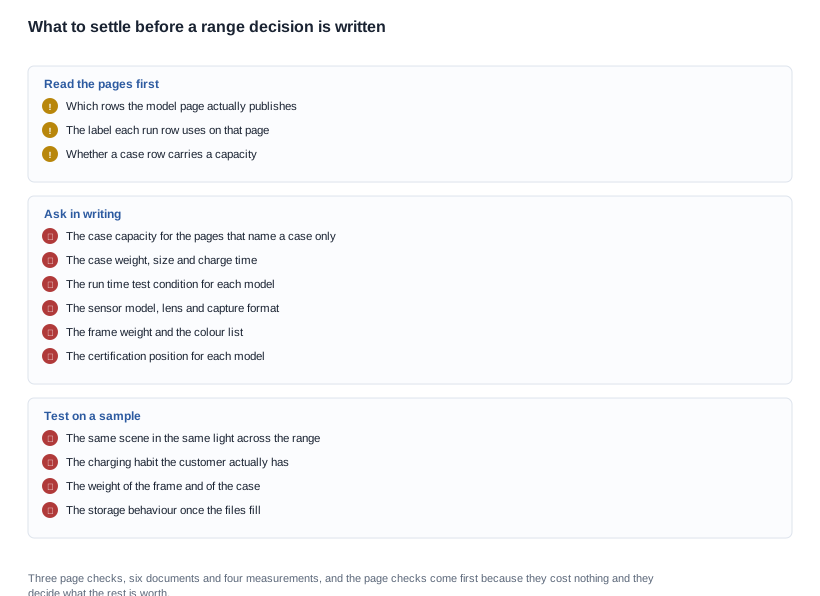
What a range decision on this model has to close
Everything below is a question with a name against it, which is the only form in which an unknown is useful in a range discussion. Reading the catalogue pages comes first, because it costs nothing and it decides what the rest is worth.
Read the page, and for each of the eleven camera models, note which rows it publishes and what label each run row uses. Confirm the two case capacities and the two variant names for the L2 Utral, and check which name maps to which capacity. Confirm whether the run row on a given page is a point figure or a range, and record the label it carries. These checks take minutes and they determine whether a number can be stated or only asked for.
Then ask, in writing, and ask every model the same way. What is the case capacity for the pages that name a charging case without giving a number, the KY06 and the MT5. What is the case weight, its dimensions, its charging interface and its own charge time, for the pages that publish a capacity. What is the run time test condition for each model, and what was the state of the product when it was measured. What is the sensor model, the lens, the field of view, the capture format and the frame rate. What is the frame weight and what colour options exist. And what is the certification position for each model in each destination market.
Then test on a sample, because these are the ones no document settles. Run the same scene in the same light across the range, with the same capture settings, and keep the files. Charge each model the way the customer will actually charge it, because a magnetic mode and a Type C port are different habits rather than different speeds. Weigh the frame and weigh the case separately, since the one published weight in the range does not say which item it measures. Fill the storage and watch what happens to the next capture.
How to read the L2 Utral against the camera range
The position is narrow and we will state it plainly. The L2 Utral's published difference from the other ten camera models is one row, the case row carrying two capacities, and that row is a packaging and planning input rather than a performance claim. We will not present the thirteen megapixel tier as an image quality claim without a sensor model and a lens, and we will not present the roughly seven hours as a working day, because no camera page states a test condition. We will not write that the four models sharing the two hundred and ninety milliamp hour cell share a firmware branch, an app or an accessory family, because the catalogue does not say that. We will not state which of the two case capacities belongs to which of the two variant names, and we will not quote a weight, a colour, an ingress rating, a Bluetooth version or a certificate number that the documentation does not contain.
The range structure that the catalogue does support is this. Eleven camera models publish a pixel tier, and the tier divides them three and eight. Four models publish the two hundred and ninety milliamp hour cell, and five publish the about seven hour endurance figure. One page publishes two case capacities, three publish one, two name a case without a capacity, and four have no case row. Two pages state a Type C port and six state a magnetic charge, in four different wordings. No camera page publishes a Bluetooth version, two publish a colour row, two publish an ingress rating, and one publishes a weight whose subject the catalogue does not identify.
A channel that builds its range from those lists, with the labels as published and the blanks left blank, ends up with a comparison it can defend. A channel that fills a blank from another model's page, or pairs a variant name with a case capacity the catalogue has not paired, ends up with a comparison that will not survive the first technical question from a buyer who has read the catalogue. The AI camera glasses which model to pick piece covers the range decision itself, and the AI camera glasses charging case options piece covers what the case in the box does to a channel, while the AI camera glasses shipping weight piece covers the parcel.
Send us the tiers you plan to cover and the markets you are quoting into, and we will tell you which rows you can state and which ones have to be closed first.


