
Searches for l2 utral smart glasses best for usually arrive with a shortlist already formed, and the shortlist is almost always built on one number: 13 megapixels. That number is real, and it is the highest resolution tier published anywhere in our camera range, but it identifies three models rather than one — the L2 Utral and the L1 Pro, and the S7 — and those three do not share a charging interface, a charging case or an ingress marking. The choice between them is decided by three rows in the catalogue, not by the camera.
This page works through those rows in order. First, what the three models publish and where they differ. Then the charging interface, because it is the only row on which the L2 Utral stands alone. Then the charging case, because it splits the tier into two models with a case and one without. Then the ingress marking, which only the S7 carries. The closing section turns those three answers into a selection for a specific channel.
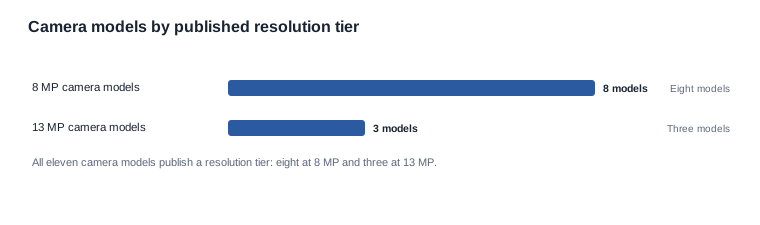
Wider context matters here, because the tier is small and the family around it is not. Our camera range contains eleven models, and every one of them publishes a resolution tier: eight at 8 MP and three at 13 MP. A buyer who has decided on 13 MP has already made the hardest filtering decision available on this family, and what remains is a three-model comparison rather than an eleven-model search.
None of the three publishes a sensor model, a field of view, a video resolution or a frame rate, so the megapixel figure cannot be defended on paper against an 8 MP product. That is a category-wide position rather than a weakness of this tier, and it is why the three questions below have to carry the entire selection.
The 13 MP choice: three models, three different constraints
Start with the cell. The L1 Pro and the L2 Utral sit on a 290 mAh frame cell with a rated runtime of about seven hours and a charge time of up to two hours. The S7 sits on a 260 mAh cell with a published endurance range of five to eight hours and the same charge-time ceiling of up to two hours. Neither cell is unique to this tier: the 290 mAh cell also carries the CY03 and the CY05, and the 260 mAh cell also carries the KY06 and the V06, both of which are 8 MP models. Energy architecture is a platform property in this range, not a tier property.
What the L2 Utral contributes that the other two models do not
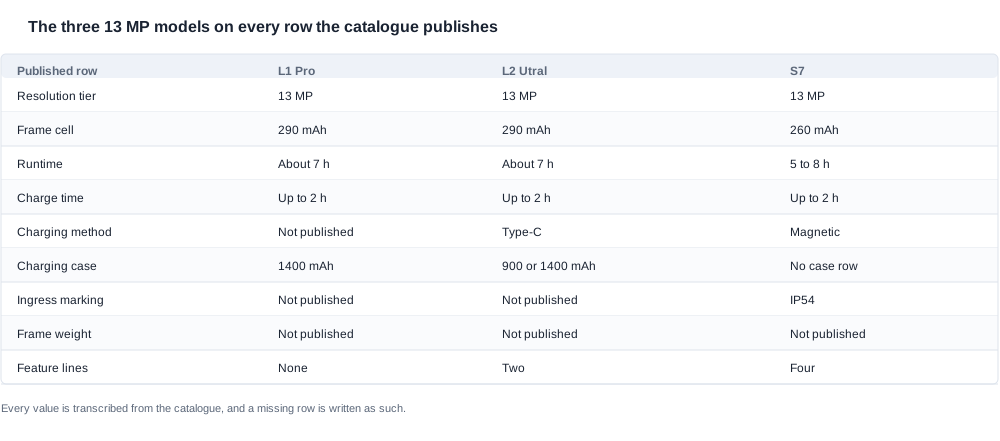
The three rows this page turns on do not sit in one column of the table. The interface row is the only one where the L2 Utral stands alone, and it stands alone because the other two are either silent or different, not because it is the most advanced of the three. The case row places it in a pair with the L1 Pro. The ingress row places it outside that pair, with the S7. A buyer who reads the catalogue once will remember 13 megapixels and a 290 mAh cell; a buyer who reads it three times will remember which model publishes what, and that second reading is what a purchase order is built on.
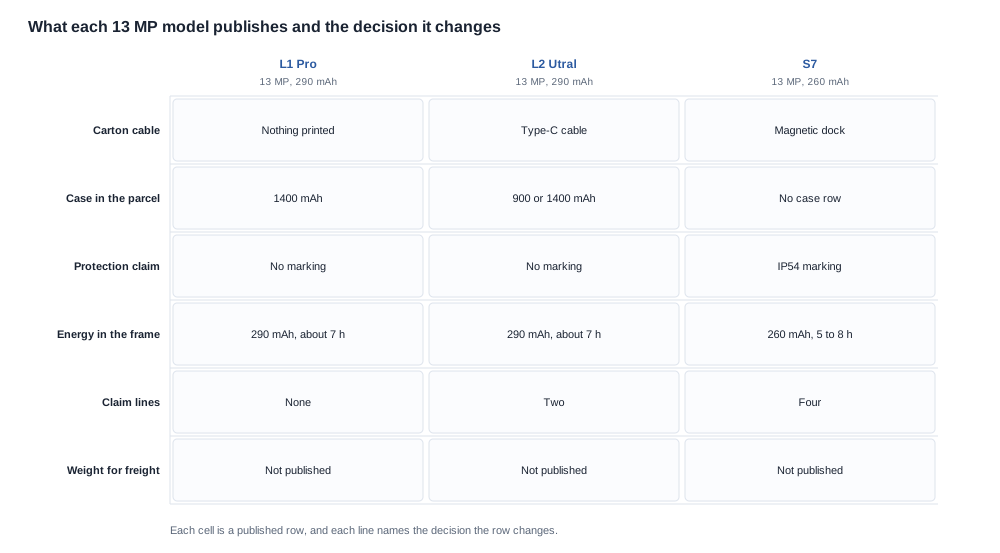
The table above is the complete published position for the three models, transcribed row by row. Reading it column by column produces the same result every time: the two 290 mAh models agree on cell, runtime, charge time and resolution, and differ on the interface row and the case row; the S7 agrees with neither on the cell and adds two feature lines that the other two do not have.
Feature lines matter more than buyers expect at this stage, because they are what a brand can actually write. The L1 Pro publishes no feature lines at all. The L2 Utral publishes exactly two: a variant name recorded as Utral and Pro Max, and the charging interface Type C. The S7 publishes four: an ergonomic design, 13 megapixel high-definition imaging, a removable inner frame, and IP54 waterproof protection.
Two cameras that look identical on a specification table are therefore not identical on the page you can publish from. A brand listing the L1 Pro has specification rows and nothing else to work with. A brand listing the S7 has four lines of copy available. The L2 Utral sits between the two, and its single useful feature line is the interface — which is the subject of the next section.
The last structural difference is what the tier does not publish. Frame weight, temple dimensions, storage capacity, file format, overwrite behaviour, certificate numbers, issuing bodies and validity periods are absent for all three models. One weight figure exists in the entire catalogue, and it belongs to the MT6 glasses unit at 158 g, so it cannot be borrowed for a 13 MP model or used as a typical value for the range.
Worth stating plainly at this point: no row on this tier separates the three models on imaging quality. The published difference between them is charging, packaging, protection and the amount of copy the supplier has published. If your channel competes on sample photos rather than on specification sheets, the resolution argument has to be settled with a physical comparison, because the paperwork will not settle it. The reasoning behind why a megapixel figure behaves as a shelf argument rather than a quality one is covered in the resolution options analysis.
Which of the three 13 MP models publishes a charging interface
One of the three, and it is the L2 Utral: it publishes a charging interface of Type C. The other two do not publish a named interface in the same sense.
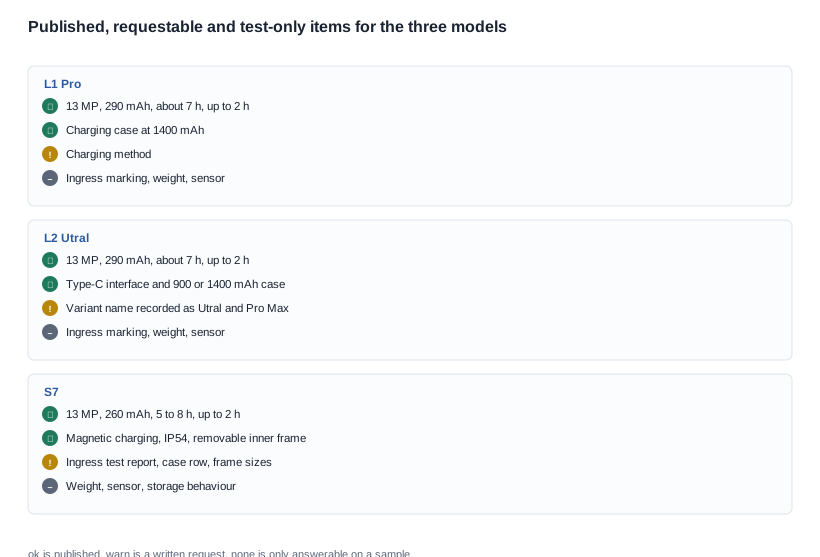
The L1 Pro publishes no charging method row at all. That is a different state from publishing a method that happens to differ from the others. Nothing about how the frame is charged can be planned from the catalogue, which means the carton cannot be drawn, the instruction leaflet cannot be written, and the replacement cable for the warranty channel cannot be ordered from what is published. The charging method for the L1 Pro has to arrive in writing before any of that work starts.
The S7 publishes magnetic charging. A magnetic arrangement is a method and a dock rather than a defined interface: the frame charges on a specific contact dock, and the end customer cannot top it up from the USB-C cable that runs the rest of their equipment. For a channel whose proposition is that one cable does everything, that is a real cost, and it belongs in the accessory, packaging and support calculations rather than being discovered after the first returns arrive.
Across the eleven camera models the published charging methods divide into three groups. Magnetic accounts for five, Type-C for two, and four models publish no charging method. The Type-C group is the V03 Pro and the L2 Utral, which means a buyer building a catalogue around USB-C has two candidates in the whole camera family and only one of them sits on this tier. The unpublished group is the L1 Pro and the CY05, and the MT6 and the CY03.
For a buyer who has already chosen the 13 MP tier, this single row is the sharpest difference available. The L2 Utral and the L1 Pro are close enough to be confused on a shelf, and the interface is what separates them in a specification comparison, in a carton, and in a customer's unboxing.
Three questions put to a supplier settle this row in one exchange, and they are worth writing down before the first enquiry rather than during it. Ask which connector the frame physically uses and whether the cable in the box is the same type. Ask whether the frame can be charged from a generic USB-C wall plug and a generic USB-C cable, or only from a supplied cable. Ask whether charging from a computer port or a power bank is supported. None of these can be inferred from a photograph of the product, and each of them changes what a customer can do with the product after the box is open.

Which of the three 13 MP models publishes a charging case
Two of the three publish a case, and they publish it differently. The L1 Pro publishes a charging case of 1400 mAh, a single capacity with no alternative printed. The L2 Utral publishes a case available in 900 mAh or 1400 mAh. The S7 has no case row at all.
Silence is the part worth attention. The catalogue does not print a case row for the S7, and that is not the same as printing that the S7 has no case. The V03 and the V03 Pro, and the V06 are in the same silent position, and no model in the camera family is published as having no case, so the S7's accessory state is genuinely open: whether a case exists for it has to be established rather than assumed in either direction.
A single case capacity on the L1 Pro and a choice of two on the L2 Utral have one practical consequence in common: the carton specification and the quotation have to name the case that is actually shipping. Two questions follow for the L2 Utral, and neither is answered by the catalogue. Whether the 900 mAh case is available at the quantity you are ordering, and whether the two capacities carry different pricing, are both quotation items. If the answer changes with volume, then the configuration on your artwork and the configuration on your purchase order have to be written down as one line each, and they have to agree.
The wider family has more states than a buyer usually expects. Five camera models publish a case capacity — the CY05 and the L1 Pro, and the CY03 — each at 1400 mAh, the L2 Utral at 900 mAh or 1400 mAh, and the MT6 in a 1200 mAh foldable case. Two more, the KY06 and the MT5, publish that a case ships with no published capacity. The remainder print nothing about it. Every one of those states changes what goes into the box and what the freight file says, and the background on how the case question affects the parcel is covered in the charging case options analysis and, for this model specifically, in the L2 Utral charging options.
One consequence is worth separating out, because it is the one that reaches the customer. A case in the box is the only thing that lets a buyer of these glasses extend the working day without a cable, and a model with no case row in the catalogue leaves the buyer to decide what to put in the carton. That decision is a commercial one — a decision about volume, freight and packaging — and it is made before the artwork is drawn, not after. The tier therefore splits on this row in a way that is practical rather than cosmetic: one model gives you a case to ship, one gives you a case to choose, and one leaves the decision with you.
Which of the three 13 MP models publishes an ingress marking
Only the S7. Its catalogue row carries an IP54 marking, and neither the L1 Pro nor the L2 Utral carries any ingress marking for its row.
The scope of that marking matters as much as its presence. Two models in the entire catalogue publish an IP54 marking — the V06 and the S7, both from the same 260 mAh group. The second digit in that marking describes protection against splashing water from any direction rather than immersion, and it is not a rating that permits an unqualified waterproof claim to a customer on its own. The catalogue attaches no test report number to the marking on either model, which means the marking is a claim to verify rather than a rating you can file.
The feature line on the S7 that reads IP54 waterproof is the item that creates the exposure. A feature line is a description of what the supplier believes the product is, and it is exactly the kind of line a brand copies into a listing. Before that line reaches a customer-facing page, the report behind it has to be in your file, and the way to ask a laboratory for it is set out in the IP rating testing notes.
The S7's remaining three feature lines are worth separating from the protection question, because they fail in different ways. The removable inner frame is a structural feature rather than a claim: it lets one outer frame serve a range of head sizes, and the inner frame sizes themselves are not published, so the size range has to be established from samples before packaging artwork and the fit description are written. The ergonomic design line is a description of the frame shape with no measurable figure attached to it. The 13 megapixel high-definition line restates the resolution tier. The S7 buyer review checklist covers what has to be established before those lines become a page.
For a channel selling into rain, washing, outdoor work or dusty environments, the S7 is the only model on this tier with a published protection marking, and that is a structural reason to include it rather than a preference. For a channel that does not need that claim, the marking is an open evidence file attached to a model you may not otherwise prefer, and the L1 Pro and the L2 Utral remain the simpler pair to document.
Matching a channel to a model: the L2 Utral on the 13 MP tier
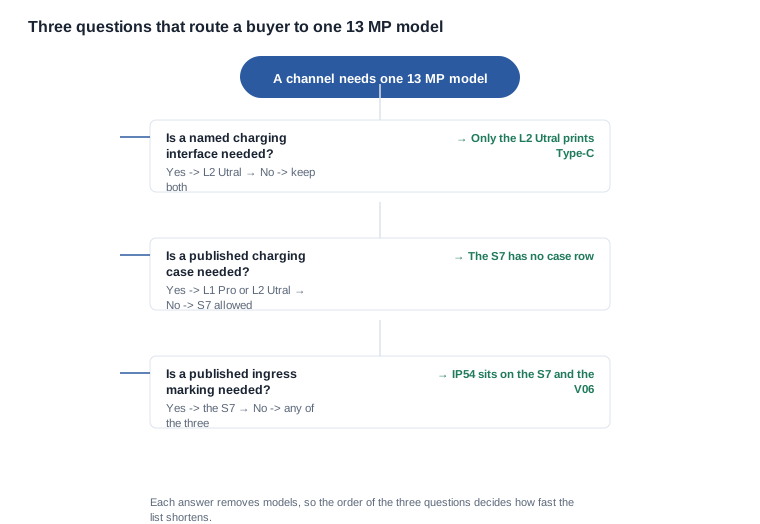
Three questions, asked in order, leave one model standing. The order matters, because each answer removes models rather than adding them, and a channel that has answered all three has already made the decision.
| Your channel | The model that fits | Published basis | What is still open |
|---|---|---|---|
| USB-C only, case in the box | L2 Utral | Type-C interface, 900 mAh or 1400 mAh case | Case availability and pricing by volume |
| A known parcel with one case | L1 Pro | 1400 mAh case, 13 MP, 290 mAh | Charging method, weight, designation |
| Outdoor, wet or dusty use | S7 | IP54 marking, removable inner frame | Ingress report, case row, frame sizes |
| Highest resolution, simplest brief | L1 Pro | 13 MP, no published feature lines | Every row the L1 Pro does not print |
The first question is whether the customer needs a named charging interface, and it has exactly one answer on this tier. The second is whether a charging case must be in the parcel, which keeps the L1 Pro and the L2 Utral in and takes the S7 out until the case question is settled. The third is whether a published ingress marking is needed, and that is what brings the S7 in. A channel that needs all three at once has a problem that no single model on this tier solves, and the honest answer there is to run two SKUs rather than to describe one model as if it carried rows it does not.
Two of these three models often end up in the same range anyway. A channel that wants a USB-C interface for the desk and a protection marking for the field is not looking for one model that has both; it is looking for a two-SKU ladder. On this tier that ladder is the L2 Utral with the S7, with the L1 Pro held in reserve for the brief that only wants the resolution tier. Two SKUs keep the packaging, the instructions and the documentation set narrower than three, and they keep the number of case states you have to manage down to two.
Once a model is chosen, five items remain to be closed before the purchase order, and none of them is a price:
- The model designation in writing, on one line, matching the artwork. On the L2 Utral the catalogue row carries a variant name recorded as Utral and Pro Max, and a designation that differs between a supplier sheet, a carton and a customs declaration creates real trouble at the border and in a warranty claim.
- The charging method for the L1 Pro, if the L1 Pro is the model. No method row is printed for it, so this is the first request on the list rather than an afterthought.
- The ingress test report for the S7, if the S7 is the model, before any protection wording reaches a listing.
- Weight and dimensions for whichever model you have chosen. No 13 MP model publishes either, and the only weight in the catalogue is 158 g for the MT6 glasses unit, which is a different model on a different platform.
- The commercial rows, which are quotation items rather than catalogue rows: unit price, minimum order quantity, lead time, production capacity and warranty terms are not published for any camera model in the range.
A sample round is where the missing rows are actually answered, and it works better as a written protocol than as a demonstration. Decide before the samples arrive what you will measure, what result counts as a pass, and what happens if a sample misses it. For the L2 Utral and the L1 Pro that protocol has to cover the interface in practice, the charge cycle from a stated start state to a stated end state, and the fit across the head sizes your channel actually sells to. For the S7 the protocol has to add the removable frame across those sizes and a water exposure check matched to whatever wording you intend to publish. The consistency side of that work is covered in the AI camera glasses quality checks.
Compliance travels with the model rather than with the family. Where the radio equipment directive applies, the reference is (EU) 2014/53/EU, and where electromagnetic compatibility is the question, the reference is (EU) 2014/32/EU. No per-model certification row is published for the L1 Pro, the L2 Utral or the S7, and no certificate number, issuing body, validity period or covered model schedule appears for any of them, so the file for your destination market has to be assembled before the order rather than after it.
What we will confirm on this tier, and what we will not. The three published rows in each model above are the position we hold and the position we answer against. We will stand behind them in writing for whichever model a buyer selects, and we will not fill an unpublished row with a typical value. A weight the catalogue does not publish stays unpublished, a model with no case row is described as having no case row, and protection wording does not reach a customer page until the report behind it is in the file. Where a row is silent, the honest answer is that it is silent.
Taken together, the tier is easier to buy than it looks, and that is because the catalogue publishes the rows that decide it. The L2 Utral is the model that prints a named interface, the L1 Pro is the model that prints a single known case, and the S7 is the model that prints a protection marking and a removable inner frame. What none of the three prints — weight, dimensions, sensor, storage, certification detail and every commercial row — is common to the whole camera family, and it is what your own sample round and your own written requests have to establish.
Which of those three rows your channel cannot work without is a question we can answer in writing for the model that carries it, together with the list of what still has to be established for that model before an order is placed.
Related reading
- The model beside it on this tier — L1 Pro smart glasses specifications and features
- The model that carries the protection marking — S7 smart glasses specifications and features
- The camera family in one page — AI camera glasses common questions
- The wider selection question — AI camera glasses which model to pick
- The range these models belong to — AI camera glasses


