

A form factor comparison between the L2 Utral and the KY06 has to start from a limitation that applies to both of them, because it applies to the whole camera range: neither page publishes a frame weight, a temple length, a lens dimension or any other measurement of the physical frame. A comparison built on shape would therefore be a comparison built on nothing.
What the two pages do publish is enough for a structural comparison, and the structure is more informative than a set of dimensions would have been. Four rows differ. The camera tier differs, 13 MP against 8 MP. The frame cell differs, 290 mAh against 260 mAh. The charging method differs, and this is the pair that publishes a method on both sides: the L2 Utral names a Type C interface and the KY06 is published as magnetic charging with a charging case. And the case row differs in kind rather than in value, because one page prints two capacities and the other prints none.
Two further rows have to be handled carefully rather than compared. The runtime figures are a point estimate on one side and a range on the other, and a range and a point are different kinds of statement. And the physical dimensions are absent from both pages, so the only way to close them is a sample.
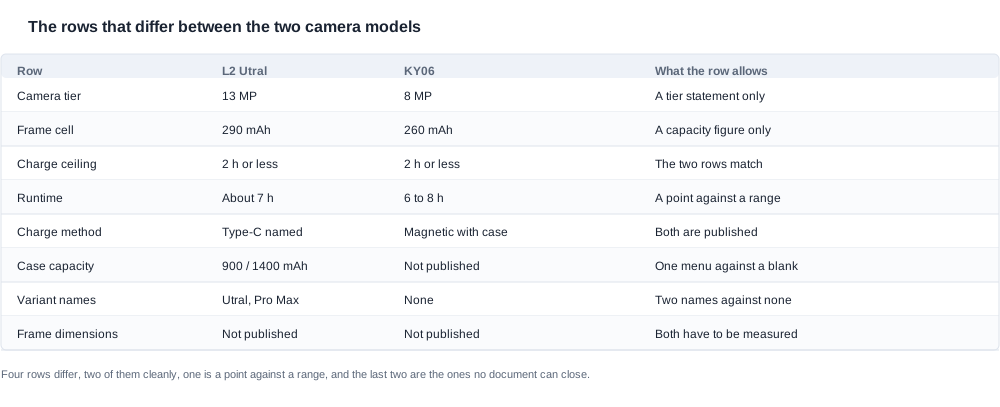
L2 Utral smart glasses vs KY06 form factor: four rows that differ and two that do not
The two rows that match, and why that is worth knowing
The charge-time row is identical on both pages: two hours or less. The runtime row is not identical, and the difference is in the form of the figure rather than in the value. One page publishes a rated figure of about seven hours and the other publishes a range of six to eight hours, and the two are not the same kind of claim even though the seven sits inside the six to eight.
Knowing that the charge-time row matches is useful because it removes one line from the request list. The same question does not have to be asked twice, and asking it once with identical wording produces an answer that can be placed next to the other one.
The rows that differ directly
Two of the four differing rows are direct comparisons, in the sense that both pages publish the row in the same form and the values can be read directly against each other. The camera row reads 13 MP on one page and 8 MP on the other, and in the camera range eight models publish 8 MP while three publish 13 MP. The cell row reads 290 mAh on one page and 260 mAh on the other, and those two figures sit in different groups in the range: four models publish 290 mAh and three publish 260 mAh, with one model at 265 mAh and three more at 220 mAh.
A direct difference is still not a conclusion. A higher pixel figure is a statement about which tier a model sits in, and a larger cell is a statement about how much energy the frame carries, and neither of those statements becomes a statement about the picture or the day without the rows that follow them.
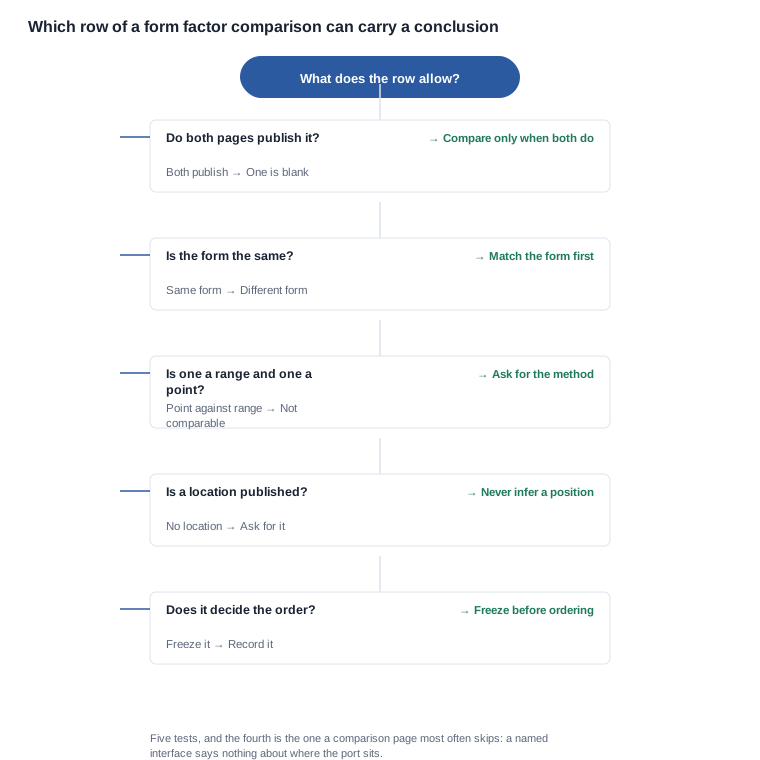
The rows that differ in kind rather than in value
The other two differing rows are not like that. The case row on one page carries two values, 900 mAh and 1400 mAh, while the case row on the other page carries no capacity at all: that model is published as charging with a case, and the size of the case is not published. And the charging row differs in a way that is worth stating precisely, because it is easy to turn into something the pages do not say — the L2 Utral names an interface, and the KY06 names a method, and neither page says where on the product anything sits.
The camera tier and the cell, the two direct differences
Thirteen megapixels against eight
The camera row is the difference a buyer will notice first on a listing, because a pixel figure is legible without any supporting document. In the camera range, eight models publish 8 MP and three publish 13 MP, and the L2 Utral and the KY06 are on opposite sides of that split.
What the split supports is a tier statement. It does not support an image quality statement, because no camera model in the range publishes a sensor model, a field of view, a video format or a frame rate, and a pixel count without a sensor behind it cannot be converted into a picture. The camera and imaging page sets out why the resolution row is an input to an imaging chain rather than an output from it, and the KY06 specification list gives the published rows for that model in full.
Two hundred and ninety against two hundred and sixty
The cell row differs by thirty milliamp hours. That is a real difference and it is a small one, and how much it is worth depends on rows that are not published for either model. Cell capacity sets a ceiling; average power draw decides the outcome; and the draw on a camera platform is dominated by the camera, whose operating state is not published for either model and whose recording behaviour is not published at all.
So the cell row can be stated, and the runtime consequence cannot. A buyer who wants the runtime to decide the comparison has the same task on both models, and the task is to ask how the figure was produced and whether the two suppliers used the same method. If the methods differ, the figures are not comparable in either direction, and that is worth knowing before a figure is quoted anywhere.
Why a direct difference still does not settle a programme
Two direct differences produce two usable distinctions and no verdict. The pixel tier separates the two models on a listing, and the cell row separates them on a specification sheet. Neither of them tells a buyer which configuration to order, how many configurations to carry, or what the delivered cost will be, and those are the questions a form factor comparison is usually asked to answer.
The charging row, which is the one both pages publish
What is actually named
The L2 Utral page carries a feature line naming a Type C charging interface. The KY06 page carries a charging-method row reading magnetic charging with a charging case. Across the camera range, seven models publish a charging method — five on magnetic charging and two on a Type-C interface — and four publish none at all. The KY06 is therefore one of the models whose method is on the page, and this pair is one of the few where both sides can be read directly.
What neither page says is where the interface or the method sits on the product. The pages name a method and an interface; they do not describe a port on a temple, a pad on a frame, a socket on a case or anything else about the physical arrangement. That is not a detail that was missed in transcription; it is a row that was not published, and it is the row that a form factor comparison most needs and cannot have.
The consequence for a buyer is concrete. A visible socket, a magnetic pad and a case that charges the frame are three different objects with three different behaviours, three different accessory lists and three different failure explanations, and the catalogue does not say which of them the two models use. So the question to ask is not which method is better, but where the method is and what a customer needs in the box on the first day.
What the difference changes downstream
The two methods lead to different accessory programmes, and the difference shows up in the carton, the instructions and the support content rather than in the specification. A method that the customer already owns needs nothing extra in the box. A method that needs a supplied accessory adds one item to the packing list and one item to the accessory range. And a case that charges the frame is a different proposition again, because it makes the case part of the charging routine rather than part of the accessory range.
None of that is a comparison of the two models' merits; it is a list of the consequences each method carries, and it is the list a buyer needs before the accessory line is fixed. The charging case options analysis works through the accessory economics, and the materials and ergonomics guidance covers what a sample can settle about the physical arrangement.
Three questions that separate a named method from a described arrangement
A published method name and a described physical arrangement are different things, and only the first of them is on these two pages. Naming a method settles which standard the product works to and therefore which third-party accessories exist for it. It does not settle what the customer has to hold, what has to travel in the box, what a failed charge looks like, or what the support script says when the product does not charge.
The three questions that close that gap are the same for both models, even though their published rows differ. Where the charging arrangement is located on the product, and how the customer connects it. Whether a cable or an accessory has to be supplied, and if so which one. And what the product does when the connection is not made properly, because a method that fails silently and a method that fails visibly produce very different support volumes and very different instruction pages.
Why to ask all three rather than the first one alone is straightforward: a buyer who knows the method but not the arrangement can plan the accessory range and still get the box contents wrong, and the box contents are the thing that is printed before the first production run. The criteria for the answer are simple, and the answer is a single line in a supplier's reply rather than a document.
The order in which to close this comparison
The sequence matters more than the number of questions, because this pair has two different kinds of gap and they have different deadlines. The first step is to fix what the pages already settle: the camera tier, the cell figure, the two published methods and the case menus. That gives a comparison note that can be circulated immediately, with the open items listed rather than merged into the published rows.
The second step is the shared request, because the five questions that apply to both models close more of the comparison than any of the model-specific items. The endurance method in particular decides whether the runtime row can be quoted at all, and asking it identically to both suppliers is what makes the two answers comparable.
The third step is the model-specific items, and they have to be sent in the same message, because a supplier who answers the charging question for one model and the case question for the other in two replies has still left the comparison half-built. The fourth step is the sample, and it is the only one that closes the physical rows: the weights, the dimensions and the charging arrangement. The criteria for the sample stage are the same as for any other model, and the buyer checklist for the KY06 is the one that applies to the model whose page has the fewest published rows.

The case, where one publishes two values and the other publishes none
A capacity that was not published
The L2 Utral publishes two case capacities in one row. The KY06 is published as shipping with a charging case and carries no capacity for it. Across the range, five models publish a case capacity, two name a case without publishing its size, and four carry no case row at all.
The temptation with a blank is to fill it from a neighbour, because most of the camera family publishes 1400 mAh and the blank would otherwise resemble an omission. That inference would be wrong in exactly the case where it matters, and it is wrong in a way that is invisible afterwards, because a filled-in capacity on a purchase order behaves like a published fact.
So the row on that side stays blank in any comparison document, and becomes a question instead: what is the case capacity, whether a second capacity is available, what the case weighs, and how the case itself is charged. The KY06 buyer checklist turns those into a sample-stage sheet, and the L1 Pro against the KY06 comparison applies the same method to the same model from a different side.
Why the difference in kind matters more than the numbers
The two case rows are not a difference of value, and they are not directly comparable. One page gives a buyer a menu, and the other gives a buyer a task. A menu can be costed against a configuration; a task has to be closed before anything can be costed, because the capacity decides the carton, the freight class and the accessory list all at once.
That asymmetry has a practical effect on a comparison document. Where one model publishes two capacities, the note has to say that the two names printed beside them are not matched to them, and where the other publishes no capacity at all, the note has to say that the capacity is an open item rather than leaving the cell blank. A blank cell and a filled cell mean different things, and a reader who cannot tell them apart will read the second as the first.

The runtime row, where a point estimate meets a range
Why seven and six to eight are not the same kind of number
The L2 Utral publishes a rated endurance of about seven hours. The KY06 publishes six to eight hours. A point estimate and a range are different kinds of statement, and the comparison has to keep them apart rather than placing them in the same column and calling the higher one the better figure.
There is a second reason the row cannot be read straight across, and it is a detail of how the catalogue is laid out rather than of the two models. On one page the endurance figure sits under a row labelled with the charging time, and on the other it sits under a row labelled with the endurance. The values are the values, but a row that is copied across the range by its label can carry the wrong number with it, and a buyer reading two pages side by side has to read the values and not the labels.
What to ask, then, is the same on both sides and in the same words: what the figure was measured with, in what state, at what volume, with the camera recording or idle, over how many units, and from what state the charge cycle started. A single answer from each supplier, asked identically, is what makes the two figures comparable — and if the answers differ in method, then neither figure settles anything.
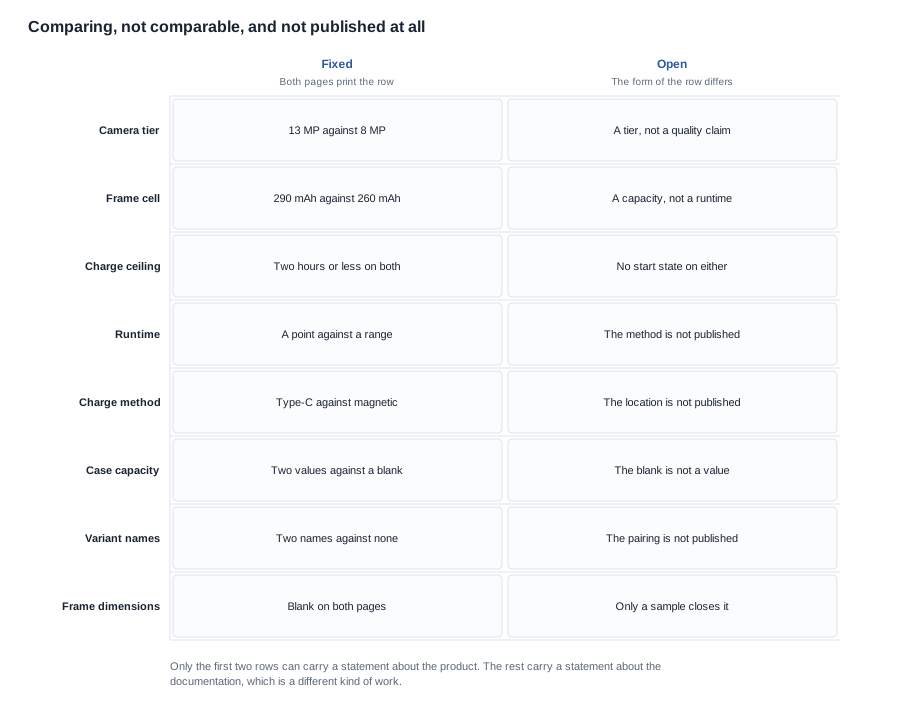
What a sample has to settle, and what a supplier has to answer
The measurements that only a sample can close
The physical rows are absent from both pages, so they are closed by measurement rather than by a request. Weigh both frames with the cells fitted and record the state. Measure the temples and the lenses with calipers and note the temple cross-section. Record where each model's charging arrangement actually sits, since neither page says. And on the model with the magnetic method, test the docking deliberately by misaligning it, and confirm whether a customer can tell that it has not seated.
Those four measurements are the whole of what a form factor comparison can add that a catalogue cannot, and the method matters more than the numbers: the same measurement taken on two units from different production runs tells a buyer something about consistency that a single sample cannot.
The questions that belong in one message
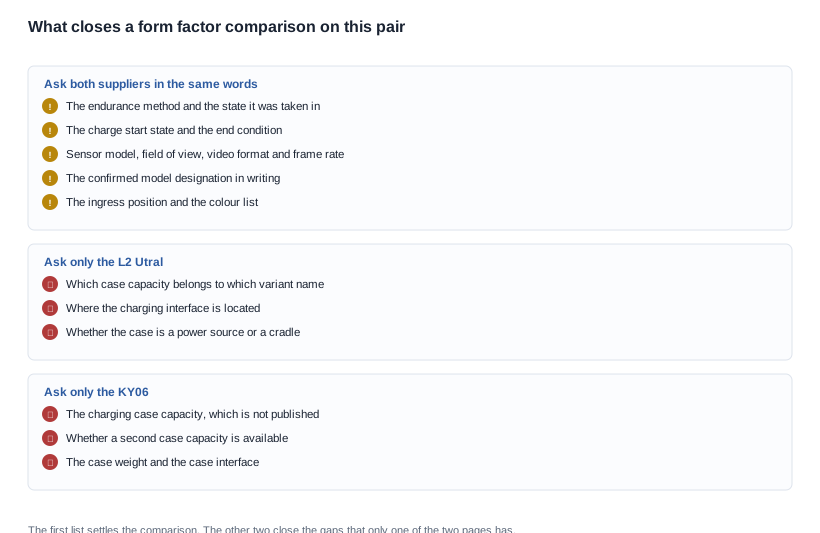
Five questions apply to both models and should be sent with identical wording: the endurance method and the state it was taken in, the charge start state and the end condition, the sensor model, the field of view, the video format and the frame rate, the confirmed model designation in writing, and the ingress position together with the colour list.
Three questions belong to the L2 Utral alone — which case capacity belongs to which of the two printed names, where the charging interface is located, and whether the case is a power source or a cradle. Three belong to the KY06 alone — the charging case capacity, whether a second capacity is available, and the case weight and interface. Sending them together matters, because a buyer who asks for them separately will receive them separately and will end up assembling a comparison out of partial replies.
What we will and will not state
This pair can be compared on four published rows and on nothing else, and the two rows that most often get compared are the two that cannot be. We will state the two case capacities, the cell figures, the two published charging methods and the camera tiers on one page, the absence of a case capacity on the other, and the two variant names printed beside the first pair. We will not state a case capacity for the model whose page does not publish one, we will not describe where either charging arrangement sits, and we will not present a point estimate against a range as though one of them were the larger figure.
We will also not quote a price, an order minimum, a lead time or a certificate number, because the catalogue publishes none of them for either model, and a comparison that needs one of those is a comparison to be made against a written quotation rather than against two catalogue pages. Send us the channel, the volume and the destination market, and we will tell you which of the four rows decides your programme and which of the open items a single reply closes. The AI camera glasses range page carries the full family.
Related reading
- The same comparison method on the other platform — L1 Pro against the KY06
- The buyer-side check for the KY06 — KY06 buyer checklist
- How to measure a frame once you have it — materials and ergonomics


