
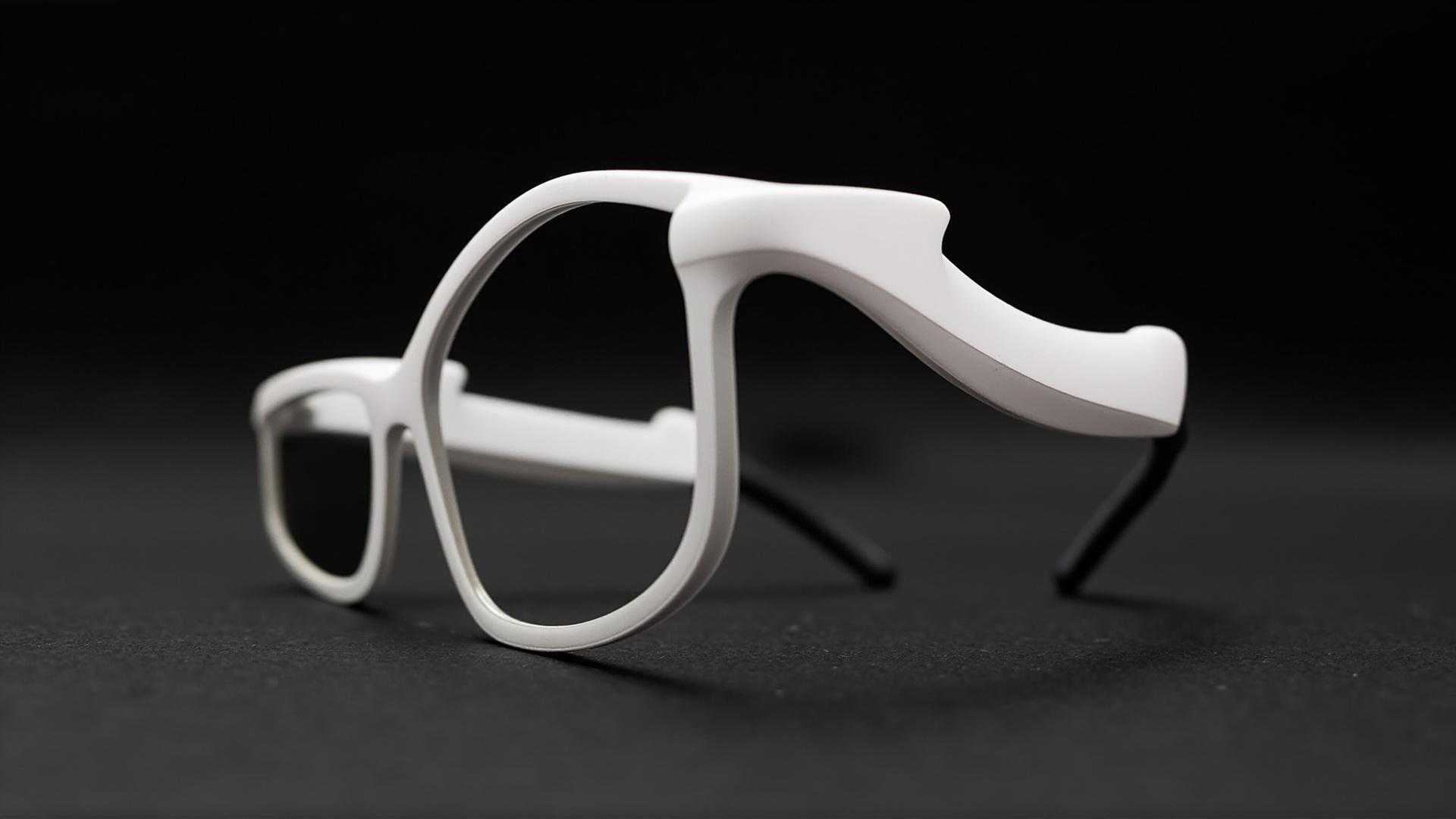
Neither of these two camera models publishes a frame weight, a temple length, a lens dimension, an adjustment range, a head-size band or a description of what its temple does. There is no published form factor for either one to be compared against. A comparison that pretends otherwise ends up telling you less than the specification sheet does, so the useful question is a different one: with form undocumented on both sides, what can still be compared, and how do you protect the programme from the gap?
The answer is that the form decision stops being a document decision and becomes a sample decision, while the specification comparison turns into a shorter list than most buyers expect. There are still six published rows to work with, and they differ in ways that matter: the two models sit on different camera classes, they carry cells of different sizes, one of them publishes a charging case capacity while the other publishes only the existence of a case, and exactly one of the two names a charging method at all.
So this is a comparison with a result. What follows sets out the published rows exactly as they stand, shows where the two models sit among the camera models in this catalogue, and then gives the sequence that converts an undocumented form factor into a decision you can defend — including which parts of that sequence are measurements, which are observations, and which are questions that have to be put in writing.
L1 Pro vs KY06 form factor: the problem stated plainly
A form factor comparison normally starts from three inputs: the dimensions of the frame, the weight, and a description of how the frame sits on a face. All three are absent for both models here. What remains is a specification sheet, and a specification sheet is the wrong document for the question a buyer is actually asking when the words "form factor" appear in the request.
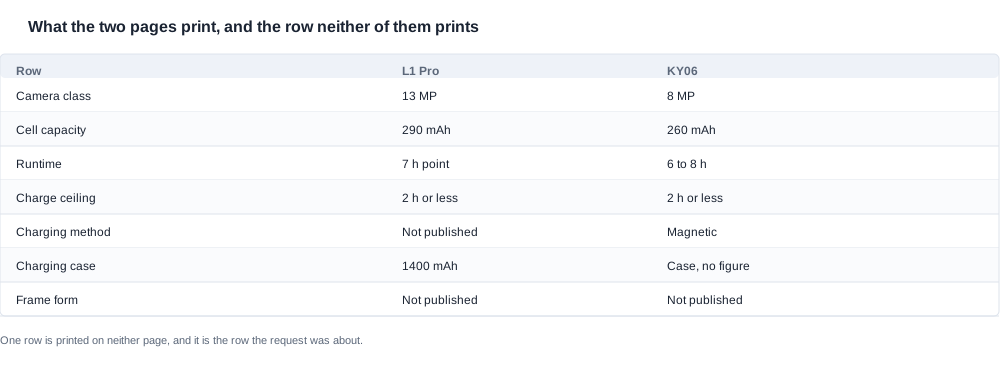
The chart above makes the shape of the problem visible. Six rows are printed on each page, one row is printed on neither, and that missing row is the one the request was about. Each of the six printed rows is real evidence and can be quoted today; none of them tells you how the frame fits.
The two entries are not symmetric, and the asymmetry is the useful part. One page carries the charging case row — a 1400 mAh figure — and leaves the charging method row empty. The other names magnetic charging with a case, and prints no capacity for that case at all. So on each side, one row is present and the other is missing, and they are missing in opposite places: a specification you can quote against a specification you can only request.
A comparison chart with a form factor row that says "not published" on both sides is not a failed chart. It is the accurate representation of what a buyer holds in their hands, and it converts an argument about shape into a work plan with named owners. That is the entire purpose of this page: the gap is real, it is predictable, and a predictable gap can be budgeted into a sourcing schedule, whereas an unpredictable one cannot.
There is one further silence worth naming before anyone starts the work. Neither model carries an ingress marking, although two other camera models in this range do carry an IP54 rating, so the absence is a property of these two pages rather than of the category. For an outdoor or sports-facing channel that is not a cosmetic omission; it is the row that decides whether the product can carry a protection claim at all.
What the two pages still allow you to compare
Six rows are published on these two pages, and each one is a real signal even though not one of them is about shape. The camera class is the widest, the cell difference is narrow, the runtime difference is wider than the cell difference, the case is the commercially consequential one, and the charging method decides what arrives in the parcel.
The camera class is the widest published difference. Thirteen megapixels against eight. As with every camera product in this range, the sensor behind them, the angle each camera looks through, the recording format and the frame rate are all left off both pages, so the difference cannot be shown on paper to produce a better image. If image quality drives the decision, it has to be settled with two units in hand, a fixed list of scenes and one lighting condition. The camera imaging notes list what a fair side-by-side test has to hold constant.
The cell difference is narrow and the runtime difference is wider than it. One model carries 290 mAh and the other 260 mAh — a gap of roughly eleven per cent — while the stated endurances are about seven hours against six to eight hours. Those two runtime figures overlap. That tells you two things at once: cell capacity is not the variable driving the outcome, and the figures were produced under conditions a reader cannot see. The how to evaluate question for runtime is therefore not which number is larger but whether the two were measured the same way, because a six-to-eight-hour range and an approximately seven-hour rating are two different ways of stating a result and only one of them is a range.
The case is the most consequential difference and the least clean one. One side publishes a 1400 mAh charging case. The other is published as shipping with a charging case but prints no capacity for it. That is a specific, answerable question: what does the case hold, and is a second capacity offered? A 1400 mAh case and an unknown case are not two comparable accessories — one is a specification and the other is a parcel you have not costed. The total cost of the two configurations cannot be compared until the second number arrives.
The charging method decides the accessory set, and only one side names it. The KY06 prints magnetic charging with a case. The other prints a case capacity and no method at all, so the connector or contact arrangement that goes in the box is unknown, and everything that depends on it — the dock, the cable, the spare stock, the line on the packing list — cannot be specified from a catalogue. Four camera models in this range publish no charging method, and this model is one of the four.
And the platform difference is invisible and still real. On the published evidence these are two separate platforms rather than two finishes of one product: different camera classes, different cells, different charging arrangements and different case states. A private-label programme built on one does not transfer to the other by assumption, and a comparison that treats them as variants of a single platform is comparing something that has not been documented. The camera glasses range is where the other nine models sit for comparison.
Two pitfalls sit inside the published rows themselves and are worth naming. The first is treating the eleven per cent cell gap as a battery advantage when the two endurance figures overlap. The second is reading the existence of a case as evidence of what that case can do. A trade-off read honestly from this pair is a wider camera class and a stated case capacity on one side against a named charging method and an unstated capacity on the other, and which side a programme can document decides how far it gets without a sample unit.

Where both models sit among the camera models
Both of these are camera models, and the camera category in this catalogue holds eleven of them: the L2 Utral and the CY03, the V03 and the V03 Pro, the L1 Pro and the MT6, the CY05 and the V06, the S7 and the KY06, and the MT5. Neither of the two under review sits outside that group, and both sit inside it in a way that is worth knowing before any request goes out.
The camera class splits the group eight against three. Eight of the eleven publish an 8-megapixel camera and three publish thirteen: the S7 and the L1 Pro, and the L2 Utral. The KY06 is in the eight. A comparison that treats the pair as a standard model and an upgraded model is one the catalogue only partly supports, because the class companions of the higher tier are two named models rather than a general band.
The cell sizes fall into four bands, and the two models sit at the top and the middle. The 220 mAh band holds the V03 and the V03 Pro, and the MT5. The 260 mAh band holds the S7 and the KY06, and the V06. The 265 mAh cell belongs to the MT6 alone. The 290 mAh band holds the L1 Pro, the L2 Utral and the CY05, and the CY03, and every model in that band states a charge ceiling of two hours or less and an endurance of about seven hours.
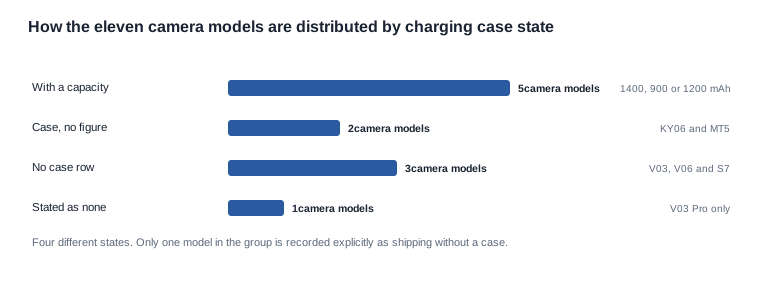
The charging case exists in four different states across this group, and they are not interchangeable. Five camera models publish a case capacity. Three of them print the same 1400 mAh figure, one gives two options between 900 and 1400 mAh, and one gives 1200 mAh for a folding case. Two publish a case with no number attached, and the KY06 is one of them. Three print no case row at all — the V03 and the V06, and the S7 — which is a different statement from the fourth state, the V03 Pro, which the catalogue records explicitly as shipping without one. These two models sit on opposite sides of the only distinction the catalogue draws here: one has a case of a stated capacity, the other a case whose capacity nobody has published.
The charging method splits three ways as well. Across this group of camera models, magnetic charging is named on five units, a Type-C port on two, and no method at all on four — the MT6 and the L1 Pro, and the CY03 and the CY05 among them. All four of those publish a case capacity, and the reason is structural rather than accidental — when the interface is not documented, the case is what the catalogue records instead. The KY06 publishes magnetic charging and belongs to the group whose own case capacity is missing.
Only a handful of the eleven carry any line that touches the shape. The V03 Pro is published with a flexible temple and photochromic lenses. The MT6 is published as portable and ultra-light with a folding charging case. The V06 and the S7 are published with an ergonomic design, a removable inner frame and an IP54 marking, and the L2 Utral is published as two named variants with a Type-C port. Neither model in this comparison appears on that list, and neither do the V03 and the CY03, and the CY05 or the MT5. The silence is therefore a fact about these two pages and not a house style, because the catalogue does describe the shape of a camera frame when it has something to say about it. For these two it has nothing, and the one weight figure published anywhere in the range belongs to the eyewear body of a third model, which is why it cannot stand in for either of them.
How to close the form factor gap yourself
Since the documentation will not do it, here is the sequence that produces a usable answer. The order matters more than the list, because three of the steps are measurements, two are observations, and two further questions belong in a written request rather than in a measurement session.

- Ask the two questions that only a supplier can answer, in one message. What capacity does the case hold on the model that publishes magnetic charging, and is a second capacity offered? What connector or contact arrangement does the model that publishes a case capacity use to charge, and does the case recharge from the same input? These are answerable in a single line each and they are the two rows that block the accessory list.
- Weigh the frames yourself, without the case, on your own scales. One figure per model is worth more than anything a catalogue could have printed, and the number you get becomes a number you own. The sample request route is the right instrument when the answer is a measurement rather than a document.
- Measure temple length and lens dimensions with calipers and record them. These are the figures your own fit data needs, and no supplier document currently holds them. Record two or three units rather than one, because the spread is the part that matters for a fit guarantee.
- Test both frames on the head shapes your customers actually have. A frame that suits an average head is not the same as a frame that suits the range of heads in your market, and this is the point where a purchase order either survives or becomes a return statistic.
- Check the lens and temple alignment yourself. A camera product's frame has to hold its alignment, because a misaligned lens changes the field of view the camera captures — a property of the frame rather than of the sensor, and therefore exactly the kind of thing a form factor comparison has to settle.
Three of those steps produce a number and two produce a description, and that difference decides what goes on the sheet. A measurement has a unit, a number of samples and a spread, which makes it usable as an acceptance criterion. An observation has words, which makes it usable in a listing but not in a purchase order. A sheet that mixes the two without marking which is which is a sheet that will be argued about at the first delivery, and the how to verify rule is simple: label every line as either measured or observed, with the sample size next to it.
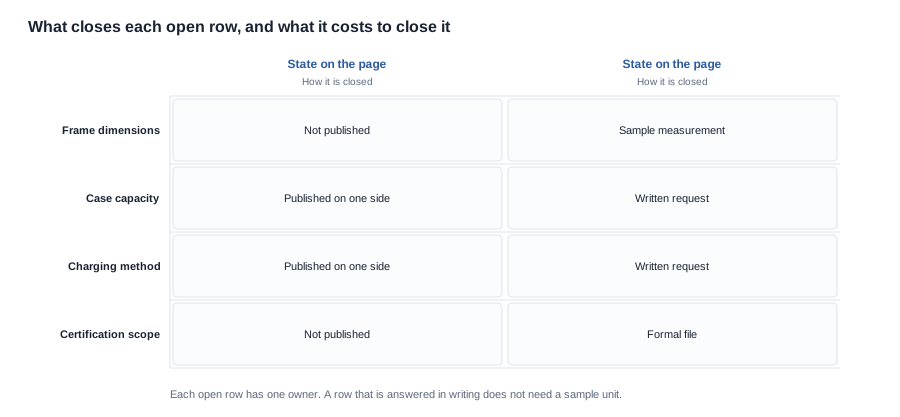
The matrix above sets the same work out by row rather than by step, with the closure method named for each one. Read across it and the pattern is plain: two rows close in an email, one closes on a bench, and one closes in a formal file that has its own lead time.
Two questions are better asked in writing than measured at all, and one item cannot be closed by either route. The case capacity and the charging method are document questions, and they should be addressed to a model designation rather than to a family, because the two models answer differently. The certification scope is a third kind of item: an absent document is not something a sample unit or a well-worded request substitutes for, so it belongs on the programme plan as a date rather than as a task, and it is the item most likely to decide whether the programme lands on time. The certification checklist is the instrument for it.
The commercial terms are a fourth category, and they are the ones nobody can read off a catalogue page. Price, minimum order quantity, lead time and warranty are not published for either model, and a due diligence file that leaves them blank is not a file that survives a finance review. Asking for them in the same message as the two technical questions costs nothing extra.
And a sign that the gap is being managed rather than absorbed is simple: the measurements have names and dates attached to them. A gap register that says "dimensions pending" for three months is an unmanaged gap; a register that says "temple measured on three units, mean and spread recorded, one request outstanding" is a closed item. The IP ratings note and the battery life guide cover the two rows on these pages that a sample unit cannot answer.
Before you order, decide which model your fit data has to describe. A range programme sold across several head sizes needs measurements on more units than a single-market programme, and the sample budget follows from that decision rather than the other way round. The shortlist criteria to agree internally are simple: the head-shape range you intend to serve, the case proposition you intend to include, and the number of units you are willing to hold for fit testing.
Where CYNRIN stands on the L1 Pro and KY06 form factor
These are two separate platforms rather than two finishes of one, that the published rows make the camera class the real decision, and the form factor is genuinely undocumented for both sides. We would rather tell you that the shape is unknown than infer it from a difference in battery capacity.
We will also say the harder part: a product whose weight, dimensions and temple are not published is a product you should be sampling rather than ordering on a specification sheet. That is not a criticism of either model. It is a statement about what a specification sheet can and cannot tell you, and it is the same statement that applies to every camera model in this catalogue.
What we will not do is carry a gap across from a neighbouring model. Nothing in the catalogue says magnetic for this model, and nothing says Type-C either: the silence it shares with three other camera models is not evidence of either interface. The one weight figure published in the range describes a different model's frame, and the IP54 marking carried by two other camera models is not a marking for either of these. Any of those would put a statement on the paperwork that nobody has checked against the product you are actually buying, and that is how a specification file turns into a document your customer disputes.
What we will not do is pretend the two gaps are the same size. The case capacity is one line in a message. The form factor is a measurement session. Treating them as one item on a request list is how a programme ends up with a sample unit in one hand and no fit data in the other, and the checklist that prevents it is short: name the measurement, name the owner, name the date.
What we can close, and how, is straightforward. The case capacity for the KY06, the charging method for the L1 Pro, the dimensions and the weight for both, the certification scope for both and the commercial terms for both are all questions with answers behind them, and the way to get them is one written request plus one sample unit per model. The KY06 buyer checklist and the charging options note are the documents that sit behind two of those answers, and the L1 Pro versus V03 Pro comparison shows what the same platform's published rows look like from the other side of the range.
And a word about who this is written for. The reader behind most of these questions is a brand buyer or a distributor assembling a procurement file, not an engineer with a catalogue open for curiosity: the e-commerce listing copy, the packaging artwork, the freight class, the supplier quotation and the purchase order all have to land on the same date as the unit that arrives. That is why the sequence above is written the way it is — one written request for the buyer, one sample unit for the buyer, and a procurement file that can be handed to a finance reviewer without a page of caveats attached. The sample request route is where that file starts, and the sport camera range is worth a look if the outdoor channel is the reason the form factor mattered to you in the first place.
And the how to choose question that survives all of that is a question about your own programme rather than about the two models. One is documented further than the other on the case row, and the other is documented further on the charging method row; neither is documented on form. Until that is closed by measurement, any shortlist you write should carry the open row on its face rather than in a footnote, because a footnote is where a form factor gap goes to disappear.
Related reading
- The same higher camera class laid out as rows — L1 Pro versus V03 Pro comparison
- How the second platform behaves in use — KY06 smart glasses compared
- The pairing seen from the other platform — V03 Pro versus KY06 form factor
Send us the channel, the volume and the head shapes you sell to, and we will come back with which of the two platforms fits and which of the open rows we can close for you.


