
A buyer searching for ky06 smart glasses specifications and features usually wants one table that ends the conversation. The catalogue row for this model does not end the conversation, and understanding why that is the case is more useful than a longer table would be.
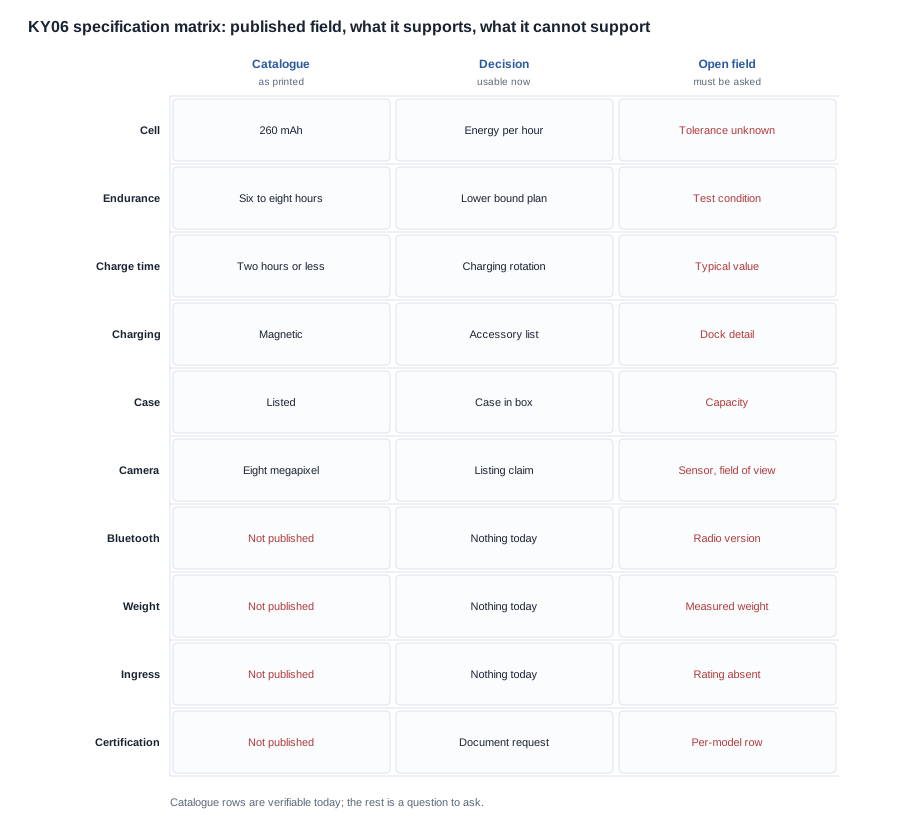
The KY06 is published as an AI photography and sport camera glasses model. The catalogue prints six entries for it: a 260 mAh cell, a rated endurance of six to eight hours, a charge time of two hours or less, magnetic charging together with a charging case, and a camera recorded in the eight megapixel resolution class. Bluetooth is listed as not published. Everything else a specification sheet normally carries — weight, dimensions, colours, lens material, ingress rating, sensor, field of view, frame rate, video format, storage arrangement, radio version, model-level certification — is absent for this model, and largely absent for the models around it.
This article does three things with that gap. It sets out exactly what the published row contains and where it stops. It lists the features this model is routinely assumed to carry and shows that they sit on other models in the range rather than on this one. And it converts the published row into a configuration sheet that a buyer can take to a supplier, a factory and a purchase order, with every missing field turned into a written question instead of an assumption.
The reader is a brand buyer, a channel partner or a sourcing manager. Each of them needs the same first artefact: a baseline they can verify without asking anyone. That baseline is the published row. Everything after it is either a question to ask or a commercial term to negotiate.
What the catalogue publishes for the KY06
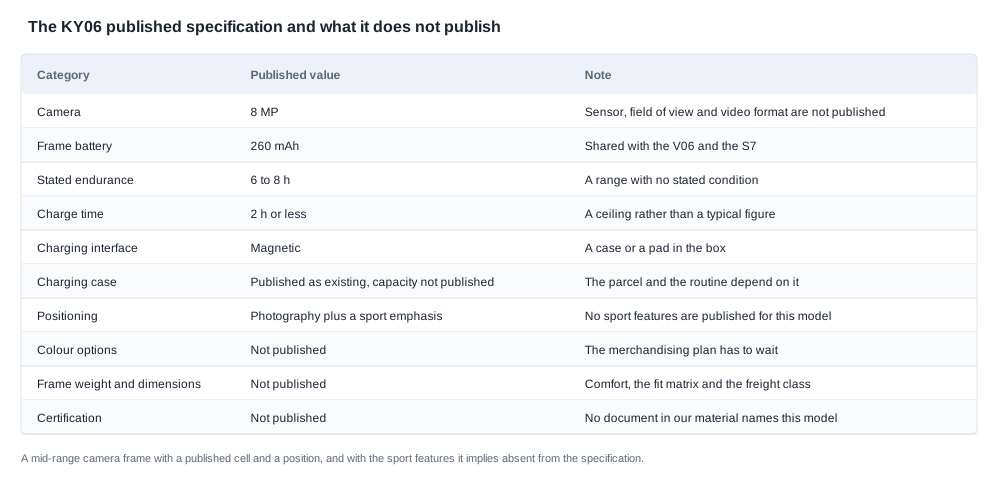
The catalogue publishes this model in one row of the camera glasses section, and that row has six entries. Read them as a set of facts with different weight rather than as a finished specification sheet.
-
Cell capacity: 260 mAh. A single number with no tolerance attached, which makes it the most directly usable figure on the row and the easiest to plan a spare-unit policy around.
-
Rated endurance: 6 to 8 hours. A range rather than a point. The disclosure is better than a single figure because it says more than one condition was measured, and it is worse than a single figure because the condition itself is not printed.
-
Charge time: 2 hours or less. A ceiling, not an average. The wording places a bound on the number rather than promising a value, and a buyer who treats it as a promise is reading a limit as a result.
-
Charging method: magnetic, with a charging case. Two separate facts in one entry. The method is published, so the interface is settled. The case is listed, so it exists, but no capacity is printed for it, which leaves the most useful number on the entry unavailable.
-
Camera: the eight megapixel resolution class. A class rather than a sensor sheet. It tells you what resolution family the product belongs to and nothing about the optics, the sensor, the frame rate or the storage.
-
Bluetooth: not published. The entry exists and the value is empty. This is an explicit absence, and it matters more than the other gaps because radio version decides pairing behaviour, accessory compatibility and certification scope.
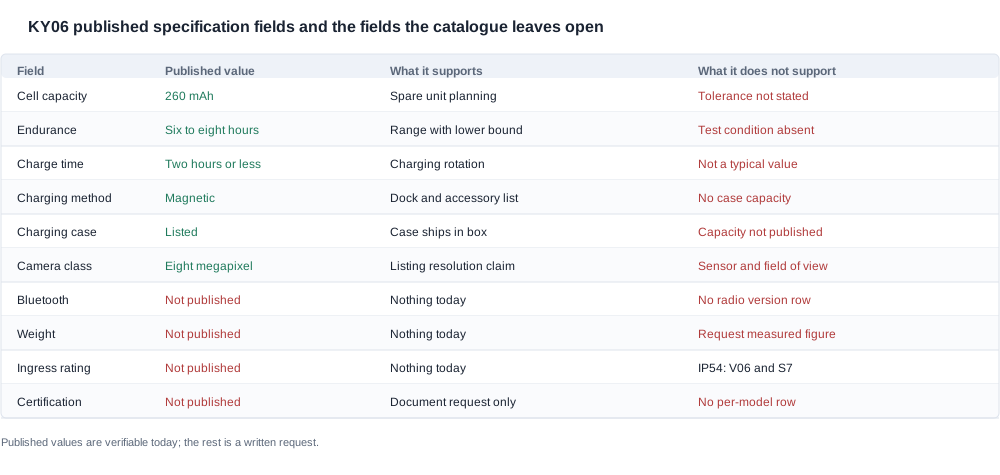
The structural point is that the first three entries are numbers a buyer can put straight into an energy calculation, the fourth is an interface, the fifth is a capability class, and the sixth is an absence. Published specification pages normally compress those categories together, which is why a row like this is frequently over-read. A model with a published cell and a published charging method does not, by implication, have a published weight, a published ingress rating or a published certificate.
The certification position, read precisely
The certification entry is the one most likely to be misread, in either direction, so it is worth stating exactly what the catalogue contains.
The export certification page in the catalogue is a company-level page. Its content is images rather than text, and it carries ten patent certificates — eight appearance-design patents and two utility-model patents. Those documents describe industrial design rights and utility models. They are not market-access approvals, and they do not attach to any individual model. The catalogue text contains no occurrence of CE, FCC or RoHS, and there is no per-model certification row anywhere in the camera section for any of the eleven models listed there.
The consequence for the KY06 is precise. Its certification position is not published, and its compliance position for any destination market is a document request rather than a claim you may repeat in a customer file, a listing, a tender response or a channel sell sheet. It is not a defect in the model, and it is not evidence that the model lacks approval either. It is a gap in the public record, and the only way to close it is a written request for model-level documentation from the factory, answered per destination market.
What the surrounding models publish, and why it is useful
The gap on this model only becomes legible against the rest of the catalogue, because the camera section is consistent about what it prints. Across the eleven camera models, the cell figures fall into four groups: four models publish 290 mAh, three publish 260 mAh, three publish 220 mAh and one publishes 265 mAh. The endurance figures fall into three shapes: about seven hours for five models, six to eight hours for two, and five to eight hours for four. The KY06 sits on the 260 mAh tier with a banded endurance figure, which is a middle position on both axes rather than an extreme on either.
Weight is the sharpest illustration of the gap, because exactly one camera model publishes one. The MT6 publishes 158 grams for the glasses themselves, excluding its folding charging case, and it is the only model in the section with a published weight at all. There is therefore no derived figure for the KY06 either: you cannot infer a weight from a neighbouring model, because frame construction, battery volume and case design all vary independently, and the catalogue gives you no relationship between them.
Ingress protection follows the same pattern. The IP54 marking appears against the V06 and the S7 and against nothing else in the camera section. The KY06 publishes no ingress rating, so the honest entry for it is not published, and a copy writer looking for a protection line for a sport camera model has to find it somewhere other than this row.
The charging case is the third pattern, and it is the one that changes purchasing arithmetic. Across the camera section the case answers take four distinct forms. The CY03 and the CY05, and the L1 Pro each publish a 1400 mAh case. The L2 Utral publishes two options, at 900 mAh and 1400 mAh. The MT6 publishes a 1200 mAh folding case. The KY06 lists a case with no capacity published, which puts it in the group of two models that have a case but no figure for it, as distinct from the three models that publish no case row at all and the one model has no charging-case row.
So the KY06 is not an undocumented model in a documentation-poor catalogue. It is a mid-range model in a catalogue whose camera section publishes a consistent, comparable, deliberately narrow row — energy, charging method, camera class — and hands everything else to a quotation and a technical file.
The specification row and what a buyer can build from it
Once the row is read as a set of usable and unusable facts, it becomes genuinely constructive. Each entry supports one part of a purchase decision and refuses to support another, and knowing which is which is most of the work.
The cell and the band, held side by side
Two of the published entries describe energy, and they answer different questions. The cell figure says what is available per charge, which determines how often the bench runs and how the spare-unit policy is set. The endurance band says how long the unit works per charge, which determines staffing and how many units a kit needs. Only the two together let you reason about energy per working hour, and that is the number a shift plan actually consumes.
The two entries also carry different risk. A model publishing about seven hours invites a straightforward promise, because there is one number to repeat. A model publishing six to eight hours invites a promise with a band around it, and the band has to be explained to whoever receives the product. The discipline that follows is short: plan on the lower bound, write the lower bound into anything a customer or a channel partner will read, and treat the upper bound as the good case rather than as the promise. The method for comparing endurance figures across the range covers the comparison rules, and the endurance note for this model covers the behaviour behind this particular band.
Charge time, and what magnetic charging fixes
Two hours or less is a ceiling. The number tells you the unit will be ready within a bound, which is enough to design a charging rotation, and it does not tell you how long it takes in a warm room or with the case closed. Treat it as a ceiling in the model and a ceiling in the copy.
Magnetic charging is the more consequential entry, because it is an interface decision with commercial consequences. Magnetic means a dock rather than a cable and a socket, which fixes the accessory list, the spare-parts plan, the packing design for a set, and the consumables budget for a channel partner who stocks spares. It also means the charging case is part of the product rather than an accessory, and a case with no published capacity is a parcel question that stays open until the factory answers it. The charging case options analysis covers the accessory economics across the range, and the shipping weight breakdown covers what the parcel looks like once the case is in it.
The camera class and what it licenses you to write
The eight megapixel class is the only camera figure published for this model, and its commercial value is that it defines what may be written in a listing without qualification. It is also where the cost of a wrong decision hides. Anything a customer needs that sits outside the resolution class — a particular field of view, a particular frame rate, a particular file format, a particular low-light behaviour — cannot be established from the catalogue at all, for this model or for any of the other ten in the section. The camera section publishes no sensor model, no field of view, no frame rate, no video format, no storage configuration and no stabilisation note for any of its eleven models, so this model is no more exposed on those points than its neighbours. The camera imaging notes explain why the sensor and the field of view are the two numbers that decide whether a camera glasses product works for its purpose, and why their absence cannot be substituted with the resolution class.
The radio entry and the claim it blocks
Bluetooth is published as not published, and the camera section publishes no radio version row for any of its models. That is a narrower gap than it first appears, because a buyer who never claims a radio version is not exposed to it. The exposure appears in two places: in a specification annex that promises a pairing profile, and in a certification scope, where the applicable radio rules are determined by the version and the market. Both are closed by the same written request, and neither is closed by inference from a neighbouring model.
The claims you can make today
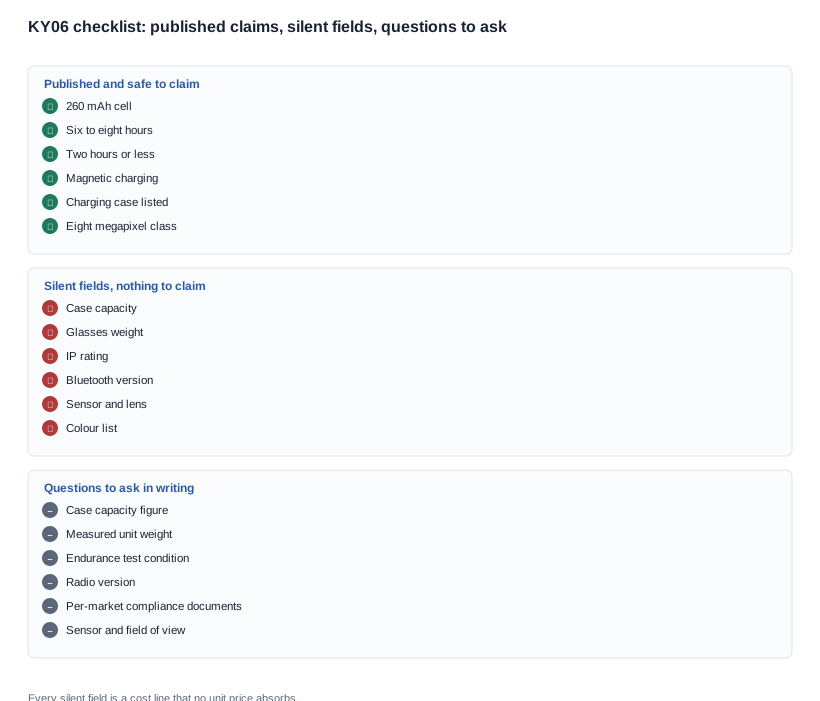
Put the six entries together and the claim set is small but defensible. You may state the cell capacity as published. You may state the endurance as a six-to-eight-hour range, using the lower bound in any operating commitment. You may state a charge time of two hours or less. You may state magnetic charging and the presence of a charging case. You may state the camera resolution class. You may not state a weight, a case capacity, an ingress rating, a radio version, a colour, a dimension, a lens material, a sensor, a field of view, a frame rate, a video format, a storage arrangement or a certification status for this model, because none of those is on the row.
That is not a thin claim set for a mid-range product. It is a claim set that can be defended in a claim, in a listing, in a tender response and in a channel agreement without a single footnote, because every number in it is printed. The weakness is not in what you can say. It is in the temptation to add a sport line, a protection line or an eight-hour runtime to make the listing read better, and in the risk that arrives later as a return.

The features that are not in the published row
A published row generates assumptions, and this model generates more than most because its catalogue name places it in photography with a sport emphasis. Sport positioning invites three specific assumptions: that the frame resists sweat and splash, that the frame is engineered for a secure fit during movement, and that the camera records reliably while the wearer is moving. None of those three is on the published row for the KY06.
The sport features that live on the neighbouring models
The two sport camera models in the section do publish a sport feature set. The V06 and the S7 publish the IP54 marking, the ergonomic frame and the removable inner frame. The KY06 publishes none of them. That means the sport half of this model's description is a positioning statement rather than a documented feature set, and a listing that treats it as a feature set inherits the difference without knowing it. The sport water resistance options analysis covers what the marking means in the places where it is actually published, and it is worth reading before any protection language is reused near this model.
The absence is not a defect and it is not disqualifying. A product that makes no protection claim and no fit claim is a simpler product to qualify and a simpler product to sell, because there is nothing in the public record for a customer to check and find missing. In a channel where the evidence is genuinely hard to obtain, that simplicity is worth something.
The control surface, the audio and the language rows
Three further rows are worth naming explicitly, because each is a feature a buyer will assume is present on any camera glasses product and each is simply absent from the catalogue for this model.
Controls. No model in the catalogue publishes a capacitive touch row. The only product that publishes a control line is the AR product, which publishes an indicator light and a button control line. So the KY06's control surface is not published: whether the camera is triggered by a button, by touch, by a companion app, by voice or by a combination is a question, not a specification.
Audio. Surround sound is published for one model in the range only, and the KY06 is not that model. No audio capability of any kind may be claimed for it.
Language. There is no translation row anywhere in the catalogue, so a translation feature cannot be claimed for this model or for any other in the range.
The complete gap list for this model
Consolidating the section, the fields that a buyer will look for and will not find published for the KY06 are the charging case capacity, the weight of the glasses and of the case, the dimensions, the colour list, the lens material, the sensor and the full video specification, the field of view, the frame rate, the storage arrangement, the radio version, the ingress rating, the endurance test condition, and the model-level certification position. The limitations analysis for this model sets out the gap set in full, and the buyer review checklist covers the comparable field work on the neighbouring platform.
What happens when a claim runs ahead of the row
The risk of an unsupported claim is not a legal abstraction. It arrives in three forms, and all three arrive after the product is already in the market.
The first is the return. A customer who bought a sport camera glasses product on the strength of a protection line, and then used it in rain, has a claim that is difficult to refuse, because the claim was the seller's. The second is the replacement shipment, which lands on the same margin as the original order and is rarely budgeted. The third is the discount request, which arrives from a customer who has noticed the same gap and is negotiating from a position of comparative evidence.
None of these three is caused by the model. They are caused by a document that promised something the catalogue does not contain. The mitigation is procedural rather than technical: the claim set has to be written down, agreed, and checked against the published row before any artwork is locked.
Turning the published row into a configuration you can order
The published row is the input to a configuration, not the configuration itself. Turning it into something you can order takes eight steps, and each one exists because a specific field is missing from the row rather than because process is valuable in itself.
-
Freeze the published row as the fingerprint. Copy the six entries into the specification annex exactly as printed: 260 mAh, six to eight hours, charge time two hours or less, magnetic charging with a charging case, the eight megapixel camera class, Bluetooth not published. This is the baseline every later document is checked against, and it is the thing that makes two quotations comparable.
-
Turn each absence into a named question. Every gap listed above becomes one line in a request: the case capacity, the weight of the glasses and of the case, the sensor, the field of view, the frame rate, the video format, the storage arrangement, the radio version, the ingress rating position, the endurance test condition, the colour list, and the model-level compliance documents for each destination market. A named question gets an answer; a general request for specifications does not. Each line carries acceptance criteria, so the reply either meets them or it does not, and a partial reply is visible as a partial reply rather than as silence.
-
Ask the supplier to quote against the configuration, not against the model. This is the single most important commercial step, because a quotation written against a model name carries no scope, while a quotation written against a configuration carries a scope. Ask for the unit price against the configuration you intend to ship, with the accessory set, the packaging and the private label work itemised, and with the exclusions listed explicitly. A quotation that lists its exclusions is easier to evaluate than a lower quotation with a silent list.
-
Run a sample order against a realistic scenario. A sample order is a real cost line, not a formality, and for a camera product it is the only way to close the field of view, the frame rate and the low-light behaviour that the catalogue does not publish. State the scenario you will test before the sample is made, record the output, and keep the record as part of the technical file.
-
Put the commercial set in writing. Minimum order quantity (MOQ), production lead time, the unit price and the tier it belongs to, bulk order pricing, tooling and non-recurring engineering, sample order terms, warranty period and its remedy, quality control and defect terms, production capacity, shipment terms, incoterms, payment terms, deposit structure, and the contract that governs all of it. None of this is published, so a number that arrives without a source is an invention rather than an estimate.
-
Scope the private label and packaging work separately. Private label means printed packaging, a branded insert, a product mark and often a firmware or app identity. Each of those is a line in the quotation and a dependency in the schedule, and the accessory design has to work with a magnetic charging interface rather than against it.
-
Close the certification and compliance position per market. Model-level documentation is a request to the factory, and it is a request with a market attached, because the applicable regime differs by destination. Ask for the technical file, the test report and the declaration that applies to the model in the market you are shipping to, and record the result in your due diligence file. If a factory audit is part of your supplier qualification process, run it before the artwork is locked rather than after the first shipment.
-
Sign the technical file and the purchase order together. The annex and the order should carry the same numbers, in the same wording, with the published figures in one column and the supplier-provided figures in another. That is what makes the configuration real: two documents that agree, rather than a catalogue page and an order that do not.
A hypothetical sourcing scenario
The following is an illustration of the sequence rather than a description of a client programme, and it is written to show how the steps interact.
A distributor is comparing two suppliers for the same model. Both quotations name the KY06, so both refer to the same published row, and the entire difference sits in the commercial terms and the depth of the answers. The first supplier states the case capacity in writing, names the endurance test condition, and lists the certification documents available for the destination market. The second supplier quotes a lower unit price, leaves the case capacity open, and describes the test condition as standard. On unit price alone the second quotation wins. On the assessment built in this article it does not: the first quotation reduces an open case to a number, so the spare-unit arithmetic can be finished, while the second leaves it as an unbounded risk that no price discount can price.
The practical conclusion is that how to evaluate a quotation for this model depends less on the price than on whether the quotation answers the same twelve questions in writing as the competitor does. The model-to-model notes and the use-case comparison against the CY05 help with the platform decision that precedes all of this, and the OEM-ready platform overview shows how models in this range group for a private programme.
The standard we hold this model to
We will not present a specification the catalogue does not print, so a buyer building a KY06 configuration should work from the published row and request the remaining fields in writing before the artwork is locked. Before you order, ask the supplier to quote against the configuration you intend to ship rather than against a model name, and hold the purchase order until the case capacity, the endurance test condition and the per-market compliance documents have arrived in writing. Put the accessory, packaging and private label cost into the comparison sheet before you negotiate, so the tooling and non-recurring lines are visible as a trade-off rather than as a surprise at the second quotation round. We will not publish a price, a minimum order quantity, a lead time or a warranty term for this model either, because the catalogue contains none of them, and any of those numbers quoted without a source is an invention rather than an estimate.
The list to paste into a request, and how to verify it before you order
The list below is what to ask, in the order that closes the risk fastest. It is written to be pasted into a request rather than paraphrased from memory.
- What is the rated capacity of the charging case, and is it the same for every unit in the bulk order?
- What are the measured weight of the glasses and the measured weight of the case, and what is the packed unit weight?
- What endurance test condition produces the six-to-eight-hour range, and at what temperature and camera setting?
- What is the measured charge time under the same conditions, and is two hours or less the typical figure or the worst case?
- What sensor, field of view, frame rate, video format and storage arrangement does the camera deliver?
- Which Bluetooth version is fitted, and is it the same version on every unit?
- Does the model carry an ingress rating, and if so which one, documented how?
- What model-level compliance documents and declarations exist for each destination market?
- What is the minimum order quantity, the production lead time and the bulk order tier structure?
- What are the tooling and non-recurring engineering costs, and which of them are refundable?
- What are the warranty period, its remedy, and the quality control and defect terms?
- Which incoterms, payment terms and deposit structure apply to the first order?
Related reading
- Where it sits in the range — KY06 smart glasses how it compares
- The platform decision — KY06 versus CY05 use case fit
- The accessory numbers — AI camera glasses charging case options
- The full gap set — KY06 smart glasses limitations
- The neighbouring buyer's field checklist — MT5 smart glasses buyer review checklist
- How the models group for a private programme — OEM-ready platforms and which models are ready
- Where the model sits in the collection — AI camera glasses
Send us the channel, the target price band and the markets, and we will tell you where the KY06 fits and which fields have to be closed before you promote it.


