
The LC-105-1 smart glasses charging options are narrower than the phrase suggests: the catalogue publishes a pair of 55 mAh cells, a rated runtime of roughly eight hours, a charge ceiling of two hours, and magnetic charging, and it leaves the dock, the carton contents and the electrical input unstated. For a buyer drafting a specification that is a workable base. For a buyer drafting a product page it is four claims and a long list of questions.
What follows is a method rather than a verdict. The catalogue publishes no prices, so nothing here ranks one model against another; the comparisons are structural, built on cell configuration, charging method and the published rows only. The article sets out what the LC-105-1 publishes about charging, what magnetic charging obliges you to settle before the carton is designed, what the two-hour ceiling omits, how these rows sit against the rest of the catalogue, and the sequence in which the packaging questions should be closed.
Three facts travel through all of it. The LC-105-1 row is identical, field for field, to the LC-105-2 row. The runtime figure for the 55mAh*2 configuration covers a spread of roughly six to eight hours instead of one fixed figure. And no model in the audio group lists a charging case, which removes the usual shortcut a buyer uses to guess what a dock holds.
What the LC-105-1 publishes about charging
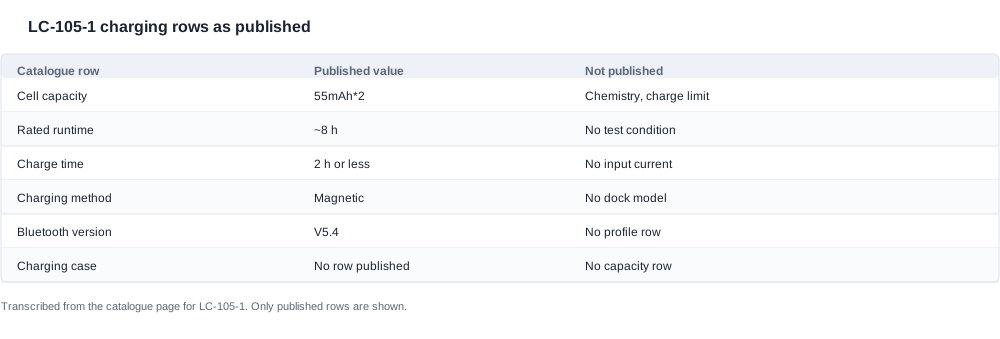
Start with the row itself, because every downstream decision rests on what it contains and what it leaves out. The catalogue page for this model carries the standard set of specification lines and nothing more: rated runtime, cell capacity, charge time, charging method and Bluetooth version. There is no feature line on the page, and there is no charging-case line either.
| Catalogue row | LC-105-1 published value | Not published on this page |
|---|---|---|
| Cell capacity | 55mAh*2 |
Cell chemistry, per-cell charge limit, current rating |
| Rated runtime | ~8 h |
Volume level, codec, distance, sample size, mean or best case |
| Charge time | ≤2 h |
Starting state, termination criterion, input current and voltage |
| Charging method | Magnetic | Dock model, dock input, whether the dock ships in the carton |
| Bluetooth version | V5.4 |
Profile, codec, connected-device behaviour |
| Charging case | No row published | Capacity, existence, whether it can be ordered separately |
| Feature line | None on this page | Everything a feature line would normally carry |
Two of those values do more work than the others. The 55 mAh figure is the lowest per-cell value published among the eight audio models, and the roughly eight-hour runtime is the longest published among the same eight. That pairing is unusual enough that a buyer comparing this model against an audio model with larger cells is not comparing a capacity upgrade; the comparison is between a long published runtime and a smaller amount of published storage, with no test conditions behind either side.
The identical LC-105-2 row deserves a warning label rather than a conclusion. Every published field matches, which gives you no basis for describing the two models as electrically distinct, and equally no basis for describing them as one platform. Shared specification rows are not a shared product. A listing that implies a shared firmware, a shared app or a shared accessory family from two identical rows would be making a claim the catalogue does not support, and a buyer who writes that claim carries the risk alone.
The runtime figure is a band, not a point. Four audio models publish the 55mAh*2 configuration: this one and the LC-105-2 at about eight hours, and the G07 and the YK12 at about six hours. The honest way to read the configuration is therefore a six-to-eight-hour range, and the way to publish this model's own figure is about eight hours with the band noted. None of the four publishes a test condition, and that is not an isolated gap: six models across the catalogue publish about eight hours, the ZH12 and the LC-105-1, the LC-105-2 and the K02, and the YKC02 and the K01, spread across four different cell configurations, and not one of them states the conditions behind the number.
That leaves the practical output of this section as four facts and one rule. The facts are two 55 mAh cells, about eight hours, two hours or less to charge, magnetic charging, Bluetooth V5.4. The rule is that the page copy may quote all five and must not extend them: no inference about how long a charge lasts from a customer's own wall adapter, no claim about a dock capacity, no claim about how long the cells last in a specific use pattern. Everything beyond those five is a question, and the questions are collected further down.

Magnetic charging and what it means for the carton
Magnetic charging is a method with a dock attached, and that is the whole difference that matters commercially. A Type-C port is a defined connector: the customer owns a cable, plugs into an adapter that already exists on their desk, and loses nothing proprietary. A magnetic interface is only defined by the dock that implements it, so the customer holds a part whose specification belongs to the supplier and whose replacement path also belongs to the supplier.
For the LC-105-1, the catalogue does not publish the dock model, the dock input parameters, whether the dock ships in the carton, or whether the dock can be ordered separately as a spare. Four blanks sit where a Type-C product would have had none, because a Type-C product's charging story ends at a port and this one's continues into an accessory.
The first consequence lands on the carton. If the dock is in the box, then the dock is a moulded component with its own tooling, its own unit cost, its own shipping weight, its own assembly step and its own quality control sample. It becomes a line on the quotation and a line on the packing list, and it joins the accessory family that has to be specified, sampled and inspected. If the dock is not in the box, then the frame is undemonstrable out of the box and every channel listing has to explain where the dock comes from, which is a support cost that most buyers forget to price.
The second consequence is weight, and it is where the catalogue is quietest. One weight figure is published in the whole catalogue, 158 g, and it belongs to the MT6 frame body rather than to a folded case. Nothing is published for the LC-105-1 body and nothing is published for a dock, so carton weight has to come from a weighed sample order rather than from a datasheet. That matters for freight and for retail shipping thresholds, and it is another reason the sample order for this model needs to be weighed rather than simply inspected.
The third consequence is ownership of a proprietary part in the customer's hands. Losing a dock is a support ticket that a Type-C product never generates, and the remedy for that ticket depends entirely on whether the dock can be reordered, at what lead time and at what unit price. None of those three are published for this model, so they belong in the same enquiry as the electrical questions.
One comparison is tempting and should be avoided. The audio group of eight models publishes no charging-case row at all, and case capacity is published only by camera models. Five camera models carry a case figure: 1400 mAh for the CY05 and the L1 Pro, and the CY03, a 1200 mAh folding case for the MT6, a 900/1400 mAh line for the L2 Utral, and a case of unstated capacity for the MT5. Those numbers belong to camera products and cannot be read across to an audio frame, no matter how convenient the arithmetic would be.
The same caution applies to the two identical audio rows. Both the LC-105-1 and the LC-105-2 publish magnetic charging and identical capacity, runtime, charge time and Bluetooth lines, and the catalogue says nothing about whether their docks are interchangeable or even physically identical. Treating them as one accessory is an assumption a buyer makes in good faith and then discovers at goods-in, so it belongs on the question list, not in the plan.

The two-hour charge ceiling and what it does not tell you
Two hours or less is an upper bound rather than a measurement, and the distinction survives contact with a customer. Twenty-six of the twenty-eight models in the catalogue publish a charge time of two hours or less, with only the D17 and the ZH12 publishing about one hour. A ceiling tells you what the figure cannot be exceeded by; it does not tell you the typical wait, the wait from a partially charged frame, or the wait when the charger supplies less current than the product expects.
What the ceiling omits is the part a customer actually meets. There is no published starting state of charge, so it is not stated whether the two hours assumes an empty cell. There is no published termination criterion, so it is not stated what counts as finished, which is what determines whether a two-hour wait can be interrupted or shortened. There is no published input current or voltage, so the figure cannot be reproduced from a customer's own phone adapter or laptop port, and there is no ambient temperature stated. The published number therefore describes a test the buyer cannot repeat.
Small cells make that gap wider rather than narrower. With the lowest per-cell value published among the eight audio models, the frame has less published storage to absorb whatever the charger delivers, so the charge specification carries more of the burden than it would for a model with a larger cell. The catalogue does not publish the arithmetic that would let you convert two hours into a wait time under a given input, and this article will not manufacture it: the honest position is that the ceiling is only meaningful once the input requirement arrives in writing.
The runtime figure carries the same kind of gap from the opposite direction. About eight hours, published without a volume level, a codec, a distance, a sample size or a statement of whether it is a mean or a best case, is a number a customer can check against their own day and find wanting. That is the standard this model is most likely to fail in public, because the runtime is the figure a buyer puts in the headline and a customer puts in a review.
A single request resolves both gaps, and it is worth sending as one email with one table to complete. On the runtime side: the volume level, the codec, the distance, the sample size, and whether the figure is a mean or a best case. On the charging side: the input current and voltage the frame expects, the starting state, the termination criterion, the ambient temperature, and whether the dock supplies the conversion or passes a source through unchanged. The answers arrive as written specification, which is the only form in which they can be used in a quotation, a product page or a quality control instruction.
Two further charging behaviours are worth asking about at the same time because each one creates a support topic if the answer is inconvenient. Whether the frame accepts a partial charge decides whether a customer can top up during a break instead of waiting out the full cycle. Whether the dock can charge the frame and hold a charge at the same time decides whether the dock is a cable substitute or a genuine second-day reserve. Neither is published, and both change the number of docks a channel has to stock per frame sold.

The LC-105-1 charging options compared against the rest of the catalogue
Across the catalogue, charging method splits three ways, and the split is the useful structural fact for a buyer who has not yet chosen a charging setup.
| Charging method in the catalogue | Models | Notes for a buyer |
|---|---|---|
| Magnetic | 17 | Method plus a supplier-owned dock; dock specification is not published |
| Type-C | 7 | Defined port; the customer supplies the cable and the adapter |
| Method not published | 4 | Camera models; no charging-method row on the page at all |
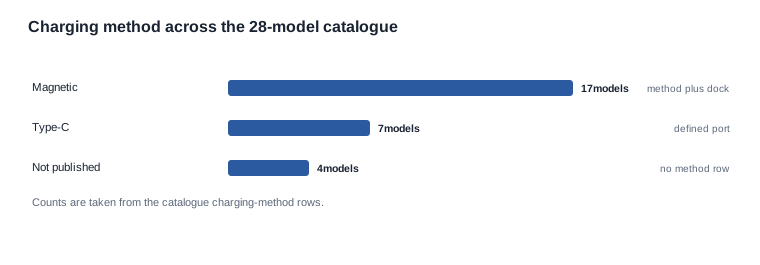
Within the eight audio models the split is sharper. Only the D11 and the D12 publish Type-C; magnetic is the audio-side default, and the LC-105-1 sits in that majority with the YK12 and the K02, the G07 and the K01, and the LC-105-2. Reading the audio group as a table is the fastest way to see which published rows actually separate the models that look similar on a shelf.
| Audio model | Cell | Runtime | Charge time | Charging method | Bluetooth |
|---|---|---|---|---|---|
| K01 | 90mAh*2 |
~8 h | ≤2 h | Magnetic | V5.3 |
| K02 | 90mAh*2 |
~8 h | ≤2 h | Magnetic | V5.3 |
| D11 | 100mAh |
~7 h | ≤2 h | Type-C | V5.4 |
| D12 | 100mAh |
~7 h | ≤2 h | Type-C | V5.4 |
| LC-105-1 | 55mAh*2 |
~8 h | ≤2 h | Magnetic | V5.4 |
| LC-105-2 | 55mAh*2 |
~8 h | ≤2 h | Magnetic | V5.4 |
| G07 | 55mAh*2 |
~6 h | ≤2 h | Magnetic | V5.4 |
| YK12 | 55mAh*2 |
~6 h | ≤2 h | Magnetic | V5.4 |
The comparison that matters commercially is not between models but between the two charging methods, because a method is a cost structure rather than a preference. Type-C transfers the charging accessory to the customer: no dock tooling, no dock line on the packing list, no spare-parts policy, and a charge experience that depends on whatever adapter the customer owns. Magnetic transfers it to the supplier: a moulded part, a tooling decision, a dock in every carton or a dock sold separately, and a replacement channel that has to exist for as long as the product is on sale. Neither is better; each is a different set of commitments, and a buyer has to accept the one that matches the channel.
The four models whose charging method is not published are camera models, and the pattern matters for a specific task. The CY03 and the MT6, and the CY05 and the L1 Pro publish cell capacity, charge time, runtime and a case capacity, but no charging-method row. For a buyer designing a carton around those models, the charging method cannot be inferred from the case figure either; it is the first item on the enquiry. For the LC-105-1 that problem does not arise, because magnetic charging is published, but the same discipline applies to the details under it.
Filtering by charging method is a structural filter, not a price tier, and it is worth stating plainly because the catalogue publishes no prices and no market data of any kind. If the channel requirement is a single USB-C cable that the customer's existing adapter serves, the Type-C rows are the ones to read, and among audio models those are the D11 and the D12. If the requirement is a dock-based presentation with a case in the carton, the magnetic rows are the ones to read, and the LC-105-1 is in that group with the smallest published per-cell value in the audio class. If the requirement is a frame and a case sold as two separate items, the published case figures on camera models give a vocabulary for the conversation with a supplier, but not a specification for an audio frame.
The honest summary is that this model's charging story is well specified in shape and empty in detail. The shape is magnetic, two hours or less, about eight hours, two small cells, Bluetooth V5.4. The detail is the dock, the input requirement, the carton contents and the runtime test condition, and all four are obtainable in writing from a supplier who is willing to state them.
Choosing a charging option for the LC-105-1

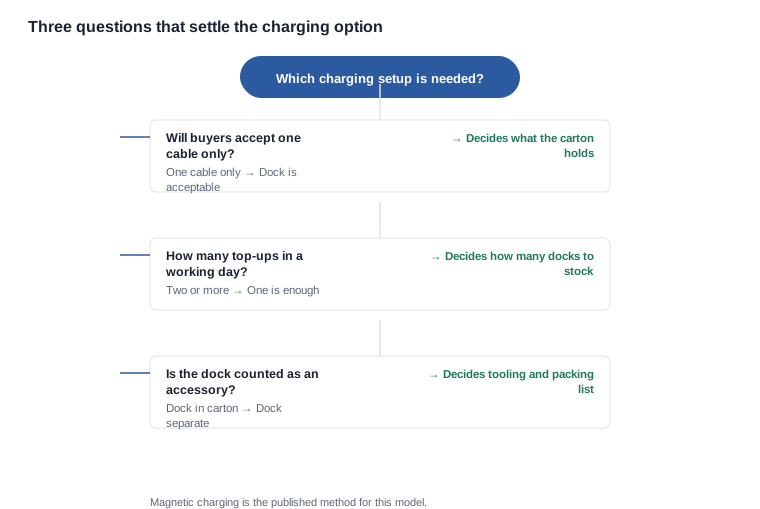
A charging option for this model is settled by three questions, and each of them changes the carton rather than the electronics. Does the customer accept only one cable type? How many top-ups does a working day require? Does the dock count as an accessory that ships in the carton or as a separate line? Answer all three before the packaging brief is written, because each answer changes the parts list, the carton size, the freight weight and the instruction leaflet.
The order of operations matters for the same reason. Fix the charging method the listing will claim, because the catalogue publishes magnetic for this model and any other claim would have to be sourced. Then decide whether the dock ships in the carton, because that decision determines the tooling and the packing list. Then set the cable, the plug and the adapter position in the manual, because the manual has to describe what is actually in the box. Then write the quick-start card and the safety text to match the real carton. Only then close the accessory list and the spare-parts policy, which depend on everything above.
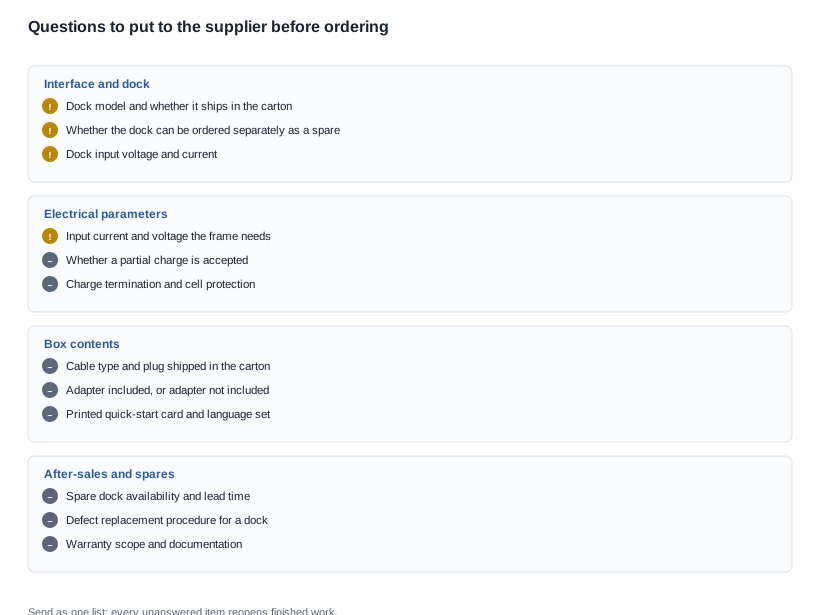
The supplier questions are best sent as one structured list rather than as a sequence of informal emails, because each group has a different internal owner and each unanswered item reopens work that has already been done. The interface and dock group needs the dock model, the dock input, whether the dock is in the carton and whether it can be ordered as a spare. The electrical group needs the input current and voltage, the acceptance of a partial charge, the termination behaviour and the cell protection. The box contents group needs the cable type, the plug, the adapter decision and the printed card. The after-sales group needs spare availability, the defect replacement route for a dock and the warranty scope.
The answers have to arrive in writing, and the distinction between a written answer and a verbal one is worth a paragraph on its own. A supplier who says the dock works well has told you nothing a product page can use. A supplier who writes the dock input as a specific voltage and current, and states that the frame accepts a partial charge, has given you material you can put in a specification, hand to a quality control inspector and use to answer a customer complaint. Write the answers into the purchase agreement rather than into a chat log, and treat any figure that arrives only verbally as not published.
A quotation for this model should carry at least four charging fields explicitly, so that two quotations can be compared on the same basis. The charging method as claimed on the product page. The charging accessory list with the dock either included or explicitly excluded. The input requirement as a stated voltage and current rather than a promise to supply whatever is needed. The runtime figure with its test condition attached rather than the bare number. Two quotations that both omit those fields cannot be compared on charging, however different their totals appear.
Several answers are worth treating as red flags in a due diligence pass. A dock that cannot be reordered as a spare means the channel carries a support cost that grows with every unit sold. A refusal to state the input requirement means the two-hour ceiling cannot be defended on a listing page. A runtime figure offered without any condition means the eight-hour claim is a marketing number rather than a specification. A weight given only for the frame body means the carton weight is still unknown. A carton that contains a cable but no adapter means the customer meets the magnetic interface with nothing to connect it to. These are questions to ask before you order, and a refusal to answer one is itself information about the supplier.
Six commercial fields on this model are not published anywhere, so a buyer who needs them has to request them in the same enquiry rather than assume them. Unit price, order quantity, lead time, warranty terms, certification documents and defect replacement arrangements are all absent from the catalogue. The charging questions above are the part of the enquiry that only this model raises; the commercial fields are the part every model raises and that this one does not answer either.
A catalogue entry has no image, no retail rating and no review history to carry the specification for it, which leaves the published rows and the supplier's written answers as the only two sources a buyer can work from. The LC-105-1 publishes five charging-relevant rows, and they are enough to decide whether this model belongs in a shortlist for a channel that already knows which charging setup it wants. They are not enough to decide anything else, and the questions above are the shortest route to the rest.
Where this model sits in the range is covered on the Bluetooth audio glasses page, the way a case changes the product is described under smart glasses battery life, and the case for testing a sample instead of a datasheet sits in sample evaluation.
Related reading
- How published runtime figures are read in this catalogue
- Reading a battery specification row before you commit
- A charging checklist for a catalogue-wide purchase
- What an overnight charge does to a small cell
- The same charging rows read against the YK12
Send the channel, the quantity and the adapter decision, and we will tell you which of these five charging questions the LC-105-1 smart glasses charging options still leave open.


