
The yk12 smart glasses vs lc-105-1 battery and charging comparison is the cleanest available demonstration that the published endurance numbers in this range are not on a common basis. Both models carry two 55 mAh cells and charge magnetically over a cycle of two hours or less. The YK12 publishes about 6 hours of rated use. The LC-105-1 publishes about 8. The difference is two hours on an identical cell configuration, with an identical radio and an identical charging method.
That is not a product difference. That is a documentation problem, and recognising which one you are looking at is the whole purpose of this comparison. A buyer who reads the two figures as a ranking will make a decision that a customer can disprove in an afternoon.
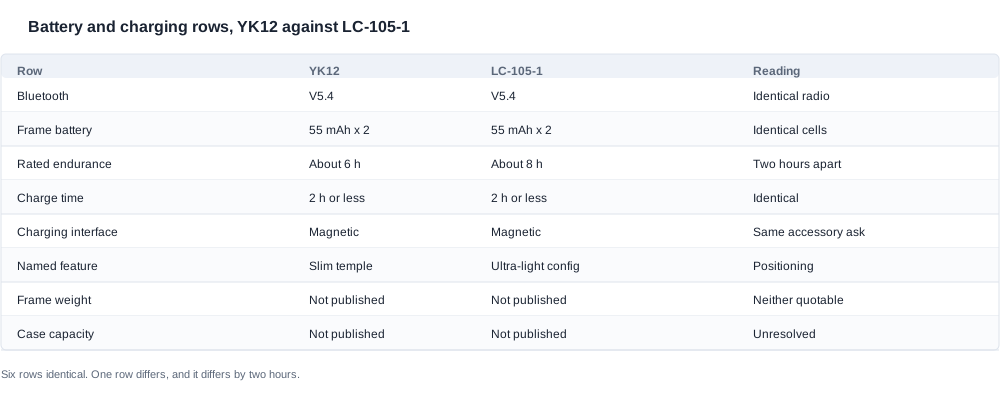
YK12 smart glasses vs LC-105-1: identical cells, two different ratings
| Specification | YK12 | LC-105-1 | Reading |
|---|---|---|---|
| Bluetooth | 5.4 | 5.4 | Identical radio |
| Frame battery | 55 mAh x 2 | 55 mAh x 2 | Identical cell configuration |
| Stated endurance | About 6 h | About 8 h | The only published difference, on identical cells |
| Charge time | 2 h or less | 2 h or less | Identical |
| Charging interface | Magnetic | Magnetic | Identical accessory approach |
| Published differentiator | Slim temple | The ultra-light configuration | Positioning, not hardware |
| Frame weight | Not published | Not published | Neither can be quoted |
| Case capacity | Not published | Not published | Unresolved on both |
Six of the comparable rows are identical, and the seventh differs by two hours without any hardware reason appearing anywhere in the specification. A comparison table where one row moves and everything else is frozen is not a comparison of products — it is a comparison of the two suppliers' documentation habits.
What that means for the decision is concrete. You cannot use the runtime row to choose between these two models, and you cannot use it to write a listing that claims an advantage. What you can use it for is diagnostic: the row tells you which supplier has published a measurement condition and which has published only a number, and that is a question worth asking both of them.
What it also means is that the platform is shared. Two 55 mAh cells and a Bluetooth 5.4 radio put both models on the same hardware family as the G07, and the LC-105-2 publishes the same configuration again. A brand that has qualified one of these has, in principle, qualified the others, which is a materially different procurement situation from qualifying two unrelated products.

Three explanations for the two-hour gap, and how to separate them
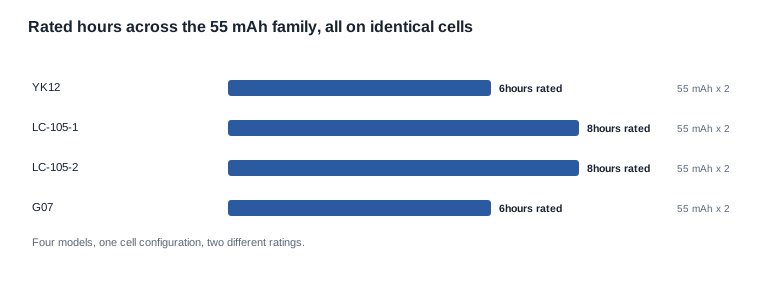
The gap has three possible explanations, and the published material supports none of them over the others. All three are common, all three produce a real number, and all three are distinguishable with one question.
The measurement conditions differ. A 6-hour figure measured under continuous playback and an 8-hour figure measured under intermittent use are different products on paper. This is the most common explanation and the easiest to test, because it is a question rather than an investigation. Ask both suppliers the same question in the same words, in the same message, and the answer either arrives as a protocol or arrives as a shrug. The how to compare battery life method covers the procedure, and the audio range battery picture shows the same inconsistency across the wider range.
The firmware or radio behaviour differs. The two models are not necessarily electrically identical behind the published rows, and a difference in connection stability, reconnection behaviour, amplifier idle draw or power-management firmware would show up as a runtime difference with no visible specification change. Nothing in the source describes either model's power management. This explanation is the hardest to test remotely because it requires measurement rather than a document, which is why the sample order matters here more than it does for a feature comparison.
The measured sample was not the production configuration. A figure taken on an engineering sample, before a firmware or driver optimisation, or on a pre-production build with a different amplifier, is a figure that will not reproduce in the field. This is worth asking about directly and without embarrassment, because the answer tells you whether the number on your own product page is safe. A supplier who says the figure came from an early build and offers to re-measure on a production unit has given you more than a supplier who repeats the number.
The one explanation that is not on the list is a capacity difference, and that is worth stating because buyers reach for it first. The cells are published as identical at 55 mAh × 2 on both models. If the actual fitted cells differ in chemistry, in discharge curve or in tolerance, that is a bill-of-materials question the catalogue does not answer, and it is a legitimate due diligence request: ask for the cell part number for the configuration ordered, on both models, and compare them.
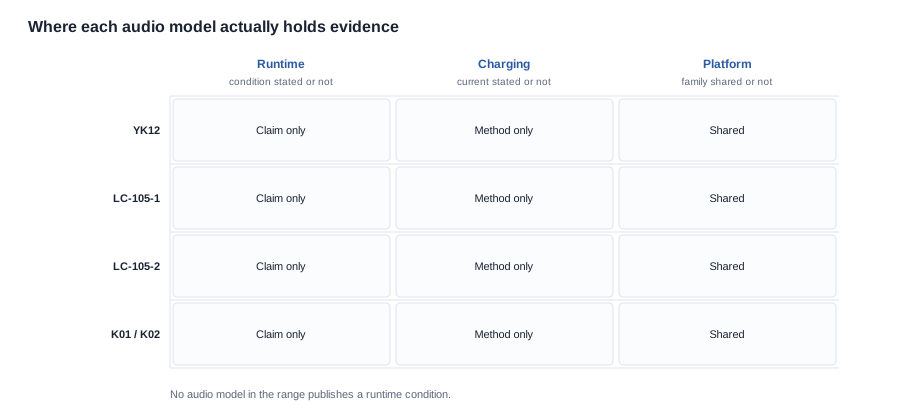
What is identical, and why the comparison still matters commercially
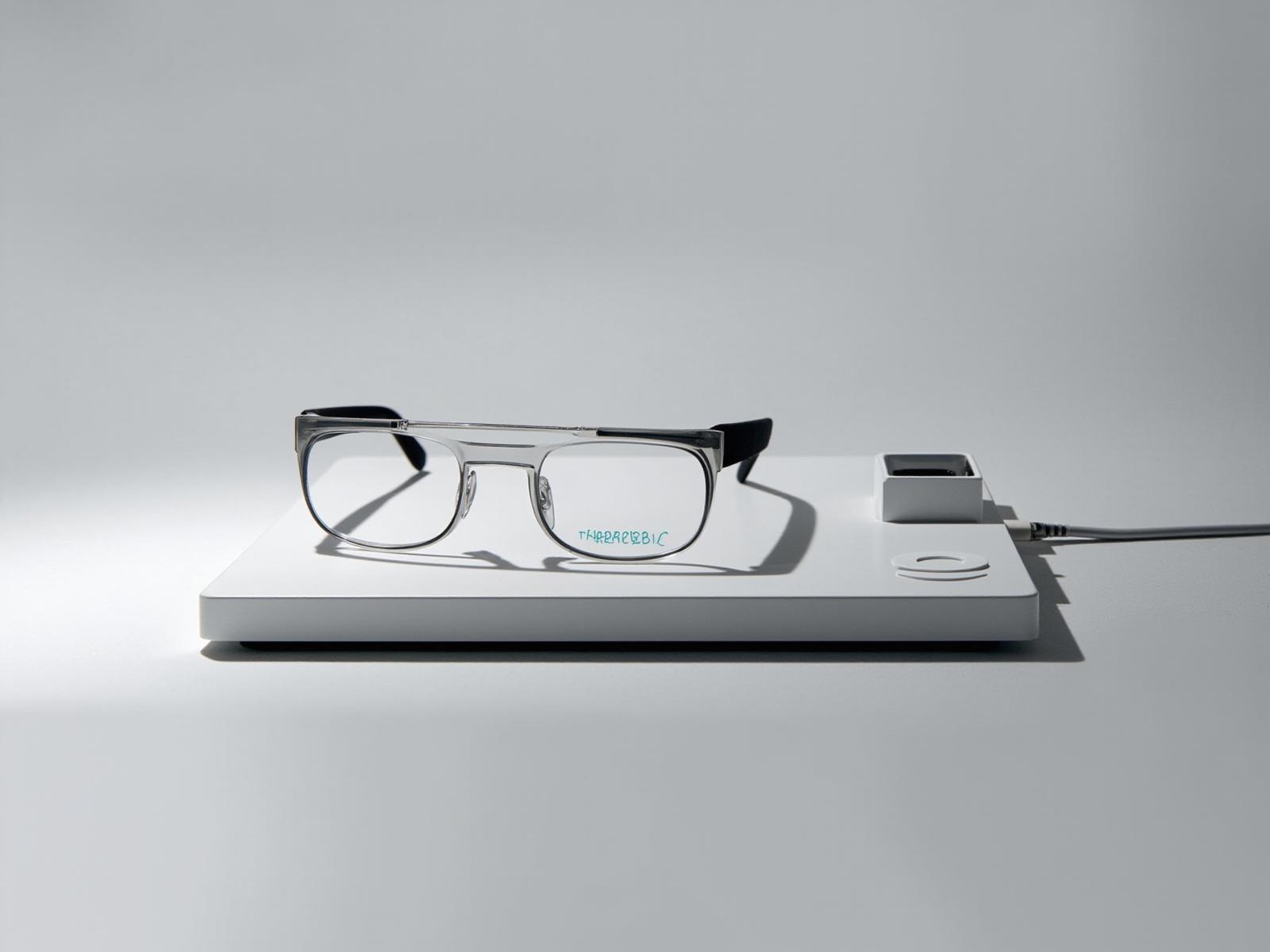
Everything operational is the same. Both models charge magnetically, which means the box needs a case or a magnetic pad, and neither publishes a case capacity. That is the same parcel-weight and freight-class question for both, and the Bluetooth audio glasses charging options piece covers the accessory economics.
Everything about the platform is the same too, which is the real commercial point. A 55 mAh twin-cell configuration with a V5.4 radio means the two models sit on the same hardware family as the G07 and the LC-105-2. The model readiness overview sets out where that structure holds — logo, colour, packaging, temple shape, system and UI, Bluetooth name and firmware are the seven documented axes at family level, and they apply across the family rather than to a single SKU.
A shared platform changes the negotiation, because it changes the alternative. If a brand can move between the YK12 and the LC-105-1 without re-qualifying the electronics, then the conversation with the factory is about positioning and price rather than about a new development programme. That is a materially stronger position at the point where you negotiate unit price, volume tiers, the accessory minimum order quantities and the lead time, because the cost of switching models is low.
What differs between them is positioning rather than hardware. The YK12 publishes a slim temple and the LC-105-1 is described in the source as the ultra-light configuration. Neither is a hardware advantage that a buyer can quote, because the temple has no dimensions and the frame weight is not published for either model. A named temple is a merchandising asset; "ultra-light" without a gram figure is an adjective. Both can carry a listing, and neither can carry a specification.

A test protocol you can run on a sample order
Because the catalogue cannot settle this, the sample order has to settle it — and a measurement run without a protocol agreed in advance produces a number you cannot use in a contract or in a listing. The protocol is short, and it is worth more than the samples themselves.
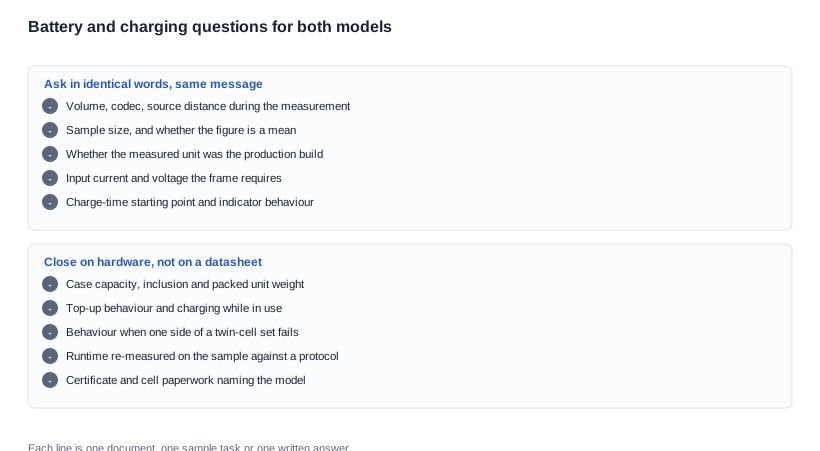
- Write the protocol before the units ship. Volume as a percentage rather than as a description, a named codec, a stated distance from the source device, and a statement of whether the result is a mean across units or the best unit in the batch.
- Run both models on the same protocol, on the same day, in the same room, on the same network. Comparing two models measured under different conditions reproduces the exact problem you are trying to fix.
- Record a mean across at least three units. A single unit is an anecdote, and a best-unit result is a marketing number.
- Repeat with the published feature engaged and disengaged. The YK12 publishes a sound description, so the mode state during measurement is a specific question rather than a general one.
- Record the charge time from a stated starting point. A two-hour figure from a flat cell and a two-hour figure from a partly discharged cell are not the same figure, and magnetic charging makes the starting state easy to overlook.
- Attach the result to the specification and to the listing copy together, with the protocol written alongside the number. A figure with a protocol attached survives a review; a figure without one does not.

Two charging questions are specific to a twin-cell architecture and worth asking on both models. First, what happens when one side fails — does the product continue in mono, or stop — because that determines whether a single-cell failure is a warranty event or a write-off, and it determines the cost of your warranty provision. Second, whether the frame accepts a partial top-up and whether it will charge while being worn, because a customer who cannot top up mid-session will ask for a case, and the case is not published.
One freight question follows directly from the charging format. A magnetic interface means the packed unit includes a dock or a case, which adds moulded weight, tooling and an assembly step. Published case capacities elsewhere in our catalogue run from 900 mAh to 1400 mAh, so the omission here spans a wide range of real products. Ask for the packed unit weight rather than the frame weight, and ask whether the case is included at your quantity, because that single line decides the freight class and therefore the landed cost on an incoterms basis.
How to ask the condition question without provoking a defensive answer. Buyers frequently ask "is six hours real?", which invites reassurance rather than evidence. The phrasing that works is administrative: ask for the measurement protocol used for the published rating — volume setting, codec, source distance, number of units, and whether the result is a mean — and ask whether the same protocol applies to the other model in the range. A supplier with a protocol answers in one line. A supplier without one answers with a paragraph about typical use, and the length of that paragraph is itself the answer.
When the supplier cannot supply a protocol at all. Then the runtime row is unusable as a specification and the decision has to be made on the other published rows: the shared platform, the cell configuration as a physical constraint, the charging format and its accessory economics, and the delivered unit cost. That is a legitimate way to buy these two models. It is worth saying so explicitly to the brand, because a decision made on a shared platform and a delivered cost is defensible in a review meeting, while a decision made on a contested runtime figure is not.
What changes if you are building a range rather than a single SKU. Across a family this size, the runtime figure is rarely the row that determines the range. It determines whether a model leads the listing, and that is a marketing allocation rather than an engineering constraint. The engineering constraint is whether the cell configuration leaves room for the capability the range is likely to add next, and 110 mAh across two cells is a tighter starting point than 180 mAh across two cells — which is the argument that actually belongs in the range review.
Shared tooling is the line worth pressing. The seven documented customisation axes apply at family level, so a brand that has already paid for a temple shape, a packaging specification or a firmware variant on one model in this family should ask explicitly whether that investment carries to the other. If the answer is that tooling is per model, the quote will reflect it and the minimum order quantity on the shared parts may differ. If the answer is that tooling is per family, that is a material reduction in the cost of qualifying the second model, and it belongs in the calculation before the second model is chosen rather than after.
Shared accessory economics cut the same way. A magnetic dock is a separate moulded part with its own tooling and its own minimum order quantity. If both models take the same dock, the second model's accessory volume can be aggregated with the first, which moves the unit cost. If they do not, each model carries its own dock minimum, and a two-model range quietly doubles that line. Ask for the dock part number on both models before committing to a range, because the answer determines whether a second SKU in this family is cheaper or more expensive to add than it appears.
Writing the runtime row into a specification and a listing
A contested figure is not a reason to leave it out of the documentation. It is a reason to write it differently — and the difference between the two approaches shows up in how a customer responds when their measurement differs from yours.
In an internal specification, treat both figures as the upper bound of a range rather than as its middle, until a supplier gives you the condition. An internal spec that says "about 6 hours, condition unverified" produces a planning assumption. An internal spec that says "6 hours" produces a plan built on a number that may not hold in the field, and the failure surfaces during a launch rather than during a quotation.
In a customer-facing listing, state the rating and state that the measurement condition is not published. This reads as competence rather than as weakness, because a listing that volunteers the missing condition is visibly different from one that hides it. It also protects you: a customer who measures four hours and finds that you never claimed a measured average has a question about the product, whereas a customer who measures four hours against an unqualified "8 hours" claim has a question about your honesty, and that question is far more expensive to answer.
In the support script, give the agent the condition and the protocol. If your own measurement is in hand, the agent can say what the runtime is under a stated condition and what changes it — volume, codec, distance, mode state. If it is not in hand, the agent has nothing but the catalogue number, and the conversation turns into an argument about the specification instead of an answer.
Three ways a runtime figure quietly becomes a warranty cost. First, if a channel sells endurance as the proposition, a customer whose expectation was set by your own listing will ask for a refund rather than a return. Second, if a cell configuration is marginal for the workload, the failures cluster in months four to six, which is inside the warranty period a brand offers and often outside the period a factory stands behind. Third, if a twin-cell unit fails on one side, the replacement policy has to say whether the whole unit or the single cell is replaced, and that decision is made before the first failure rather than during it.
One measurement worth running even if you buy only one model. Charge a sample and a spare, leave both idle for a week, then run the protocol. A unit that has been in a warehouse is the realistic starting condition for a customer who opens a box, and the difference between a fresh unit and a rested one is a number nobody publishes and everybody eventually discovers.
The questions to ask, as a shortlist. If a buyer can only make one request to the factory before signing, the criteria that matter are narrow: the measurement protocol, the cell part number, and the packed unit weight. Those three close the two-hour gap, the bill-of-materials question and the freight question in a single message. Anything else can wait for the second round, because nothing else changes what you can write on a listing.
What goes in the purchase order, and what stays out
The clauses to include. The cell configuration as ordered, with the cell part number if the supplier will state it. The rated runtime with the measurement protocol attached, or with an explicit statement that the figure is a manufacturer rating and unverified. The charge time with its starting state. The charging method and whether a dock or case is included. The frame weight and the packed unit weight as measured on the sample. The single-side failure behaviour. The warranty period with a stated response time, and the replacement basis where a twin-cell unit fails on one side.
The questions worth the negotiation time. The unit price and the volume tiers. The accessory minimum order quantities, which matter more on a magnetic format than on a cabled one because the dock is a separate moulded part. The lead time on the sample order and on the first bulk order stated separately. The payment terms, with a deposit structure and a node tied to a quality control inspection. The return terms, which move more in a range where the runtime figure is contested than in one where it is not.
Where the quotation has no room. What certification costs and how long it takes are worked out by the schedule and by whoever runs the test. Tooling is frequently bundled into the same line as certification, which hides which is amortised across the first order and which is per product family — ask for them separately. Incoterms and freight class follow from the packed weight you have now asked for.
What to leave out. Any endurance figure presented as a comparative advantage. Any capacity, weight or case figure that is not published or not measured. Any inference about which model lasts longer in real use, because the catalogue does not support one.
This pair demonstrates a documentation problem in the range rather than a product difference, and it would be wrong to present either endurance figure as a comparative advantage. We will publish 6 hours and 8 hours as manufacturer ratings, we will not rank them, and we will not quote a weight or a case capacity for either model. The published YK12 specification list and the published LC-105-1 specification list are the honest baselines, and the LC-105-1 limitations analysis sets out the full gap set for the model carrying the longer figure.
Five questions to close for both models
- The endurance test condition, asked in identical words to both suppliers.
- Whether the measured sample was the production configuration.
- The cell part number for the configuration ordered, on each model.
- Frame weight, packed unit weight and the case capacity or inclusion.
- The certification position for each model, in each destination market, in documents that name the model.
Related reading
- The published rows for the YK12 — YK12 smart glasses specifications and features
- The published rows for the LC-105-1 — LC-105-1 smart glasses specifications and features
- Choosing across the range — Bluetooth audio glasses which model to pick
Send us the application and the expected daily use, and we will tell you which published figures apply to your case and which have to be measured on a sample.


