

The catalogue row for the LC-105-2 fits on a single line: Bluetooth V5.4, two a charge time of two hours or less, 55 mAh cells, a rated runtime of about eight hours, and magnetic charging. That is enough to anchor the LC-105-2 smart glasses buyer review checklist, and it is nowhere near enough to sign a purchase order against — every row that decides whether the order is correct sits outside that line.
A workable review therefore sorts the missing information into four groups. Some rows are published and can be quoted directly into a specification. Some exist only as questions you can put to the supplier in writing. Some can be settled only by running a sample under a condition you define yourself. And some will never be published, which means the honest handling is to decide before you commit whether the order can move forward without them. Blur those four groups together and a buyer ends up signing for goods that cannot be received against, which is the single most expensive defect in a sourcing file.
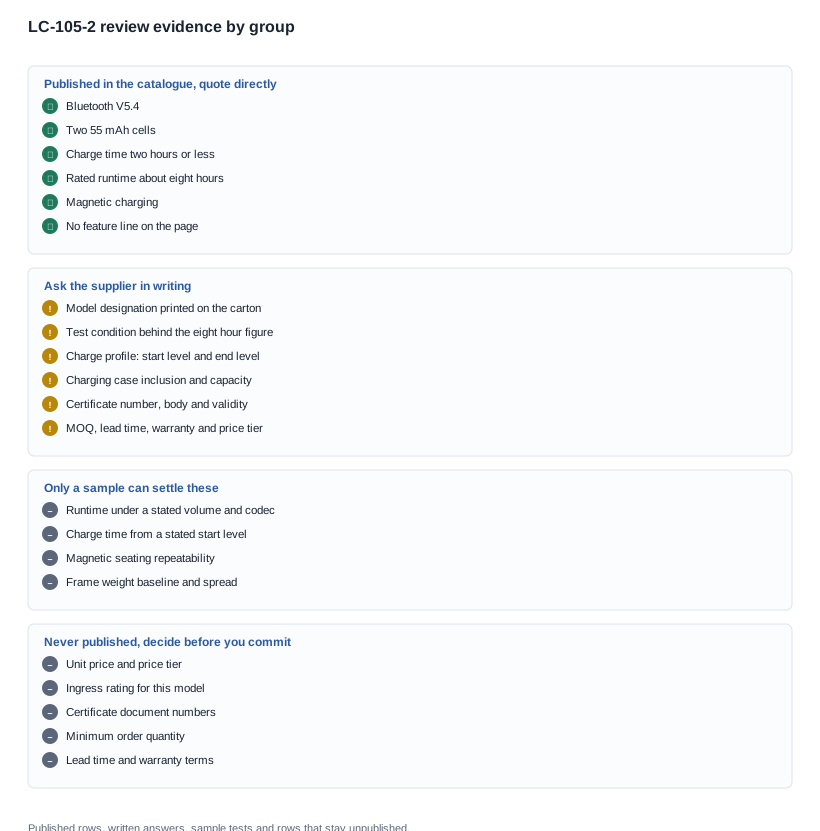
The published rows the LC-105-2 checklist starts from
Page 25 of the catalogue carries the LC-105-2 AI Bluetooth audio glasses, and that page publishes five specification lines and nothing else — no feature line of any kind, no colour line, no variant line. Those five lines are the entire published position for this model, and they are the only rows you can quote in a specification without asking anyone for anything.
The comparison that carries the most weight here is with the LC-105-1 on page 24, and the result of that comparison is the point: the two published rows are identical line for line.
| Catalogue row | LC-105-2 (p25) | LC-105-1 (p24) | Difference |
|---|---|---|---|
| Bluetooth version | V5.4 | V5.4 | None |
| Cell configuration | 55mAh*2 | 55mAh*2 | None |
| Rated runtime | ~8 h | ~8 h | None |
| Charge time | <= 2 h | <= 2 h | None |
| Charging method | Magnetic | Magnetic | None |
| Feature line | None published | None published | None |
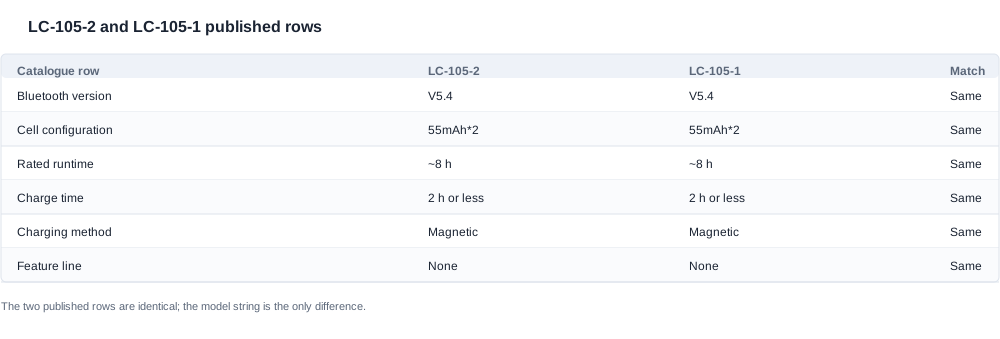
The only thing that separates the two products in the catalogue is the model string itself. That has a direct procurement consequence: on specification, the LC-105-2 and the LC-105-1 are the same hardware row, so a supplier quotation that separates them must be separating them on packaging, branding, lead time or MOQ, not on the published technical position. If a quotation arrives claiming a technical advantage for one of the two, that claim has no row behind it in our catalogue and should be treated as an assertion to be priced accordingly rather than a specification to be accepted.
Read one tier wider and the same pattern holds. The eight audio models publish their rows on pages 20 to 27, magnetic charging is the default on that side of the range, and Type-C charging appears only on the D11 and the D12 — so a USB-C port on an LC-105-2 is not something the catalogue promises and should not be assumed when you draft a packing or accessory list. Across the whole catalogue, the rows you would want for an acceptance test on this model are missing on the audio side as a group: no charging-case row for any of the eight audio models, no IP rating row, no weight, no dimensions, no sensor line, no storage line, no certification line, and no commercial line of any kind.
Two reference points prevent that gap from being filled with borrowed figures. The charging-case capacity is published only for five camera models, so a case capacity from that group says nothing about what an LC-105-2 carton contains. The only published weight anywhere in the catalogue is 158 g on the MT6 glasses body, a camera model with a folding case, and that figure belongs to a different product and cannot be carried across to an audio model.
Certification needs the same discipline, because here the absence is absolute rather than partial. CE, FCC and RoHS do not appear in the catalogue at all, and there is no per-model certification line for any of the twenty-eight models. What you can legitimately name is the regulatory framework you would ask a supplier to answer against: RED (EU) 2014/53/EU and EMC 2014/32/EU. Those two names are the framework for your written request, not evidence that any certificate exists.

The identity questions to settle before anything else
Because two catalogue pages publish identical rows, the first block of the LC-105-2 review is not about hardware at all — it is about which model string arrives in the carton. Get that wrong and every downstream check, from the charge timing to the certificate, is performed on an object nobody can name.
Ask the supplier to state, in writing, the model designation that appears in four separate places: on the device itself, on the retail carton, on the shipping carton, and on the packing list. Each has to carry the same string. A supplier that answers "it is the same product, only the number is different" has not answered the question, because the review and the goods-in inspection both depend on a string that can be read, photographed and compared against the purchase order.
The next question is about production consistency. Ask whether the sample unit and the production unit carry the same designation, and ask what happens to a batch in which the designation on the carton does not match the purchase order. A supplier willing to state the rejection rule in advance — for example, that mismatched designations are held for inspection and not accepted — has given you a receiving criterion you can write into the agreement. A supplier that cannot name the rule leaves your goods-in team with no basis on which to refuse a wrong model, and the cost of that gap is a mislabelled carton rather than a delay.
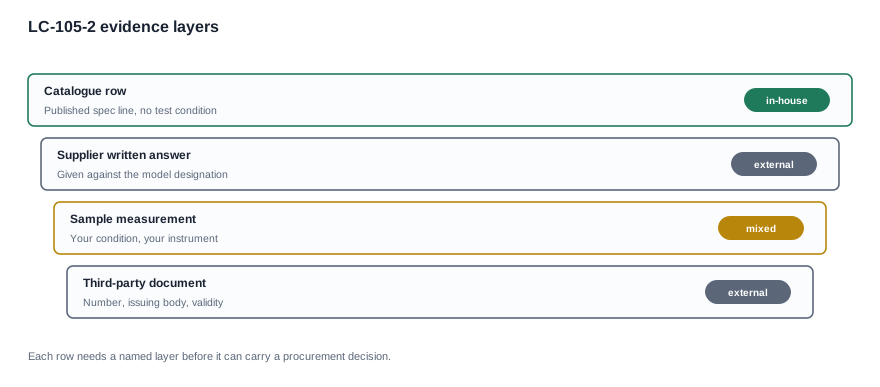
Four layers of evidence can sit behind any row in this review, and it helps to name them before the review starts. The catalogue row is the layer you already hold, and it is solid but narrow: it states capacity, runtime, charge time, charging method and Bluetooth version, and it states nothing about conditions, tolerances or documents. The supplier's written answer is the layer where commercial rows become usable, and it is only usable if it arrives as an answer tied to the model designation. The sample measurement is the layer you control, and it is the only layer that produces a number under a condition you chose. The third-party document is the layer for anything about compliance, and for the LC-105-2 it is currently empty in our own material, which is precisely why it belongs in your written request rather than in your assumptions.
Record the identity evidence per shipment, not per order. A photograph of the designation label on the carton, filed against the batch number on the packing list, gives the goods-in team something they can compare when a query arrives months later. The cost of that record is small and the cost of its absence is a sourcing file with no way to close an identity question.
Runtime, charge time and the accessory question
The rated runtime on page 25 reads about eight hours, and the number carries no test condition of any kind — no volume level, no codec, no source device, no distance, no sample size, and no statement of whether it is a mean or a best case. Within the same 55 mAh × 2 tier, the LC-105-1 and the LC-105-2 publish about eight hours while the G07 and the YK12 publish about six hours, so the honest summary of that tier is a runtime of roughly six to eight hours with two published values inside it, neither of them tied to a condition.
The wider catalogue makes the point sharper. Six models publish the same ~8 h figure, and they span four different cell configurations and both the audio and the sport lines. A runtime figure that does not move with cell capacity is a catalogue convention rather than a measurement, which means it cannot be used as a proxy for anything else in the review — not for battery selection, not for a shift pattern in a warehouse, not for a retail scenario with a customer demo running all afternoon. The comparison between the ~8 h and the ~6 h rows in the same cell tier is covered separately in the battery and charging comparison for this model pair, and the practical conclusion there matches the one reached here.
The way out of that problem is not to argue about the number but to replace it with a condition you define. Write into the purchase order that runtime is measured at a stated volume level, from a stated source device, over a stated period, with the unit kept within a stated distance of the source, at a stated ambient temperature, across a stated sample size, and reported as a mean rather than a best case. Six clauses, and the row becomes usable in a dispute. Leave the condition out and the row stays a slogan that both sides can interpret in their own favour.
Charge time carries the same gap in a different form. Two hours or less is published, and published alongside it is nothing about the state the unit starts from, nothing about the level that counts as finished, and nothing about the input current and voltage. A charge criterion written as "two hours or less" is not testable, because one side can start from empty and the other from a partly charged unit, and both can claim the row. The criterion that survives an argument names the start level, names the end level, names the adapter rating, and states the ambient condition. The same applies to the magnetic charging method: because the contact is alignment-dependent, the acceptance test is a defined number of seat-and-lift cycles with a stated indicator state, not a single successful charge on a bench.
The accessory question follows from the catalogue structure rather than from this model. The eight audio models publish no charging-case row at all, while case capacity appears on five camera models — so a case is not a published line for the LC-105-2 in either direction. You cannot quote "with charging case" and you cannot quote "without charging case" from our material. Ask in writing whether a case is included at your quantity, whether its capacity is stated, what charging method it uses, whether it appears as a separate line on the quotation and on the invoice, and what happens to a returned unit whose case is missing. The box-contents question for this model has an article of its own in the charging options note, which covers the accessory side of the same catalogue rows.
The acceptance criteria to write into the purchase order
Not every published row can become a contractual criterion, and the distinction is worth making explicitly because getting it wrong produces a purchase order full of clauses nobody can verify. A row becomes a criterion only when it is published, testable at goods-in or against a document, and stated with enough precision that two parties would measure it the same way. Rows that fail the second test — the cell configuration, for example — cannot be checked by inspecting a carton; they are documentary rows that arrive with the shipment as a declaration or a cell test summary, and they belong in the document block rather than the inspection block.
The published rows that do survive the test are few, and each needs a written method attached. The Bluetooth version becomes a criterion when the inspection records a scan result of V5.4 per batch. The charge time becomes a criterion when the start level, the end level, the adapter and the ambient condition are named. The charging method becomes a criterion when the seat-cycle count and the indicator state are named. The runtime becomes a criterion only when the full condition clause from the previous section is attached, because without it the published figure is not a measurement. The cell configuration remains a documentary criterion, supported by the supplier's declaration and by the UN38.3 test summary for the cells, and it should be matched against the two 55 mAh cells published for this model.
The rows you should keep out of the purchase order entirely are the ones that sound checkable but are not. Do not write the 158 g weight; it belongs to a camera model and would be a false criterion from the first sample. Do not write an ingress rating for the LC-105-2, because the audio group publishes no IP row and IP54 appears on the V06 and the S7 only. Do not write a runtime criterion with no condition, and do not write a certification clause that asks the supplier to "be certified" without asking for the certificate number, the issuing body, the validity period and the list of covered models — a claim of certification without those four elements is exactly the kind of row that survives a purchase order and fails at the point of sale.
The commercial and documentary block sits beside the technical criteria and needs the same treatment, because each of these rows is currently unpublished and each is a normal part of a purchase order for this product. The list that has to be closed in writing runs to unit price and price tier, minimum order quantity and whether it varies by configuration, lead time and its starting point, warranty terms and what they exclude, landed cost basis and the terms it assumes, defect categories and the quality control inspection that applies at goods-in, and the sample order terms that let a first unit be evaluated before the bulk order is released. None of these numbers exist in our catalogue, and no estimate of them is a substitute for an answer.
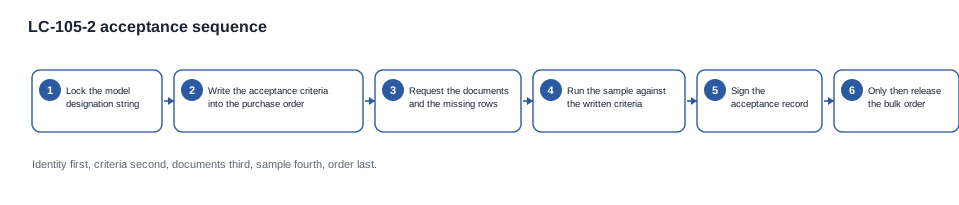
The sequence in the chart above is the order these criteria should be worked in. Locking the model designation first is not administrative tidiness: a runtime criterion written against the wrong model string is worthless, and a certificate request that names the wrong model returns the wrong document. Writing the criteria before requesting the documents keeps the request specific — a supplier answers "what is the start level" far more usefully than "tell us about the battery". And signing the acceptance record before releasing the order is what converts a sample from a demonstration into evidence.
The LC-105-2 buyer review checklist, item by item
The list below is the review itself, organised by where each answer comes from. Items 1 to 6 you can already do, because the catalogue row supports them. Items 7 to 14 need a written answer from the supplier before the purchase order is signed. Items 15 to 21 need a sample and a condition you define. Items 22 to 26 are the rows we do not publish, and each one needs a decision from you rather than a request from us.
- Record the published row. Bluetooth V5.4, two 55 mAh cells, charge time two hours or less, rated runtime about eight hours, magnetic charging, no feature line. Write this into the specification as a quoted line, with the catalogue page reference, and do not extend it.
- Record that the LC-105-1 row is identical. Same Bluetooth version, same cell configuration, same runtime, same charge time, same charging method, no feature line on either page. Any differentiation between the two must come from a written answer, not from the specification.
- Check the tier, not the model. Inside the 55 mAh × 2 tier the published runtime runs from about six hours to about eight hours, so quote the range and the two models behind each end of it rather than a single figure for the tier.
- Check what the audio group does not publish. No case row, no IP row, no weight, no dimensions, no sensor line, no storage line. Treat each absence as a row to request, not as a property of the product.
- Check the certification position. CE, FCC and RoHS appear nowhere in the catalogue and there is no per-model certification line. Name RED (EU) 2014/53/EU and EMC 2014/32/EU as the framework for your written request.
- Check the figures you must not borrow. The 158 g weight belongs to the MT6 camera glasses, and the case capacities belong to camera models. Neither can be quoted for the LC-105-2.
- Ask for the model designation on the device, the retail carton, the shipping carton and the packing list. One string, four places, in writing, before the order is signed.
- Ask for the rejection rule. How a carton whose designation does not match the purchase order is held, inspected and refused at goods-in.
- Ask for the sample-to-production consistency statement. Whether the sample unit and the production unit carry the same designation, and how that is confirmed.
- Ask for the runtime test condition behind the eight-hour figure. Volume, codec, source device, distance, sample size, mean or best case. If the supplier declines to state it, your criterion has to state it instead.
- Ask for the charge profile. Start level, end level, input current and voltage, and the time to reach the end level on a named adapter.
- Ask for the magnetic contact specification. How a correct seat is indicated, and how many seat cycles the contact is rated for.
- Ask for the charging case question in writing. Included at your quantity, capacity, charging method, separate line on the quotation and invoice, and the returned-unit rule when a case is missing.
- Ask for the documents. Certificate number, issuing body, validity period, covered model list, and the UN38.3 test summary for the cells, all tied to the model designation.
- Measure runtime under your own condition. Write the condition first, then measure across the sample size you specified, and report a mean.
- Measure charge time from a defined start level. A unit that starts from empty and a unit that starts from part-charged are not comparable, and the second is what arrives in your channel.
- Count magnetic seat cycles. Repeat the seat-and-lift action the number of times your criterion names, and record how often the contact failed to seat cleanly.
- Check the Bluetooth version by scan at goods-in. Record the scan result per batch against the purchase order.
- Establish a frame baseline. No weight is published, so weigh several units from the batch and record the spread — an acceptance criterion in its own right.
- Record the identity evidence per shipment. Photograph the designation label against the batch number on the packing list.
- Run the sample against the written criteria, not against the catalogue. The catalogue row tells you what was published; the sample tells you what arrived.
- Decide how to handle unit price and price tier. Not published. Either obtain them in writing before committing, or set the commercial review point after the sample passes.
- Decide how to handle MOQ and configuration variance. Not published, and it varies by configuration in most sourcing files. Obtain it in writing, and write whether it varies for the LC-105-2 specifically.
- Decide how to handle lead time. Not published, and a lead time without a starting point is not a lead time. Obtain the starting point in writing.
- Decide how to handle warranty terms and exclusions. Not published. Obtain the terms, and check that a two-cell product and its magnetic charging contacts are inside the scope rather than beside it.
- Decide how to handle the rows nobody publishes. Price, MOQ, lead time, warranty, certificate numbers, ingress rating, dimensions and storage are all outside our catalogue. Either your sourcing file carries a written answer from the supplier, or the order proceeds with those rows explicitly marked as unverified on your own internal sheet.
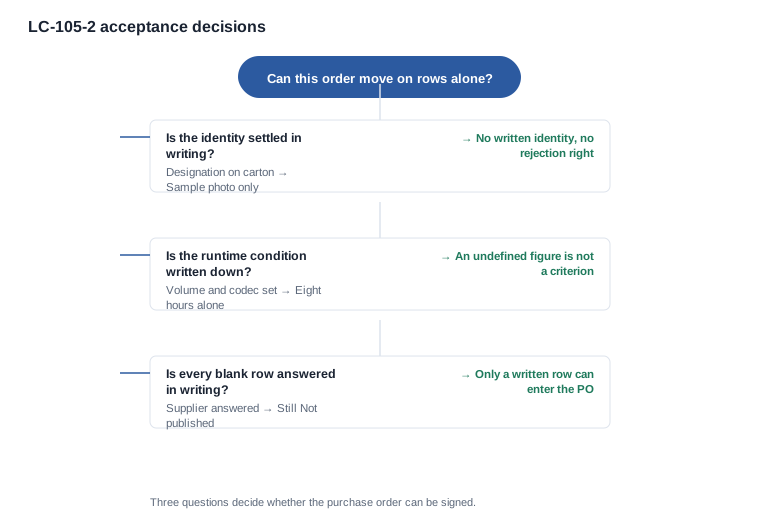
Three questions decide whether this order can move. The first is whether the identity is settled in writing — if the designation is not committed to the carton and the packing list, there is no rejection right at goods-in, and everything downstream inherits that weakness. The second is whether the runtime condition is written down, because an undefined figure is not a criterion and will not survive the first complaint. The third is whether every blank row has a written answer, because only a written row can enter a purchase order; a row that stays at Not published is a row you have decided to carry as risk, and that is a legitimate decision only when it is made deliberately.
We hold the published rows for the LC-105-2 and nothing beyond them. We will not fill an acceptance criterion with a figure that belongs to another model, and we will not present a runtime figure as measured when its test condition has never been published. What we can do is state which of the twenty-six items above can be closed from the catalogue alone, which need one email to the supplier, and which need a sample under a condition you write down first.
Send us the model designation you need printed on the carton, the runtime condition you intend to test under, and the four commercial rows you need closed before signing, and we will tell you which of them we can answer in writing and which need the sample stage.
Related reading
- The two published rows side by side — LC-105-2 and LC-105-1 battery and charging
- What the catalogue does and does not say about approval — LC-105-2 certification status
- The charging rows in context — LC-105-2 charging options
- Where this model sits against the rest of the audio group — LC-105-2 specifications and features
- The audio range this model belongs to — Bluetooth audio glasses
Send the model designation you need on the carton and the runtime condition you will test, and we will tell you which of the twenty-six review items can be closed from the published row alone.


