
Compliance work on the LC-105-2 begins with an unusual starting point: the catalogue prints five specification rows for this model and no certification row at all. The five published rows are a cell configuration of 55mAh*2, a rated endurance of about 8 hours, a charge time of two hours or less, magnetic charging and Bluetooth version V5.4. Everything a procurement file needs in order to describe the product is present in those lines, and everything a compliance file needs in order to prove conformity is absent from them.
This article is written for the person who signs for market access on a model that has not yet been through a laboratory: the brand buyer, the channel buyer, the sourcing manager and the compliance reviewer. It sets out what the LC-105-2 catalogue row actually publishes, why the absence of a certificate number against this model is a structural feature of the catalogue rather than an oversight in one document, which two frameworks genuinely apply to a Bluetooth product of this kind, what to request in writing before the first order, and a checklist you can run against whatever comes back.
What the LC-105-2 catalogue row publishes
Five lines are the entire published specification for this model: Bluetooth version V5.4, cell configuration 55mAh*2, rated endurance about 8 hours, charge time of two hours or less, and charging method magnetic. There is no feature row on the LC-105-2 page. That absence carries weight in a procurement conversation, because feature rows are where descriptive claims live — the sentence a channel can print on a listing, the wording a marketing team can quote, the claim a reviewer can challenge. For this model there is no such sentence to reuse.
Across the eight audio models in the range, five publish no feature row at all: the K01 and the LC-105-1, the D12 and the LC-105-2, and the K02. The remaining three do publish one, and the contrast is instructive for anyone evaluating what an absence means. The D11 carries a surround sound row and a long battery life row, the G07 carries an ultra-slim row and a detachable temple row, and the YK12 carries surround sound and a slim temple row. Where the catalogue speaks, it speaks in claims. Where it does not speak, a buyer has nothing to quote and must go and ask.
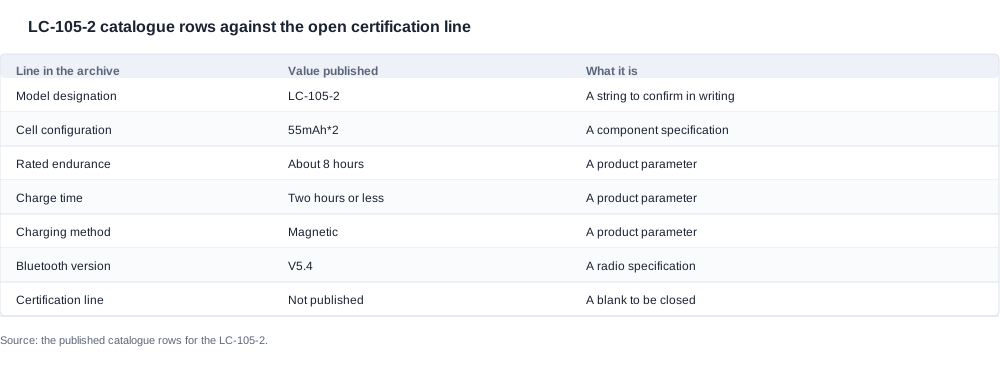
The table below sets out the lines that will enter the compliance archive for this model, and what each one actually is once it is filed.
| Line that enters the archive | Value published for the LC-105-2 | What that line is |
|---|---|---|
| Model designation | LC-105-2 | A string, still to be confirmed in writing by the supplier |
| Cell configuration | 55mAh*2 | A component specification, not a compliance record |
| Rated endurance | About 8 hours | A product parameter, not a compliance record |
| Charge time | Two hours or less | A product parameter, not a compliance record |
| Charging method | Magnetic | A product parameter, not a compliance record |
| Bluetooth version | V5.4 | A radio specification, not a compliance record |
| Certification line | Not published | A blank line in the file to be closed by a document |
Restating any of those parameter rows does not convert it into compliance evidence. A cell configuration becomes a transport question and nothing else. A charge time becomes an operational figure. A Bluetooth version is the one row that raises a radio question, and it raises it for the framework rather than for the model. A buyer who treats the parameter block as evidence of conformity has simply read the wrong column of the specification sheet.
Two structural comparisons help place this model inside the range. Endurance divides the eight audio models into three bands: about 8 hours for four models (the K01 and the LC-105-2, and the K02 and the LC-105-1), about 7 hours for two (the D11 and the D12), and about 6 hours for two (the G07 and the YK12). Cell configurations divide them differently: 90mAh2 for the K02 and the K01, 55mAh2 for four models (the LC-105-1 and the G07, and the LC-105-2 and the YK12), and 100 mAh each for the D11 and the D12. In other words, the LC-105-2 fits two cells of 55 mAh where the D11 and the D12 each fit one cell of 100 mAh, and that is a difference of architecture rather than of scale: the paired figures and the single figures are not two points on one scale, so they cannot be read as one capacity being larger than the other. The LC-105-2 sits at the top of the endurance bands at the same time. Charging method splits the audio group once more: a Type-C charging interface appears on the D11 and the D12 only, and magnetic charging is the default across the audio side of the range.
Two further absences are worth recording precisely, because they are the kind of line a buyer misreads. The audio group as a whole publishes no charging case row — not for this model and not for any of the eight. That is a statement about publication. It is not a statement that the product has no charging case, and the two must not be merged. The same holds for ingress protection: no audio model carries an IP row, and the only two models anywhere in the catalogue with an IP54 line are the V06 and the S7. The LC-105-2 therefore has no ingress claim available to print on a listing, on a datasheet or in a tender response.
One last observation about the endurance figure completes the parameter picture. Six models across the catalogue are marked at about 8 hours — the LC-105-1 and the ZH12, the LC-105-2 and the K02, and the YKC02 and the K01 — and those six span four different cell configurations. Not one of them publishes the test condition behind the number, so the figure is usable for grouping and not for comparison against a rival's tested figure.

Why no certificate number appears against the LC-105-2
The absence has three separate causes, and a request that separates them is far shorter than one that treats the whole gap as a single unanswered question.
The first cause is the nature of the instrument. A certificate is a dated document issued by a named body against a stated requirement, and a catalogue row is none of those things. A catalogue describes what a product is; a compliance file records what a third party checked. A buyer who asks a catalogue for a certificate number is asking a source that structurally cannot answer, and no amount of further reading of the published pages will produce the number.
The second cause is the export certification page, which carries ten patent certificates — eight appearance-design patents and two utility-model patents — presented as images. That total is a company-level fact and it belongs to the company, not to this model. A patent is a right to exclude: it protects an ornamental shape or an invention at a lower threshold of inventive step. No patent certificate is issued by a body that performs conformity assessment, none of them records a test against a safety, radio or electromagnetic requirement, and none of them carries a validity period tied to a market. Hand one to a market surveillance authority as evidence of conformity and the enquiry begins again from zero, with less time in hand than before.
The third cause decides the whole approach. No line in the catalogue maps a model designation to a certificate number, an issuing body and a validity period, and there is no schedule of covered models for any model. Counting the catalogue text directly, the terms CE, FCC and RoHS do not appear in it at all — not for this model, not for its twin, and not for the range. So there is no route by which an LC-105-2 certificate can be derived: not from a sibling model, not from the export page, and not from the existence of the export page itself. A request built on the assumption that such a route exists will stall at the first reply.
The twin-model question sharpens this third cause. The catalogue page for the LC-105-1 and the catalogue page for the LC-105-2 print identical rows — the same Bluetooth version, the same cell configuration, the same endurance, the same charge time, the same charging method and the same absence of a feature row — and the catalogue states nothing about what separates the two. Identical rows create a strong temptation to believe that identical paperwork follows, and that belief is the expensive mistake available on this platform. Conformity evidence attaches to a model designation, so a file written for the LC-105-1 does not carry the LC-105-2 with it. A document has to name the model that is actually shipping.
Read the gap narrowly, because a wide reading produces a false finding. What is missing is publication, not necessarily the product. The catalogue does not publish a certificate number for the LC-105-2, and that sentence says nothing about what the supplier holds in its own file. A buyer who concludes from the catalogue alone that this model has no compliance documentation has turned a documentation gap into an accusation, and that accusation is harder to retract than the original request. The useful formulation is narrow: the evidence is not in the document you hold, the supplier is the only party that can produce it, and the request set below is the route to it. A dated refusal naming the specific report that does not exist is still an answer, and it is an answer a reviewer can file.
The evidence sits in four layers, and knowing which layer a fact belongs to tells you how long it will take to obtain.
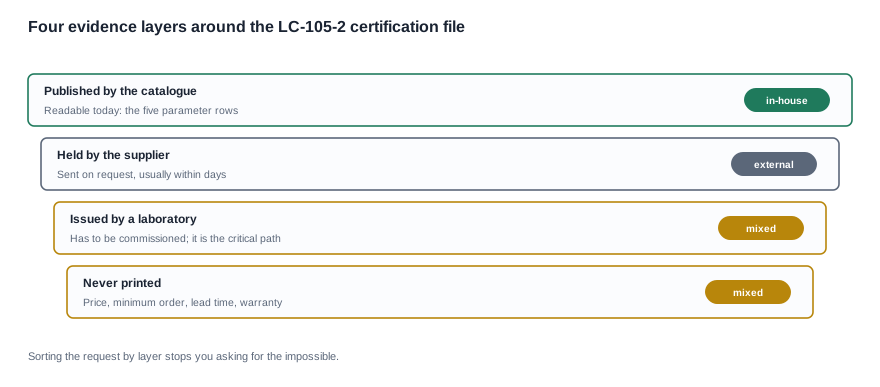
The first layer is what the catalogue prints, which you can read today. The second layer is what the supplier holds and will send on request, usually within days if the file exists. The third layer is what only a laboratory can issue, which has to be commissioned and therefore sits on the critical path. The fourth layer is what will never appear in printed form at all — unit price, minimum order quantity, lead time and warranty — and which belongs in the quotation instead. Sorting your request into those four layers before you send it stops you asking a supplier for something they cannot produce, and stops you expecting a catalogue page to carry a commercial term.
The two frameworks that apply to the LC-105-2
Because the LC-105-2 publishes Bluetooth V5.4, it is a radio product, and radio equipment rules apply to it in full. For a European Union destination the governing instrument is the Radio Equipment Directive (EU) 2014/53/EU, which addresses spectrum use and radio behaviour. The second instrument is the Electromagnetic Compatibility Directive (EU) 2014/32/EU, which addresses a different question: whether the emissions and the immunity of the product interfere with other equipment. These two are assessed separately and referenced separately, so a supplier who cites one directive number in answer to a question about the other has not answered, and a document described loosely as covering the European requirements leaves you unable to tell which assessment was actually performed.
Both names earn their place in a request because they tell you which document to ask for. Neither is a certificate held against this model, and no certificate number, issuing body or validity date is published for the LC-105-2 under either instrument. A request that names a framework by number and full title tends to return a document or a dated refusal; a request that says only "your certificates" tends to return a brochure. The distinction between those two answers is the whole negotiation.
The radio side has an open parameter worth raising explicitly. The catalogue publishes no radio output power and no module reference for any model in this range, which means there is nothing on the printed page against which a technical file can be checked when a future revision of the hardware appears. Ask which module sits behind the V5.4 radio in this model, and ask what the output power is, so that a later comparison of samples is possible at all. Two more points keep the request proportionate. A supplier that has run a proper radio and electromagnetic compatibility programme will usually have both documents from one laboratory exercise, because the same setup covers much of both; receiving only one may indicate that the exercise was never completed rather than that half the answer was withheld, so ask for both and treat the second as a completeness check. And a refusal remains useful, because a dated and specific statement that a report does not exist tells a reviewer that the question was asked and answered, and tells you early which lines to escalate to a supplier manager.
The battery side runs on a different track. The LC-105-2 carries a 55mAh*2 configuration and charges magnetically, and lithium cells shipped in any arrangement raise transport questions that a radio conformity document does not answer at all. That means a UN38.3 test summary for the cell as fitted, plus whatever cell-safety documentation your destination and your logistics provider require. Because the audio group publishes no charging case row, you cannot assume a case ships and you cannot assume it does not: if a case does ship, its cell needs its own coverage and its own test summary, and the catalogue gives you no basis for deciding which situation you are in. That is a question for the supplier, and it should be asked as one.
The substance regime sits outside both directives and is handled as a third, separate piece of work with its own declaration and its own scope. The applicable regime differs by destination market and by material, so treat it as a per-destination request: state the country and the date by which the declaration has to be current. Alongside it sits the commercial structure that no technical document covers — the manufacturer identification and economic operator details that appear on the label, the accompanying paperwork and the online listing, and who holds that role in the destination market. If the product will be sold under your own brand, ask explicitly which entity a regulator contacts on your documentation, because the answer decides who carries the obligation once the shipment has cleared.
The boundary of what this article will claim is narrow on purpose. A company statement of conformity only opens a conversation, and the real question a buyer should ask is whether the supplier can produce documents that name the model it is selling. We do not publish a certificate number we have not seen, we will not state a certification status for the LC-105-2 that our documentation does not support, and we will not present any conformity claim as verified. What the catalogue does publish for this model is the five parameter rows above, and that is the honest baseline for the product. The published LC-105-2 specification list sets out those rows in full.

What a buyer has to request before the first order
A document request works when it is written as named documents with named conditions rather than as a general question about compliance. Ask the whole question at once and the reply arrives as a brochure; ask for one specific document and the reply arrives as the document, or as a dated refusal you can act on. The eight lines below are written in the order a procurement team should send them.
- Radio equipment conformity evidence for this model. Name the Radio Equipment Directive (EU) 2014/53/EU explicitly, and require the document to state the model designation, the standards applied, the issue date, the validity period and the batch or serial range covered. A document with no validity period and no covered range describes an earlier configuration, and a configuration change is exactly what a supplier is most likely to make without mentioning it.
- Electromagnetic compatibility evidence, held as a separate document. The Electromagnetic Compatibility Directive (EU) 2014/32/EU, with its own report reference and its own covered range, requested separately so that one combined reference cannot hide an assessment that was never carried out.
- A written confirmation that the file names this model and not only its twin. The LC-105-1 and the LC-105-2 publish identical rows, so the question has to be asked explicitly: does a document exist that names the LC-105-2, and if the answer is that the platform is covered, where does the designation appear.
- Cell and transport documentation for the 55mAh*2 configuration. A UN38.3 test summary for the lithium cells as fitted, the cell-safety documentation your logistics provider requires, and confirmation that the charging method on the unit is magnetic, so the paperwork describes the hardware that actually ships.
- The radio module and output power behind the published Bluetooth version. The catalogue publishes no radio parameters for this model, so ask for the module reference and the power figure, and record both against the model designation.
- A material and substance declaration for the destination market. State the destination country and the date by which the declaration must be current, and keep it as a separate item from the radio papers so the scope stays visible.
- The manufacturer identification and economic operator details for the destination market. Ask which entity a regulator contacts on your documentation, and where those details will appear on the label, on the accompanying documents and on the online listing.
- A written statement of what is not held, together with a change-control undertaking. A supplier who states plainly which documents do not exist gives a reviewer more usable information than one who answers optimistically, and the change-control half tells you what you would be notified about if a component, a supplier or a process changed in a way that would affect the documentation.
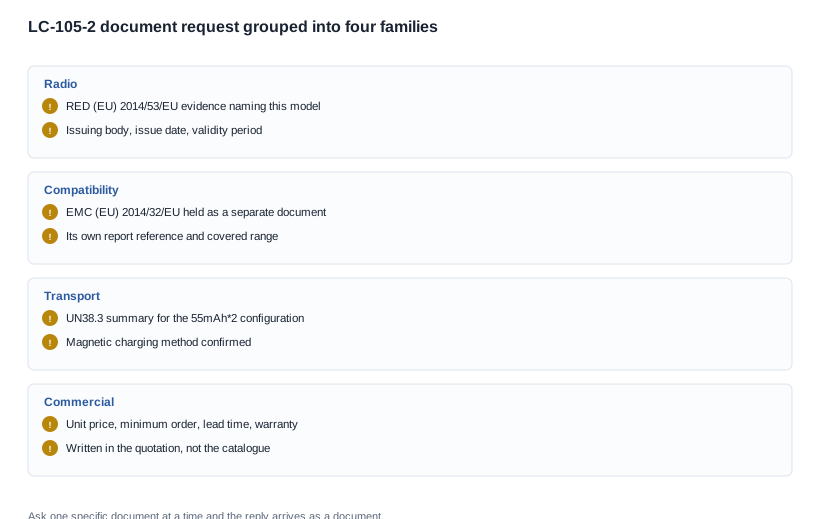
Sort those eight lines into three buckets before you send them. Documents whose absence should stop the order become conditions in the purchase order, which is a normal commercial structure because it transfers a documentation obligation rather than a price obligation. Documents whose absence creates work later go out as a request with a date attached. Documents you would like but can live without stay out of the conversation until the first bucket is resolved. Buyers who send one undifferentiated list receive one undifferentiated answer; buyers who send a sorted list receive a sequence they can act on, and they can see early when a stall is a commercial signal rather than a scheduling problem.
Write each line the way your reviewer will actually ask it. Reviewers do not ask whether the supplier holds the radio report; they ask what evidence supports radio conformity for the LC-105-2 in the destination market, so write the request in the second person and against a named market. Attach a deadline and a consequence, both expressed commercially: before the purchase order is signed is actionable, and at your earliest convenience is not.
Several reply patterns deserve to be treated as red flags rather than as progress. A document that names no model designation, or that names a family instead of this model, is the most common reason a compliance file stalls after signature. A validity date that has already passed, or that expires before your planned shipment, is a scheduling problem to be settled before the order is placed rather than after. A reply consisting only of framework names, with no laboratory, no report reference and no unit under test, describes a route rather than a completed assessment. A supplier claiming that the export certification page covers the model is making a category error, and one a buyer can correct quickly once the distinction is understood. A supplier who asks you to sign the purchase order before the documents arrive is not necessarily being unreasonable, but the answer has to be written into the order as a condition rather than carried as an assumption.
The commercial lines sit alongside the technical ones and stall files just as often. Unit price, minimum order quantity, lead time and warranty terms are not published for this model, and no attempt should be made to infer them from any other model or from the range. They belong in the quotation, written against the same configuration and the same model designation as the documents in the request, so that a later comparison is between like configurations rather than between a quotation and an assumption. Sample order and bulk order terms should be settled on the same document set, because a sample arriving under one designation and a bulk shipment under another is the expensive version of this problem. File each request, each reply and each document against the model designation rather than against the person who sent it, because the question returns at the next order and the fastest answer is the one already on file.
The sequence below is the order in which that work actually moves.

Locking the model string first costs nothing and prevents the most expensive failure mode, which is documentation that arrives for a designation nobody agreed on. Third-party testing comes third because it is the most costly route and should only be used for the lines the supplier genuinely cannot close. Writing the confirmed numbers, validity dates and covered ranges into the specification sheet and the purchase order comes next, because a document that lives only in an email thread is not a condition anybody can enforce. Packaging artwork comes last for the same reason: marking and labelling requirements are assessed separately, and artwork released against the wrong document set is expensive to correct once tooling exists. The export documentation checklist covers the paper that travels with the goods, and the certification coverage notes set out the reasoning behind per-model rather than per-platform files.
The LC-105-2 certification status checklist
For the LC-105-2 the file closes through three gates, and each one has to clear before the next can be worked on. The first gate is the compliance file itself: does it cover the LC-105-2 designation, or only the LC-105-1? The second gate is artwork: can the packaging print the confirmed model string? The third gate is market access: does the product enter the destination market on the strength of what the first two gates produced? A gate that fails does not stop the work; it identifies which gate has to be reopened first, and the order of the questions is the order of the dependencies.
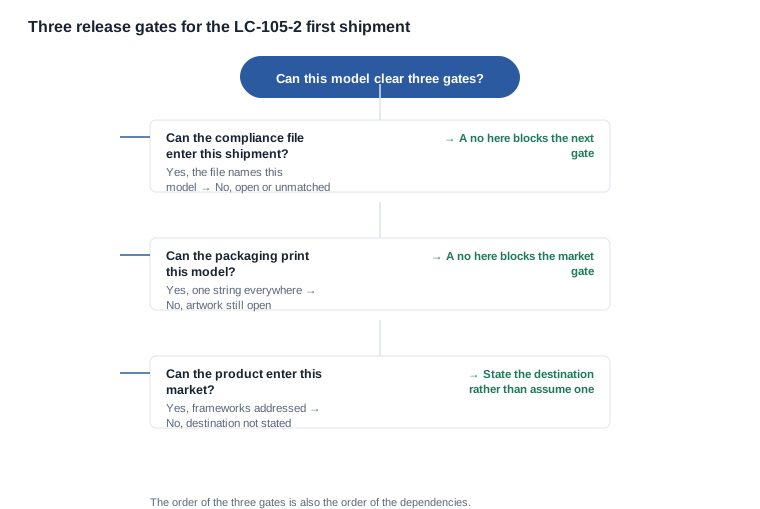
The gate on the shipment is documentary. The file is complete for this model when the designation is confirmed in writing, the certificate numbers, issuing bodies and validity dates are stated, the covered-model schedule names the LC-105-2 rather than the LC-105-1, the electromagnetic compatibility report is held separately, the substance declaration sits apart from the radio papers, and the transport scope covers the 55mAh*2 configuration as fitted.
The gate on the artwork is a consistency test. The string on the box, on the label, on the manual, on the warranty card, on the declaration of conformity and on the customs declaration has to be one string, and it has to be the string that appears on the documents. If artwork is still open, it should stay open until the naming answer is in, because artwork is the cheapest thing to change before it is printed and among the most expensive to change afterwards.
The gate on the market is the framework question. For a European Union destination the file has to address the Radio Equipment Directive (EU) 2014/53/EU and the EMC Directive 2014/32/EU, and the economic operator details have to be ready for the label and the listing. For other destinations the requirements differ, and the correct response to a supplier is to state the destination rather than to assume one.
Before any of this turns into a purchase order, every answer has to survive the checks below. Some lines close from documents already in hand. Others stay open at the moment of signing, and the honest position is to name them as open rather than leave them implied. What follows is the list worth running against the LC-105-2 file, line by line.
- Model designation on every document. Confirmed in writing, identical across the radio paper, the electromagnetic compatibility paper, the substance declaration and the transport file.
- The twin row resolved. A written answer stating whether a file names the LC-105-2 specifically, given that the two rows are identical.
- Radio evidence against the Radio Equipment Directive (EU) 2014/53/EU, with an issuing body, an issue date and a validity period that covers your shipment date.
- Electromagnetic compatibility evidence held separately, with its own report reference and its own covered range.
- Transport evidence for the 55mAh*2 configuration, issued for the arrangement you will actually ship, with the magnetic charging method confirmed.
- Radio module and output power recorded against the model designation, since the catalogue publishes neither.
- Substance documentation issued for the destination market, dated, and naming the entity that holds the manufacturer role there.
- Covered batch or serial range stated on the documents, and the traceability route from a unit on a shelf back to that range understood before the first shipment.
- Change-control undertaking obtained, so that a future component or process change is something you hear about from the supplier rather than discover at an enquiry.
- Written statement of gaps on file, dated, covering every line the supplier does not hold for this model.
- Commercial lines in the quotation, with configuration, model designation, minimum order quantity, lead time and warranty written against the same unit the documents cover.
- Storage of the file against the model designation, with a named expiry review for each dated document.
The three questions above apply to every document that arrives, and they are quick to run. If the designation on the document is not the designation on the order, the document cannot enter this batch, and a covering letter does not cure the mismatch. If the string on the packaging differs from the string on the file, the packaging cannot go out. And a document issued for one destination does not transfer to another, so the country in your request has to match the country printed on the document. Where a model-level gap is unavoidable, the right response is a written disclosure that names the gap, its owner and its date, filed against the LC-105-2 rather than left in an inbox.
Related reading
- The rows published for this model — LC-105-2 smart glasses specifications and features
- The twin platform question — LC-105-1 versus LC-105-2
- The document set in general — OEM ready platforms export documentation
- Radio identifiers worth requesting early — Bluetooth SIG certification buyer checklist
- The cell side of the file — Battery transport compliance buyer checklist
Tell us the destination market and the shipping mode for the LC-105-2 and we will say which of the eight requests sit on the critical path for that lane.


