

MT6 smart glasses best for portability and weight is a question the published rows answer more cleanly than any other model in this catalogue, and the answer has a precise boundary. The model carries the only weight figure published anywhere in these specifications — 158 g — together with an explicit portability feature row, and it pairs that with a 1200 mAh case that folds. On portability, it is the best-documented product in the camera group by a wide margin.
That is a documentation result, not a purchase recommendation. No price, unit price, price tier or landed cost is published for any model here, and a weight figure says nothing about image quality, endurance, cost or compliance. What follows sets out what this model supports, what a buyer profile can safely be told, and the criteria for deciding whether it belongs on your shortlist.
MT6 smart glasses best for: the rows that carry the claim
Four published rows do the work here, and one absence limits how far they can be taken.
The 158 g weight. Published on the product page alongside the portability and lightness feature rows. It is the weight of the glasses body with the 265 mAh battery and the camera fitted, and it excludes the folding charging case.
The portability feature row. The page describes the product as portable and as light, in those terms, and pairs that with the weight figure. This is the rare case in this catalogue where a marketing descriptor and a measurement sit on the same page.
The 1200 mAh folding case. Published with a capacity, and the only folding case in the catalogue. A folding accessory is a portability accessory, and it is what turns the weight figure from a component specification into a product-level one.
The 265 mAh cell. A middle value among the camera models, sitting between the 260 mAh group and the 290 mAh group.
The absent charging method. The model has no charging-method row. That belongs to a group of four camera models — the CY05 and the MT6, and the L1 Pro and the CY03 — that share this absence, and all four publish a case capacity. It does not damage the portability claim, but it means the charging story cannot be told in a way that supports it.
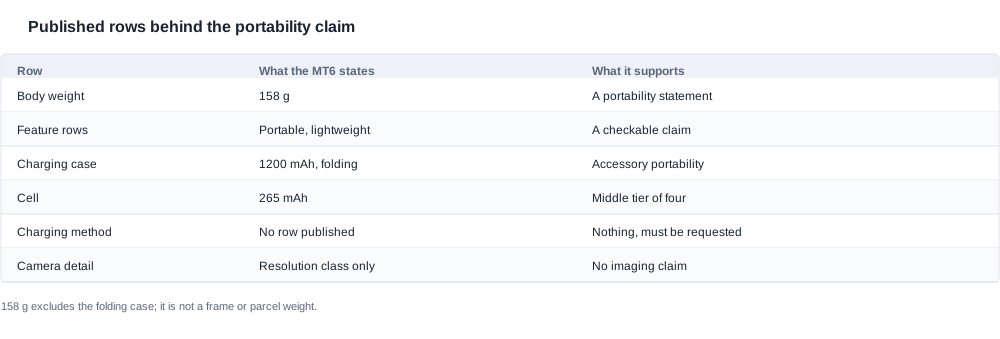
Compare that with the rest of the camera group and the result is stark. No other model publishes a weight at all. No other model publishes a case capacity and a fold behaviour together. No other model pairs a measurement with a descriptive feature row on the same page. On the specific question of whether a buyer can claim portability with a number behind it, this model is the only one that can — and that is a statement about the documentation, which is the only thing these specifications can support.
The 158 g claim and the three claims it cannot carry
The weight figure is genuinely useful and genuinely easy to misuse. Four rules keep it honest.
Rule one: it is not a frame weight. The catalogue publishes no bare frame weight for any model. The 158 g figure includes the battery and the camera, so describing it as the weight of the frame misstates what was measured. It is the weight of the assembled product the customer carries.
Rule two: it is not the packed unit weight. The case is not included, and the case carries a second cell. Anyone modelling freight from the 158 g figure will understate the parcel, and the correction after a master carton is printed is a reprint rather than an edit.
Rule three: it cannot be transferred. Because no other model publishes a weight, this figure cannot be borrowed by a neighbouring product. The temptation to spread a published number across a shared platform is strong and produces specification sheets that are wrong in a way nobody catches.
Rule four: it is not a shipped weight. Packaging, inserts and the master carton all add mass, and none of it is published for any model.
Against those four limits, the claim it does support is a real one: this model is documented as light, and the number behind that word is available for a customer to verify. That is worth having, because portability is one of the few product benefits a buyer can demonstrate in ten seconds in a shop rather than describe in a paragraph.
The AI camera glasses shipping weight analysis covers the arithmetic that follows once a packed unit has been weighed on a calibrated scale, and that measurement remains the only figure worth putting into a freight model.

Who this model suits, as a buyer profile
Rather than a use case, this is better expressed as a buyer profile — because the difference between a model that fits a channel and one that does not here is operational, not situational.
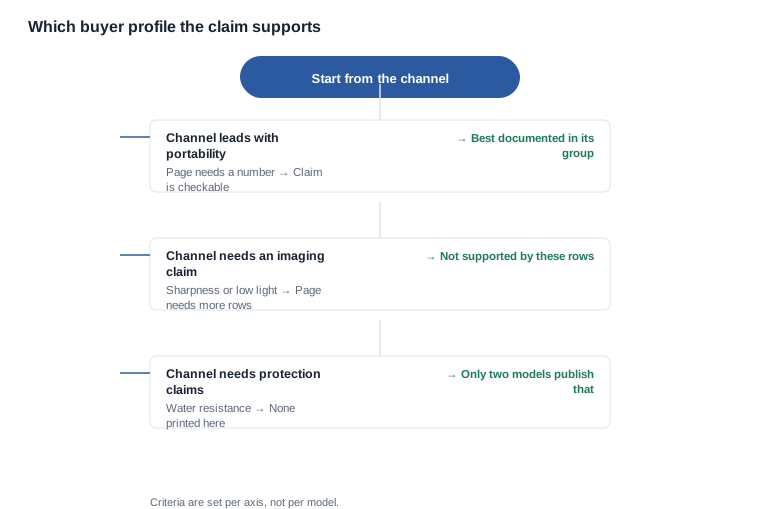
A channel that competes on portability. If your product page leads with how light something is, this is the only model in the camera group where that page can be written with a number. That is a real commercial advantage in a category where most listings compete on adjectives.
A brand that needs a documented, checkable differentiator. A published weight is unusually durable marketing material, because it is difficult for a competitor to dispute and easy for a customer to test. It also travels into retail conversations, packaging copy and sales training without needing reinterpretation each time.
A channel whose logistics team is the constraint. If parcel weight is the binding constraint on your operation, the 158 g figure gives your freight team a starting point even though the case still has to be weighed. A model that publishes nothing at all gives them nothing.
A channel that cannot use it. If your listing depends on an imaging claim, this model does not support one — no sensor model, no field of view, no frame rate, no video format. If it depends on an endurance claim, the about-seven-hour runtime is a point with no stated condition, which is weaker than the ranges published on neighbouring models. If it depends on a protection or water-resistance claim, this model publishes no IP54 marking; only the V06 and the S7 do.
The last group matters as much as the first. A model can be the best-documented in its class on one axis and unusable on another, and the shortlist criteria have to be set per axis rather than per model.
What it costs to claim portability, and what it saves
Claiming portability has costs that are easy to underestimate, and naming them is part of the criteria.
The cost is the case. A product that claims portability and ships with an accessory that has to be carried alongside it is making a claim it then qualifies. The fold helps — a folded case is smaller than a rigid one — but the case weight is not published, so the qualification cannot be quantified from the catalogue.
The cost is the transit risk. A folding case introduces a hinge and a failure mode a rigid case does not have. Before a first shipment, put one through a shipping cycle on sample units and write down what happened; after a complaint, the same test costs considerably more. The durability approach for the sport group covers how to record such a test so it means something.
The saving is the freight conversation. A published body weight lets your logistics team start modelling before the accessory is measured, which is unusual in this category and worth more than it sounds when lead times are long.
The saving is the marketing claim. One sentence, one number, one page, no qualification needed about what the number does or does not include. In a category where almost every claim has a footnote, that is worth pricing.
No price is published for this model or any other, so none of those costs can be expressed as money here. What can be expressed is direction: this model trades a small amount of specification work and one transit risk for one durable, checkable marketing claim and a head start on freight modelling.
Shortlist criteria and red flags
Six criteria decide whether this model belongs on a shortlist. They are written so that they can be answered before a sample arrives.
- Does your channel lead with portability? If yes, this is the only model here that can support the claim with a number. If no, the advantage largely disappears.
- Does your operation act on a partial parcel weight? If yes, the 158 g figure is a usable starting point. If your freight model needs a final figure before it can run, the case still blocks it.
- Can your product page carry a resolution class without an imaging claim? If yes, the camera row is usable as stated. If your channel needs a sharpness or low-light claim, this model does not support one.
- Can your operation accept an unstated charging method? If yes, the absence is a documentation detail. If your customer service team needs a written answer on day one, it is not.
- Can your logistics operation absorb a folding accessory? If yes, proceed. If returns from transit damage would be expensive in your market, test the fold first.
- Can you accept an endurance figure with no test condition? If yes, publish it as a point with the condition noted as unpublished. If your channel needs a defensible endurance claim, ask the supplier to run a protocol on sample units.

Four red flags are specific to this model and worth naming before an order is placed. The first is a claim that the 158 g figure includes the case, which is false by a wide margin. The second is a claim that it is the frame weight, which is also false and is the most common error in this category. The third is the 158 g figure being used as a shipped weight in a freight model. The fourth is an endurance claim built on the about-seven-hour point without a stated condition, which no supplier has published.
None of those four is a reason to avoid the model. They are reasons to write the specification carefully, which on this product is a shorter job than on most others in the catalogue.
The request list that closes the remaining gaps
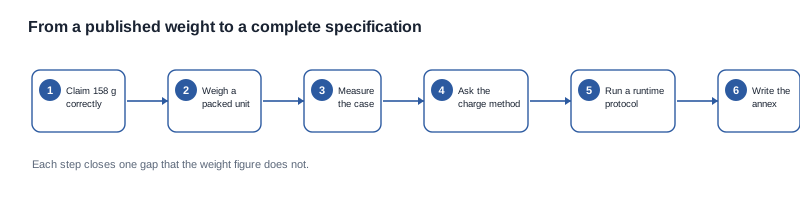
Six questions, ordered by how much each answer changes the commercial outcome:
- What is the packed unit weight with the case in the carton, on a calibrated scale? The only measurement that turns the 158 g figure into a parcel input.
- What is the case weight and what are its external dimensions? Neither is published, and both are needed before a carton is finalised.
- What does the case do — recharge the frame or hold a spare cell? Unpublished for every case in this catalogue, and it determines whether an endurance claim is available at all.
- What charging interface does the frame use? The method row is absent, and the answer affects what belongs in the box.
- What is the runtime test condition? Camera state, radio state, battery endpoints and sample size. A supplier who will run this on sample units converts the weakest row on the sheet into the strongest.
- What are the minimum order quantity, lead time, sample policy and warranty terms? None of this is published, and all of it belongs in the same document as the specification annex.
Around those, the compliance question is the same one every model in this catalogue raises. The documentation carries a company-level export certification page holding ten patent certificates — eight appearance-design patents and two utility-model patents — and no per-model certification row anywhere, and the catalogue text contains no reference to CE, FCC or RoHS. For European Union buyers the relevant buyer-side instrument for radio equipment is the Radio Equipment Directive (EU) 2014/53/EU; the electromagnetic compatibility directive, (EU) 2014/32/EU, is a separate requirement and the two are routinely confused. Ask for the scope that applies to the model in your purchase order and check the model designation on whatever arrives.
How to build the claim so it survives reuse
The portability claim on this model has an unusual property: it can be repeated by anyone, in any channel, without reinterpretation, and it will still be true. Most product claims degrade as they travel — a copywriter tightens a sentence, a retailer abbreviates a specification, a distributor's listing drops a qualifier — and after three handovers the claim is a different claim. A single measured figure degrades much more slowly, because there is nothing to tighten.
That property is worth exploiting deliberately, and it changes how the specification should be written. Three habits make the difference. First, write the weight claim once, in the exact form that will be reused, and treat that form as a controlled string rather than as marketing copy — so that the packaging, the listing, the retailer feed and the sales script all draw from one source. Second, attach the exclusion to the claim at the first point of publication rather than in a footnote; "158 g for the glasses body, case not included" is one sentence, and it prevents the four misinterpretations that follow when the figure travels alone. Third, decide in advance who owns the number, so that a later request to change the wording goes through an owner rather than through whoever is writing at the time.
The same habit applies to the claims that cannot be made. Writing "the case weight is not published" once, in a place the whole team can see, prevents three separate teams from each deciding that the omission looks like an oversight worth quietly fixing. In this category the omissions are the specification, and treating them as part of the specification is what keeps a page defensible.
There is a commercial consequence too. A claim that can be reused without reinterpretation is cheaper to maintain than a claim that needs re-approval each time it appears, and in a channel operation where copy passes through legal, retail and localisation review, that difference compounds. This is not a reason to prefer one model over another; it is a reason to prefer this claim over a more exciting one that cannot survive the same number of handovers.
Where this model sits in a wider range decision
If the question is not which single model to buy but what a range should be built around, this model's published rows have a specific structural contribution that is worth naming.
It is the only model in the camera group with a published weight. That makes it the natural anchor for any range where freight or handling is part of the value proposition, because it is the only place where a mass figure exists to anchor an estimate.
It is one of only five camera models with a printed case capacity. In a range where accessories are sourced centrally, that is one of two cases where the accessory can be ordered against a number rather than against an enquiry.
It is one of eleven models on a shared cell tier, with the cell tier being one of four published values across the group. Carrying this model alongside others in the 260 mAh and 290 mAh groups means several accessory regimes to manage, which is a real cost and should be planned rather than discovered.
It publishes no feature rows that describe the frame or the lens. The two rows it does publish describe portability, lightness and the foldable case. For a range built around a brand identity rather than around a specification, that thinness is less costly than it would be for a reseller, because there is less on the page that can be described wrongly.
The trade-off a range decision has to make here is between a claim that is checkable and a specification that is thick. This model has the checkable claim and not the thick specification. Whether that is the right trade depends on whether your channel competes by being verifiable or by being able to answer every question on a product page — and for most operations the answer is that a claim you can defend beats five rows you cannot, which is the argument for including this model rather than for excluding it.
One final point on sequencing, because this model invites a specific delay. The gaps here are gaps in supporting detail, not in the claim itself, and the claim can be published today. A buyer who waits for every supporting figure before publishing anything ends up publishing nothing, which loses the one advantage this model has. The workable order is to publish the weight claim now in its controlled form, carry the five open items on a named list with owners and dates, and treat the parcel weight as the one item that blocks the logistics plan rather than the marketing plan. Separating those two plans is what makes this model usable on a normal schedule, and it is also what keeps the claim from quietly acquiring a qualifier it did not need.
What we will publish for this model is the 158 g body weight, the 265 mAh cell, the two-hour-or-less charge ceiling, the about-seven-hour runtime, the 1200 mAh folding case and the portability and lightness feature rows, each exactly as documented. What we will not publish is a parcel weight, a frame weight, an endurance guarantee, an imaging claim, a water-resistance claim, a charging method that is not printed, or a certificate number the documentation does not contain. On the single question this article addresses — which model here can support a portability claim with evidence — the published rows give one answer, and the MT6 specification list and the MT6 value analysis are the two honest places to read the underlying rows.


