
These two models are closer than most comparisons in this category, and the honest way to start is by saying how close. Both publish an eight megapixel camera resolution class. Both publish a runtime of about seven hours and a charge time of two hours or less. Both publish no charge method, which puts them in the same group of four camera models where that row is absent. Both publish no ingress rating, no colour options, no Bluetooth version and no per-model certification row.
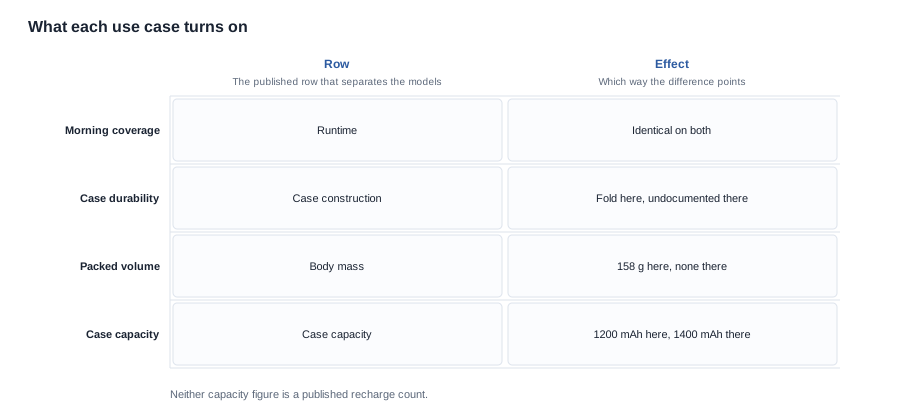
Three published rows separate them. The cell capacity is 265 mAh on this model against 290 mAh on the CY05. The case is 1200 mAh and folding here against 1400 mAh there. And this model publishes a 158 gram body mass, the only mass figure in the entire catalogue, while the CY05 publishes none at all.
That is the entire factual separation. What follows is how to turn three rows into a use-case decision without pretending the record supports more than it does.
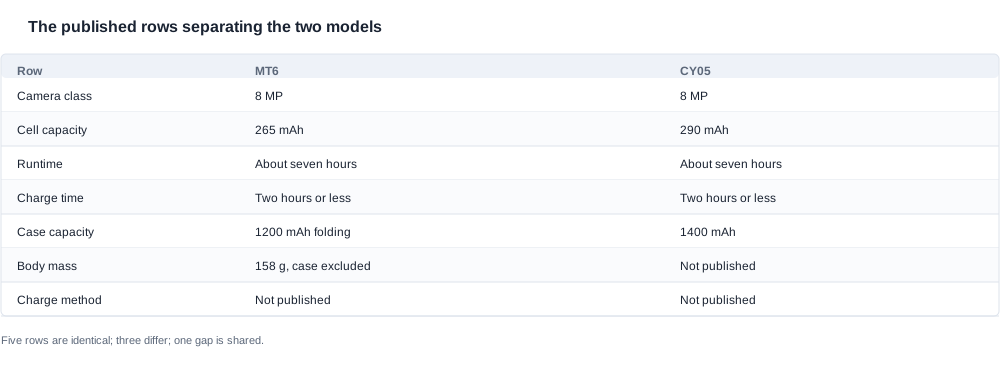
MT6 smart glasses vs CY05 use case fit: reading the three separating rows
The case row is the most consequential and the least obvious. This model ships with a case described on its page as portable, ultra-light and foldable. It is the only camera model in the range whose case is described as folding. The CY05 publishes a 1400 mAh case and no descriptor at all.
Two consequences follow, and they point in different directions. The fold is a mechanical element, which makes it a testable durability point and a plausible failure mode — so if your use case involves the case travelling in a bag, being dropped, or being folded repeatedly, the fold is a question to put to the supplier rather than a feature to rely on. And the fold is a moulded mechanism, so it is the kind of component that shows up as a distinct line in a quotation, which matters if you are comparing cost structures rather than specifications.
The capacity runs the other way. 1400 mAh against 1200 mAh means the CY05's case is larger by the published figures, and a larger case is not necessarily a better one — capacity you do not use costs volume and weight, and the case mass for this model is not published at all. What the numbers support is a planning statement: on published capacity alone, the CY05's case holds more, and this model's case is the one that folds.
The mass row is the one that changes what you can actually do. Because this model publishes a body mass, you can write an acceptance criterion, brief a freight team on a real number, and set up a sample measurement that produces a number you own. Because the CY05 publishes none, any such activity there starts with a request rather than a measurement. That is not a quality judgement; it is a difference in what evidence is available to work from.
The cell capacity is the weakest of the three as a discriminator. Both models publish roughly the same duration from different cells, which tells you the two published durations were probably measured under different workloads, or one of them is generous. Without test conditions on either row, the capacity difference cannot be turned into a runtime advantage.
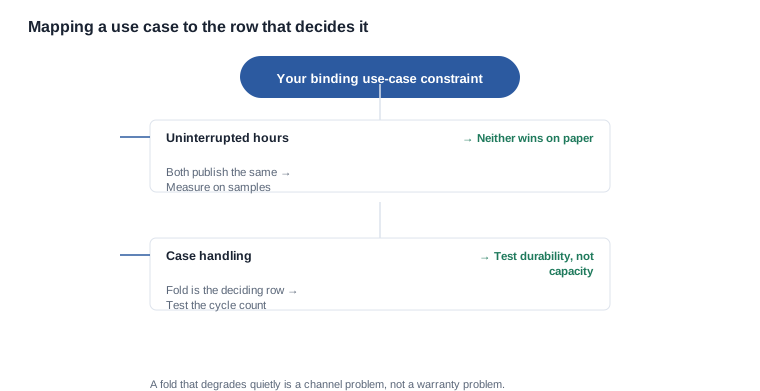
Mapping a use case to the row that decides it
The useful way to run this comparison is to start from the use case and work back to the row, rather than starting from the rows and looking for a reason to prefer one.
If your use case depends on the device being out for a full working period away from any charging point, both models publish the same duration, so neither wins on paper. Your decision there should be about what you can verify: a measured runtime under your actual workload, taken on a sample, is worth more than either published figure, and it is worth taking whichever model you are considering.
If your use case depends on the case travelling and being relied on between charges, the fold is the deciding row — and the deciding question is durability, not capacity. Ask how many cycles the fold is rated for, what the failure mode is, and what the warranty position is on a case mechanism. A case that folds is only an advantage if it survives your operating pattern.
If your use case depends on freight cost, packing volume or a channel that needs an acceptance criterion, the mass row decides it, and it decides it in favour of this model — not because it is lighter, which nothing supports, but because it is the only one of the two you can measure against a published figure.
If your use case depends on case capacity as a proxy for fewer spare units, the CY05's larger published figure is the relevant input, and you should note that neither figure tells you a recharge count, because conversion losses and cut-off thresholds are unpublished for both.

A worked comparison
Consider a hypothetical scenario rather than a real client project. A distributor is evaluating these two models for a field-service channel where devices go out in the morning, come back at midday for a case top-up, and travel in a case that lives in a vehicle. The use case has three constraints: the device must last the morning period, the case must survive being handled daily, and the packed volume has to fit the vehicle's existing storage.
Against the first constraint, both models publish roughly seven hours and neither separates, so the distributor measures both on samples under the same stated workload rather than choosing on the published figure. Against the second, this model's folding case is the distinguishing feature and therefore the risk; the distributor puts a cycle requirement to both suppliers and asks for the failure mode in writing, because a fold that degrades quietly is a channel problem rather than a warranty problem. Against the third, this model's published 158 gram body mass gives the distributor a starting point for freight that the alternative simply does not offer, and the case mass is measured on the sample because it is unpublished for both.
The decision that follows is not "this model is better". It is: the use case is sensitive to case durability and to packed volume, those are the two rows where the models differ, and one of those differences is a risk rather than a benefit. A distributor who weighs it that way can run the cycle test, price the outcome, and make a defensible choice either way.
That is the shape of a good use-case comparison in this category. It does not produce a winner; it produces a shortlist of tests whose results decide the question.
The questions to ask both suppliers
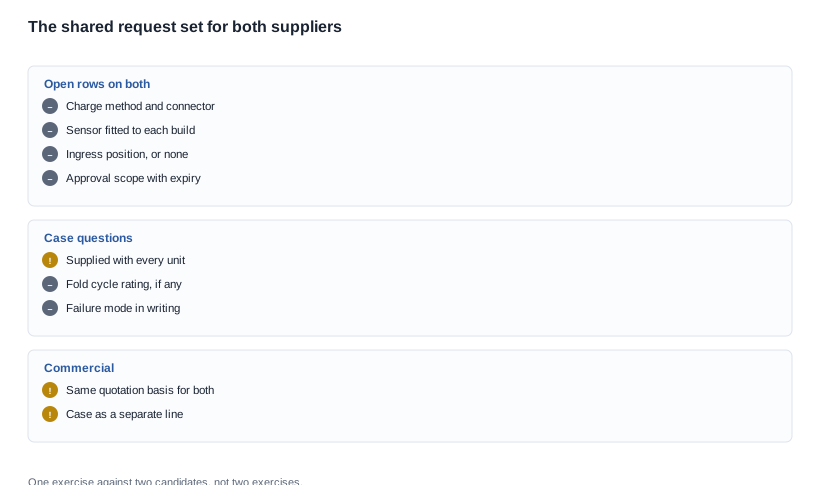
Because these two models share five published rows and four shared gaps, the due diligence is one exercise, not two. Send the same written question set to both and compare the answers side by side.
Ask which charge method each configuration uses, since neither publishes it. Ask which sensor is fitted to each, since the resolution class is identical and the sensor is not published for either. Ask for the ingress position for each, and treat a written statement that no rating applies as a usable answer rather than a non-answer. Ask for the approval scope with report numbers and expiry dates for each model designation. Ask for the case configuration, including whether the case is supplied for every unit and whether the fold carries a stated cycle rating.
Then ask the two commercial questions that make the comparison usable: whether the quoted basis is the same for both models, and whether the case configuration appears as a separate line so that a difference in the quotation can be attributed rather than assumed. Those five answers and two questions are enough to decide between two models that differ on three rows.
Where neither model can answer for you
Three limits apply equally, and stating them protects the decision more than any additional argument would.
No imaging conclusion is available for either. Both publish an eight megapixel resolution class and nothing behind it — no sensor, no field of view, no frame rate, no video mode. A use case that depends on image quality cannot be decided between them from the record, and a buyer who treats the pixel class as a proxy is deciding on something that is not published. The reasoning behind that limit is set out in AI camera glasses imaging.
No durability conclusion is available for either. Neither publishes an ingress rating, and the fold on this model is the one mechanical feature in the comparison that a sample can actually test. Material and construction questions are therefore worth asking in writing rather than assuming, and the broader treatment of construction and geometry sits in materials and ergonomics.
No cost conclusion is available for either. We do not publish prices, and a comparison that assumes one model is cheaper is not supported by anything in this catalogue. What can be done is fix the quotation basis and compare like with like, which is discussed in the wider buying material at AI camera glasses buying guide.
The gap both models share around charging is treated in charging solutions, and the row-by-row treatment of this model's published figures is in MT6 smart glasses specifications and features.
Building the comparison into a repeatable process
The reason to run this comparison properly once is that it does not need re-running. Five published rows are identical, so a repeat comparison of those rows produces the same answer every time. Three rows differ, so only those three can change the decision. What changes between orders is not the specification but the evidence underneath it, and the process below is designed to capture that change rather than to re-derive it.
Keep four items for each candidate. The published rows, quoted as published, with the source. The supplier answers, each dated and referenced to a purchase order number, kept in a separate column so that a supplier statement is never mistaken for a catalogue fact. Your own sample measurements, with the conditions attached to each one. And a short note on which use-case constraint the comparison was run for, because the same pair of models answers differently for a freight-driven channel and a capacity-driven one.
On the next order, the work is three checks rather than a full exercise. Confirm the supplier answers have not been withdrawn or superseded. Re-measure the two or three figures that drive your specific use case. And confirm that the configuration description on the quotation matches the one you recorded. If all three hold, the previous conclusion stands and no further analysis is required.
That is the practical value of a comparison built from published rows rather than from impressions: it is cheap to maintain, it is obvious when it has gone stale, and it does not depend on anyone remembering what was said in a meeting six months ago.
What to ask before a sample order is placed
Five questions, asked before any units are made, because they are far cheaper to ask at that stage than after the order is committed. Which configuration the sample represents, in the same words that will appear on the purchase order. How many units the sample contains and what that number is intended to prove, since a two-unit sample proves that a unit works and not that the process does. Whether the sample is drawn from the same production window as the eventual bulk order. What the supplier will do with a defect report raised at sample stage. And when the sample will ship, because a sample that arrives after the decision has been made is documentation rather than evidence.
The third question catches the most common problem in this comparison. A sample built from a different configuration than the bulk order validates nothing you can rely on, and the difference is frequently invisible — the model designation is identical, the change is inside. Ask for the configuration in words, not in a part number.
Managing the open items across both models
Both models share four documentation gaps and one shared omission that is easy to forget: neither publishes a charge method, so the accessory plan for both is provisional in the same way and to the same degree. Treat them as one workstream rather than two, because the questions are identical and the answers will arrive together or not at all.
Track each open item with three fields: what would close it, who owes the answer, and by when. A gap without an owner is a gap that will be open at the next order, and a gap without a date is a gap that has been deferred indefinitely without anyone deciding to defer it. Both fields are one line each, and together they turn a list of unknowns into a schedule.
The practical benefit appears at reorder, when the questions that were answered last time stay answered and only the genuinely new ones need asking. Suppliers notice this, and a supplier who finds that your request set is shrinking rather than repeating itself is dealing with a buyer whose technical file is worth maintaining.
The decision, and what it rests on
At the end of the process, the choice between these two models rests on one of three things, and it is worth being explicit about which. Either your binding constraint is measurability, in which case the published mass row decides it and you should say so plainly in your own file. Or it is case capacity, in which case the larger published figure decides it and you should measure the recharge count before relying on it. Or it is something that depends on how the device charges, in which case neither model can be evaluated until a supplier answers, and the correct action is to obtain that answer rather than to choose.
What should not appear in that reasoning is a preference, a brand impression, a competitor's price claim, or an assumption carried over from a neighbouring model. Three published rows and four shared gaps are what the record offers, and a decision that can be traced to those is a decision you can defend when the next order arrives.
Sequencing the comparison against an order timeline
Order matters here more than in most comparisons, because both models share their gaps and a shared gap answered late costs twice as much as a gap answered early. Four stages, each with its own question.
At the quotation stage the only question worth asking is which rows exist and which of your requirements depend on them. That is free, it takes one message, and it determines everything downstream. A buyer who establishes it here learns immediately that a charge-method-dependent requirement excludes both candidates — which is more useful than any comparison, because it narrows the field before any effort is spent.
At the sample stage the questions become demonstrative rather than documentary. Confirm the documented charge method against the unit itself, cycle the fold, weigh the case, weigh the body against the published figure, time a charge cycle against the two-hour ceiling, and run a runtime test under a workload you state in advance. Six checks, all of them cheap, and together they produce the figures you own rather than borrowed.
At the order stage the answers become conditions. Ask for the charge method, the sensor, the ingress position and the approval scope as written commitments against the purchase order, and attach the box contents as an exhaustive list. Everything that was demonstrated at sample stage and asserted at order stage is a line someone will have to honour.
Before shipment, reconfirm that anything carrying an expiry date is still valid on the shipment date. This is the check most often omitted and the one that most often fails, because it is the only stage where a report can lapse between the order and the dispatch.
What a strong answer looks like
It is worth being specific, because vague answers are the main reason these comparisons stall. A strong answer to the charge method question names the physical arrangement and says where it sits. A strong answer to the sensor question names a component and states whether it changes at reorder. A strong answer to the ingress question either names a tested rating with a report reference, or states plainly that no rating applies to this configuration — and the second is a complete answer, not a non-answer.
The test is whether the answer can be written into a purchase order without translation. If it needs to be paraphrased before it can be filed, it is not yet an answer, and asking again while the supplier is still engaged costs nothing.
Where an answer does not arrive, the decision is not to assume. Assume the more conservative option, write it into the plan as provisional, and schedule the review. A plan built on an explicit assumption with a review date is a professional position; a plan built on an unexamined assumption is a risk nobody has priced.
Related reading
- The camera range these models belong to — AI camera glasses
- Every published row for this model — MT6 smart glasses specifications and features
- The charge method both models share as a gap — MT6 smart glasses charging options
- The gaps on this model, itemised — MT6 smart glasses limitations


