

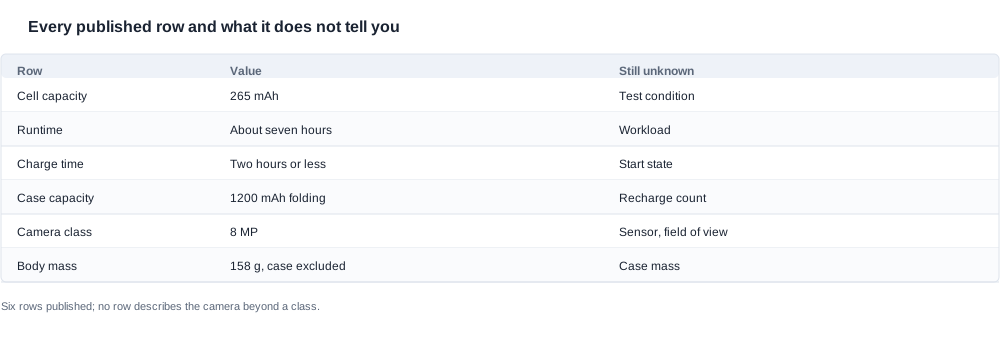
Stating limitations honestly is more useful than stating them apologetically, and this model is a good place to practise. The MT6 publishes a 265 mAh cell, a runtime of about seven hours, a charge time of two hours or less, an eight megapixel resolution class, a 1200 mAh folding case, and a 158 gram body weight. Those six figures are citable. Everything else a buyer usually wants — the connector, the sensor, the field of view, the video mode, the ingress rating, the colour options, the certification scope — is absent, and the absence is not a claim that the feature is missing.
That distinction runs through the whole of this note. A limitation here means a gap in published evidence. It does not mean the product lacks the capability. Treating the two as the same produces two opposite errors: assuming a capability that nobody has documented, or excluding a model that would in fact satisfy the requirement. Both errors cost money, and the second one costs more because it is invisible.
MT6 smart glasses limitations: what the model publishes and where the record stops
Read the MT6 catalogue page as a complete document rather than as an extract, and the shape of it becomes clear. It is a short page. Five standard specification rows carry the load, three short descriptors sit alongside them — portable, ultra-light, foldable case — and that is the whole of the text.
The significance of a short page depends on what the surrounding catalogue contains. In this range, other pages carry colour rows, ingress rows, camera-class variants, battery descriptors and interface rows. This page carries none of them. So the limitation is not that the range is sparsely documented; it is that this particular page publishes a narrower set than its neighbours, which makes the gaps more likely to be filled by assumption.
Two structural facts make those gaps unusually easy to bridge by accident. First, the model sits among eleven camera models, several of which do publish a charge method and two of which do publish an ingress rating. Second, the body mass is unique in the whole catalogue, which invites the assumption that a model distinctive enough to publish a weight is distinctive in other ways too. Neither inference is safe, and both are common.
The camera gap and the conclusions it rules out
The camera row for this model is a resolution class: eight megapixels. That is the entire published camera record. There is no sensor model, no field of view, no frame rate, no video format, no stabilisation row, no low-light description, no storage capacity and no file format.
The conclusions this rules out are worth stating, because each is one a buyer might otherwise draw. You cannot conclude that this model produces better or worse images than a thirteen megapixel model, because pixel count is the only published imaging difference and nothing correlates it to output. You cannot conclude what the device records or at what resolution, because no video row exists — and the absence of a video row is not a statement that video is unsupported. You cannot write a camera acceptance test against a specification, because no imaging specification exists to test against.
What you can do is narrower and still useful. You can state the published resolution class in your own material, which is a legitimate citable claim. You can test consistency across units by photographing the same scene under identical conditions on several samples and comparing the results to each other, which is a valid quality control activity even with nothing published to compare against. And you can ask for the sensor and the recording mode as a supplier document. The reasoning behind why an unpublished sensor caps what an imaging evaluation can conclude is developed in AI camera glasses imaging.
The comparison across the camera group is worth carrying into that conversation: eight of the eleven camera models publish the eight megapixel class, three publish thirteen megapixel. So the resolution row is a genuine shortlisting filter, and it is nothing more than a filter.
The charging gap and the decisions it blocks
The MT6 publishes a case capacity of 1200 mAh and a folding case, and it publishes no charge method and no charge interface. It is one of four camera models in that position, alongside the CY03, the CY05 and the L1 Pro, and all four publish a case capacity — so the gap is about method, never about whether a case exists.
The decisions this blocks are concrete rather than abstract. It blocks the bundled cable decision, because a magnetic contact arrangement and a Type-C receptacle require different cables. It blocks the charging-station decision for a fleet deployment, because the dock depends on the connector. It blocks the counter and warehouse procedure, because the replenishment method differs. And it blocks any connector statement in your own channel copy, which is a real commercial constraint when a competitor listing simply states the type.
Note also what the gap does not block. The case capacity is published and citable. The charge time of two hours or less is published and citable. And the runtime of about seven hours is published. So a buyer can plan power logistics without the method, provided they plan for the possibility that the accessory list changes once the method arrives. That is a manageable position, and the wider treatment of it sits in MT6 smart glasses charging options.
One related limitation is easy to miss. A 1200 mAh case against a 265 mAh cell invites a division, and the result is not a published recharge count. Conversion losses, case overhead and the cut-off threshold are all unpublished, so any cycle figure is a planning hypothesis. The case options across the group are covered in AI camera glasses charging case options.

Weight, colour, ingress and the rows that exist elsewhere
Three rows exist elsewhere in the catalogue and not on this page, which makes each a standing temptation.
Ingress protection is published for two models in the entire catalogue, both camera models, and this is not one of them. The consequence is not that the product is not water resistant; it is that no durability claim can be written into your listing, and that a channel partner who wants one will need a document. The background on testing rather than inferring a rating is in how to test IP rating before ordering.
Colour options are published for two models and this is not one of them, so a colour-dependent channel plan cannot be built from the catalogue for this model at all.
Body mass is published for one model in the entire catalogue, and it is this one, at 158 grams for the body including battery and camera and excluding the case. That figure is genuinely useful and carries two limitations of its own. It is not comparable, because nothing else in the range offers a figure to compare it against. And it is incomplete, because case mass is not published — and the case is what consumes packing volume. The freight question is set out in AI camera glasses shipping weight.
The certification limitation, stated precisely
This is the item most often described inaccurately, so it is worth being exact. Our product catalogue contains a company-level export certification page whose content is pictures rather than words, and those ten certificates are patent documents — eight appearance-design and two utility-model. The catalogue text contains no reference to CE, FCC or RoHS anywhere, and there is no per-model certification row on any page of any model.
So the limitation is not that approvals are absent. It is that no approval is documented at model level, and a company-level page of patent images cannot supply one. A patent certificate protects an appearance or a mechanism; it says nothing about radio, electrical safety or electromagnetic behaviour. Any statement that an approval is claimed, held or pending would be an inference this record does not support, and the file it produces will not survive review. The correct position, and the one a buyer can act on, is that approval scope for this model is a written supplier request — set out in MT6 smart glasses certification status and in the broader certification checklist.
A limitation in the runtime figure itself
The runtime is not absent, but it is thinner than it appears. About seven hours carries no workload, no camera state, no ambient condition and no battery-age reference. A runtime measured with the camera idle and a runtime measured with the camera recording are different numbers, and neither is wrong — but they are not comparable unless the condition travels with the figure. The same applies to the charge time, which is a ceiling with no start state and no completion criterion. The broader method is in how to compare battery life.
That is a limitation of measurement rather than of the product, and it is worth separating the two. A specification that is published but under-specified can usually be closed by agreeing test conditions in a contract. A specification that is not published has to be created first, which is slower and costs more.
Turning the list into a request list
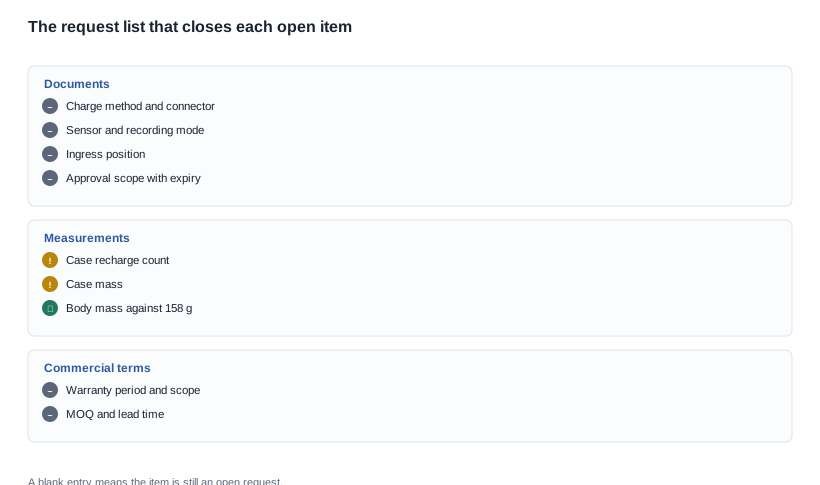
A limitations list is only worth carrying if each item on it becomes an action. The conversion is mechanical: for each open item, name the document or the measurement that would close it, who provides it, and what it is attached to.
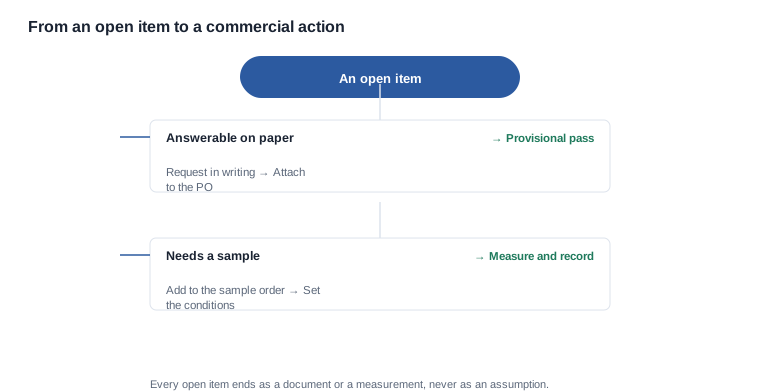
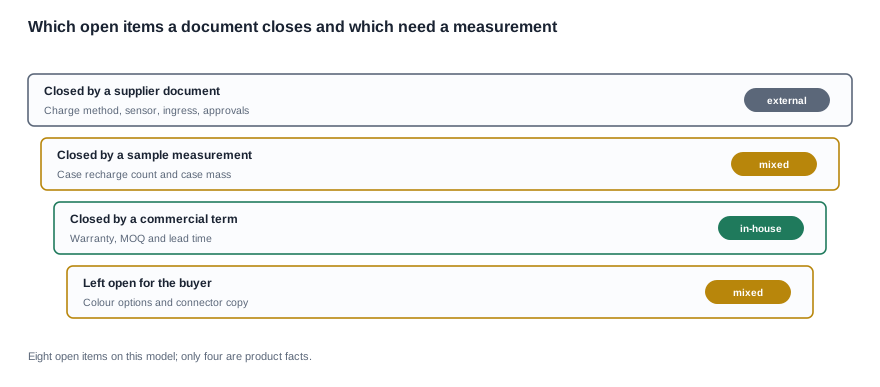
Four of the open items on this model are closed by a supplier document: the charge method, the sensor and recording mode, the ingress position, and the approval scope. Two are closed by a measurement on a sample: the case recharge count and the case mass. Two are closed by a commercial term on the order: the warranty terms and the MOQ and lead time, neither of which is a product specification and both of which belong in the quotation.
That distribution is itself informative. Four documentary answers, two measurements and two commercial terms is a normal due diligence load for this category. What makes this model unusual is not the number of open items but the fact that several of them are absent while their neighbours in the same range publish them — which is exactly the circumstance in which a buyer is most tempted to fill the gap by inference, and most likely to be wrong.
The honest summary is short. This model publishes a usable power specification, a citable resolution class, a published case capacity and the only mass figure in the range. It publishes nothing about how it charges, what its camera sensor is, what it can record, whether it resists water, what colours it comes in, or what approvals it holds. Each of those is a question to ask in writing before you order, and each is a question a supplier either answers or cannot.
What we will not claim on this model
We will state the published rows exactly as written, and we will not extend them. That means we will describe the 158 grams as a body weight that excludes the case, and not as a frame weight, because the catalogue has never published a bare frame mass for any model and the two are different measurements. We will describe two hours or less as a ceiling, and not as under two hours, because the first permits a unit that takes exactly two hours and the second does not. We will describe the camera as publishing an eight megapixel resolution class, and not as publishing no camera specification, because the class is published and the absence concerns everything behind it.
Each of those distinctions looks pedantic until the day a contract, a product page or a customs document has to survive review without it. The first kind of error is caught in seconds. The second kind travels.
We will also decline to infer. A neighbouring camera model publishing a magnetic charge method does not make this one magnetic. A neighbouring model publishing an ingress rating does not give this one. A company-level page of patent images does not establish a model-level approval. In each case the inference is available, plausible, and unsupported — and in each case it is the inference a buyer is most likely to make, because the surrounding catalogue makes it look reasonable.
Turning each gap into a specific written request
A gap that is not converted into a request stays open until somebody remembers it. The conversion is mechanical, and four questions per gap close it: what document or measurement resolves it, who provides it, by when, and what it attaches to.
The charge method resolves with one line naming the connector or contact arrangement. The camera gap resolves with a sensor model, a field of view and a recording mode. The ingress gap resolves with either a report or a written statement that no rating applies. The certification gap resolves with a report number, an issuing laboratory and an expiry date. Each is a small question, and each is one a supplier either answers precisely or cannot answer at all — which makes the answer itself a useful signal about how a repeat order will go.
Two gaps here are commercial rather than technical. Warranty terms and MOQ and lead time are not specifications and will never appear in a catalogue; they belong on a quotation. Recording them as "unpublished" rather than "unavailable" keeps them in the right category, where they can be negotiated, instead of in the wrong one, where they look like product faults.
Four criteria a supplier response must satisfy
Apply four criteria to whatever comes back, and apply them before you decide whether it is sufficient. Coverage: does the answer name the configuration, or only the product family. Precision: does it carry a value and a test condition, or a value alone. Currency: does it correspond to the production run you are receiving, or an earlier one. Traceability: can the supplier produce the underlying record without searching for it.
Most disappointing answers fail on coverage rather than on any technical point. A charge method described as "USB" may be describing the case input rather than the body connection, and if the case ships separately the answer does not apply. The remedy is a narrow follow-up asking which end of the cable, rather than a challenge — because a supplier asked precisely will usually answer precisely, and one asked adversarially will defend a general answer instead.
The second useful discipline is logging answers against the purchase order number on the day they arrive. Technical files fail quietly rather than loudly: an answer filed in the wrong folder is effectively lost, and the same question gets asked again next quarter. A single line per answer, dated and referenced, prevents that at no meaningful cost.
Sequencing the requests around the order timeline
Timing changes which requests are worth making. At the quotation stage, ask which rows exist for this model and which of your requirements depend on them — that question is free and determines everything after it. At the sample stage, ask for the documents and state the measurements you want, because the sample is the last cheap point at which a supplier can be asked to demonstrate rather than assert. At the order stage, attach the answers as conditions, since that is where conditions carry weight. Before shipment, reconfirm that anything with an expiry date is still valid on the shipment date.
Two of those steps are routinely skipped. Confirming validity before shipment catches the case where a report expired between order and dispatch, which is common and entirely avoidable. And attaching answers as conditions catches the case where a supplier answered the sample stage and treated the conversation as discharged.
The checklist implied by all of this is short enough to reuse across models: which rows are published, which of my requirements depend on unpublished rows, which are closed by a document, which by a measurement, which by a commercial term, and what the plan is if the answers arrive late. Run it for this model and you will find that four gaps need documents, two need measurements and two belong on a quotation — an ordinary due diligence load, made heavier only by the fact that the neighbouring models publish several of the same rows and make the gaps easy to overlook.
One last practical note for anyone building a technical file from this model. Keep the published rows and the supplier answers in separate columns, on the same page. It is tempting to merge them once a supplier has confirmed a figure, and merging is exactly how a supplier statement becomes a specification by repetition. Six published rows and perhaps six supplier answers, clearly separated, is a file that stays accurate for years; the same information merged into one list is a file that is quietly wrong within two orders.
The same page should carry a column for what you measured yourself, with the conditions attached. Those numbers belong to no supplier and no document, which makes them the most valuable and the most easily lost. A body mass weighed across five units, a runtime measured under a stated workload, a case recharge count run to a stated end condition — record them, because on the next order they are the only figures that came from your own equipment.
Related reading
- Every published row on this page — MT6 smart glasses specifications and features
- The evidence gap, itemised — MT6 smart glasses certification status
- The charge method question — MT6 smart glasses charging options
- What the mass figure can be used for — MT6 smart glasses value for money


