

The questions an ODM programme actually gets asked, once the first meeting has passed, fall into a small number of recurring types, and the fact that they recur is what makes a standard answer worth writing down. This article gives fourteen of them, in the order they tend to arrive, with the answer we can actually support — including the ones where the answer is that the figure is Not published and has to be confirmed per enquiry.
The value of a standard answer is not efficiency. It is that recurring questions are exactly where a buyer's expectation and the manufacturer's position diverge most often, and where an unanswered question becomes a dispute in month nine rather than a clarification in week one.
Our published position shapes several of these answers, and a buyer is better served knowing that before asking. The configuration space is wide — cell configurations from 40 mAh to 290 mAh, magnetic or Type-C charging, case capacities at 900, 1200 and 1400 mAh, camera resolution at 8 MP and 13 MP, Bluetooth 5.3 on two models and 5.4 across the rest. Three colour options are published for the V03 Pro and four for the V06. For the adult models, our catalogue publishes no CE, FCC or RoHS text and no per-model certification row, with the specific model and any certificate numbers still outstanding; on the children's models, the certification position has not been published to us.
So odm development common questions is best treated as a set of routings rather than a set of replies. Each question below is sorted by the kind of answer it can honestly receive, because the routing determines what you can do with the response on the day you receive it.
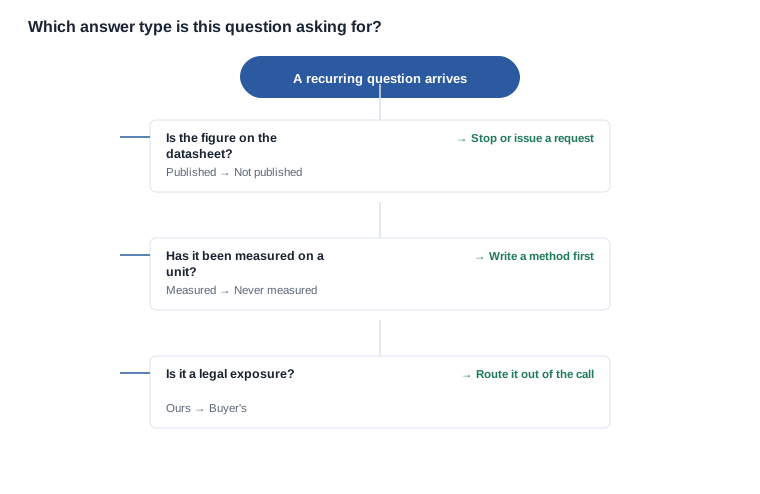
odm development common questions: the six that recur every month
1. "Can you build it exactly like this?" Usually yes, and the cost depends on the layer. The published customisation record is not one list across the range — the camera tier records seven entries, the audio tier five, the sport tier five, the children's tier two — and what to ask is which of those recorded items apply to the model you are actually quoting. The useful part of the answer is not the yes — it is which recorded layer is a finish decision and which requires a tool, because the kind that requires a tool carries a one-off cost and a lead time that the other does not. The customisation layers distinguish the two, and a buyer who has that distinction before the first quotation saves a revision cycle.
2. "How long will it take?" Confirmed per enquiry. Production lead time and capacity are Not published, and they depend on configuration, quantity, documentation scope and the current schedule. What we can give without hedging is the phase structure and an indication of which phase is normally the constraint — in our experience a laboratory queue for a new test, or a tooling lead time, rather than assembly capacity. A buyer who needs a committed date needs a configuration and a quantity, and a buyer who needs a planning date can work from the phase structure.
3. "What is the minimum order quantity?" Also confirmed per enquiry, and attached to the configuration rather than to the model. This is the question where buyers most often take a number from a competitor's website and assume it applies, which is how programmes end up quoted on a minimum that the chosen options do not support. The MOQ structure explains why one model with four options can carry four different minimums: the MOQ attaches to the lowest-volume option.
4. "Can you do the app under our brand?" Yes, at one of four levels with materially different obligations — a skin, a white-label build, a custom application, or no application. The complication is that our published position is that the AI feature details, the subscription position and the data location are all Not published, so the app architecture has to be settled before the scope can be written. Buyers who treat the app as a later add-on routinely discover in month five that the data location decision was a fork in the road.
5. "Who owns the design?" Four artefacts with four owners: the industrial design, the design files and the tooling, the firmware and the application, and the product data. The answer is not a single yes and it is not a single no, which is why it needs to be written rather than spoken. The ownership discussion sets out the four and identifies the one that matters at year three.
6. "What happens if certification is a problem?" It depends on the market and on the claim, and it is as much a legal function's question as a supplier's. Our published position is that our catalogue publishes no CE, FCC or RoHS text and no per-model certification row for the adult models, that any certificate numbers await confirmation, and that the children's tier carries no published certification position at all. The distinction that protects a buyer is between a supplier's manufacturing obligation and an importer's own obligation to hold evidence for what it places on a market.
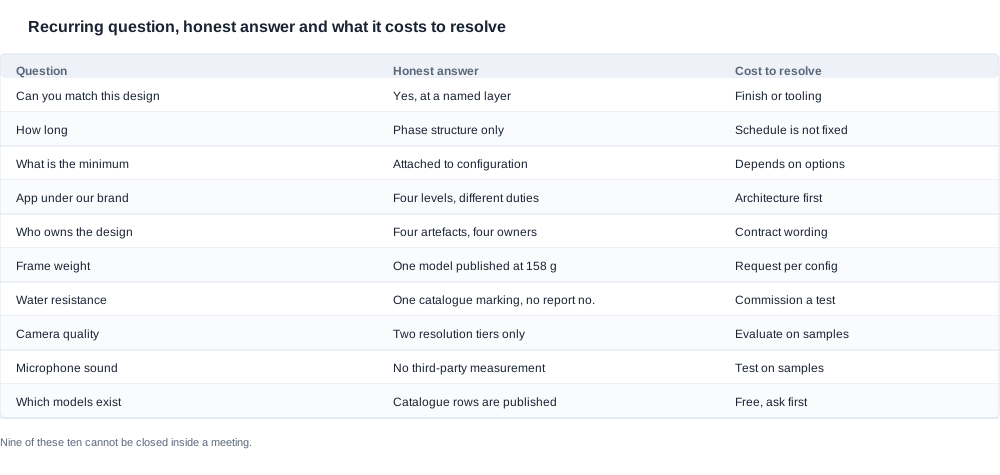

The four hard questions and what an honest answer sounds like
These four are the ones where the answer is genuinely constrained by what has and has not been measured. Each is given with the reasoning, because an honest answer that includes the reason can be planned around, while an honest answer without one reads as an excuse.
7. "What does it weigh?" Published for one model in the entire catalogue — 158 g for the MT6 — and Not published for everything else. The honest answer is that the figure has to be requested for the exact configuration, and that it is worth requesting in writing rather than by call, because a spoken figure becomes a specification in somebody's notes. The reason is straightforward: a frame weight depends on the cell configuration, the material and the electronics, and those are selected per programme.
8. "Is it waterproof?" Only two models in our range carry an IP54 catalogue marking, and it is a catalogue marking with no third-party test report number published behind it; no other model and no case in the range carries a marking at all. The honest answer is the marking itself plus what it does and does not establish. A catalogue marking describes a tested configuration somewhere; it does not describe your units, and a buyer with a retail listing that says waterproof is making a claim that a distributor or a regulator may test.
9. "How good is the camera?" The published data is two resolution tiers. Neither the sensor, the field of view nor the video specification is published. The honest answer is that resolution is the only published axis, that image quality is determined by sensor, optics, processing and lighting, and that the only way to evaluate it is on samples under the buyer's own conditions.
10. "What does the microphone sound like?" No third-party acoustic measurement supports any model in this range. The honest answer is the architecture — where the microphone sits relative to the user, what the wind and echo handling is — followed by a test on samples in an acoustically realistic setting. Microphone performance is one of the two specification areas in this category where a measurement is nearly always required before a claim can be made, the other being ingress.
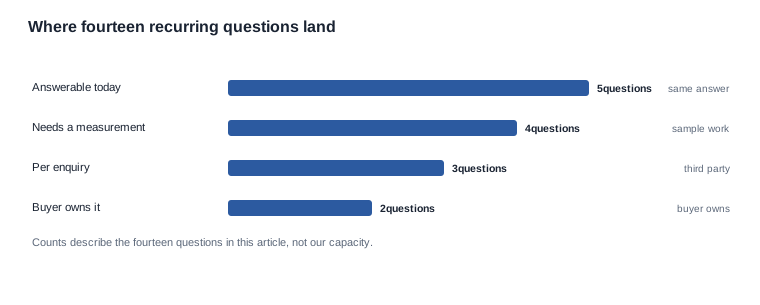
The counts in that chart describe the fourteen questions in this article and nothing else. They are not a claim about our capacity or our responsiveness, and they should not be read as one. What they do show is that only five of the fourteen can be closed inside a single meeting, which is the practical reason to route the rest rather than attempt to answer them live.
What makes questions 7 to 10 hard is not that the answers are secret. It is that the evidence behind them either does not exist yet or exists for a different object than the one being asked about. A frame weight exists for a specific combination of frame, cell and electronics. An ingress rating exists for a specific tested unit. A camera specification exists for a specific sensor, and the resolution published in a catalogue is a different measurement from the one a buyer wants, which is how the image looks.
That distinction has a practical consequence for cost, and buyers who plan for it do better. A request for a document that already exists costs a request. A request that triggers a measurement costs the measurement, and in this category the measurement usually has to be redone for the next programme unless the method is written down. So the correct follow-up question is never "how much for the report" — it is "what method, against which sample, under which condition, and can that method be written into the programme file so the next order references it instead of repeating it." A supplier who can answer all four has a mature process. A supplier who answers only the first has a price list.
There is also a sequencing point that is worth more than any individual figure. Questions 7 to 10 should be answered after the configuration is fixed and before the sample evaluation begins, not during it. If they are answered during the evaluation, the evaluation has no acceptance criteria and degenerates into an opinion, which is exactly the failure mode that makes a first-article rejection become a negotiation. Fixing the configuration first, then writing the criteria, then testing against them, is one extra week of paperwork and it removes the single most expensive ambiguity in a development programme.
Two of these four questions also carry claim exposure for the buyer rather than for the supplier. Weight and ingress both appear in retail listings, in comparative tables and in distributor tenders, and in each case the figure or the marking is reproduced without any of the conditions that produced it. A buyer who publishes a water resistance marking has adopted a claim about a product it did not test. So the right question to ask before you commit is not only how good the product is; it is which of these numbers you intend to state publicly, and on whose evidence.
The four questions that are cheap to answer early
- "Which models exist in the published range, and what are their rows?" The cheapest question in the whole sequence and the one that most often finds an existing configuration that already satisfies the requirement. It costs a buyer fifteen minutes and it can remove an entire customisation layer from the programme. Ranges like ours carry dozens of models and the published rows are genuinely searchable, so a requirement matching exercise before the first meeting is not optional work.
- "What is the documentation position for our exact model and our exact market?" This determines the schedule more than any other question, because it determines whether certification is a formality or a phase. It is also the question most often deferred, on the reasonable but wrong assumption that the supplier will handle it.
- "Which of our requirements are configuration and which are development?" This determines the cost. A requirement that can be met by selecting a published option is an hours matter; one that requires a design change is a weeks matter with tooling behind it. Buyers who sort this themselves, in writing, before a quotation request, get a quotation that holds.
- "What is the flat-battery behaviour, and what happens at the end of a charging cycle?" Both are product behaviours rather than specifications, and customers find out about them. Neither appears in a datasheet, and both are cheap to establish during a sample evaluation and expensive to establish from returned units.
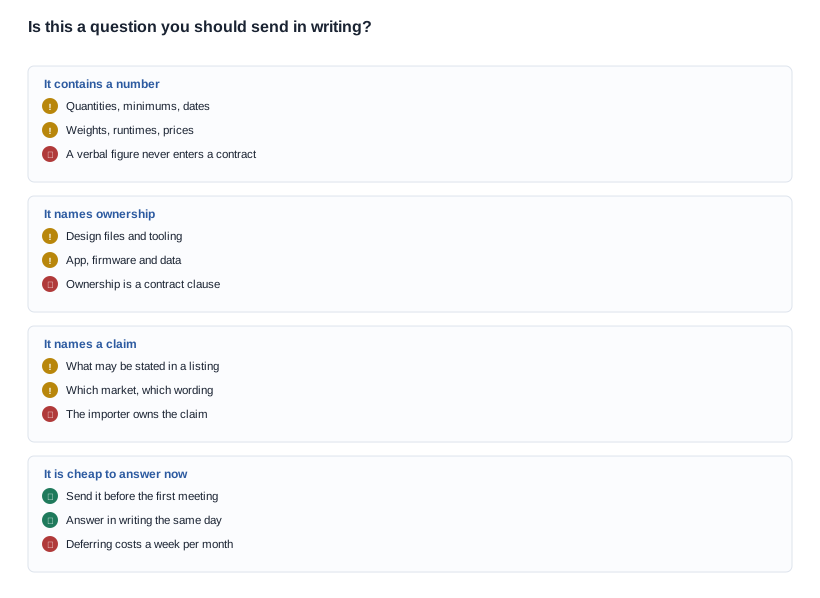
The general rule underneath these four is that any question involving a number, an owner, a claim or a date should be sent in writing rather than answered in a meeting. Quantities, minimums, weights and runtimes are numbers, and a verbal number is the one that ends up in a contract. Ownership of design, tooling, application and data is an owner question, and ownership is a contract clause. What may be stated about the product, and in which market, is a claim, and the importer owns it. Which phase a date belongs to, what constrains it and what happens when it moves is a date question, and dates given verbally are treated as aspirations for the entire programme.

Why the same question produces two different answers
Buyers frequently report that a supplier gave one answer in the first meeting and a different answer in the third, and assume bad faith. The more common explanation is that the question was answered at different levels of precision by two people who were both being honest.
An MOQ is a good example. In the first meeting the question is answered at model level, because that is how the catalogue is organised and nobody has yet selected options. By the third meeting the options are known and the answer is given at configuration level, which is higher, because a four-colour variant with a specific cell and a specific case genuinely carries a different minimum from the base configuration. Both answers were true about different objects. The failure is not dishonesty; it is answering at the level of the question rather than the level of the programme.
A lead time is the same story. In the first meeting the answer is a phase structure, because nothing is configured. In the third meeting the answer is a range, because the configuration and the quantity are known and the schedule is known. The second answer is narrower and more useful, and it is also more conditional, which is why it can sound like a retreat.
The remedy is procedural rather than personal: ask each question at the level of specificity the programme currently supports, and require that the answer names the level it was given at. Any answer that does not name its precision should be treated as a working assumption, entered into the programme file with the date, so that when the configuration firms up nobody has to remember what was said.

The fourth route in that flow is the one most suppliers skip and the one that protects both sides. Answering in writing, naming the source and flagging the lead time attached to the request converts a conversation into a document, and a document can be checked, versioned and cited in a purchase order. A spoken answer cannot, which means the next conversation starts from zero even when everyone remembers the same thing.

The questions we will ask you back
An ODM programme that only runs one way is a supplier presenting a catalogue rather than a supplier developing a product. So the questions below are the ones we put to a buyer in the first substantive call, and asking them is how we find out whether the programme is likely to succeed.
What is the channel, and is it retail, distribution or both, because the packaging, the labelling and the documentation scope differ completely between them. What is the target retail price, and what does that imply for the landed cost, because an unachievable price target discovered at quotation stage costs a month. Which markets at launch and which later, because certification is per market and the sequencing changes the schedule. What is the expected first-order quantity and the expected twelve-month volume, because the tooling and the minimum decisions are made on the first and cannot be revisited cheaply on the second. Who is the named owner on your side for a specification decision, because the programme stalls without one.
We ask these early for the same reason we answer early: the questions that are cheap at week one are expensive at week twelve, and a programme that treats them as routine correspondence is the one that ends in a dispute nobody saw coming.
The criteria for grading an answer before you build a shortlist
Because these questions recur, the answers recur too, which means a buyer can compare them across suppliers. That is worth doing deliberately, because the comparison is usually more informative than any single answer. Five criteria separate an answer you can build a shortlist on from an answer you have to chase again in three weeks, and they are the criteria below.
It names its source. "The figure is 158 g on the MT6 in our current catalogue" is a usable answer. "It is lightweight" is not, because there is nothing to check and nothing to cite later. The source matters more than the confidence: an answer that names a document can be verified, and an answer that only sounds certain cannot be.
It names its precision. A number quoted at model level and a number quoted at configuration level are different objects, and the difference has to be visible in the answer. This is where most supplier comparisons go wrong, because the same figure appears in two quotes at two different levels of definition and the buyer records both as agreement.
It names its lead time. "Confirmed per enquiry" is an honest answer only if something follows it. What follows is what matters: a day count, a dependency, or a named third party. An answer that flags a lead time of unknown length is materially weaker than one that says the answer needs a laboratory queue and gives a typical duration, and the difference between the two should affect which supplier you shortlist.
It names the owner of the residual risk. Somebody always ends up holding a Not published row. If the answer does not say who, the risk sits with whoever asks the question next, which is usually the buyer's own legal function discovering it during a listing review.
It says what cannot be done. The most reliable answer in this category is the one that declines something. A supplier who tells you in week one that a particular requirement needs tooling and a second certification cycle has saved you the month in which you would otherwise have found out. Answers that accept everything are not more accommodating; they are less informed, and a due diligence process that does not probe for limits ends up validating enthusiasm rather than capability.
Against those five, there are three red flags worth naming. The first is a number that arrives without a unit. The second is a specification quoted with no model, which in a category with variant configurations means the number describes nothing. The third is a date expressed as "around four to six weeks" with no statement of what it measures from — because the same phrase covers the interval from purchase order to first article and from first article to shipment, and those are rarely the same length.
The practical sequence is short. Ask the four recurring questions that are cheap to answer early, send the rest in writing, and grade each answer against those five criteria before you commit to a supplier on the strength of it. When you are deciding which two or three suppliers to take further, the criteria are what let you compare without re-interviewing everyone, and the trade-offs you accept should be written down at the same time as the answers so that they are still visible at contract stage.
What to ask when an answer comes back too vague is simple and effective: ask for the same answer at configuration level, in writing, with the source named. Suppliers who can do that are the ones worth shortlisting. The ones who cannot will tell you they need time, and how they handle that request is itself a data point about how a long programme will run.
If you send your requirement set and your markets, we will answer these fourteen questions in writing before a first meeting, marking each one as published, measured, confirmed per enquiry, or yours to own.
Related reading
- ODM development
- Standard OEM common questions
- ODM design phase
- Smart Glasses OEM: how to get started
Send your requirement set and markets and we will answer these in writing first.


