

The minimum order quantity for a private-label programme on OEM ready platforms is not a number the catalogue publishes, and the reason is that it is not a property of a product. It is a property of a production run — of which components are customised, which are finished to stock, which need artwork, and which can share a run with a standard build. That is why the same model can carry two different minimums on two different configurations, and why a range-wide figure is the one number that is always wrong. Minimum order quantity, unit price, lead time and production capacity are all unpublished here; what follows is the structure that determines them, and the questions that turn the structure into a quotable answer.
OEM ready platforms and why the minimum order varies by configuration
A minimum order quantity is the smallest run the supplier can commit to producing for one configuration without losing money or breaking a schedule. Everything that changes the cost of a single unit changes the minimum.
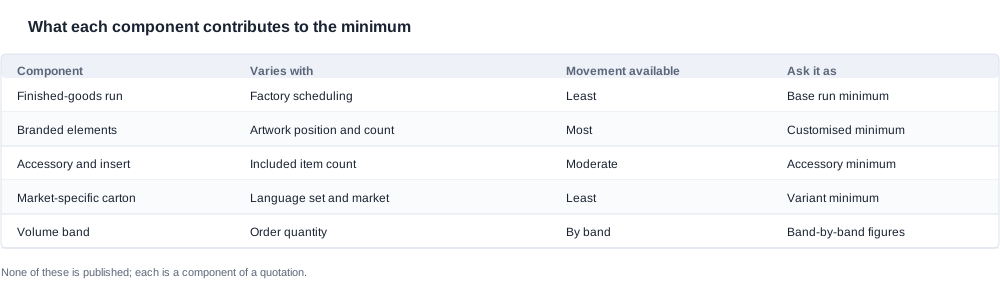
Four components account for nearly all of the variation, and they are worth separating because they behave differently.
The finished-goods minimum. The base run the factory needs before it will schedule a build at all. This is the component that most suppliers quote first, and it is the one that varies least between configurations of the same model.
The branding minimum. When artwork is applied to the product, to the packaging or to inserts, the customised run is often a different quantity from the standard run. The product-level minimum and the branded minimum are frequently different numbers, and a buyer who is quoted only one of them has half the picture.
The accessory and packaging minimum. Where an accessory, a printed insert or a language-specific carton is involved, that component has its own minimum, which is often the highest of the three because it is produced in the least flexible way.
The per-market minimum. Where a carton is market-specific — a different language set or a different marking — that variant has its own minimum, and it can be much higher than the model minimum because it cannot share a run.
The practical consequence is that a programme's effective minimum is not the model minimum. It is the largest of the component minimums for the specific configuration, and a buyer who builds a plan on the model minimum is planning on the smallest number in the set.
The decision path from configuration to minimum
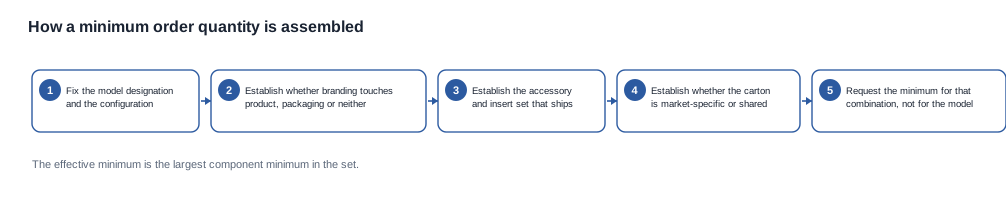
The question that produces a quotable minimum is not "what is your MOQ". It is which of the four components the programme is actually using, for which model, in which configuration.
The path is short. Start with whether branding is applied to the product, to the packaging only, or not at all. Then establish whether an accessory or insert set ships with the unit. Then establish whether the carton is market-specific or shared. Then ask for the minimum for the resulting combination rather than for the model.
A buyer who runs this path before requesting a quotation gets a more specific answer, and a supplier who is asked a specific question is far more likely to give a specific number.
Why the range's structure makes this harder than usual
Two published facts in this range make the minimum-order question more configuration-sensitive than it would be on a simpler platform.
The first is the charging-case split. Across the eleven camera models, four distinct case states exist: five publish a case capacity — the CY05 and the L1 Pro, and the CY03 — each at 1400 mAh, the L2 Utral at 900/1400mAh and the MT6 at a 1200 mAh folding case; two, the KY06 and the MT5, publish a case without publishing its capacity; three, the V06 and the S7, and the V03, publish no case row at all; and one, the V03 Pro, has no charging-case row. A configuration that ships a case and a configuration that does not are different production runs, and a minimum quoted across both is arithmetic rather than information.
The second is the naming ambiguity on the L2 Utral, whose page prints Utral and Pro Max side by side with a case row reading 900/1400mAh and no stated relationship between the names and the capacities. A minimum quoted without resolving that relationship cannot be attached to a specific configuration, because two configurations may exist behind one page.

The three components of a minimum order
It is worth being precise about the anatomy, because a buyer who understands the components can often negotiate one of them independently of the others — which is usually where the achievable movement lies.
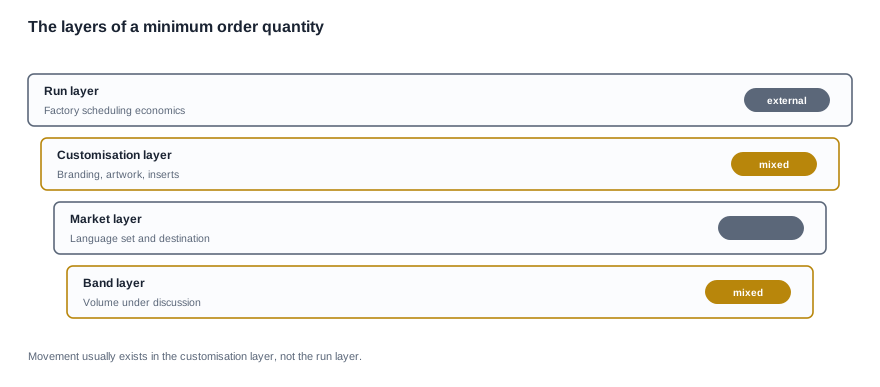
Component one: the run itself. Determined by the factory's scheduling economics and published nowhere on this platform. It is the component least likely to move and the one that should be established first, because everything else is negotiated relative to it.
Component two: the customised elements. Branding, artwork, inserts and accessories. This is where movement is most often available, because a customised element is frequently a separate production run that can be sized independently, combined with a different run, or scheduled against a different timeline.
Component three: the market-specific elements. Language-specific cartons and destination-specific markings. This component is usually the highest minimum in the set and the least flexible, because it cannot share a run with a different market's variant.
A checklist to send with the request
Because minimum order quantity is per configuration and not per model, the request has to describe the configuration. This checklist is what makes that possible.
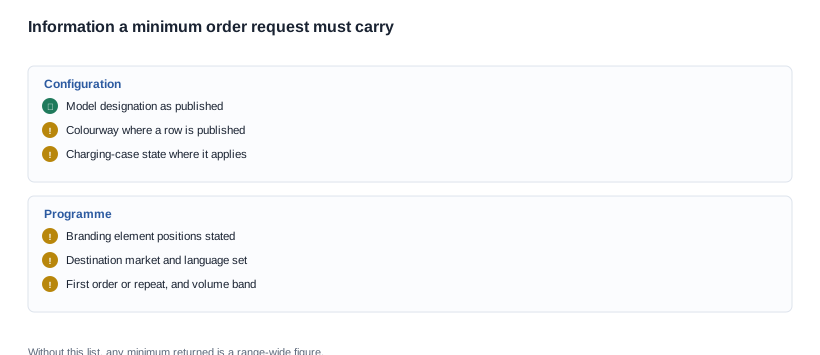
- The model designation, exactly as published.
- Whether branding is applied to the product, the packaging only, or not at all.
- The number of branded elements and their positions.
- The accessory or insert set, if any.
- The carton language set and destination market.
- The colourway, where the model publishes a colour row.
- The charging-case state, where it applies.
- The quantity under discussion and the volume band it sits in.
- Whether the programme is a first order or a repeat.
- The requested delivery window.
The reason for items eight and nine is that a first order and a repeat of the same configuration are different runs, and quoting one minimum for both hides the more useful of the two numbers.
What the minimum does not tell you
A minimum order quantity is not a statement about anything else, and three inferences should be avoided.
It does not indicate how long production takes. Lead time is a separate term, quoted separately, and the two are frequently conflated because both appear in the same conversation.
It does not indicate the unit price. A minimum and a price tier are separate terms, and a buyer who assumes the minimum sets the price band has not been given either.
It does not indicate capacity. Production capacity is not published on this platform and cannot be inferred from a minimum, because a factory can commit to a small minimum for a long run without having spare capacity at all.

Working the minimum back to a run you can actually place
Once the components are named, the negotiation becomes concrete, because each component can be asked about separately and adjusted separately. The method is to start from the programme you want and work backwards to the smallest run that supports it.
Step one: list the configurations you intend to launch. Not the models — the sellable configurations, which is colourways times packaging languages times destination markets. This number is frequently larger than the model count by a factor the buyer did not intend, and it multiplies rather than adds because each combination carries its own minimum.
Step two: group them by shared production. Configurations that can share a run should be grouped, and the group counts once toward the run minimum rather than once per configuration. This is the single most effective reduction available, and it depends on a supplier answer about what can share a run.
Step three: identify the market-specific residue. Whatever cannot share a run — typically a different carton language set — has its own minimum and needs to be negotiated as a separate line.
Step four: separate the first run from the repeat. A first private-label run includes preparation that a repeat does not, so the two minimums and the two lead times are different. Ask for both, and use the first one to judge whether the programme fits and the second one to judge whether it continues.
Step five: price the configuration count, not only the quantity. Where the supplier confirms that the configuration count rather than the per-run quantity drives the price, the reduction that matters is a reduction in configurations. That is a different negotiation from asking for a discount on units, and it is usually available when units are not.
Where movement actually comes from
In practice, movement in a minimum order quantity is concentrated in three places and largely absent from a fourth.
Movement exists in the customised element minimum, because a branded run is often schedulable against a shorter window and can sometimes be combined with other work. Movement exists in the configuration count, because fewer configurations means fewer runs. And movement exists in the volume band, because band boundaries are commercial rather than physical.
Movement is largely absent from the base run minimum, which is set by the factory's scheduling economics and is published nowhere on this platform.
A buyer who knows this distribution does not spend negotiating energy on the base run and can direct it to the levers that respond.
The total-cost view of a minimum
The minimum order quantity is a cash figure, but it is not the only cash figure, and comparing two configurations on the minimum alone misses most of the difference. Three other figures belong in the comparison.
The customisation cost, which is often a one-time charge and is not published on this platform. The inventory carrying cost of a larger run sitting in a warehouse. And the cost of a configuration that does not sell, which for a private label has no natural outlet on your own channel and requires separate branding work to place elsewhere.
A configuration with a lower minimum can be the more expensive choice. The comparison is worth doing once, explicitly, before the configuration structure is fixed — because after the first production run the structure is expensive to change.
Turning the minimum into a contract clause
A minimum quoted in an email is an intention. A minimum written into the agreement, with the conditions attached, is a term. The difference matters at exactly the moment it is needed: when a second order is placed below the minimum the first one was quoted against, or when a market variant is added that nobody priced.
Three clauses do most of the work. First, tie the minimum to the configuration as written on the order, so a later order cannot be rejected against a range-wide figure you were never shown. Second, state what happens when the buyer adds a colourway or a market after the first run — whether it can ride on the next production slot or requires a separate run, and at what quantity. Third, state which component the minimum comprises, so that a later change to the artwork or the accessory set does not silently trigger a different threshold.
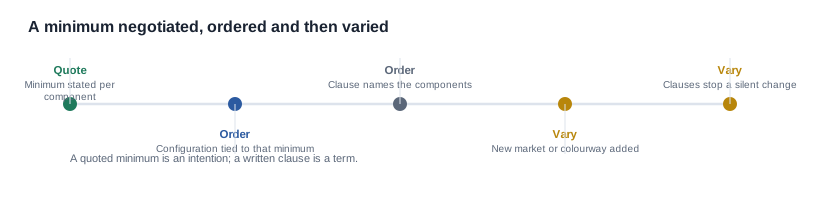
A fourth clause is worth adding when a programme spans several markets: state the relationship between a market variant's minimum and the base run. Without it, the second market becomes an unbounded commitment discovered after the first shipment has already worked.
None of these clauses is unusual, and none of them is published by any supplier as a default. They are ordinary commercial terms that belong in the agreement, and a buyer who writes them before the first order avoids a class of dispute that is otherwise entirely predictable.
What to do when no minimum is offered at all
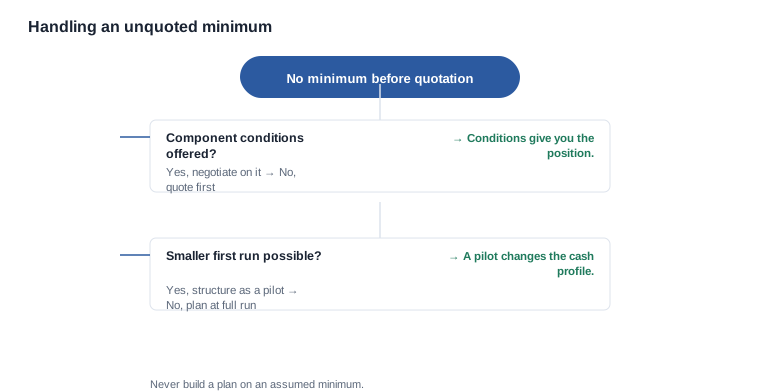
Some suppliers will not state a minimum before a quotation. That is a legitimate position, and the response is to work with it rather than to treat it as a refusal.
Ask instead for the components as conditions: under what circumstances would a smaller run be acceptable, what would have to change, and whether a first pilot run is possible at a smaller size. A supplier who cannot quote a minimum but can describe the circumstances under which a smaller run becomes viable has given you the negotiation position you needed.
What to avoid is building a plan on an assumed minimum and treating it as fact. On this platform every commercial term is unpublished, and an assumed minimum that turns out to be wrong produces a purchasing plan that fails at the purchase order rather than at the planning stage — which is the most expensive place for it to fail.
Why a range-wide figure misleads
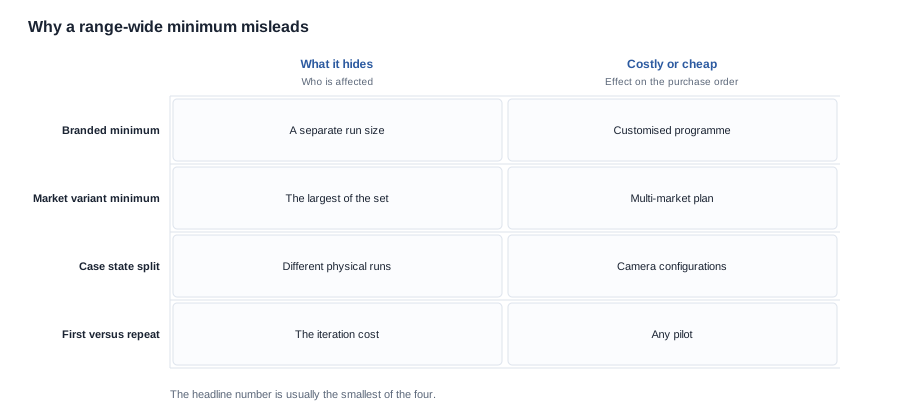
The most common failure in this category is a range-wide figure: one minimum, quoted once, applied across twenty-eight models. It is offered in good faith, it is almost always wrong, and it is wrong in a direction that surprises the buyer at the point of purchase order.
It misleads in four ways. It hides the branded minimum, which is frequently the number that governs. It hides the market-variant minimum, which is frequently the largest. It hides the split between configurations that share a physical product, such as the camera case states. And it hides the difference between a first run and a repeat, which is the difference that determines whether the programme can iterate.
The correction is not to reject the range-wide figure but to ask for the derivation. Ask which component each component minimum represents, and ask what the minimum becomes for the specific configuration as described. A supplier who can give the derivation has given you a number you can plan against; a supplier who cannot has given you a number that will move at the purchase order.
Comparing two suppliers on minimum order
Comparisons between suppliers on minimum order almost always fail because they are made on the headline number. The comparison that works puts the same configuration description to each supplier and compares four answers separately: the base run minimum, the customised element minimum, the market-variant minimum, and what changes when the volume band changes.
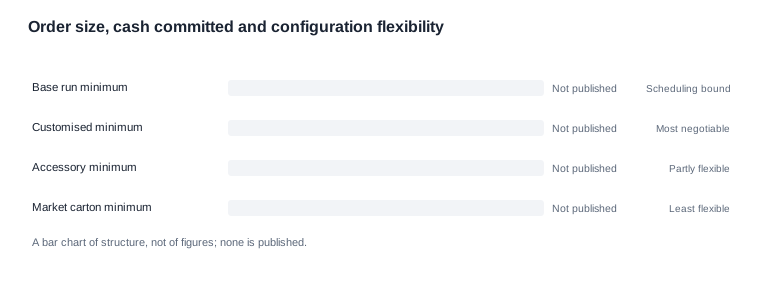
After that, two further comparisons are worth making. Whether a second market's carton can share a run with the first, and whether artwork changes after the first run require a new production slot. Both materially change the cost of a multi-market programme, and both are unpublished.
Negotiating the quantity without moving the risk
Quantity is negotiable; risk usually is not. The useful discipline is to separate the two, so that a reduction in quantity does not quietly transfer an exposure the buyer did not intend to absorb.
Four moves are normally available. Reduce the configuration count rather than the per-configuration quantity, which is usually the cheaper reduction and always the more sensible one. Sequence configurations rather than committing them together, so that one proven configuration funds the next. Combine several elements into one production run, if the supplier allows it and if the combined quantity is reachable. And accept a longer lead time in exchange for a smaller run, which is a genuine trade and often the one that makes the smallest run viable.
The move that fails is reducing quantity while keeping the configuration count and the timeline. That combination produces a small order of several configurations, each still subject to its own minimum, on a schedule that has not improved — which is more expensive than a larger, cleaner order.
Payment terms and the quantity conversation
The minimum and the payment terms belong in the same negotiation, because they determine the same exposure. A deposit structure tied to events rather than calendar dates — a deposit, a milestone against approved artwork, a balance against shipment readiness — keeps the buyer's exposure proportionate to how far production has progressed, and it makes the artwork deadline a contractual event rather than a courtesy.
Two questions close this. What is the total cash committed at the moment artwork is approved, which is usually the peak. And what remedy applies if the delivery date is missed, which determines whether a delay is an inconvenience or a financial event.
The questions to ask before committing
- The base run minimum for the named model and configuration.
- The minimum for the customised elements, stated separately.
- The minimum for the market-specific carton, stated separately.
- Which of these governs when they differ.
- The minimum for a first order and for a repeat of the same configuration.
- What changes at each stated volume band.
- Whether a second market's carton can share a run with the first.
- Whether an artwork change after the first run requires a new production slot.
- Whether the configuration count, rather than the quantity, is what drives the price.
- The payment milestones and the event each one is tied to.
None of these ten is published on this platform, and all ten are ordinary questions answered in one supplier message. We will not publish a minimum order quantity or a unit price, because neither is available as a range-wide fact and a figure quoted across the range would be wrong on the model you chose. What we will do is tell you which of the ten depend on your configuration and which depend on your volume band, so that the quotation you request is one that can actually be returned.
Send us the models, the branding elements, the destination markets and the volume you have in mind, and we will mark which parts of your minimum order quantity are fixed by the product and which are open terms.
Related reading
- The cost side of the same decision — inventory planning that survives
- The clock a quantity sits inside — how lead time is actually built
- The elements that create the branded minimum — logo and packaging in real detail
- The state split behind the configurations — logistics planning for a multi-part box


