

Most positioning work in this category fails because it tries to position on specifications that were never published. Price is not published on this platform. Minimum order quantity is not published. Lead time is not published. Certification scope is not published, and the range documentation contains no per-model certification row and no reference to CE, FCC or RoHS anywhere in its text. A positioning that depends on any of those is a positioning built on a number nobody has. OEM ready platforms can be positioned — but on structure, sequence and certainty rather than on figures.
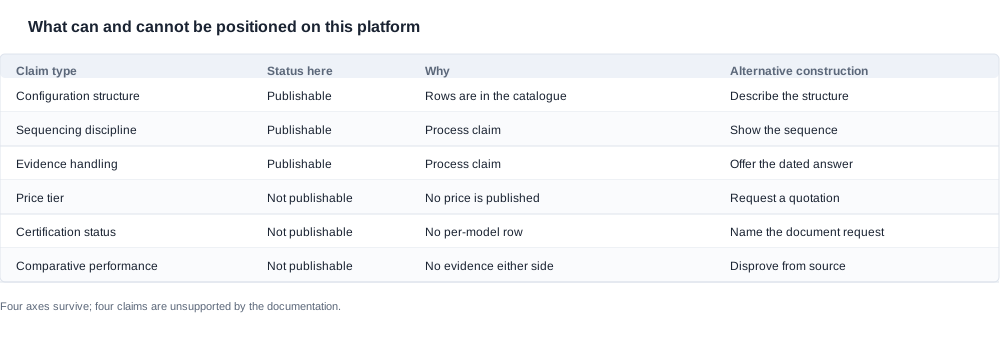
The consequence is not that positioning is impossible. It is that the axes have to change. Where a category is positioned by specification, this platform has to be positioned by configuration structure, by how the supplier handles a question it cannot answer from its own documentation, and by what a buyer's evidence file looks like after working with it.
OEM ready platforms position on structure when specifications are unpublished
Four positioning axes survive on this platform, and none of them is a performance claim.
Configuration structure. The range publishes enough structural information to describe how it is organised, and that description is checkable. Eight audio models publish a Bluetooth version, a cell configuration, a charging method and a runtime. Eleven camera models publish a resolution class, a cell, a runtime and a charge-time ceiling, but no Bluetooth version for any of them, and their charging-case position splits into three states: five models publish a capacity, two publish a case with no capacity, and four publish no case row at all — the V06 and the V03 Pro, and the V03 and the S7. One model in the entire range publishes a weight.
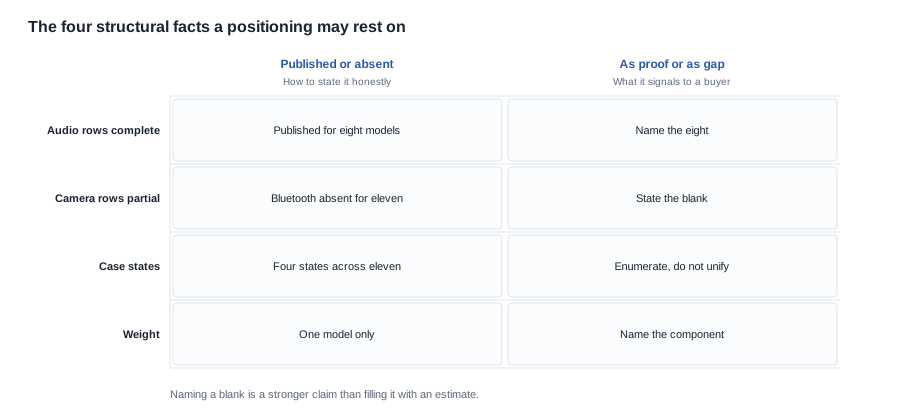
That last fact is itself a positioning asset. A supplier that publishes one weight correctly, says which component it applies to and states plainly that the other twenty-seven are unpublished, is demonstrating the behaviour it is claiming. On a platform where most sellers write inference into their copy, accuracy is a differentiator that is cheap to demonstrate and expensive for a competitor to copy without changing their documentation habits.
Sequencing and configuration discipline. How a supplier handles a configuration that is ambiguous — the L2 Utral's two names printed side byside, its case row reading 900/1400mAh with no stated relationship between the names and the capacities — says more about how a programme will run than any specification table. Resolving it in writing before the purchase order is the signal.
Evidence handling. What happens when a buyer asks for something the documentation does not contain. The right answer names the gap and asks for a written document. The wrong answer produces a plausible number.
Commercial transparency about openness. Which terms are per configuration rather than per range, stated plainly, so a buyer knows what a figure covers.
What cannot be positioned, and why
Four things are worth naming explicitly, because they are the ones that get written into positioning by habit.
Price and price tier. Nothing is published, and this article will not construct a tier structure from models and characteristics — that would be a fabricated ranking presented as a market structure. A buyer who wants a price position has to request quotations against a stated configuration.
Certification claims. The range carries a company-level export certification page whose content is images rather than text, showing ten patent certificates — eight appearance-design patents and two utility-model patents. It is not a per-model compliance record, and it cannot be converted into one by description.
Comparative performance. A comparison against another supplier requires evidence that does not exist on either side here. Positioning that relies on being better than an unnamed alternative is asserting something no document supports.
Durability and quality claims. No defect rate, no certification of quality management, no test data and no warranty terms are published on this platform. A positioning built on build quality is built on assumption.

Segmenting by published row rather than by price tier
The useful substitute for price-tier segmentation is structural segmentation — describing what the catalogue actually contains, so a buyer can locate themselves in it rather than being sold a position.
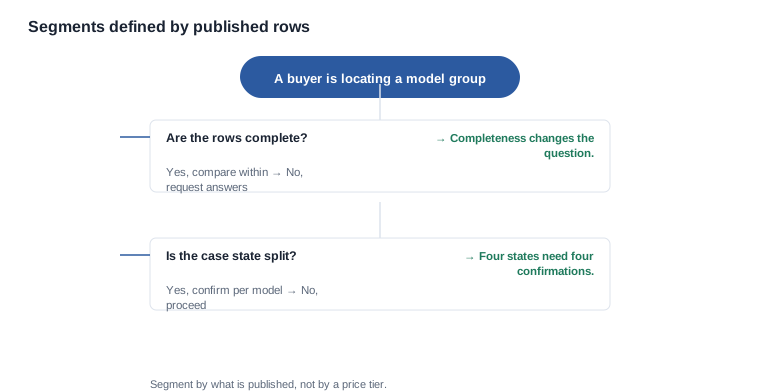
Three structural segments are visible in the range as published, and each answers a different buyer question.
The fully specified audio segment. Eight models that publish a Bluetooth version, a cell configuration, a charging method and a runtime. The buyer question here is narrow: which model in the segment suits the channel, and the answer is a selection among comparable rows rather than a discovery process.
The camera segment with split documentation. Eleven models that publish a resolution class — eight of them at the eight-megapixel class and three at thirteen — alongside a cell, a runtime and a charge ceiling, while leaving the Bluetooth version unpublished for all eleven and splitting the charging-case position three ways. The buyer question is different in kind: what is actually known, and what has to be requested.
The single-figure segment. Colour rows exist for exactly two camera models, and a weight figure exists for exactly one. The buyer question is what to do about the blanks.
Describing segments this way is not a marketing device. It tells a sourcing manager, before any conversation, which models will be straightforward to evaluate and which will need written answers before a quotation is even possible — which is genuinely useful and which almost nobody in this category does.
The claim audit that keeps positioning honest
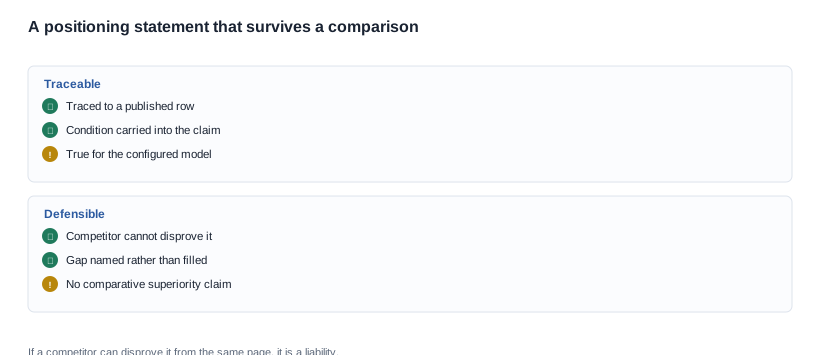
Every claim in a positioning should pass four questions before it is written. Can it be traced to a published row or to a written document? Does it state a condition rather than a bare value? Does it remain true for the model as configured rather than for a family? And could a competitor disprove it from the same public source?
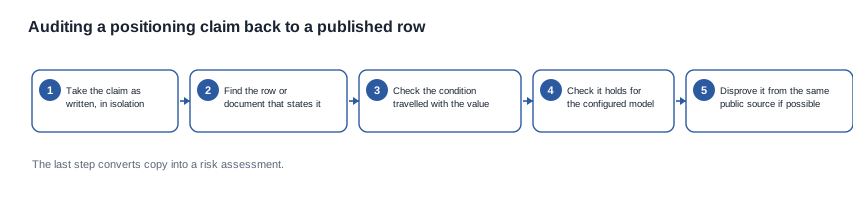
The fourth question is the useful one, because it converts positioning from a copywriting exercise into a risk assessment. A claim that can be disproved from the same public documentation is a liability at the point of comparison — and comparison is exactly where positioning is supposed to win.
The most common failures in this category all fail the traceability test. "Under two hours" where the catalogue says two hours or less. A weight carried across from a sibling model. A Bluetooth version stated for a camera model. A charging-case statement that treats three unpublished rows as negative statements. Each of these is disprovable from the same page a buyer already has open.

The positioning statement that survives a comparison
A positioning that survives is built from claims that are simultaneously true, verifiable and inconvenient for a competitor to copy without changing behaviour. There are four constructions available on this platform.
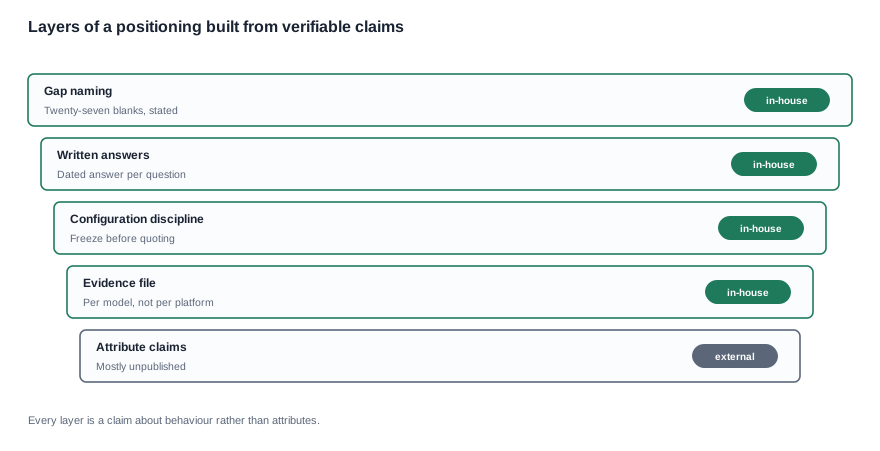
Construction one: name the gaps in your own catalogue. A supplier whose documentation publishes twenty-seven blanks and says so is making a claim that is both true and hard to fake. It also converts a weakness into a diligence instrument, because the named gaps tell a buyer exactly what to request.
Construction two: make the written answer the deliverable. Positioning the relationship around a written, dated answer to each configuration question positions on reliability rather than on product characteristics — and it is measurable, because the buyer can audit it.
Construction three: position the configuration discipline. Explaining why a configuration must be frozen before commercial terms are quoted, and showing the consequence of quoting first, positions on process quality. Few competitors will adopt the same framing because it requires saying no to work.
Construction four: position the evidence file. Offering that the compliance and export documentation is assembled per model rather than per platform is a positioning claim about the supplier's process that a buyer can verify in a single request.
The common property of all four is that they are claims about behaviour rather than about attributes — which is fortunate, because behaviour is the only thing available when attributes are unpublished.
The questions a positioning should invite
A good positioning on this platform ends in questions rather than in a purchase decision, because the decisive information is not public. The questions a buyer's next message will contain are predictable: which models carry a full set of published rows; which attributes are unpublished and what the supplier can confirm in writing; which configuration changes can be made without restarting production; how a quotation is structured and what it assumes; and what a pilot has to settle.
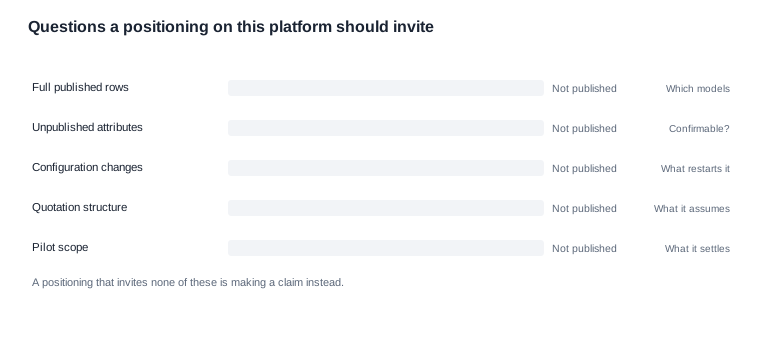
A positioning that invites none of those is making a claim instead, and claims are what this platform cannot support.

What a buyer does with a positioning statement
Positioning is only useful if it changes what the buyer does next, so the practical test is behavioural rather than rhetorical: does the positioning lead to a better question, a faster diligence process, or a shorter specification cycle?
It leads to a better question when it is specific about the structure. A buyer told that the camera group splits three ways on charging case will ask about the case state; a buyer told a camera model has an 8 MP camera will ask about the sensor, which the documentation does not publish. The first question is answerable and useful; the second produces another blank.
It shortens the specification cycle when it names the blanks in advance. A buyer who knows that charging method is unpublished for four specific models can put that in the first request instead of discovering it during quotation. The saving is real and it is entirely in the request, not in the product.
It fails — and produces nothing — when the positioning is built on attributes. Every attribute-based positioning in this category ends at the same place: the buyer asks for evidence, there is none, and the conversation becomes a request for a number the supplier cannot substantiate. That is not a bad outcome, but it is a wasted one.
Comparing positioning against published evidence, row by row
A useful exercise is to take a competitor's positioning and test each claim against the same source you hold. The procedure is short.
For each claim, establish four things. Whether a published row states it. Whether the condition travelled with the value — a ceiling carried as a measurement is the most common failure in this category. Whether it is stated for the model as configured rather than for a family. And whether the row that would disprove it is one the buyer already has open.
Where the answer is no on the first question, the claim is unsupported. Where it is no on the second, the claim is overstated. Where it is no on the third, the claim will fail on the specific model you are considering. Where it is no on the fourth, the claim will be used against the seller by someone else.
Applied consistently, this procedure does something a broad comparison cannot: it separates suppliers whose positioning is honest from suppliers whose positioning merely sounds confident, without requiring any information the buyer does not already possess.
Turning the gaps into a shortlist criterion
The same procedure works in reverse and is more useful. For a range where the decisive attributes are unpublished, published completeness is a selection criterion.
A model group that publishes a Bluetooth version, a cell configuration, a charging method and a runtime can be evaluated against a written specification without further requests. A model group that publishes a resolution class, a cell, a runtime and a charge ceiling but leaves the Bluetooth version and the charging method unstated cannot — and the difference is knowable before any supplier is contacted.
This is a shortlist criterion in the strict sense: it narrows the field before commercial conversations begin, it is derived from published information rather than from opinion, and it applies equally to every supplier whose documentation has the same structure. It also has the useful property of being cheap: it requires reading one table.
What a supplier can state, and what it should offer
If you are on the supplier side of this analysis, the position is narrower than it looks. Four statements are available from the documentation as published: how many models the range contains and how they divide by group; which rows each group publishes; which attributes are unpublished for which models; and which commercial terms are per configuration rather than per range.
The fourth is the one most suppliers leave implicit and it is the most commercially useful. Stating that minimum order quantity, unit price and lead time are quoted per configuration rather than per range tells a buyer immediately that a range-wide figure will not be forthcoming, and it saves both sides the exchange in which one is produced and then withdrawn.
Offering the written answer as a deliverable — dated, per configuration, filed with the order — is the positioning that survives longest, because it is the only one that produces evidence rather than assertion. A buyer cannot audit a claim, but a buyer can audit whether the answer arrived when it was promised.
The ten questions a positioning should be able to answer
A positioning statement is finished when a buyer can get specific answers to a short list of questions from it, without a sales conversation. Ten questions cover the category.
- How many models the range contains and how they divide into groups.
- Which rows each group publishes.
- Which attributes are unpublished, and for which models.
- Which models carry a complete specification set.
- Which models split into several physical states, such as the four charging-case states in the camera group.
- Which colourways are published, and for which models.
- Which commercial terms are quoted per configuration rather than per range.
- What a quotation states and what it assumes.
- What a pilot is expected to settle, and what it is not.
- What the supplier will provide in writing on request, and when.
None of the ten requires a commercial discussion, and all ten are answerable from the range structure plus a written response. That is the test of whether a positioning is doing work or whether it is only describing a product.
When to rebuild the positioning rather than adjust it
Three signals indicate that a positioning has stopped describing the business. The range structure has changed — a new group has appeared or a group has moved — and the segment descriptions no longer match what is published. The gap list has changed materially — attributes that were unpublished have been confirmed, or confirmed attributes have become uncertain — and the naming strategy no longer pays. And the commercial terms have become per model rather than per configuration, which changes what a buyer has to fix before a quotation is possible.
In each case the correction is to rebuild from the published structure rather than to amend the existing framing, because the existing framing was derived from a structure that no longer holds. Rebuilding is cheaper than it appears: the source material is a published table, and the derivation takes an afternoon.
The review that catches positioning drift
Positioning drifts quietly, and the drift is usually caused by someone else adding a claim for a good commercial reason. A seller adds a comparison because the category page is thin. A supplier adds a certification mark because a marketplace asked for one. A product page gains a superlative because a listing template suggested it.
The review is therefore a recurring task rather than a one-off, and it has a short procedure. Take every claim currently on the page and re-run the four traceability questions: is it sourced, does it carry its condition, does it hold for the configured model, and can it be disproved from the same public source. Any claim that now fails goes back to the supplier as a request for evidence rather than as a deletion, because the underlying claim may be perfectly supportable and only the sourcing is missing.
Run this quarterly and after any supplier update, and record the date. A positioning that has been reviewed on a date is a positioning you can defend; one that has not is a set of sentences that happen to be true today.
The shortlist criteria a buyer can apply without a conversation
Everything a positioning offers can be tested against four criteria that require no information the buyer does not already hold: is the claim traced to a published row or a written document; does the claim carry the condition its source attaches to it; does it hold for the model as configured rather than for a family; and could a competitor disprove it from the same source the buyer already has open.
A supplier that passes all four has a positioning a buyer can rely on, and one that fails any of them has a claim rather than an argument. Applied to a shortlist rather than to a single supplier, the four criteria narrow the field before any commercial conversation, which is the point at which they are most useful.
What positioning cannot do for you
Three limits are worth stating, because they are the ones that get discovered after launch rather than before.
Positioning cannot create margin where the cost structure is unknown. Without published commercial terms, a positioning promising value cannot be evaluated against cost, and the value claim becomes an assertion.
Positioning cannot fix a documentation gap. If the certification scope for a model is unstated, no amount of framing makes it stated, and the gap remains a request that has to be made and an answer that has to be obtained before the position can be defended.
Positioning cannot substitute for a fit check. The range's structural description tells a buyer which models are straightforward to evaluate and which require written answers; it does not tell them which model suits their channel, their market or their programme. That determination remains a selection against stated requirements, made by the buyer.
What positioning can do is make the buyer's next question the right one. That is a smaller claim than most positioning documents make, and on this platform it is the one that holds.
We will not publish a certification status for a model our documentation does not support, will not state a certificate number we have not seen, and will not construct a price ranking from unpublished commercial terms. What we will do is describe precisely what the range publishes, name what it does not, and tell you which of the gaps has to be closed with a written answer before you can commit.
A closing test for the whole positioning
Before publishing any positioning for this platform, put it through one test: could a sourcing manager who disagrees with every word of it still take your documentation and reach the same conclusion you are claiming?
If yes, the positioning is defensible, because it rests on the evidence rather than on the framing. If no — if the conclusion depends on language rather than on rows — then the claim is a promise, and a promise in this category is a liability with a short shelf life.
Send us the markets and channels you are targeting, and we will mark which models carry enough published structure to support a decision without further requests, and which do not.
Related reading
- The documentation a position depends on — the export documentation set to ship
- Making every claim traceable — listing optimization without guessing
- Choosing among structurally different models — inventory planning that survives
- The term that cannot be positioned — minimum order quantity for private label


