

A market entry plan for OEM ready platforms fails less often on strategy than on sequence. Teams choose the model first, then the lane, then the paperwork, and discover in that order that the lane forbids the certification scope they assumed, that the model needs a case nobody has specified, or that the destination's marking requirements rewrite the carton. This article is about the order of the decisions, because on this platform the order is what determines whether a plan survives contact with a quotation. OEM ready platforms support a workable sequence, and it is not the sequence most teams use first.

The governing principle is simple. Compliance and destination determine what you may sell and how it must be marked. The model determines what you can claim. The commercial terms determine what you can commit. Each later decision is constrained by the earlier one, which is why reversing the order produces plans that have to be rewritten.
OEM ready platforms and the order of decisions in a practical plan
A plan that starts with the model is starting with the least constraining decision. The range holds twenty-eight models and the choice among them is wide, which feels like progress and is actually a deferral — because most of the constraints arrive afterwards, from the lane and from the documentation.
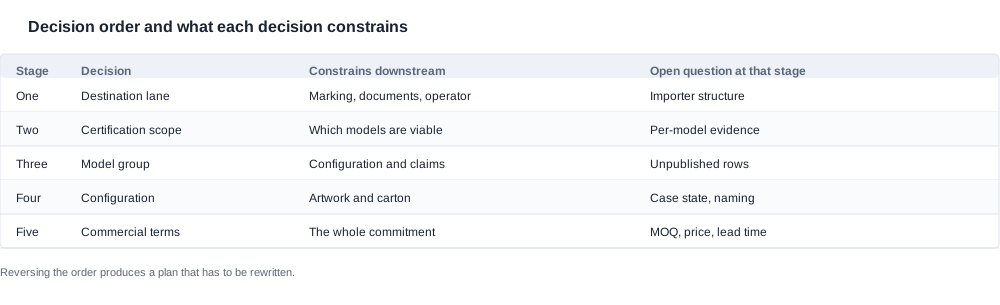
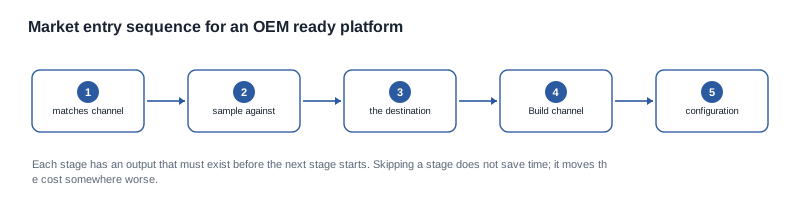
The workable order runs in four stages.
Stage one: the destination lane and the destination market. What are you actually selling into, through which channel, into which regulatory environment, with which operator and responsible-person structure. This is the most constraining decision and it is usually made last, which is the error.
Stage two: the model group, not the model. Camera, audio, sport and the children's group carry materially different documentation and marking profiles, and the group constrains the model far more than the other way round.
Stage three: the configuration. Model designation, colourway, charging-case state and packaging language, written down and consistent with each other.
Stage four: the commercial commitment. Minimum order quantity, unit price, lead time and payment terms, quoted against the configuration fixed in stage three.
Each stage produces something the next one needs. Run out of order and stage four is quoted against a configuration that later has to change, which is the single most common cause of a private-label programme losing money before it ships.
What the destination actually constrains
The destination constrains four things, and it is worth being specific about which because buyers often assume it constrains only the paperwork.
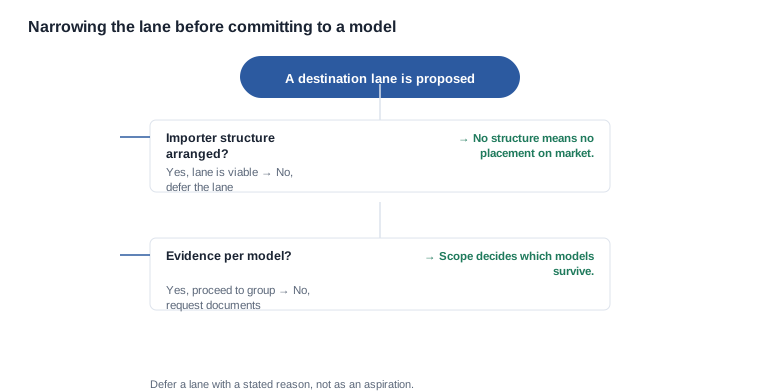
Whether you may sell at all. Some destinations require a conformity assessment and an economic operator in the destination before a product may be placed on the market. That is a precondition, not a formality, and it is a buyer obligation rather than a factory one.
What must be on the packaging. Language, warnings, operator details, traceability marks and any destination-specific labelling requirement. Each of these is artwork, and artwork sits on the critical path described in the logo and packaging note for this platform.
Which documents must exist per model. Where the destination requires a declaration of conformity, a technical file and traceability arrangements, those obligations attach to a specific product with a specific designation.
What the importer position requires. The economic operator and responsible-person structure is a buyer-side arrangement with real cost and real lead time, and it is often the stage that determines the true start date of a market entry.
The range's published structure as a constraint
The range's structure helps at stage two because it tells you how much each group constrains you. The camera group publishes a resolution class, a cell figure, a runtime figure and a charge-time ceiling, but no Bluetooth version for any of its eleven models, and its charging-case position splits into four states. That makes a camera configuration a more demanding entry than it looks, because two of its most commercially relevant attributes — what it connects to, and whether it ships with a case and what capacity that case has — are the two things the documentation does not settle.
The audio group publishes a Bluetooth version for all eight models, a cell configuration, a charging method and a runtime, which makes the specification side of an audio entry substantially more straightforward. Sport models are three in number and publish their own rows. The children's group carries additional marking questions that must be settled before the plan is complete.
This is a structural observation about the documentation, not a recommendation of one group. It tells you where the unknowns are concentrated, and therefore where the written questions in stage one have to do more work.

Building the compliance set one lane at a time
The compliance set is not range-wide. This is the point that trips up plans built as if it were. Obligations attach to a destination, and a product sold into several destinations needs a different marking and a different document set for each — while the underlying product and its model designation stay the same.
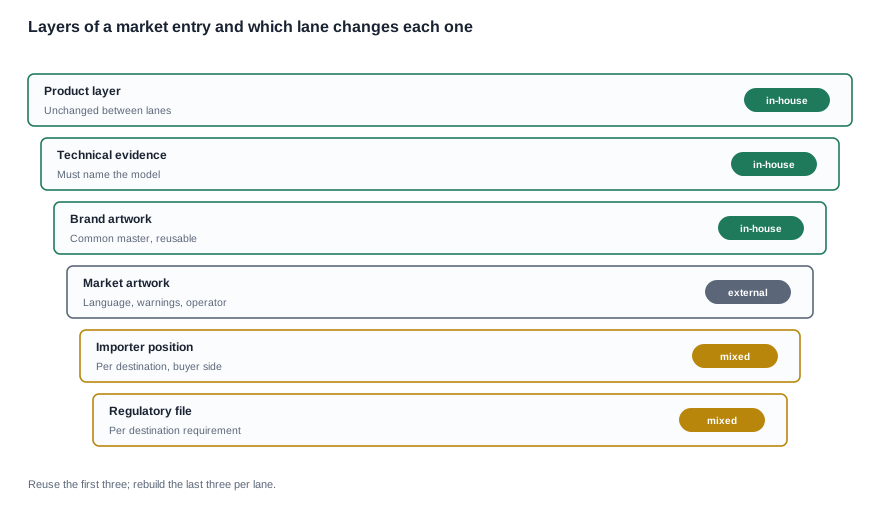
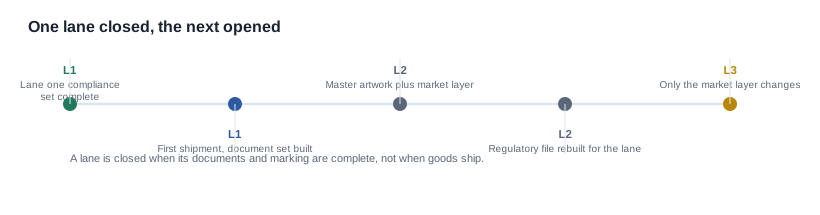
The consequence for planning is that a multi-market programme is a sequence of single-market programmes sharing a product, not one programme with several markets attached. Building them in that order — one lane complete, then the next — is slower on paper and considerably faster in practice, because each lane's completion makes the next lane's work a modification rather than a construction.
The certification position on this platform, stated precisely
Be exact about what the range documentation does and does not contain, because the imprecision is what produces false claims. One company-level export certification page sits in the catalogue the page holding images rather than text, and that page shows ten patent certificates — eight appearance-design patents and two utility-model patents. The catalogue text contains no reference to CE, FCC or RoHS, and there is no per-model certification row anywhere in it.
The correct plan conclusion is therefore neither "certified" nor "not certified". It is that the certification scope for a specific model is a document that has to be requested in writing, per model, before the lane plan can be closed. That request is part of stage one, not stage three, because the answer may change which models are viable for the lane.
Where a lane involves radio equipment, the relevant framework in the European Union is the Radio Equipment Directive (EU) 2014/53/EU, with the Electromagnetic Compatibility Directive (EU) 2014/32/EU and its harmonised standards covering the EMC aspects. Ask for the two bodies of evidence separately, because a supplier who treats them as one document may send the wrong one, and because the model designation on each is what makes it usable.

Sequencing the second market
Once one lane is closed, the second is a modification exercise rather than a fresh build, and the order of that modification work determines how much rework the third lane requires.
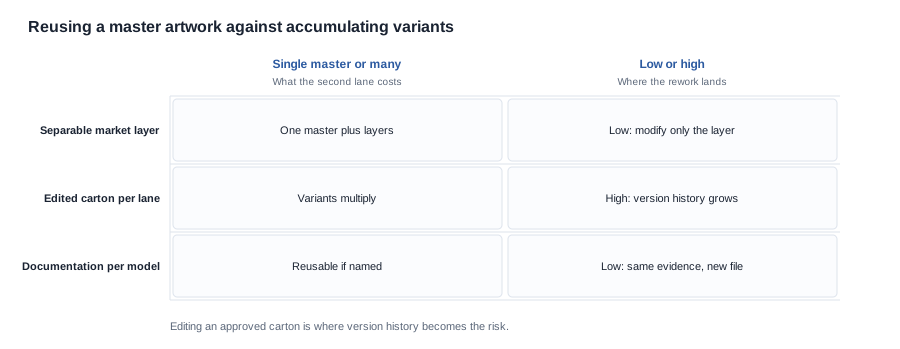
Three things should be built to be reused across lanes: the product and model designation, which do not change; the technical evidence for that product, which is largely lane-independent but must name the model; and the artwork system, which should be structured so that the market-specific layers — language, warnings, operator details — are separable from the brand layers.
The thing that should not be reused is the assembled carton artwork. A carton that has been proofed for one lane and then edited for another accumulates variants, and the version history becomes the compliance risk rather than the safeguard. Building each lane's carton from a common master with a market-specific layer is more work at the start and much less work by the fourth lane.
When a lane should be deferred rather than entered
Some lanes should not be entered on the current documentation, and the plan should say so explicitly rather than leaving them as an aspiration. The common reasons are that the certification scope is unstated, that the destination marking requirements are unknown, or that the importer-side obligations cannot be met within the timeline.
Recording a deferred lane with the specific reason is more useful than a roadmap entry, because the reason tells you what has to change before the lane becomes viable. A lane deferred for an importer-structure reason becomes viable when the structure is arranged; a lane deferred for a certification reason becomes viable when the documents arrive, if they arrive at all.
The questions that close stage one
Before a model is chosen, ask these in writing for the intended lane. Each closes a specific constraint:
- Which conformity documents exist for each candidate model in this lane.
- Which of them name the model designation explicitly rather than a family or platform.
- What marking, language and warning text the destination requires on packaging.
- Whether the economic operator and responsible-person structure is required for this lane.
- Which models are viable for the lane if any certification evidence is unavailable.
- Whether any accessory or included item is restricted in this destination.
- What the destination-side cost and lead time of the importer structure are.
- Which battery transport rules apply to the configurations in scope.
- What the lane requires for traceability records.
- What would have to change to add a second lane later.
None of these is published on this platform, and all ten are ordinary questions a supplier answers in one message. We will not state a certification status for a model our documentation does not support, and we will not publish a certificate number we have not seen; what we will do is tell you which of these ten are fixed by your destination and which depend on the model, so that stage one does the work it is supposed to do.

What a market entry plan has to state before anything is quoted
A plan becomes quotable at the point where the configuration is specific enough that a supplier can price it without asking a question. That bar is lower than it sounds and higher than most plans reach.
The configuration statement has five parts: the model designation exactly as the supplier publishes it; the colourway, where the model publishes a colour row and otherwise the colour confirmed in writing; the charging-case state; the packaging language set; and the destination market with its channel.
Each part is short and each has caught an error in practice.
The model designation matters because of the L2 Utral, whose page prints Utral and Pro Max side by side alongside a case row reading 900/1400mAh with no stated relationship between the names and the capacities. A designation chosen by inference at this stage propagates into the purchase order, the carton, the export file and the declaration.
The colourway matters because only two camera models in the range publish colour rows — the V03 Pro and the V06 — so for every other model the colour list is something you have obtained rather than something you have read, and it may still be growing.
The case state matters because the camera group splits into three: five models publish a capacity, two publish a case without one, and four publish no case row at all, and the last of those three states is the one that has to be resolved with the supplier before the market plan is costed. Each state is a different physical product and a different freight profile.
The packaging language matters because it is artwork, and artwork sits on the critical path. Adding a market later is cheaper than adding it after a print run.
The channel matters because it sets the barcode and data requirements, and a data error found at artwork proof costs nothing while the same error found after a print costs the run.
The commercial stage, once the configuration is fixed
Only after the configuration statement exists should commercial terms be requested, and only against it. Minimum order quantity, unit price, lead time and payment terms are all unpublished on this platform, and all four are per configuration rather than per model — which is why quoting them earlier produces a number that has to be re-quoted.
The questions worth asking at this stage are the ones that make a quotation usable rather than indicative: whether the minimum applies per model or per configuration; whether the price holds at the stated volume and configuration; whether the lead time is stated from accepted purchase order to arrival and whether it includes customs; whether the payment milestones are tied to events rather than calendar dates; and what changes any of the four.
A quotation that answers those five can be built on. One that answers only the headline price cannot, and the difference between the two becomes visible at the worst moment.
What to record, and why the record is the plan
The durable artefact of a market entry is not the strategy document; it is the set of dated written answers that closed each stage, kept in order beside the artwork files and the packing lists. That record is what makes the second market a modification rather than a rebuild, and it is what makes a dispute about whether something was agreed answerable.
Three habits keep it useful. Date everything and name the owner. Store the answer beside the artefact it governs, so a certification answer sits with the model it covers and a quotation sits with the configuration it priced. And when an answer changes, supersede it rather than overwriting it — a changed answer is itself information about how stable the position is.
We will not quote a price, a minimum order quantity or a lead time against a configuration you have not fixed, because that number does not survive the first change of colourway or destination. What we will do is tell you which parts of the configuration statement are fixed by the model and which depend on your programme, so that the request we return is quotable rather than provisional.
A risk register for the entry, kept in four columns
The plan is easier to defend if the risks are written down at the stage where they arise, because at that point they are still abstractions rather than realised costs. Four columns are enough: the risk, the stage it belongs to, the question that would resolve it, and who owns the answer.
The four that earn their place in almost every entry on this platform are these. The certification scope for the chosen model, owned by the supplier's documentation and resolved by a written per-model request. The configuration ambiguity where a model publishes more than one name, resolved before the purchase order rather than after. The artwork lead time, which is on the critical path and resets whenever a market layer changes. And the configuration count, which grows quietly and is the usual source of an inventory exposure nobody planned.
Writing them at the stage where they arise has a second benefit: it makes clear which risks are already closed, which are open with a named owner, and which are accepted knowingly. A plan with three named open risks is in a stronger position than a plan asserting that the entry is low risk, because the second claim cannot be tested and the first can.
When the plan should be rewritten rather than adjusted
There are three signals that a plan needs rebuilding rather than amending, and all three are structural. The chosen model has an unresolved documentation gap that the lane will not tolerate, which means stage two produced the wrong answer and everything after it is provisional. The importer structure cannot be arranged in time, which means the lane cannot open regardless of what the product is. And the configuration count has multiplied during the plan, which means the commercial terms were quoted against a structure that no longer exists.
In each case the correction is to go back to the stage where the error entered rather than to patch the later stages, because later stages built on a bad earlier one cannot be patched into consistency. That is the whole argument for the order of decisions: it is not a preference, it is what makes a correction local rather than total.
The stage-gate checklist that keeps a plan auditable
The order of decisions is only useful if it is enforced. A stage gate is a short checklist that must be satisfied before the next stage begins, and it exists to catch the specific failure this article is about — a later stage being actioned on the assumption that an earlier one is closed.
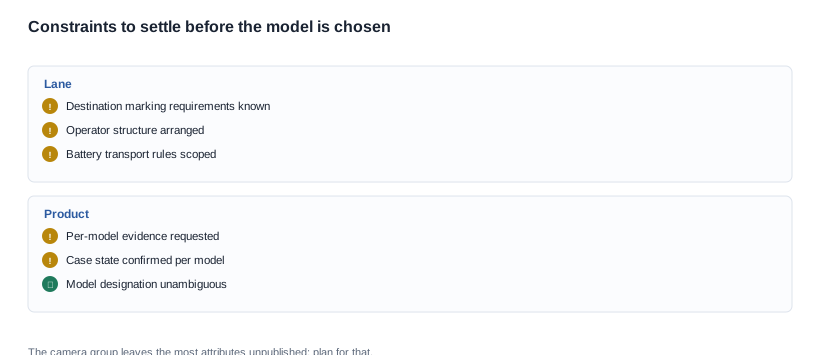
Five gates cover a market entry on this platform. Gate one, lane: the destination is named, the channel is named, and the economic operator and responsible-person arrangement is either in place or explicitly deferred with a reason. Gate two, evidence: the certification scope has been requested in writing per candidate model, and the models that have no evidence are identified. Gate three, group: the model group is chosen against what the evidence allows, not against what is attractive. Gate four, configuration: the designation, colourway, case state and packaging language are written down and consistent. Gate five, terms: minimum order quantity, unit price, lead time and payment terms have been quoted against that exact configuration.
A plan that cannot show which gate it is standing on is a plan whose assumptions are unlocated, and unlocated assumptions are the ones that surface at the purchase order. The criteria for passing each gate are simple: a gate passes on a written artefact, never on a conversation. If the artefact does not exist, the gate has not passed, regardless of how confident anyone is about the answer.
The questions a gate should force before the next one starts
Each gate carries its own questions, and asking them at the gate is cheaper than asking them after the commitment.
At the lane gate: what may be sold here, what marking is required, who is the responsible person, and what does that arrangement cost in time and money. At the evidence gate: which documents exist for each candidate model, which name the model explicitly, and which models become non-viable if a document is unavailable. At the group gate: what does the group leave unpublished that the lane will require. At the configuration gate: is the designation unambiguous, is the case state fixed, and is the artwork language set final. At the terms gate: what does the quotation assume, what changes it, and are the payment milestones tied to events.
The value of the last gate is that it is the one buyers most often skip, because by that point everything feels settled. It is also the one that most often reveals that the configuration was never as fixed as assumed — a colourway that was open, a case state that was ambiguous, a market variant that was never priced.
What to do when a gate cannot be passed
Sometimes a gate cannot be satisfied, and the plan needs a route through rather than a workaround. Three routes are legitimate, and choosing between them is a decision worth making explicitly.
Pass it provisionally and record what would have to change to close it. This works when the missing artefact is expected shortly and the commitment it governs is small enough to survive a delay. Defer the stage it gates, which works when the missing artefact is structural rather than procedural. Or proceed knowingly, which works only when the exposure is bounded and accepted at a level above the working team — and which should be written down, because a decision taken knowingly and a decision taken by accident fail in the same way.
The unacceptable fourth option is proceeding without recording which gate is open. That is not a route; it is the loss of the information that would have made the exposure visible, and it is the reason a programme discovers late that its lane and its product were never compatible.
A closing checklist for the whole entry
Before the first purchase order is raised, seven questions should be answerable in writing. What may be sold in the destination market. What marking the carton carries. Which models have evidence naming them. What configuration each candidate model runs in. What the minimum order quantity, unit price and lead time are for that configuration. Where responsibility passes under the incoterm. And what happens to the entry if the importer structure does not arrive on time.
If all seven have written answers, the entry is auditable. If some are open, each should carry a named owner and a date rather than an assumption — because the distinction between a plan with open questions and a plan with unstated assumptions is the difference between a manageable risk and a surprise at the purchase order.
Deciding whether the entry is working
A market entry plan needs a review that can conclude something, and the measures that support one are narrower than most plans assume. Three are diagnostic; the rest are activity counts.
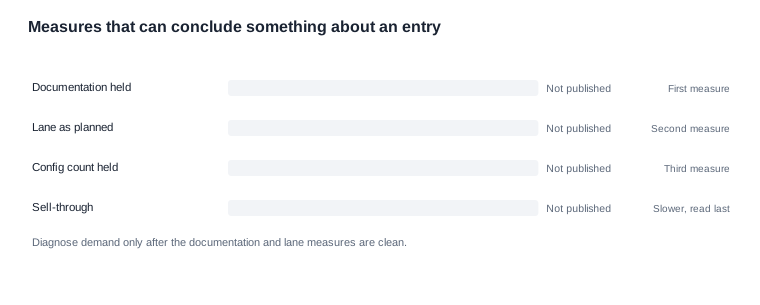
Did the documentation hold? Specifically: did the goods arrive matching the configuration, the artwork and the marking, and did the export file pass without a query. This is the first measure because it tests the part of the plan this article is about.
Did the lane behave as planned? Did the importer structure work, did the destination requirements match what was quoted, and did the lead time hold against the number the quotation stated.
Is the configuration count under control? Whether the actual number of sellable configurations matches what was planned, or whether it has grown — because a programme that has quietly added configurations has added inventory exposure it has not accounted for.
Sell-through is a measure, but it is a slower and noisier one, and it is better read after the documentation and lane measures have confirmed that the entry is running as designed. Diagnosing a demand problem in a programme that has a documentation problem produces the wrong conclusion.
The order, restated as a checklist
- Destination lane and market, with the operator and responsible-person structure.
- Certification scope requested per candidate model, in writing.
- Model group chosen against what the documentation position allows.
- Configuration fixed: designation, colourway, case state, packaging language.
- Commercial terms quoted against that fixed configuration.
- Artwork built with separable market layers.
- First shipment, with the document set complete before goods leave.
- Review at a set date against the three diagnostic measures.
This is the whole plan, in order. The version that fails is the one that starts at step five because that is the step everyone can act on immediately, and it fails by discovering at step two that the model was never viable for the lane.
Send us the destination markets, the candidate model groups and the channels you intend to use, and we will tell you which parts of this order are fixed by your lane and which are decisions you still have open.
Related reading
- The documentation a lane requires — the export documentation set to ship
- The artwork that sits on the critical path — logo and packaging in real detail
- The terms that must be quoted last — minimum order quantity for private label
- How the four clocks behave — how lead time is actually built


