

Open ear audio glasses smart glasses advanced considerations are the things that surface after a launch, and they are the things a launch review cannot see. The useful way to think about them is as a walk through a year of ownership of an open-ear audio product, because each of them appears at a different point, and each of them is a decision rather than a defect.
Seven issues, and five of them are settled with a document or a policy rather than with an engineering change.
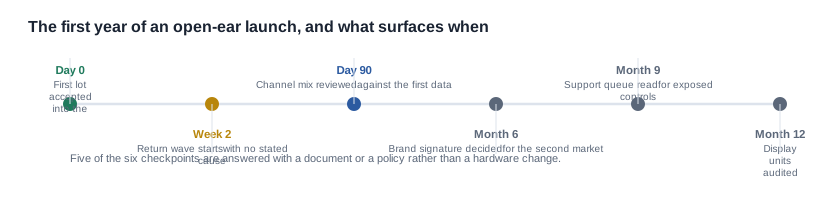
Open ear audio glasses: twelve months after launch
A buyer thinking past the launch is usually a brand lead or a product manager who has been through one, and they hold a product, a channel plan, a set of returns data and a target price. What they will not hold is a view of which of the seven issues below is already handled by the platform and which is being carried by the brand as an unmanaged liability.
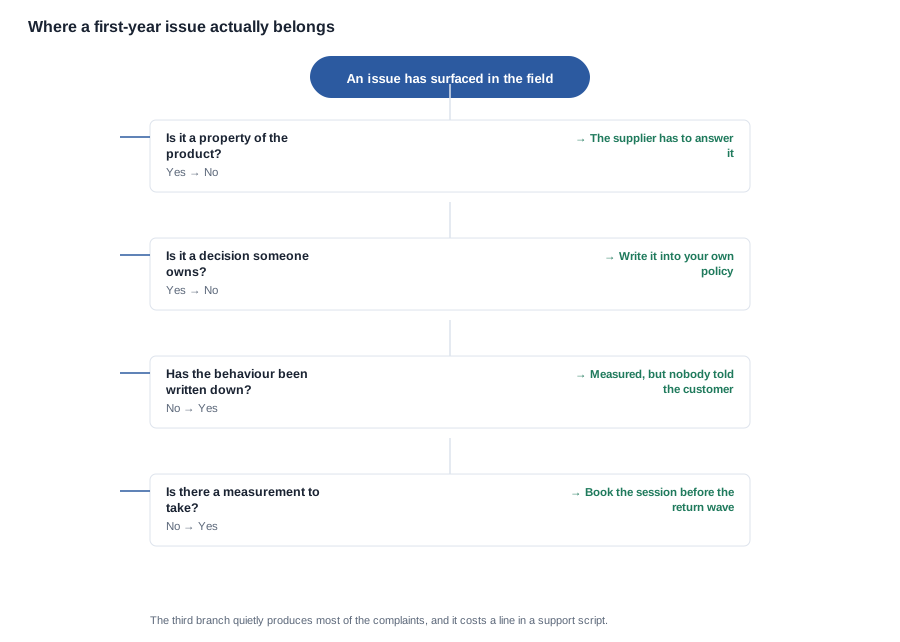
That distinction is the whole of this article. Some of these seven are properties of the product and are therefore your exposure. Some are properties of the platform and are therefore the supplier's. And three of them — the tuning, the app surface and the display-unit policy — are properties of your operating decisions, and nobody else is going to fix them for you.
The sequence matters because the issues arrive in a fairly reliable order:
- In the first weeks, returns arrive with no stated cause. The most common underlying reason is a channel balance problem that was invisible in the demo environment.
- At around ninety days, the channel mix has settled and the first real data exists. This is the point at which a balance tolerance can be set against a failure rate rather than against a pass rate.
- Around six months, the second market opens and the brand signature question stops being theoretical.
- Around nine months, the support queue has enough volume to show which exposed controls customers are actually using.
- At twelve months, the first display units have been on shelf for a year and are about to be sold or returned.
The reason this order is reliable is that each issue needs a population behind it before it can be diagnosed. A balance error needs units in the field. A tuning decision needs a second market to be worth making. A support pattern needs volume. A display unit needs time.
The two issues that genuinely need new hardware
The other five are policy, documentation or measurement. Two are not, and they are worth naming separately because they change who has to pay.
The brand signature. A warmer or brighter tuning is not a volume knob on the existing DSP profile. It is a different driver profile, possibly a different driver, and occasionally a different supplier entirely. The question at the sourcing stage is not "can we change the tuning" but "how many distinct tunings are practical, what does each one cost to carry, and what is the lead time for a new one". A brand that will run three markets with three signatures needs that answer before the platform is chosen, not after the second market opens.
The acoustic-path warranty. A failed speaker is a warranty event with an unusual property: it is audible to everyone around the wearer and not only to the wearer, which means customers report it more readily than they report other faults. A failed driver in a sealed frame is a service question rather than a component-level one, because the frame does not come apart. That has consequences for the service process, the turnaround time and the spare-parts line, and it cannot be settled by a policy note.
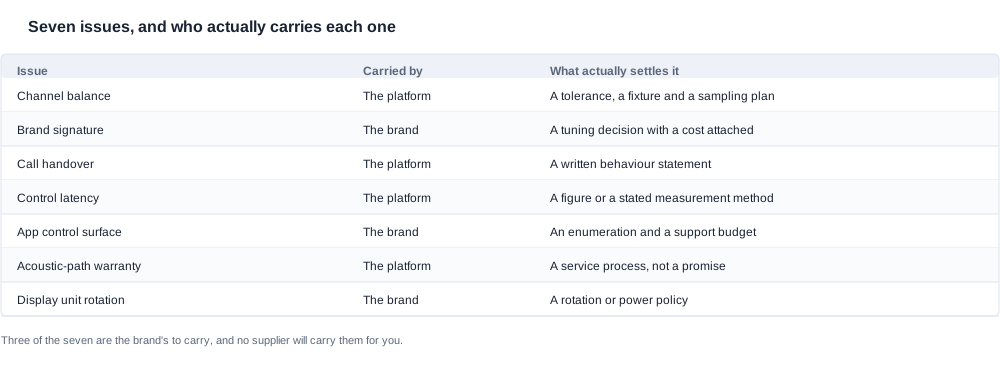
Which of the seven issues the platform carries and which the brand does
The table above assigns each issue to one of two owners, and the assignment is not a matter of opinion — it follows from where the answer physically lives.
Channel balance, call handover, control latency and the acoustic-path warranty are properties of the product. They can only be answered by whoever designed and built it, and they can only be changed by whoever designs and builds it. The brand can write them into an inspection instruction, a test protocol and a purchase order, but it cannot answer them on the supplier's behalf.
The brand signature, the app control surface and the display-unit rotation are different. They are decisions, and a decision can be made by anybody who accepts the consequences. Nobody will make them for you, and every one of them is a place where a supplier offering to "help" is actually offering to transfer an operating cost back to you.
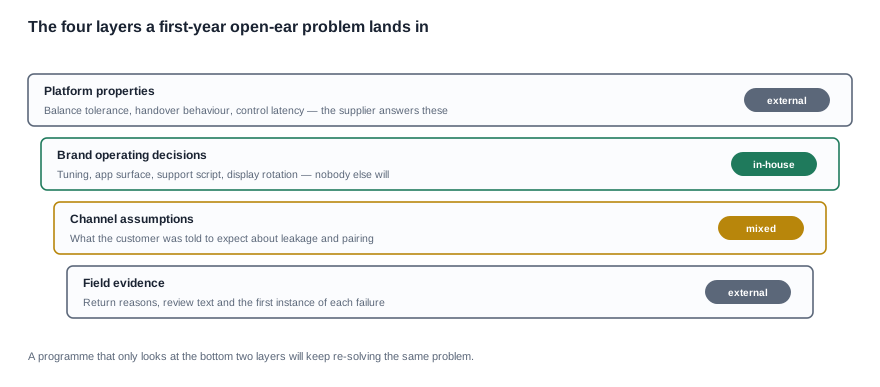
The layer diagram matters because a programme that only looks at the bottom two layers will keep re-solving the same problem. A return arrives, it is attributed to a defect, a replacement goes out, and the actual cause was a support script that never explained what happens on a call. The field evidence at the bottom of the stack is the only layer that tells you which of the other three you actually have a problem with.
There is a commercial consequence to the assignment that is worth stating before anybody signs anything. The platform-carried items belong in the supplier's scope: they should appear as acceptance criteria in the sample, as inspection instructions in the production instruction, and as obligations in the contract. The brand-carried items belong in your own operations documentation, and if they are not written down, they will be decided by whoever picks up the phone first.
Channel balance, the tolerance that has to be written down
A unit with a marginal channel imbalance sounds fine to a listener in a quiet room and obviously wrong to a listener in a street, because the ear's sensitivity to channel differences changes with the ambient level. The reason this is invisible at launch is that a good unit genuinely sounds good. A bad one sounds bad on a bench too, so a bench test will find it — but a bench test will not find the marginal ones, and the marginal ones are the ones that come back.
The remedy for channel balance is a better tolerance, not a better unit. Measured on a fixture with a defined head position, and with a sampling plan that looks at the failure rate rather than the pass rate. A supplier measuring the pass rate is measuring the good units; the failure rate is what predicts the return wave.
Our catalogue publishes the acoustic methods for this family — open-ear acoustic structure, directional audio and intelligent noise reduction — and it publishes no balance tolerance for any model. We would rather write the tolerance into an inspection instruction than into a marketing page, and we would rather say "not published" than fill a cell with a number from a typical device.
There is a specific reason the tolerance cannot be inherited from a neighbouring model in this range. The published cell configurations across the audio family vary widely: 55 mAh by two on the G07 and the LC-105-1, and the YK12 and the LC-105-2; 90 mAh by two on the K01 and the K02; and 100 mAh single cells on the D11 and the D12. Among the sport models, the YKC02 publishes 70 mAh by two and the D17 a single 115 mAh cell, and the AR glasses entry publishes its own 100 mAh single cell. A mass distribution that varies that much across a family cannot be assumed to produce a consistent balance behaviour, so a tolerance written against one model is not a tolerance that transfers to the next.
Three things to put in the inspection instruction, then: the fixture and the defined head position, the tolerance figure itself, and the sampling plan expressed as a failure rate over a stated number of units. If the supplier cannot supply the first two, that is a platform question you should resolve before the first production lot rather than during the first return wave.

The app control surface and the support load it creates
Every exposed control is a support surface. This is the least technical item in the article and the one that most reliably consumes support capacity in year one.
The mechanism is simple and it repeats. A tone control in the app, if there is one, becomes the customer's expectation rather than the manufacturer's default within a few weeks. Customers discover it, they use it, they adjust it, and then they contact support because the setting they chose makes the product behave differently from the way the listing described. The listing did not change. The customer's expectation did.
Our catalogue publishes no application detail for any model in this family, and the question worth asking is therefore not what the app does — it is what a customer can change and what they cannot, and which of those changes the brand is willing to support indefinitely. Three things follow from the enumeration:
- Decide deliberately which controls are exposed. An unexposed control cannot generate a support question, and an exposed one always will. Where a control exists because the platform ships it, decide whether it is enabled on your units.
- Budget the support surface each exposed control creates. The cost of a control is not the engineering, it is the recurring conversation. A brand that exposes four controls has agreed to answer four families of question indefinitely.
- Write the default into the leaflet, not just the listing. The default is the thing the customer compares against when something feels different, and if the leaflet does not state it, the comparison happens in a support ticket.
The same logic applies to the wake word and to any assistant behaviour, and to the extent our catalogue lists an AI voice assistant on this family it publishes no detail about it. That gap is best closed by asking what the customer sees when recognition fails, because the failure state is what generates the contact, and the failure state is a design decision rather than an accident.
Call handover and control latency as documentation problems
Call handover is a documentation problem, not an engineering one. The moment a customer has a phone call and a music session at the same time, the handover behaviour becomes visible, and it is among the most common complaints in the category after sound quality — not because the product is broken, but because nobody told the customer what would happen.
Our catalogue publishes no multipoint or coexistence behaviour for any model in this family, so the honest position is that it has to be established on a sample and then written down. The test itself is short: pair to one phone, then to a second, start a call during playback, and record what the customer is told to do. That last part is the part that is usually missing. A measured behaviour that exists only in the buyer's notes does not help a customer, and the two lines that do help — one in the leaflet and one in the support script — cost nothing.
Control latency is invisible in a demo and obvious in use. A tap on a temple has to be timed against something else in a way that a demonstration never reproduces. In a livestream, where a tap has to land on a cue, a delay is felt immediately and it is reported as a fault even though the device is behaving as designed.
The question to ask is a figure, or at least a stated method to measure it, because there is no published latency for any model in our range and no published control scheme either. A tolerance for control latency does not need to be aggressive; it needs to be written down, measured on a sample, and put in the acceptance criteria, so that the customer who reports a delay is reporting a deviation rather than an opinion.
The phone-change handover is the third behaviour in this family, and it is the one that arrives on a schedule nobody controls. Customers replace their phones every two to three years, and the product has to survive that event without the customer being asked to reset something they do not know how to reset. Our catalogue publishes no pairing behaviour for any model in this family, so the position is the same as the other two: establish it on a sample and write it down. The test is pair to one phone, pair to a second, and see what the customer is actually asked to do at that point. If a factory reset is required, the customer will not perform it — they will return the product, and the return reason will be recorded as "does not work", which tells you nothing about what to fix next time.
The year-one operating policy that costs nothing but time
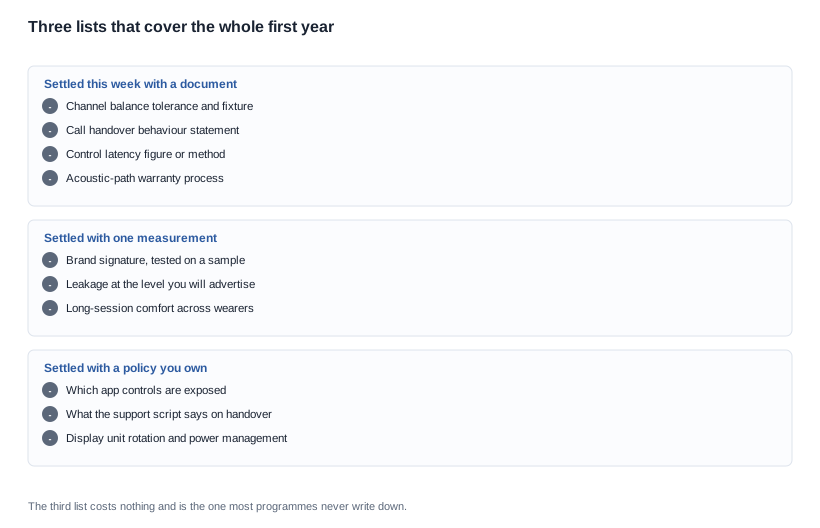
The three lists in the checklist above are the year-one plan. Most of them cost nothing and take an afternoon; two of them require a sample; and one — the brand signature — requires a conversation with the factory before it can be scheduled.
A display unit is a wear item, not a stock unit
The display unit is entirely a retail problem and it is worth planning for separately, because it is the one item on this list that is caused by the channel rather than by the product.
A display unit that has been powered on and playing continuously for a year has a cycled battery and a tired driver. It is sold to a customer as a new product. If it fails inside the warranty period, the customer has no way of knowing that it was a display unit, and the brand absorbs the replacement and the review comment.
The two mitigations are a rotation plan and a power management policy, and both are cheaper than the returns they prevent. A rotation plan decides how often a display unit is moved to the back of the stock and how long it stays there. A power management policy decides whether the unit runs all day or only during trading hours, and whether the frames are swapped at all. Either way the rule is the same: the display unit is logged as a wear item, it has a date on it, and it is not sold as new without the brand's knowledge.
The same reasoning applies to any unit that has been out of its box in the channel. A demo unit, a review unit and a display unit are three names for the same commercial situation, and a returns policy that treats them as new stock is a returns policy with a predictable hole in it.
The commercial terms the year-one plan can lean on
A few of the year-one items can be settled in the contract rather than in the operating policy, and it is worth putting them in the purchase order while the purchase order is still being negotiated rather than twelve months later.
The model designation should appear as a line item with the certificate numbers attached, and the acceptance criteria from the sample session should reference the balance tolerance, the call handover test and the long-session comfort test. A clause should require notice before any change of transducer, DSP tuning, default processing state or firmware — because a firmware change alters the acoustic result without altering the hardware, and a brand that has measured its product has a right to know when the thing it measured has changed underneath it. A further clause should cover who bears the cost when the sample does not meet the acceptance criteria, and a final clause should cover the acoustic-path warranty process, the turnaround time and what the customer is told in the first twenty seconds of the call.
The things a contract cannot move are the certification fee and the certification elapsed time, the acoustic design itself, and the tooling amortisation volume. The certification cost is per product family and the elapsed time belongs to the test laboratory. The acoustic design — the transducer, the frame geometry and the signal chain — is the product, and a supplier who is unwilling to discuss it is telling you the acoustic behaviour is fixed.
Where our own published rows leave the year-one plan
Here, we publish the rows our catalogue holds and we publish the empty measurement rows next to them rather than filling them with typical values. For this family we publish the Bluetooth version, the charge time, the cell configuration, the runtime, the charging mode, the surround configuration where it is stated — the YK12 and the ZH12, the D17 and the D11, and the YKC02 all publish a surround or stereo configuration — and the additional features where they are stated, including the remote control photo on the D17 and the ZH12, the detachable temple on the G07, the slim temple on the YK12 and the detachable inner frame on the V06 and the S7.
We will not infer a driver size, a leakage distance, a balance tolerance, a codec, a control latency or a multipoint behaviour that we have not established, and we will not present a default tuning as a brand signature. We publish no charging case for any model in this family, and we will not describe a case that stores as though it were a case that charges.
What we can do is take a specific configuration and tell you which of these seven issues our documentation already answers, which need a sample, and which need a written policy rather than a measurement. The technical background is under open-ear audio technology, the audio range is on the Bluetooth audio glasses page, the quality control side is in open ear audio quality control, the shared vocabulary is in open ear audio glossary, and the platform choice is in how to choose open ear audio glasses.
Related reading
- The quality regime that protects it — open ear audio quality control
- Choosing the platform — how to choose open ear audio glasses
- The vocabulary a team has to share — open ear audio glossary
Tell us the launch date and the channels, and we will tell you which of these seven issues will surface first for you.


