

Quality control in this category is different from quality control in most electronics, and the difference is that the product is worn against the head rather than held. A defect that would be invisible in a phone — one channel slightly louder, a driver seated a millimetre out of position, a touch control that responds half a beat late — is immediately obvious on a head, because the person on the receiving end is the antenna, the acoustic cavity and the measuring instrument all at once. Open ear audio glasses smart glasses quality control is therefore mostly about station design and tolerance setting, because the bench cannot see what the head will show.

The commercial framing for a buyer is simple and slightly uncomfortable. A quality regime is a cost, and the cost of the fixture and the tolerance is a fraction of the cost of the returns it prevents. A brand that skips the balance station saves the cost of a fixture and pays for it in the return rate, which is a worse trade and a much harder one to reverse.
Open ear audio glasses: four layers, one dropped
Why a good product and a bad product read the same on the bench
Most of the stations in this category are subjectively operated unless the criteria are written down. That is the central fact about quality control in open-ear audio, and it explains why the returns data and the factory's own quality data can disagree for a long time without either party noticing a discrepancy.
A station without a criterion produces an opinion, and an opinion has nowhere to go except into a return rate. It cannot be trended, it cannot be attributed to a process step, and it cannot be audited. The same station with a written criterion produces a number, and a number can be charted against the lot, the shift and the material batch.
That is why the inspection instruction, rather than the inspection itself, is the document worth negotiating. An instruction that lists stations with acceptance criteria can be audited and improved. An instruction that lists things to look at can only be argued with.
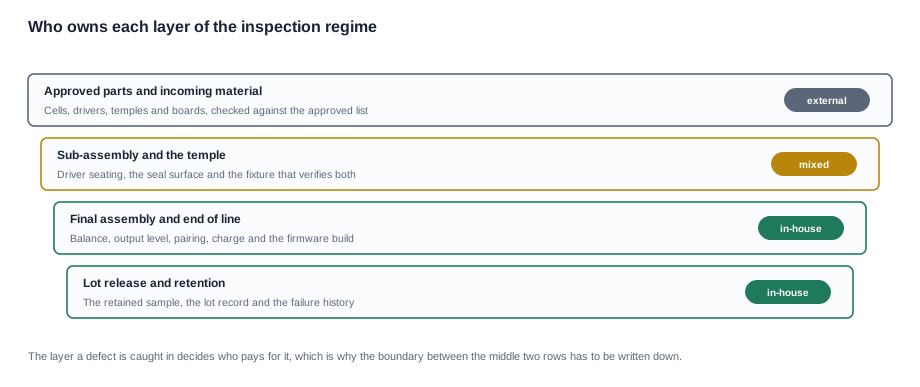
The four layers, and what each one owns
Incoming. The cell, the driver, the temple, the board and the mechanical hardware, checked against the approved part list and the drawing. This layer decides the configuration, and it is the only layer that can catch a substitution before it becomes a lot.
Sub-assembly and the temple. Driver seating, the seal surface, the pivot and the hardware. This is where the acoustic architecture is physically realised, and it is the layer where the two things that cannot be seen on a finished unit are set.
Final assembly and end of line. Channel balance, output level, connection and reconnection, the charge path, the control response and the firmware build. Most of these have to run on every unit, because they are fast, because a failure here is a return, and because several of them cannot be inspected visually.
Lot release and retention. The runtime and the microphone measurements that are too slow to run on every unit, the retained sample, the lot record and the failure history. This is the layer that makes the other three layers accountable, because it is where the sampled results are compared against the units that actually shipped.
The layer that gets dropped first
In our experience the layer that gets dropped first under volume pressure is not final assembly — it is the fixture-based work at end of line, because it is the one that needs capital equipment rather than labour. It is also the layer that catches the defect this category returns most often for: a channel imbalance, which is obvious within seconds of putting the product on, cannot be worked around, and produces a return with a description that says the sound is wrong rather than anything a support script can resolve.
The commercial structure of the trade is worth putting to the factory in those terms rather than as a request for a better quality system. A fixture is a one-off cost against a return rate it prevents, and it is the one item on the inspection instruction where the payback is clearest.
Incoming inspection, where the configuration is decided
The incoming checks that catch a substitution
The incoming layer has one job that no other layer can do, and that job is to make sure the parts that arrived are the parts that were ordered. In a range where several models share a radio generation, several cell configurations and two charging interfaces, a substitution is easy to make and hard to detect downstream.
Four checks carry most of the value.
The cell, by part number and by batch. The cell configuration is the field that decides the runtime tier, the charging interface, the charge time and the mass distribution across the temples. Our own catalogue illustrates the range of variation inside a single tier: single 100 mAh and 115 mAh cells on four models, and two-cell configurations at 55 mAh × 2, 70 mAh × 2 and 90 mAh × 2 on seven others. A cell swapped within the same tier can move a model between the roughly six, seven and eight hour bands without any visible difference in the finished unit.
The driver, by part number. This is the single most consequential incoming check in the category, and it is the check that protects the acoustic specification. A driver of the right form factor and the wrong characteristics will pass a visual inspection, will pass an end-of-line functional check, and will only show itself in the balance and output-level stations — if those stations exist and have tolerances.
The temple and the mechanical revision. The temple carries the acoustic chamber, so a temple revision is an acoustic revision, and it is also a tooling revision. The incoming check has to catch the case where a production run uses a temple from a superseded revision, which happens when the drawing changes and the stock does not.
The change notification. The process that catches a substitution is not really the comparison — it is the supplier being required to tell you in advance that a part has changed. Without that obligation, the comparison becomes an audit of what arrived rather than a control on what will arrive.
The cell and the driver, as the two things that arrive wrong
The other incoming items are more forgiving. A board is either the right revision or it is not, and it fails loudly at end of line. A charging interface is visually obvious. The temple hardware is dimensionally checked.
The cell and the driver are different because both can be wrong in a way that is invisible until much later. A cell with a different internal resistance produces a unit that charges slightly differently and runs slightly differently, and the drift is small enough to be inside any tolerance that has not been set. A driver with a different resonant behaviour produces a unit that is measurably different on the frequency curve and indistinguishable by eye, by connection and by charging.
The practical consequence for the inspection instruction is that these two parts should be verified by part number against an approved list that is version-controlled, and the approved list should be a document the buyer can see rather than a document the factory keeps.
What cannot be checked against a published value
There is an honest limit on the incoming layer that a buyer should understand before writing the instruction. For most parameters, the catalogue publishes no value to check against — not for the driver characteristics, not for the cell's discharge behaviour, not for the acoustic output of the assembled unit, and not for the weight of any model in the audio tier.
Across the whole catalogue there is one weight on record, the MT6 glasses body at 158 g, measured with the 265 mAh cell and the camera of that model inside the figure and its 1200 mAh folding charging case outside it; nothing is published for the weight of the case, and no model in the range has a published bare frame weight.
So an incoming or in-process weight check cannot be a check against a published number for the audio tier. What it can be is a consistency check against a retained reference unit from the first approved lot, which catches drift across a production run without pretending to know the right value. That is a weaker control than a specification and a much better one than nothing, and the distinction should be written into the instruction so that nobody later mistakes it for a conformity check.
Line and end-of-line stations, and the fixture behind them
The stations that need a fixture and a defined head position
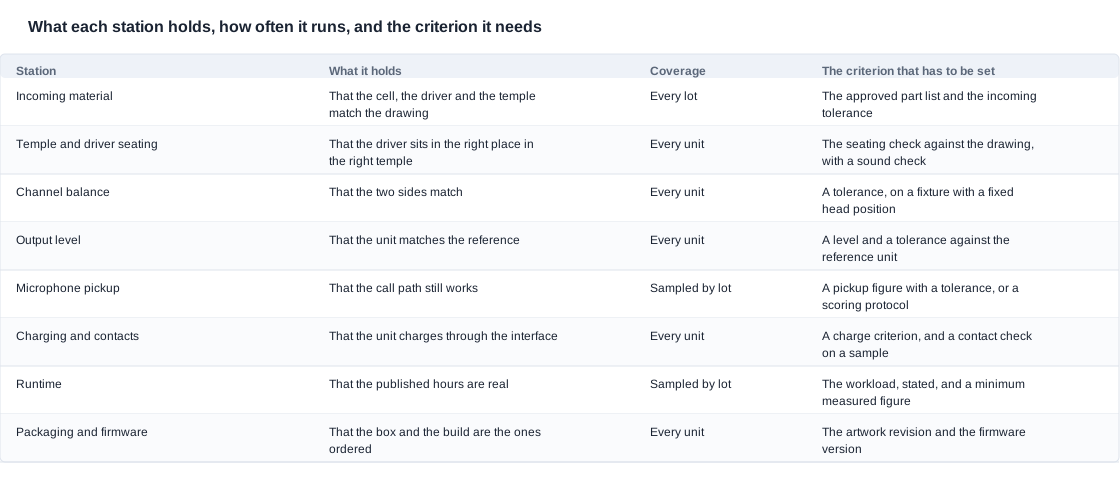
The fixture is the reason a meaningful level measurement is possible at all. Without a defined head position, an output-level reading is a measurement of whoever is holding the frame as much as of the product, and two operators will produce two different numbers for the same unit.
The stations that need one are channel balance and output level, and they need it for the same underlying reason: in an open-ear product the acoustic result depends on the geometry between the transducer and the head, so the geometry has to be held constant for the number to mean anything.
A fixture is therefore not a luxury. It is the difference between a station that produces a comparable number and a station that produces a note saying the unit sounded correct.
Channel balance and the tolerance that has to be set
Channel balance is the station that matters most in this category, and the tolerance has to be set rather than assumed, because two drivers in one product will not match by themselves.
The threshold a buyer should set is a maximum difference in output between the two sides, measured on the fixture with a stated reference signal at a stated level, and expressed as a figure rather than as a judgement of whether it sounds balanced. A judgement cannot be trended and cannot be audited; a figure can be recorded per unit, charted per lot and used to trace a defect back to a material batch or a shift.
Two units in the same lot that differ on this station is a process finding, not a sample finding, and it is one of the few findings in this category that is worth escalating immediately.
Output level, and the reference unit it is compared with
Output level against a reference unit on the same fixture is what catches a substituted driver, and it is the reason the fixture and a retained reference unit have to exist together. A reference unit that drifts becomes a reference that approves drift, so the reference has to come from the first approved lot and has to be re-checked on a schedule.
The pass line is a level and a tolerance, both set by the buyer. It is worth being explicit that this number is not comparable with any published figure from any supplier, because no supplier publishes a comparable figure for this category. The level measurement exists to detect drift within a production run, not to compare products across suppliers.
The control and the seal, which sit on two different checklists
A capacitive control on the temple puts a physical feature into the surface that forms the acoustic seal, so the control and the acoustics are the same piece of design rather than two independent items. No model in the range publishes a capacitive touch row, so the control surface has to be established with the supplier before this checklist can be written. What the catalogue does publish is the slim or detachable temple on the G07 and the YK12, and once a control has been confirmed the interaction between that control and a temple surface becomes a live question rather than a theoretical one.
Almost nobody checks this, because the control sits on an electronics checklist and the seal sits on an acoustic one, and the two checklists belong to different people. The station that catches it is a combined one: press the control, then check the seal and the level again.
The failure it prevents is expensive and misclassified. A unit whose level changes when the control is pressed is an acoustic fault from the customer's point of view, and it will be returned as one, and it will be counted against the defect rate, and the real cause will be in a part of the design that nobody thought to protect.

Sampling logic, and which controls cannot be sampled
Why three controls cannot be sampled
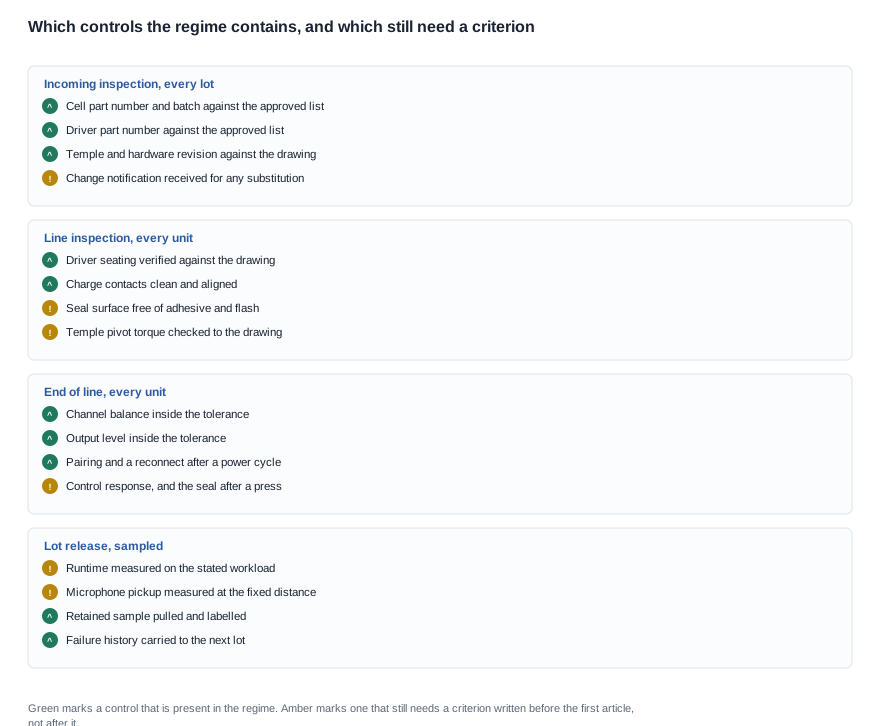
Sampling is a trade of coverage against cost, and it is the right trade only for controls where a defect is both rare and consequential. Three of the controls in this category do not meet that test.
Channel balance must run on every unit, because the control is fast, the fixture is already standing there, and the defect is visible to the customer within seconds.
Output level must run on every unit, for the same reason, and because it is the station that catches a driver substitution.
The charge path must run on every unit, because an intermittent charge problem is a contact problem more often than a failed cell, and because a unit that charges on the bench and not in a customer's pocket is a failure that survives the factory. The contacts should be wiped and inspected before the charge test rather than after it, so the inspection is on the condition the unit actually ships in.
Connection and reconnection after a power cycle also belongs on every unit, because it is the cheapest station on the list and the one with the highest return on effort. The customer performs it once, and it sets their impression of the product for a long time.
The ones that can be sampled are the slow ones: the runtime on a stated workload, and the microphone pickup at a fixed distance. Both are measured in minutes rather than seconds, and both have a tolerance that can be argued about on a sample.
A risk-based plan instead of a uniform one
Uniform sampling is the default in most inspection regimes and it is almost always wrong, because it treats a cosmetic blemish and a channel imbalance as equivalent events. A risk-based plan weights each station by what the defect actually costs you.
The weighting is easy to compute from information a buyer already has. Take the return rate attributable to each defect class, multiply it by the cost of the return including the freight, the packaging and the channel margin, and multiply again by the probability that a sampled check would have caught it. That gives a number for the station, and the plan allocates its budget to the stations with the largest numbers.
The commercial point is that a risk-based plan is cheaper than a uniform one at the same defect escape rate, which means it can be agreed at the same cost with more coverage. It is also the document that a factory will find hardest to argue with, because it is built from the buyer's own return history rather than from a general principle.
The lot record, and why retention is the layer that makes the others work
Two things have to happen at lot release. First, the sampled results have to be recorded against the lot and carried forward, so that a defect rate can be trended across lots rather than restarted at each one. Second, a retained sample has to be pulled, labelled and stored.
The retained sample does more work than it appears to. It is the reference unit that later lots are checked against, it is the physical evidence when a customer complaint arrives four weeks later, and it is the unit whose absence turns an argument about quality into an argument about memory.

Change control, and why a new transducer reopens a station
What a change notice has to cover
A change notice in this category is not a formality, and the reason is that several of the stations are only valid for a specific configuration. If the transducer changes, the balance tolerance and the output reference are no longer calibrated to the product they were set for. If the chamber geometry changes, the seal changes, and the seal is what the level depends on. If the DSP tuning or the default processing state changes, the level at the output changes and the reference unit no longer represents the production build. If the firmware changes, the reconnection behaviour changes and the pairing station may need to be re-run against the new build.
So the change notice has to cover, at minimum: the transducer, the chamber geometry, the temple design, the cell configuration, the DSP tuning and default processing state, the firmware build and the app version. And each item has to say which station it invalidates.
That last part is what makes the notice useful rather than decorative. A notice that says "we changed the driver" tells you something happened. A notice that says "we changed the driver, so the output-level reference and the balance tolerance must be re-established, and the first three lots should be checked at full coverage" tells you what to do.
Why the buyer has to be in this loop
The factory owns the process and the buyer owns the acceptance criteria, and a change to the product sits across that boundary. That is why the clause has to be in the purchase order rather than in the correspondence: a notification obligation with no consequence is a request, and a request is not a control.
The three parts of the clause that matter are the advance notice, the list of items that trigger it, and the statement of which stations are reopened. The third part is the one most often left out, and it is the one that prevents the failure mode where a station quietly stops being valid and nobody notices until the field data moves.
There is a second reason the buyer belongs in this loop. A change is also an opportunity to re-establish a criterion that was never set, because a change gives you a natural point at which to say "and now the tolerance is this, and the reference unit is that, and the first lots are checked at full coverage".
What we run, and what a buyer should ask to see
The inspection instruction as a negotiable document
The inspection instruction and its acceptance criteria are negotiable, and agreeing them before production is materially cheaper than adding a station after a return trend appears. The sampling plan is negotiable, and a risk-based plan costs less than a uniform one. The negotiation is a discussion about risk, and it is much easier when both sides are looking at the same return history.
What a buyer should ask to see, in order: the station list with the acceptance criteria beside each one; the fixture specification and the head position; the balance and output-level tolerances; the reference unit's origin and its re-check schedule; the runtime workload; the firmware build and the known-issue list; the change-notification procedure with the station-invalidation list; and the lot record format with the retention arrangement.
Two of those are contractual rather than documentary. The retained unit and the fixture should be available for the buyer's audit, and the cost allocation for a lot that fails the inspection criteria should be settled before the deposit, not during the first rejection.
What we publish, and what a station needs that we have not set
We publish the acoustic methods our catalogue states — the open-ear structure, directional audio, intelligent noise reduction and, on five models in the audio tier, surround sound — and we publish the empty measurement rows next to them rather than filling them with values from a typical device. We publish no leakage figure, no driver size and no channel balance tolerance that we have not established, and we will not tell you that a station is running when its criterion has not been set.
We will also be direct that a quality regime is a cost, and that the cost of the fixture and the tolerance is a fraction of the cost of the returns it prevents. That is the argument we make internally and the argument we make to a buyer who is weighing the line item.
The four requests we can answer immediately
-
Send us your inspection instruction. We will tell you which of the stations described here it covers, which of the published rows each station actually verifies, and where an acceptance criterion still has to be set rather than read.
-
Send us your return history by defect description. We will tell you which of those descriptions map to a station, and which of them are consequences of a boundary rather than of a defect — which is a distinction that changes what you should ask the factory for.
-
Ask us about the fixture. We will tell you what the head position is, what the reference unit is and how often it is re-checked, and we will be explicit about which of those answers are specific to our line rather than general.
-
Ask us which changes close a station. We will list the items that trigger a change notice and the stations each one reopens, because a buyer who has that list can defend the clause without negotiating it from scratch.
The technical background is under open-ear audio, the range is at Bluetooth audio glasses, the sample-side measurement protocol is in how to measure open ear audio, the vocabulary a station has to share is in the open ear audio glossary, and the use-case mapping that decides which stations matter is in open ear audio for different use cases.
Related reading
- The vocabulary a QC station has to share — open ear audio glossary
- The measurement side — how to measure open ear audio
- Choosing by use case — open ear audio for different use cases
Send us your inspection instruction and we will tell you which of the eight stations it covers and where an acceptance criterion still has to be set.


