

This is a checklist for the decision, not for the sample. It is built around a single observation: in this category the published specification is a handful of rows, and the difference between a good supplier and a difficult one is entirely in the rows they will and will not fill. Every item below therefore has a pass condition and a walk-away signal, so it can be used as a questionnaire and as a scorecard.
The reason a questionnaire rather than a comparison is that a comparison cannot be built from documents in this category. Our catalogue publishes the cell configuration, the Bluetooth version, the charge time, the runtime and the charging mode for every model in the audio family. It publishes a surround or stereo configuration for the D11 and the YK12 in the audio family, and for the YKC02, the D17 and the ZH12 among the sport models. It publishes a detachable temple on the G07, a slim temple on the YK12, a remote control photo on the D17 and the ZH12, and an indicator light with button control on the AR glasses. That is the whole of the published surface.
It does not publish a driver size, a frequency response, a leakage figure, a microphone specification, a codec, a frame weight for any of the audio models, a frame dimension, a control scheme, a companion application detail, a control latency, a multipoint behaviour, or a charging case for any model in the family. Those are not small gaps in a rich document — they are the majority of the decision.
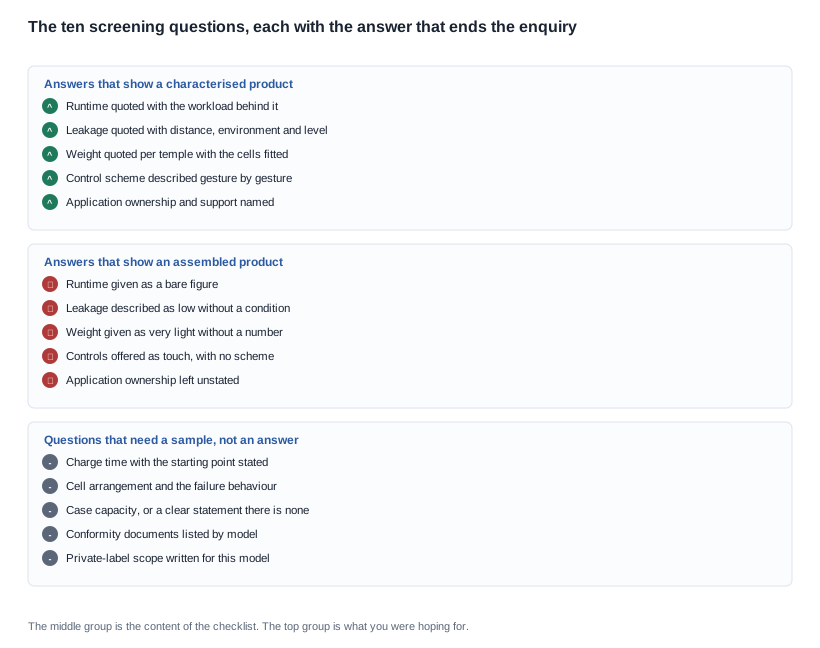
Open ear audio glasses: ten questions in writing
The ten items are asked in writing, in one message, before any sample is ordered. The order is not arbitrary: the first five are the ones that decide whether the product can be sold at all, and the last five are the ones that decide whether it can be shipped and supported.
- The runtime test condition. What was active, at what volume, over how many units, and whether the figure is a mean or a peak.
- The acoustic figures. Leakage at a stated volume and distance, a frequency response, a driver size and a microphone count.
- The weight and the dimensions. A weight in grams, per temple and with the cells fitted, plus temple length, lens dimensions and bridge width.
- The control scheme. Every control and every gesture, and what a long press does that a short press does not.
- The companion application. Whether one is required, who publishes and supports it, which phone systems it covers, and what happens to a customer when it is updated.
- The charging interface and the indicator. A stated charge input, a stated charge time from a stated starting point, and confirmation of what the charge indicator shows.
- The case, or the absence of one. A case capacity, or a clear statement that there is no case, and the availability of a spare.
- The cell arrangement and the service story. The cell configuration, whether the cells are field-replaceable, and what happens when one fails.
- The conformity documents, by model. Certificate or declaration numbers, the issuing body, the validity period and the schedule of covered model variants.
- The private-label scope, in writing. A written list of which customisation routes are available for the specific model, and which of them touch the radio, the battery or the enclosure.
The published rows this checklist has to work around
Every one of the ten questions exists because the published catalogue does not answer it. For orientation, this is what the audio family's published rows actually say — and this table is the reason a buyer in this category needs a questionnaire rather than a comparison.
| Model | Bluetooth | Cell | Charge time | Runtime | Charging | Published feature |
|---|---|---|---|---|---|---|
| AR glasses | V5.4 | 100 mAh | 2 h or less | ~8 h | Magnetic | Indicator light, button control |
| K01 | V5.3 | 90 mAh × 2 | 2 h or less | ~8 h | Magnetic | — |
| K02 | V5.3 | 90 mAh × 2 | 2 h or less | ~8 h | Magnetic | — |
| D11 | V5.4 | 100 mAh | 2 h or less | ~7 h | Type C | Surround, long endurance |
| D12 | V5.4 | 100 mAh | 2 h or less | ~7 h | Type C | — |
| LC-105-1 | V5.4 | 55 mAh × 2 | 2 h or less | ~8 h | Magnetic | — |
| LC-105-2 | V5.4 | 55 mAh × 2 | 2 h or less | ~8 h | Magnetic | — |
| G07 | V5.4 | 55 mAh × 2 | 2 h or less | ~6 h | Magnetic | Ultra-slim, detachable temple |
| YK12 | V5.4 | 55 mAh × 2 | 2 h or less | ~6 h | Magnetic | Surround, slim temple |
| YKC02 | V5.4 | 70 mAh × 2 | 2 h or less | ~8 h | Magnetic | Surround, long battery life |
| D17 | V5.4 | 115 mAh | ~1 h | ~7 h | Type C | Remote control photo, surround |
| ZH12 | V5.4 | 100 mAh | ~1 h | ~8 h | Type C | Remote control photo, stereo surround |
Read across the table and three things become obvious. Every model publishes a runtime and not a single model publishes the workload behind it. Every model publishes a cell configuration and not one publishes where the cells sit in the frame. And the charging interface splits the family into two groups — magnetic on the AR glasses, the LC-105-2 and the K01, the K02 and the LC-105-1, the G07 and the YK12, and the YKC02, and Type C on the D11, the D12, the D17 and the ZH12 — which is a shipping and packaging decision rather than a performance one, and which is still worth settling before the first order because it determines what the customer has to own.
The two models that publish a feature beyond the electrical rows are worth noticing too. The G07 and the YK12 publish a temple characteristic, and the D17 and the ZH12 publish a remote control photo function. Those are the only published differentiators in this family, and a buyer looking for a way to position two otherwise similar models should start there rather than inventing one.
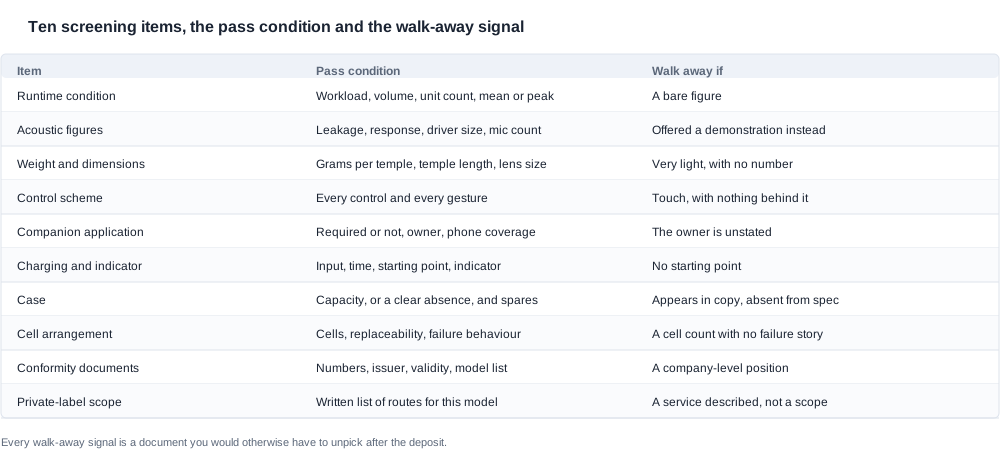
Each item's pass condition and the walk-away signal behind it
The pass condition tells you the answer is real. The walk-away signal tells you the answer will not become real later, which is the more useful of the two because it saves the second round of supplier evaluation.
| Item | Pass condition | Walk away if |
|---|---|---|
| Runtime condition | Workload, volume, unit count, mean or peak | A bare figure is given, with no method offered |
| Acoustic figures | Leakage, response, driver size, microphone count | A confident answer to none of them, with a demonstration offered instead |
| Weight and dimensions | Grams per temple, temple length, lens size, bridge width | "Very light", with no number |
| Control scheme | Every control and every gesture | No control method published, and no reason given |
| Companion application | Required or not, owner, phone coverage | The supplier does not want to say who owns it |
| Charging and indicator | Input, time, starting point, indicator behaviour | No starting point and no description of the indicator |
| Case | Capacity, or a clear absence, plus spare availability | A case with no capacity, or a case in the copy but not in the specification |
| Cell arrangement | Cells, replaceability, behaviour on failure | A cell count with no failure behaviour |
| Conformity documents | Numbers, issuing body, validity, model schedule | A company-level position offered in place of a model-level document |
| Private-label scope | A written list of routes for this model | A service described on a page, with no model-level scope |
Why a walk-away signal matters more than a pass condition
A pass condition tells you whether a supplier can answer today. A walk-away signal tells you whether this supplier is the one you want, and it does that in a way that a pass condition cannot: a supplier can pass a pass condition by supplying a figure, and still fail on the thing that actually matters.
The two clearest examples are on the list. A supplier can produce a runtime figure in any form at all, including a bare one, and it will still pass a badly written pass condition — but a bare runtime is unusable, because a figure without a workload cannot be compared with the figure on the next quotation, and the buyer will end up choosing on the number that looks best rather than on the number that describes the product. And a supplier can name an application owner in one line and change the answer later, at which point your customers are using somebody else's software and your support desk receives the questions about it.
There is a third reason the walk-away signals are the content of this list. They are the only part of it that can be checked by a reader who does not know the category. A procurement manager who cannot judge whether a leakage figure is plausible can still judge that an answer which declined to give one is not an answer, and that is enough to end a conversation.

Running the questionnaire without turning it into an interrogation
The mechanics matter more than they sound, because the quality of the answer depends almost entirely on how the question is asked.

- Send the ten questions as one numbered list, with the target model named in the subject line. Ten separate emails produce ten partial answers and a supplier who has answered nine of your questions before you get to the tenth.
- Ask for answers in writing, with units. A unit is what turns a number into a specification, and asking for one is what separates an answer from an adjective.
- Allow a week and no chase. The single most informative thing about a supplier's response time is whether it needs reminding. A supplier who answers a ten-question list in a week without a prompt has a documentation process, because most of the answers have to be looked up rather than remembered.
- Score each answer as real, soft or open. Three categories, and they are enough. "Real" means the condition is attached. "Soft" means a figure exists but not its condition. "Open" means the answer was a promise to supply it later.
- Mark the two questions only a sample can close. These are the two that require the physical product, and the questionnaire should end by naming them rather than by waiting for them.
- Take the scorecard into the sample session. The scorecard decides what you measure, in what order, and what you need the sample to prove. A supplier who scored well on items 1 to 4 still needs the sample to answer items 2, 3 and 4 properly.
The failure mode for this process is not a hostile supplier. It is a friendly one who answers everything with a plausible paragraph. The scorecard is what prevents that outcome, because it forces a classification of every answer before the conversation moves on.
How the published configurations narrow the shortlist
Once the ten answers are scored, the published rows above do the actual narrowing, and there are three trade-offs worth naming because they are the ones buyers in this family argue about.
The charging interface is a customer-ownership decision. A magnetic interface means the customer owns a proprietary cable or a proprietary dock; a Type C interface means the customer owns a cable they already have. The second is easier to explain and easier to replace, and it is why a Type C configuration often sells better in a channel where the customer is not a technology buyer. The published runtime differences are small enough that the interface usually matters more in the return reasons than the cells do.
The cell configuration is a mass-distribution question, not a capacity question. Two 55 mAh cells and one 100 mAh cell can describe a similar amount of energy, and the two arrangements put the mass in completely different places in the frame. Two cells in the temples and one cell near the bridge feel different over an afternoon, and the difference is the kind that shows up as a comfort return rather than as a defect report. This is why item 3 asks for a weight per temple and not a total.
The Bluetooth generation is a battery and lifecycle input. V5.3 appears on the K01 and the K02, and V5.4 appears on the rest of the family. The generation matters for power budget and for the lifecycle of the phone ecosystem your customer will use over the next three years. It does not tell you anything about microphone pickup, and a buyer who uses it as a proxy for call quality has made a mistake — the method for the call question is in how to measure smart glasses microphone quality.

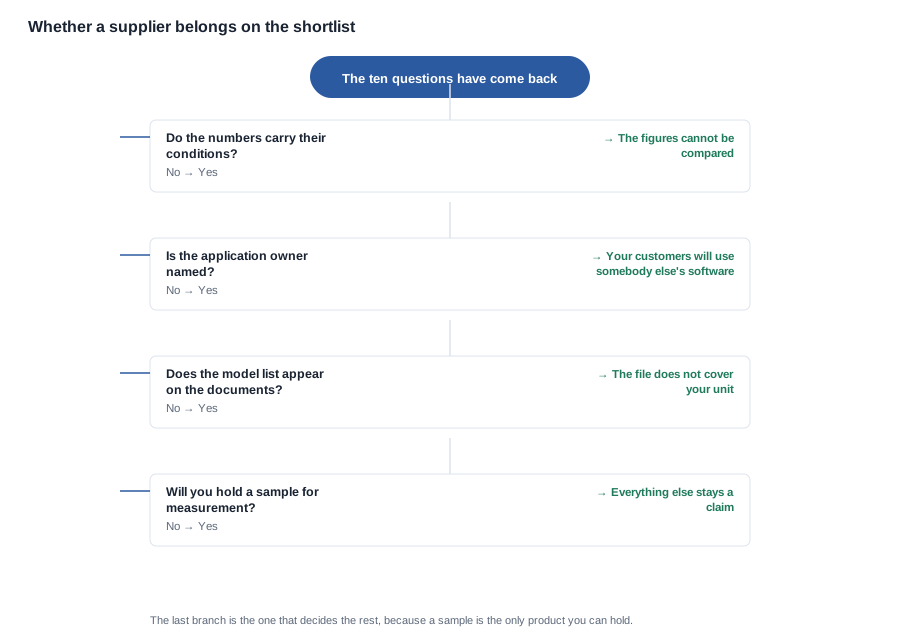
The two questions that turn a questionnaire into a decision
"What is not published, and when will it be?" A supplier who answers this plainly is telling you where the risk sits, and the answer is usually more useful than the ten answers above. It converts an unknown into a scheduled item, and a scheduled item can be put in a launch plan. An unknown cannot.
"Can we hold a sample and measure it?" A weight with a set of scales, a runtime with a stopwatch, leakage with a meter, a call with a second person in a noisy room. Everything else on this list is a document. That one is the product.
There is a third question worth adding, and it is the one that separates a supplier who has characterised the product from one who has assembled it: "Which of these ten figures would you put in your own technical file?" A supplier who has an internal file naming the leakage method, the balance fixture, the runtime workload and the weight measurement procedure has characterised the product. A supplier who has to ask their colleague is telling you the answer will come from somewhere less reliable than a document.
The measurement you cannot get in writing
Three of the ten items are measurements in disguise, and a buyer who treats them as document requests will get documents that describe the intention rather than the result.
The leakage figure is the first, and it is the number that decides the return rate, because leakage is the format's defining weakness and the one nobody publishes. The second is the weight, and weight is the single largest driver of returns in a product worn on the face all day — in this range exactly one model in the whole catalogue publishes a weight at all, and it is a camera model rather than an audio one. The third is the control latency, which is invisible in a demonstration and obvious in a livestream.
For all three, the position to take to a supplier is the same. Ask for the method, not only the result. A supplier who can describe the fixture, the environment and the sampling plan can usually also tell you the result, and if they decline to give the result they have told you something useful about how the number was produced.
What this checklist can and cannot settle for you
This checklist is a screening instrument, and it is worth being precise about what it settles. It settles whether a supplier is worth continuing to talk to, and it produces the scorecard that decides what the sample session has to measure. That is a real outcome, and in a category where the published rows are this thin it is the outcome that most purchasing decisions actually need.
What it does not settle is the product. No amount of documentation establishes how the unit sounds, how it leaks, how it feels over a long afternoon, or whether the call survives a street. Those are the sample's job, and the checklist's contribution to them is that it arrives at the sample session knowing which measurements actually matter rather than testing everything equally.
There is one more thing it cannot do, and it is the thing buyers most often expect it to do: it cannot produce a price. A ten-item questionnaire narrows the field; it does not rank the survivors on cost. Ranking requires quotations against a defined configuration, and the configuration has to be settled first — which model, which colour count, which packaging, which markets — because an open configuration produces quotations that are not comparable.
The practical sequencing, then, is three passes. The questionnaire narrows a field of suppliers to two or three. The sample session, run against the scorecard this questionnaire produces, narrows those to one and writes the acceptance criteria. Only then does a defined configuration go out for quotation, and only then is a price comparison meaningful. A buyer who skips the first pass and goes straight to quotations is comparing configurations as well as suppliers, and will usually conclude that the cheapest quote is the right one.
Concretely, items 1 to 10 are the questions that separate a supplier who has characterised the product from one who has assembled it, and the walk-away signals are the real content of the list. A supplier who answers none of them but answers the last two questions well is a supplier worth talking to.
We will tell you which of these ten we can answer for you directly — the platform rows, the family feature descriptions, the customisation routes by category — and which are process questions for the factory. We will not publish prices, minimum order quantities or lead times, and our internal documentation currently holds three conflicting minimum order quantity figures that have not been arbitrated.
Tell us the channel, the volume, the target market and the environment the product is sold into, and we will come back with the published rows and the open questions. The same twenty questions in supplier form are collected in what to ask a supplier about open ear audio glasses, the family is on our Bluetooth audio glasses range page, the format itself is explained under open-ear audio, and what to do once the sample lands is in quality checks.
Related reading
- The same twenty questions in supplier form — open-ear supplier questions
- How the format actually behaves — open-ear audio
- What to check once a sample arrives — quality checks
Tell us the channel, the volume and the target market, and we will come back with the published rows and the open questions.


