

Eight limitations sit under this category, and every one of them is a specification that is not published rather than a design fault. The level a listener receives depends on the seal between the frame and the head. The product leaks, measurably. Low-frequency response is limited. The microphone degrades faster than the audio does. A radio, an audio path, a camera on some models and a small cell compete for the same capacity. A long session establishes pressure. The published runtime carries no test condition. And nothing in this range carries a third-party acoustic measurement.
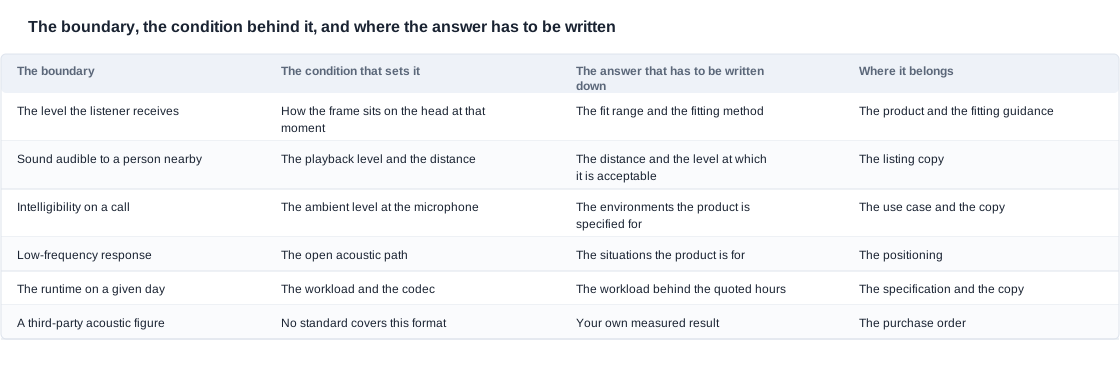
None of that makes the category unusable. It makes it a category where the buyer's work is deciding, for each limitation, whether it is answered in the product, in the listing copy, in the support process, or by nobody at all — because two of the eight cannot be closed by any of those three. A buyer who discovers them after the packaging is printed has already lost the ability to position the product correctly, and that is a margin decision rather than an engineering one.
Open ear audio glasses: eight boundaries, and what sets them
Where the boundaries sit in the purchase decision
The eight are not equal, and treating them as a list is how buyers end up with the wrong one dominating the conversation.
Two of them decide a purchase. The seal decides whether the product works for the customer at the level they need, and the microphone path decides whether it works at all in the environment they will use it in. A buyer who accepts a product whose seal is poor on their customer's head is accepting a return rate they have already priced wrongly.
Two of them decide a listing. Leakage and low-frequency response are properties of the format, and the only place they can be handled is the copy, because no amount of product work removes them. A listing that does not handle them honestly will be falsified by a customer, not by a competitor.
Two of them decide a bill of materials. The shared power budget and the length of the session determine what the unit has to be, and both of them are inputs to a product decision rather than to a copy decision.
Two of them decide a support process. The pressure that establishes itself over a long session, and the runtime figure with no condition attached, are the two that generate the tickets your team will spend the most time on.
And then there are the two that nobody can close, which the section near the end of this article treats on their own, because they decide which environments the product is allowed into.
The level the listener receives
The level is set by how the frame sits on the head at that moment, not by the electronics. Two customers using the same unit on heads of different geometry will receive different levels, and the same customer on a different day, after a long session, with a different temple position, will receive a different level again.
This is the limitation that makes single-head sample evaluation misleading, and it is the reason the fixture-based inspection that a factory runs has a defined head position rather than a person holding the frame.
The condition that sets it is the seal, and the condition that changes the seal is the temple position, which means it is partly a specification question (which temple architecture is on the model) and partly a customer question (how the frame is adjusted). A buyer who needs a predictable level has to decide which of those two they are buying, and the answer in this range is that only the first is available: two of the eight audio models list a slim or detachable temple, and the published rows do not tell you what that does to the level.
Sound that a nearby person can hear
The product leaks, and the amount depends on the playback level and the distance to the listener. This is not a defect and it is not a matter of degree — it is what the open path is. The same consequence appears on the buyer side: a unit in a shared office or at a counter is audible to people who are not part of the conversation.
The condition that sets it is the distance and the level, and the only honest way to handle it is to publish the position rather than imply the opposite. The privacy question is worth working through in detail before the copy is written, because the claim that gets falsified fastest in this category is the one that says the audio is private.
Low-frequency response in an open frame
The path around and through the ear does not carry low frequencies the way a sealed coupling does. This is a limit of the format rather than of any particular model, and it is the reason a "deep bass" line is the first thing a customer notices as wrong.
The commercially important consequence is about positioning rather than about hardware. A product positioned as a communication and awareness tool can live with this limit indefinitely. A product positioned as a music product cannot, and the gap between the two positionsings is where the expectation returns come from.
The microphone in a loud environment
The capture path degrades as the environment gets louder, and no amount of gain changes the signal-to-noise ratio at the far end. The microphone sits in the temple rather than at the mouth, so the path runs through the frame and through the air, and the wearer's own voice arrives by a completely different route than it does in an ear-mounted headset arrangement.
The condition that sets it is the ambient level at the microphone, and this is where the boundary stops being a product matter. No product work fixes a site where the ambient level overwhelms the capture path. It is a scoping decision, and it belongs in the use case selection before a model is chosen — which is why a microphone specification should not be treated as something to optimise later. The measurement procedure is set out in how to measure smart glasses microphone quality.
Power shared between four loads
The radio, the audio path, the camera on the models that carry one, and the cell all draw from the same budget, and the runtime is set by the heaviest load rather than by the average one. This is the limitation that connects the electrical rows to the customer's day.
The published position in this tier is instructive. Eight audio models publish rated runtimes of roughly six, seven and eight hours, with cell configurations from a single 100 mAh up to two 90 mAh cells, and with no test condition attached to any of the figures. So the buyer cannot compute the day's runtime from the published rows at all. What they can do is specify the workload they expect their customer to create and ask for the runtime under that workload — which is a question, and it is answerable.
The session that ends in pressure
The first hours are comfortable for almost any frame, and the pressure only establishes itself once the person has stopped thinking about the device. The end of a working day is where a frame is either accepted or returned.
The condition that sets it is the duration and the temple geometry, and it is the one limitation that a sample of one cannot answer at all, because the establishment of pressure takes hours. A buyer who tests for thirty minutes has tested nothing relevant here.
The runtime that carries no condition
Two suppliers quoting eight hours have measured two different things, and in this tier the same is true of the models within a single supplier's own catalogue. The G07 and the YK12 publish 55 mAh × 2 and about six hours; the LC-105-1 and the LC-105-2 publish the same 55 mAh × 2 and about eight hours.
The condition that sets it is the workload, the volume and the codec, and the limitation is not in the product — it is in the documentation. Which is why the answer to it is a specification: write the condition down, put it in the purchase order, and the comparison becomes possible.
The acoustic figure that does not exist
No model in this range publishes a third-party acoustic measurement. No driver size, no frequency response, no leakage distance, no microphone pickup figure, no codec list, no latency.
The condition that sets it is the format itself: an open-ear device has no seal and no coupler, so the reference points that the headphone measurement world depends on do not exist for it. That is why this limitation is the root of several of the others, and why a buyer who waits for a figure to appear will be waiting indefinitely.
The boundaries that have to be answered in the product
Which ones can be engineered around, and which can only be disclosed
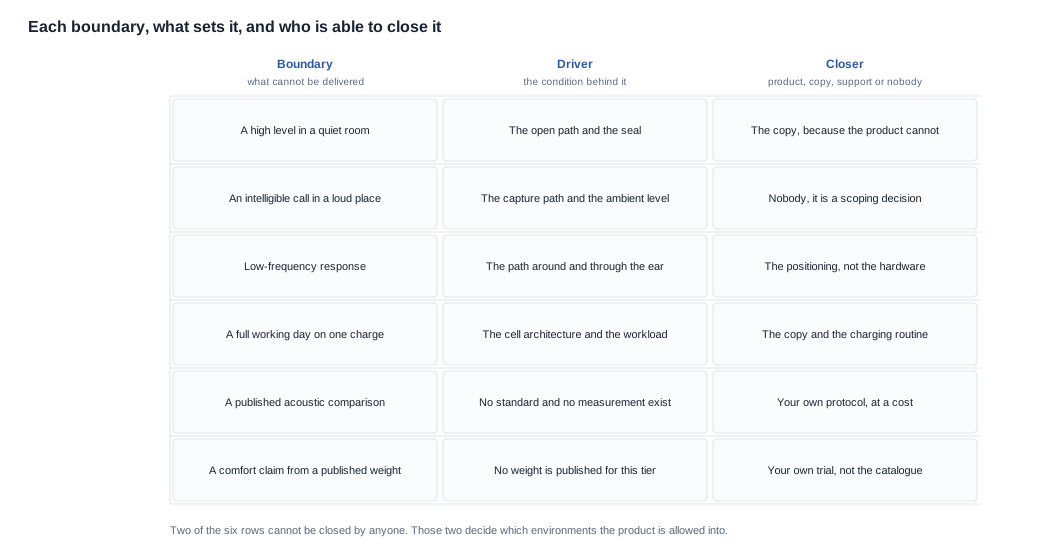
The right-hand column of that matrix is the one that matters for a purchase decision. Four of the eight can be closed by the product or by the buyer's own testing. Two can be closed only by the copy. Two cannot be closed at all, and they are the ones that decide the scoping.
The practical use of the matrix is as a pre-shipment check. Before the artwork is approved, read the right-hand column against what your programme actually does. Any row that says "the copy" has to appear in the copy review; any row that says "nobody" has to appear in the use case decision; and any row that says "the product" has to appear in the specification you send to the supplier.
The product-side boundaries, and what to ask for
The seal and the temple geometry. Ask which temple architecture is on the model, and whether the unit is supplied with an adjustment range or a single fixed position. Then run the frame on more than one head, for a full working day rather than a demonstration, and check both the level received and the leakage at the end of it. The condition that sets this boundary is the head, and the only way to find out how your customer puts it on is to have several people try it.
The session length. Ask the supplier what the long-session testing consists of — how many hours, how many people, what is recorded. If there is no answer, the boundary is yours to test, and the test is a day rather than an hour. The procedure for confirming that a sample unit is the production configuration is at sample evaluation, and the model designation on the unit should be checked against the paperwork at the same time.
The power budget. Ask for the runtime with the workload stated, and specify the workload your customer will actually create: continuous playback, a day of intermittent calls, or a day with the camera running on the models that carry one. Then ask what happens at the moment the power expires, because a device that dies silently in the middle of a call is a support ticket and a warranty question rather than a specification detail.
What a boundary costs when it lands in the wrong place
A boundary handled in the wrong layer becomes a return. The mapping is mechanical. The seal lands in the copy, so the customer discovers the level in week one and describes it as a fault. The runtime condition lands in the product, so the supplier quotes six hours against your customer's workload and the gap appears on the listing. The ambient level lands in the product, so you ship a product into a site where the capture path cannot work and every call fails.
That last one is worth a note, because it is the most expensive misallocation in the category. It is not a quality problem, and it will not be fixed by a better unit from the same supplier. It is a scoping error, and the only remedy is to decide which environments the product is for before the model is chosen. The use case mapping is set out separately on this site.
The boundaries that have to be answered in the copy
The copy has to carry what the product cannot
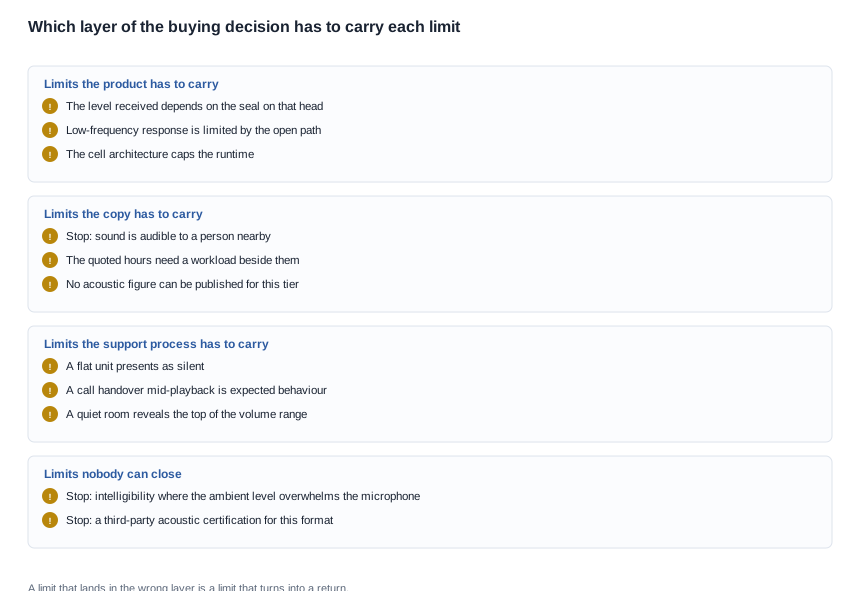
The amber rows in that checklist are the ones a buyer has to write before the artwork, and they are unglamorous. Each of them is a sentence that makes the product less impressive and the listing harder to falsify.
There is a business argument for doing it that is stronger than the risk argument. A listing that states its conditions accurately tends to attract the customer the product actually suits, because the customer reading it can tell whether the product matches their situation. A listing that promises everything attracts the customer it will disappoint, and the cost of that customer is a return, a rating and a channel conversation.
Writing the conditions without weakening the proposition
The technique that works is to replace an outcome with a situation. "Deep bass" becomes "audio designed for calls and awareness rather than for a music substitute" — narrower, and it is the truth about the format. "Up to eight hours" becomes "about eight hours of continuous playback; a full day of intermittent use needs a recharge in between" — again narrower, and it is what the data supports.
The technique that does not work is to soften the claim. A claim that has been softened rather than specified is still an outcome claim, and it is still falsifiable. The difference between the two is whether there is a condition a customer can check.
Two boundaries in particular are worth getting right in the copy, because they are the two customers test first. Leakage: say that the audio is audible to a person nearby, and if the channel needs a privacy statement, say it plainly. Volume ceiling: the top of the volume range in an open design is where the format shows its cost, and a listing that implies unlimited level will produce a complaint that no support script can resolve.
The documents that support what the copy claims
Before a deposit, the file should carry the measurement results with their conditions, the model designation table, the certificate register with numbers and validity dates, the packaging artwork proof, the agreed incoming inspection criteria carrying the pass lines, and the battery transport documentation at battery transport. The certificate register procedure is at certification checklist, the clause language is at contract terms, and the commercial structure of a first order is at pricing.
A listing claim that has no document behind it is a claim your own compliance team will eventually ask about, and the answer you want to be able to give is a number with its conditions, not a reassurance.

The boundaries that have to be answered in the support process
The two limitations that generate the most tickets
A flat unit presents as silent. The customer's mental model is that it is broken, and the ticket becomes a return regardless of what the product is doing. Where a charging case is supplied, the case can be flat while the glasses appear charged, which makes it worse.
A call handover during playback is expected behaviour. The handover between a call and playback is the most common complaint in this category after sound quality, and it is not something the product is broken by — it is something nobody wrote down. Where a model publishes a charge time at or under one hour, as the D17 and the ZH12 do, the recharge routine is short enough that this behaviour is likely to be encountered in normal use rather than rarely.
Turning a boundary into a support script
The script is the cheapest place to close a documentation boundary, because it costs a paragraph rather than a hardware change. Three things belong in it.
First, the pairing and reset procedure for each firmware build, with the version the procedure applies to. A script that opens with "please try connecting again" without a version will not resolve anything, because the procedure changes.
Second, the instruction for wiping the charge contacts. On the magnetic models in this tier, lint and skin oil on the pads prevent charging with no visible fault, and a surprising share of "dead" units are fixed by it. That instruction belongs in the documentation pack as well, because a support ticket costs several times what a line in the manual costs.
Third, the phone volume assumption. At the bottom of its range a phone makes an open-ear design genuinely very quiet, and a customer who has to find the right setting will conclude the product is quiet. Stating the assumption in the copy removes the ticket as well as the complaint.
The boundaries that will still arrive as returns
Two of the eight will reach your support desk whatever you write, and the useful thing is to recognise them when they arrive rather than to treat them as new problems. A unit that is quiet on a particular head is a seal outcome. A call that fails in a loud environment is a capture-path outcome. Both are recognisable from the description, and both are handled by a support script that explains the condition rather than by a replacement.
The operational discipline that makes this work is the classification. If a return is a fault, it goes to the factory and it counts against the defect rate. If it is an outcome of a documented boundary, it goes to the expectation bucket and it counts against the copy. A programme that keeps one bucket and calls everything a defect will over-invest in quality control and under-invest in the copy, and the symptom is a supplier whose quality is improving while the return rate does not move.
The two boundaries nobody can close
Intelligibility where the ambient level overwhelms the capture path
This is the hardest of the eight, and it is worth being precise about why. It is not the bass or the leakage, both of which can be handled with a sentence in the listing. It is the microphone, because the microphone's performance is a property of the environment rather than of the device, and no amount of product work fixes a site where the ambient level overwhelms the capture path.
What can be done is narrowing. You can specify the environments the product is for, and refuse the ones where it will not work, and the refusal has to happen at the use case selection rather than at the specification stage. A buyer who takes a project with a 95 dB ambient environment and expects an open-ear frame to deliver an intelligible call has bought a support problem, and it will present as a defective product.
A third-party acoustic certification for this format
A certification for this format cannot be obtained, because there is no reference method to certify against — the absence is structural rather than a gap in any particular registry. What this means commercially is that your supplier's document pack will always look thinner than a competitor's for a product with a sealed earbud, and the difference is not diligence. It is that the competitor is holding a document that certifies a different kind of product, and your buyer should be able to see that before the pack is compared.
What is available instead is the protocol: your own measurements, on your own units, under your own conditions, written into the purchase order so that a lot failing them is a lot you can refuse. That is not the same as a certification, and it is worth not confusing the two when a supplier's document pack appears thinner than a competitor's.
What a boundary costs, and how it reaches the margin
How a boundary becomes a margin problem

Every step in that chain is a place a buyer can interrupt it, and the listing is the cheapest one by a wide margin. A sentence written before the artwork costs nothing. The same sentence discovered by a customer costs a return, a rating and a channel conversation.
The financial shape of the problem is worth putting in front of a finance colleague, because the return cost is rarely the part that gets modelled. A returned unit costs the unit, the freight, the packaging and the channel margin, and none of it is recoverable because the product was fine. Then the rating sits permanently under the listing, which depresses the price a distributor will offer, because the distributor's own risk assessment reads the same feed. Then the returns inflate the defect rate, which is the number the factory's quality reporting is judged on, which means the quality effort moves to the wrong place while the real cause goes unaddressed.
The commercial mitigation is unglamorous and reliable: decide the boundary before the artwork, write it into the copy, write the matching condition into the purchase order, and keep the two documents together.
The negotiation that closes the boundaries
The boundary that can be closed by negotiation is the specification one. If a supplier will state the workload behind a runtime figure, attach conditions to a leakage figure and provide a microphone pickup figure at a stated distance, then a large part of this list becomes a set of numbers rather than a set of unknowns, and the comparison becomes possible. That is worth negotiating for directly, because it is the one item on the list where the supplier's answer changes what your programme can do.
What is not negotiable is the architecture itself: the transducer, the chamber geometry and the signal chain are the product. A supplier who will not change them is telling you the sound is fixed, which is a fair position and a useful one to know before the deposit rather than after the first sample.
Our position, and what we cannot promise
The boundary we hold: we publish the electrical and interface rows exactly as the catalogue states them, and we publish the absence of third-party acoustic measurement, of any leakage figure, of any runtime test condition and of any unit weight with the same prominence. We will not present a feature name as a performance result, and we will not quote a typical performance figure for the category, because a typical figure is what produces a customer expectation the product cannot meet.
On weights specifically, the position is narrow and we will not widen it. No model in the audio tier publishes a weight at all. The single weight our catalogue records anywhere is the MT6 glasses body at 158 g, a published figure that carries the 265 mAh cell and the camera of that model inside it and leaves its 1200 mAh folding charging case outside; the weight of that case is not published, and the range carries no published bare-frame weight for any model at all. Where a model has no published weight, we will tell you it has none and that you need to ask the supplier for it.
We also make no vision, health or eye-protection efficacy claim for any of our products in any market, and we will not let a channel imply one. A device whose function is to deliver sound and to detect a position or a distance is not a clinical intervention, and a listing that implies otherwise is a regulatory exposure rather than a marketing decision.
Environment, session length and price point
-
Send the environment, the session length, the channel and the price point. We will tell you which of the eight limitations applies to that combination and which of them have to be answered in the product rather than in the copy.
-
Send the models you are comparing. We will tell you which published rows separate them and where the boundaries that no supplier has published sit between them.
-
Send us your draft copy. We will mark the sentences that promise an outcome the format cannot deliver and tell you which of the eight each one corresponds to.
-
Ask us which boundaries we can close for you. The honest answer will be narrower than you want, and it will be about conditions, methods and protocols rather than about figures.
The technology background is at open-ear audio technology, the alternative mechanism is at bone conduction audio, the selection procedure is at how to choose open-ear audio glasses, the use case mapping is at open-ear audio for different use cases, the privacy question in detail is at will others hear my music, and the range is at Bluetooth audio glasses.
Related reading
- The technology and the published rows — open-ear audio technology
- The alternative mechanism — bone conduction audio
- The selection procedure — how to choose open-ear audio glasses
- The privacy question in detail — will others hear my music
Tell us the environment and the session length, and we will tell you which of the eight limits applies to your product.


