

Cost and performance in open-ear audio are usually discussed as though sound quality and price sat on one axis, and they do not. What a buyer is actually trading in this category is architecture against expectation, and the price is the second question rather than the first. A budget does not buy better sound here; it buys margin, scope and the number of configurations a supplier has to carry, while the acoustic result is set by geometry that was decided before the quotation existed. Open ear audio glasses smart glasses cost vs performance is therefore a decision problem with reusable thresholds rather than a comparison with a winner, and this article gives four thresholds that decide a shortlist before any pricing arrives, three budgets with a distinct trade available at each, four things a higher budget genuinely cannot buy in this category, and a ceiling rule that can be written before the first quotation lands.
The published position of our range defines what is and is not available at each budget level. Bluetooth 5.3 on the K01 and the K02 and 5.4 on the other nine open-ear models; cell configurations at 55 mAh times two, 70 mAh times two, 90 mAh times two, a single 100 mAh cell and a single 115 mAh cell; charge windows of one hour on the D17 and the ZH12 and two hours on the rest; operating windows of roughly six, seven or eight hours; magnetic charging on seven models and Type-C on four; no touch control row published for any model in the tier; and surround sound, ultra-slim detachable temples, a slim temple and remote control photography on specific models. On acoustic performance the published position is that no third-party measurement supports any model.
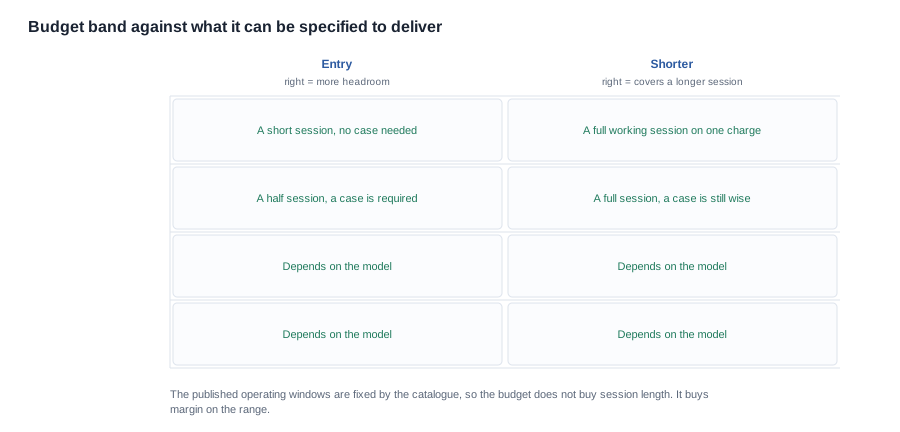
Open ear audio glasses: what a budget buys
The first thing to establish is that the published configuration rows do not move with the price. Every open-ear model in the range publishes its radio version, its cell configuration, its charge window, its operating window and its charging method, and those rows are the same whether a buyer is sourcing a single model for a promotion or a range for a distributor. A budget cannot buy a longer operating window, because the window is a property of the cell configuration and the power budget, and those are engineering decisions. A budget can buy margin, and it can buy the freedom to hold more configurations, more colours and a more complete accessory programme without moving the product itself.
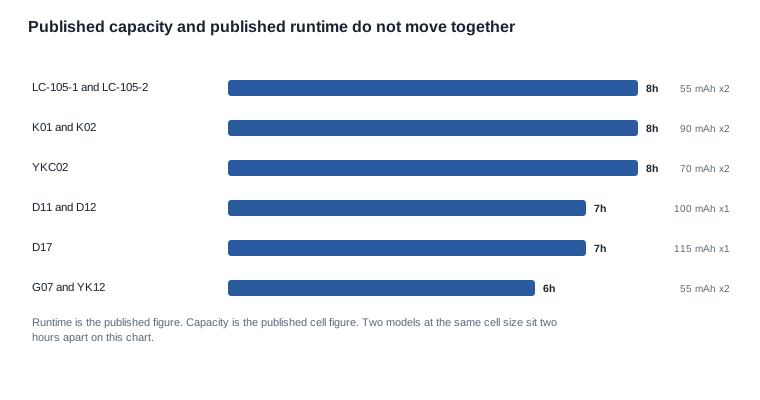
Session coverage against the published operating windows. The published windows group the tier into three bands. The ZH12 and the LC-105-2, the K01 and the LC-105-1, and the YKC02 and the K02 sit at roughly eight hours. The D11, the D12 and the D17 sit at roughly seven. The G07 and the YK12 sit at roughly six. These are the only rows on which a budget can have an effect, and the effect is indirect: a budget that cannot absorb a charging case forces a shorter session, and a shorter session forces one of the lower bands. This is the first threshold, and it is a threshold about the accessory budget rather than the product budget.
The accessory commitment as a fixed point in the budget. Seven models charge magnetically and four charge over Type-C. A channel that already ships Type-C everywhere has a lower accessory cost on the four Type-C models, and a channel with an established magnetic dock programme has a lower accessory cost on the seven magnetic models. That difference is real money and it is the one place where a price tier genuinely interacts with a technical row. A buyer who compares a magnetic model against a Type-C model on unit price alone has ignored the line that usually moves the comparison.
Feature rows and the listing they support. Surround sound appears on the YK12 and the D17, and the D11 and the YKC02, and stereo surround on the ZH12. Remote control photography appears on the D17 and the ZH12, a slim temple appears on the YK12 and ultra-slim detachable temples on the G07. A feature row is worth paying for only when the listing depends on it — when the marketing page, the channel listing or the retailer conversation turns on a specific capability. A feature the customer cannot name is a cost with no return, and in this category the easiest way to over-specify is to buy a feature row and then fail to write it into the listing.
The configuration count as a budget multiplier. Two models in two colours in one production run is a different programme from two models in two colours in two runs, and the difference shows up as certification workload, packaging variants, per-model minimums and the number of acceptance conditions that have to be settled. Every configuration added to a programme multiplies the documentary cost without multiplying the revenue, which is why the configuration count is the budget variable that a buyer controls most directly. The structural cost drivers behind each of these lines are set out at the cost factors breakdown.
Four thresholds that decide a shortlist before the pricing arrives
These four thresholds can be applied before any quotation arrives, which is the point of them. A buyer who applies them first arrives at the negotiation with a shortlist and a set of exclusions rather than with a list of candidates and an open mind.
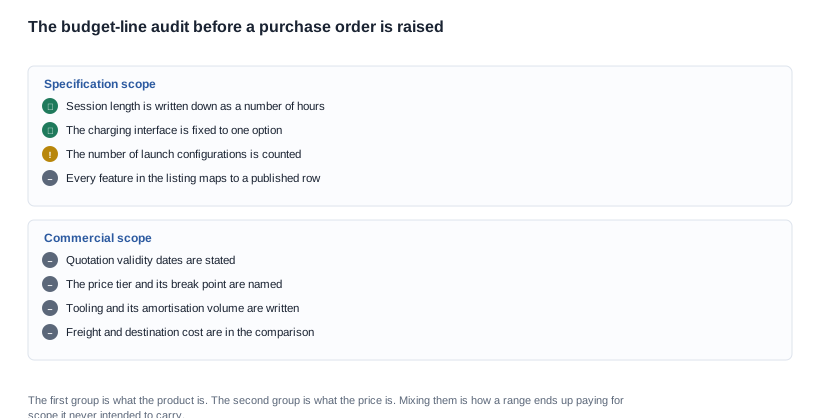
Threshold one: does one charge have to cover the whole session? Write the session length in hours and compare it against the three published bands. If the session crosses the band of a candidate model, that model either needs a case — which is an accessory budget and a packaging decision — or it is out. This threshold is binary and it removes models before anything else is considered.
Threshold two: does the charging interface match what the channel already stocks? If it does, the interface line is close to free and the comparison proceeds. If it does not, the channel either changes its accessory line or the model changes, and the second of those is an engineering conversation with tooling attached. This threshold is also binary, and it is the one most often applied after the shortlist is drawn rather than before.
Threshold three: does the listing depend on a published feature row? Write the listing claims first and mark each one against the feature rows. A claim without a published row has to be created by the supplier, which means either an unpublished capability or a marketing decision that the evidence does not support. A claim with a published row is a claim the buyer can defend.
Threshold four: is a second configuration needed at launch? If the answer is no, the programme is cheaper and faster regardless of the budget, and the saving is real rather than theoretical. If the answer is yes, the second configuration has to be named before the quotation, because adding one later changes the certification workload, the packaging and the minimums.
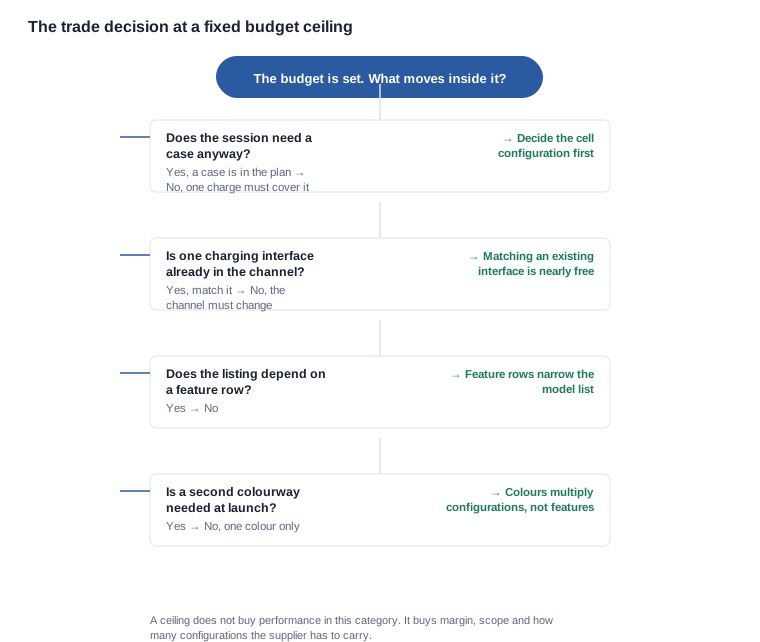
How the four thresholds combine. Applied in order, they produce a shortlist of one to three models with a documented reason for each exclusion. Threshold one is applied first because it removes the most models; threshold two comes second because it is the one with an accessory cost attached; threshold three comes third because it is the one that depends on the marketing plan; threshold four comes last because it is the one that depends on the commercial plan. A buyer who applies them out of order will find that a candidate excluded at threshold one reappears at threshold three and consumes attention it should not have received.
The trade a buyer can actually make at each budget level
Three budget positions have three genuinely different trades available. Naming them is more useful than a price ladder, because the ladder would be invented and the trades are structural.
The trade that can be made at an entry budget. At the tightest viable position, the trade is between session coverage and accessory consistency. The buyer keeps one charging interface to match the channel, keeps the model count at one, and takes the shortest session that still covers the working period, which in our published rows means the six-hour band with a case or the seven-hour band without one. What the buyer gives up is the feature rows entirely, which means the listing has to be written on the architecture rather than on a capability. The most common error at this budget is paying for a feature row that the listing never mentions, which is the more expensive version of the same mistake.
The trade that can be made at a mid budget. At the middle position, the trade becomes between configuration breadth and margin per unit. The buyer can carry two models across the same charging interface and keep a thin margin, or one model at a healthier margin with a faster launch. The deciding variable is not the price but the forecast: if the channel's demand is uncertain across two models, the breadth option costs more than it earns, because it doubles the certification workload while the inventory risk doubles with it. A second colourway within one model is a softer version of the same trade and is usually the better first move.
The trade that can be made at a premium budget. At the top position, the trade is between a published specification and a specified one. A premium buyer can afford to have the supplier document the acoustic configuration — the driver, the chamber, the sealing, the measurement method — even when it is not a third-party certified figure, and that documentation is what turns an untestable product into a testable one. What the buyer cannot buy is a better acoustic result from the same geometry, because the geometry was set in the tooling. A premium budget buys specification clarity, not performance, and the difference between those two words is the difference between a good procurement decision and an expensive mistake.

Where spending more buys nothing at all
Four things in this category are not available at any price, and a buyer who has read a supplier's proposal carefully will have noticed that none of them is quoted. Listing them saves the time of looking for them.
- A third-party acoustic certification. No model in our range is supported by a third-party acoustic measurement, and no budget inside or outside our catalogue produces one. What a budget can buy is the supplier's own documented method and the results of the supplier's own measurement.
- A longer operating window than the published band. The window follows from the cell configuration and the power budget. A different window at the same price is a different model, and it has to be quoted and published as one.
- An ingress marking on the audio tier. Our audio models carry no published ingress marking, and only two models in the whole catalogue carry one — the V06 and the S7, both on the camera and sport pages, both marked IP54. If a programme requires a marked model, it is a camera-tier question and the budget does not change the tier.
- A certificate number that has not been issued. The catalogue's export-certification page carries ten patent certificates, eight appearance-design patents and two utility-model patents, and names no CE, FCC or RoHS marking, so the model-specific conformity documents have to be requested rather than read off a catalogue row — and the compliance work behind those documents has to be budgeted per model and per market, because the documentation cost follows the order and not the catalogue. A budget can pay for a certification exercise and its elapsed time, and it cannot buy a document that does not exist.

What our own catalogue settles, and what a budget cannot buy
On budget decisions, deliberately narrow, and it is worth stating before a buyer asks us for a recommendation.
We publish the configuration rows and not the acoustic ones. Every open-ear model in our range publishes its radio version, its cell configuration, its charge window, its operating window and its charging method, and those rows are the ones a buyer can use to apply the four thresholds without contacting anybody. We do not publish a driver size, a chamber dimension, a leakage figure, a frequency response, a pickup distance or any third-party acoustic measurement, and we publish no acoustic performance claim that our own data does not support. That is not modesty. It is a statement of what a range sheet can carry: an acoustic number without a stated method is a number nobody can check, and a number nobody can check cannot be used in a comparison or in an acceptance condition.
We do not publish a price list, and we will not quote a landed cost without its basis. A price list in this category would have to assume an acoustic configuration, a cell configuration, an interface, a configuration count, a volume, a freight basis and a validity period, and every one of those assumptions would quietly become a specification in the buyer's head. Instead, we quote a unit price against a stated configuration and volume, with a validity period, and we add packaging, accessories, freight and destination cost to it on request. We will also tell you when the budget you have in mind makes the configuration you have asked for unreachable, which is a more useful answer than a lower number for a different product.
What we will not do. We will not present a published operating window as an acceptance value. We will not describe an open-ear unit as suitable for confidential conversation. We will not quote a certificate number we do not hold, and we will not tell a buyer that CE, FCC or RoHS approval for one model in a family covers a private-label derivative of it. And we will not tell a buyer that a higher budget buys a better acoustic result, because in this category it does not — it buys specification clarity, margin and scope, and saying otherwise would be selling the wrong thing.
The two documents we will send with any quotation. The first is a configuration sheet that names the model, the cell configuration, the radio version, the charging method, the published operating window and what is included in the box, so that the quotation can be compared with any other quotation on the same basis. The second is a document request list — the certificate numbers with their issuing bodies and the model designations each one names, the acoustic configuration note, the cell and charge data behind the published window, and the weight of the unit as shipped without accessories — so that the evidence a buyer needs is requested once rather than piecemeal after the deposit.
The three questions we would ask a buyer before quoting. What is the working period, in hours, and does one charge have to cover it. What charging interface does the channel already stock. And what does the listing actually claim, because a claim with no published feature row behind it is a specification that has to be created rather than selected. Answer those three and the quotation can be short and exact; leave them open and it has to be long and conditional, which is not in either party's interest.
A reusable rule for setting the ceiling before the quotations land
The ceiling rule is simple enough to write before the quotations arrive and specific enough to keep a buyer out of an expensive comparison. It has three parts, and all three are derived from the published rows rather than from anyone's price list.
The ceiling rule, written before the quotations arrive. Take the landed cost per unit that the channel can carry at its target retail price and its required margin. Subtract the accessory and packaging cost at the interface the channel already stocks. Divide what remains by the configuration count the programme will actually launch with. That figure is the ceiling for the product itself, and any quotation above it is not a competitive price — it is a different programme. Then apply the two exclusion tests: if the quoted model cannot cover the session on one charge without a case the channel has not budgeted, it is out regardless of price; and if the quoted model requires a charging interface the channel does not stock, it is out unless the accessory line is cheaper than the unit price difference.
Why the rule is set before the price. Set afterwards, a ceiling is a negotiating position that has already been anchored by the quotations in front of the buyer. Set beforehand, it is a constraint that removes candidates before they can anchor anything. In this category the effect is larger than in most, because the published configuration rows let a buyer identify which models can possibly comply and which cannot, and the ones that cannot comply should never reach a price comparison at all.
What the ceiling does not do. It does not tell a buyer which model to choose, and it should not. The model choice is made by the four thresholds in the earlier section, and the ceiling only tells the buyer which shortlisted models are affordable. A buyer who reverses the order and looks for an affordable model first will find a cheaper product that fails a threshold, and the cheaper product will cost more in the end.
Where the published detail sits. The configuration rows behind these thresholds are collected at the open-ear audio key specifications, the standards and conformity background is at the open-ear audio industry standards reference, the full range is at bluetooth audio glasses, and the technical background is at open-ear audio technology.
The two requests to make this week. Write the ceiling rule on one page with the four thresholds on it, and send it to every factory you are evaluating so that every quotation comes back against the same criteria. Then ask each factory for its landed figure rather than its unit price, and for its acoustic configuration note, and compare those two documents. The comparison you end up with will be about programmes rather than about prices, which is the only comparison in this category that stays valid after the launch.


