

The reason an open-ear range has eleven models is not that there are eleven kinds of person. It is that there are several distinct technical environments, and each one imposes a different constraint on the acoustic design, the power budget and the acceptance test. A buyer who selects on the environment rather than on the feature list ends up with a programme that can be defended at acceptance. A buyer who selects on the feature list ends up with a range where every SKU reads the same to a customer and the only visible difference is the price. This article is written for the first case: each scenario below is given as environment → constraint → acceptance condition, so that a procurement team can turn a scene description into a written requirement and then into a refusal clause.
Our published rows are the same for every scenario: Bluetooth 5.3 on the K01 and the K02, 5.4 on the other nine open-ear models; cell configurations at 55 mAh times two, 70 mAh times two, 90 mAh times two, a single 100 mAh cell and a single 115 mAh cell; charge windows of one hour on the D17 and the ZH12 and two hours on the rest; operating windows of roughly six, seven or eight hours; magnetic charging on seven models and Type-C on four; and feature rows for surround sound, slim and detachable temples and remote control photography. What separates the scenarios is the constraint each one places on those rows, and the condition each one needs written into the purchase order.
Open ear audio glasses: one model cannot serve every environment
Every scenario in this category makes the same architecture trade, and the trade is controlled by something other than the electronics: the seal between the frame and the head, and the amount of energy the driver has to put into the room to be heard. The more the surroundings matter to the job, the more the open path is an advantage. The more the job depends on an undistorted, private signal, the more the open path is a liability. That single relationship is what produces the scenario split, and it is why the same model can be the right answer in a logistics hall and the wrong answer in a meeting room.
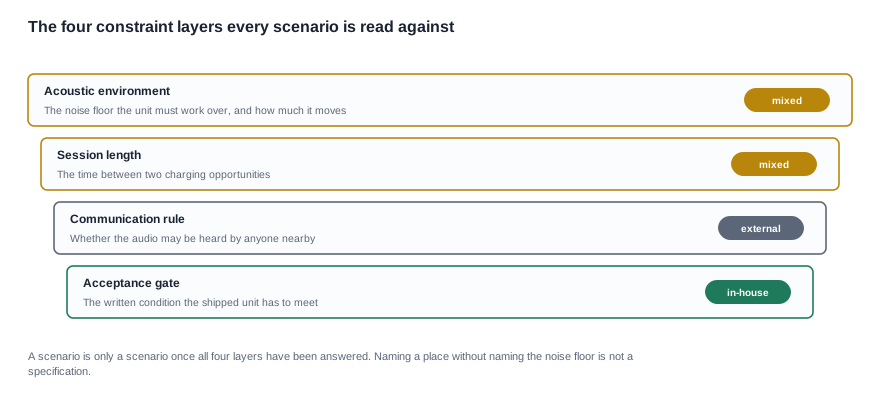
The three constraints that actually separate the scenarios. Every scenario below is described by the same three constraints, and a buyer who can answer them for a channel can select a model from the published rows without a sample.
- The noise floor. The level of the environment the unit has to work over, and how much that level moves. A stable moderate floor and a variable high floor are different engineering problems, and the second one can defeat the architecture entirely.
- The session length. The longest continuous interval between two charging opportunities, expressed in hours. This is the constraint that selects the cell configuration, because our published operating windows run from roughly six to roughly eight hours.
- The privacy rule. Whether the audio may be heard by anyone standing nearby. This is a channel rule before it is a technical rule, and it is the constraint that most often eliminates a scenario entirely.
The noise floor and intelligibility, and the number to write down. The number a buyer needs is not "how loud is the room" but "at what level must speech arrive to be understood by the person on the unit, over what floor, measured how". A requirement written as a number has three parts — a signal level, a noise floor, and a protocol — and a requirement written as a place name has none of them. The protocol matters as much as the number, because the same pair of levels measured on a desk and measured on a warehouse floor produce different results, and an acceptance condition with no protocol is a dispute waiting to happen.
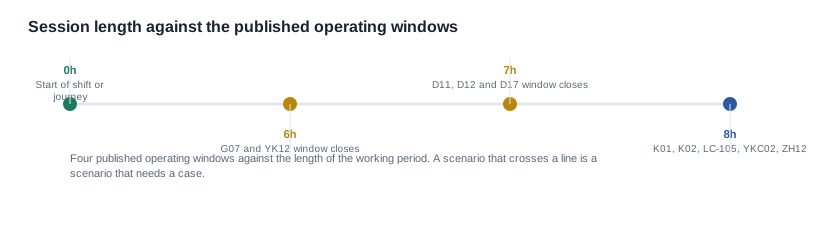
The session length against the published operating windows. Our published windows place the K01 and the LC-105-2, the LC-105-1 and the YKC02, and the K02 and the ZH12 at roughly eight hours; the D11, the D12 and the D17 at roughly seven; and the G07 and the YK12 at roughly six. A scenario whose session crosses the window of the candidate model does not fail — it acquires a charging case, which is a new accessory line, a new packaging requirement and a new cost line.
The privacy rule and why it is a channel constraint. In the retail floor and the training room, a customer hearing the product is evidence that the product is working. In the meeting room and the open office, the same customer hearing the product is a complaint. Nothing about the hardware changes between the two; what changes is who is standing nearby. A buyer who takes the privacy rule from the channel rather than from the engineering team gets it right by default.
The constraint set that separates a warehouse from an office
Two environments that appear similar on a shelf are the furthest apart in this category, and they are worth setting side by side because the differences are instructive rather than obvious.
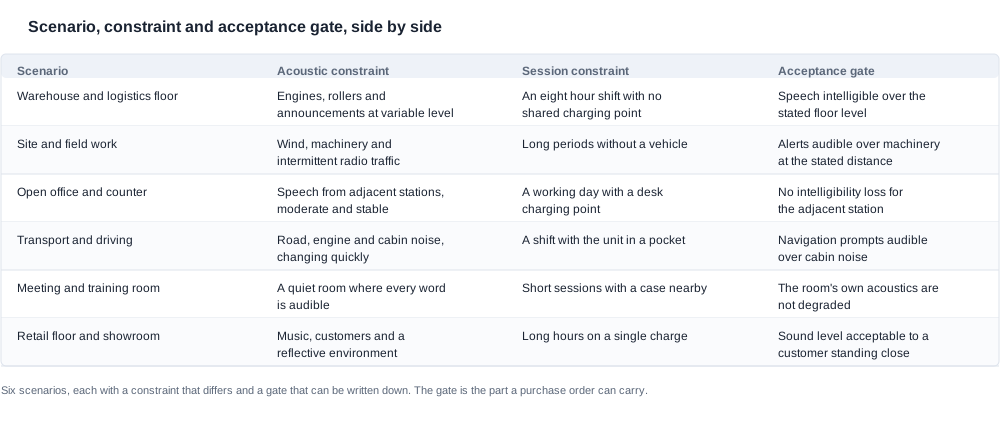
The warehouse and logistics floor. The environment is variable: engines start and stop, rollers run, announcements interrupt. The privacy rule is permissive, because in a warehouse a colleague hearing an alert is the alert working. The session length is a full shift with no shared charging point, which puts the requirement at the eight-hour end of our published windows. The binding constraint is therefore not sound quality but the combination of a variable floor and a long session, and the acceptance condition should be about intelligibility over the stated floor with the unit at a defined level, combined with the published window covering the shift without a case. The models that satisfy the session requirement are the YKC02 and the K02, the ZH12 and the LC-105-1, and the LC-105-2 and the K01, and the interface decision separates them further because the first four are magnetic and the ZH12 is Type-C.
The open office and the counter. The environment is moderate and stable, which makes it the easier acoustic case in the whole range. The privacy rule is restrictive, because the colleague at the next desk is within a metre. The session length is a working day with a charging point at the desk, so a case is realistic and the seven-hour models become viable. What changes most here is not the model but the acceptance condition: it has to state that the unit does not degrade the room's own acoustics, because in a quiet office a person speaking to a colleague is the ambient noise that the unit is adding to. A supplier who has never considered that will fail the condition and will not understand why.
A worked contrast. Take one unit — the D12, a Type-C model publishing a single 100 mAh cell and roughly seven hours — and place it in the two environments above. In the warehouse it is one hour short of the shift and its interface commits the channel to a Type-C accessory line. In the office it covers the day with a desk charger and its interface is irrelevant because a cable is already at every desk. The same unit, the same unit price, and two entirely different acceptances. This is why scenario selection has to happen before the shortlist and not after it.

Movement, weather and the cabins where the channel differs
The second group of scenarios share a constraint the first group does not: the acoustic geometry changes while the unit is in use, and in some of them the frame has to survive a condition our audio tier does not publish anything about.
Movement. In a vehicle cabin or on a bike, the distance between the driver and the open path changes constantly, and the relationship between the unit and the head changes with every posture. The published rows say nothing about that, and no acoustic figure in this range is measured under motion. A buyer in this scenario should therefore treat the acoustic acceptance condition as a scenario-specific test rather than a catalogue comparison, and should write the test into the order with the motion condition written down — a stationary cabin test and a moving cabin test are different tests.
Weather and dust. Our audio tier publishes no ingress marking on any model. Only two models in the whole catalogue carry one: the V06 and the S7, both on the camera and sport pages, and both marked IP54. A programme whose scenario includes rain, washdown or a dusty site therefore cannot be served by the audio tier on the strength of a published marking, and the choice is between sourcing a marked model from the camera tier and sourcing an unmarked model with a written acceptance condition. The background on ingress options is at sport smart glasses water resistance options, and the camera tier that holds the marked models is at AI camera glasses.
The camera as a separate constraint. Where a scenario needs capture as well as sound, the unit is no longer an audio model with a camera, it is a camera product with an audio function, and the two carry different compliance files, different case options and different ingress rows. The published camera rows show 8 MP and 13 MP configurations, charging cases at 1400 mAh on three models and 900 and 1400 mAh on one, and a 1200 mAh foldable case on the MT6 whose glasses unit is published at 158 g including its battery and camera and excluding the case. A buyer running the scenario selection across both tiers will find that the camera tier is sometimes the only tier that answers the environmental constraint, and that this changes the accessory and certification questions entirely.
The meeting room, the training room and the retail floor. These three are close relatives and they separate on the privacy rule. In a training room the audio is public by design and the constraint is that the emitted level must not damage the experience of the room, which means an upper bound as well as an intelligibility requirement. In a meeting room the constraint is the opposite and there is no audio-based answer to it. In a retail floor the privacy rule is permissive and the environmental constraint is a music system, so the acceptance condition has to be written against a background level that the retailer controls and the unit does not.
From a named scenario to a written acceptance condition
The value of the scenario step is that it produces a document. A buyer who can take each row of the table above and turn it into a clause has converted a sales conversation into an acceptance standard, and that conversion is what allows a lot to be refused.
Writing the acceptance condition so that a lot can be refused. Every acceptance condition in this category needs four parts, and a condition missing any one of them is not usable as a refusal basis. It needs a measurable value, a test protocol, an operating state, and a named pass or fail. "Speech is intelligible in the warehouse" has none of them. "Speech from a recorded source at a level of 65 dB at 500 mm is understood by three of three listeners over a 75 dB floor measured at the listening position, with the unit at its defined operating level" has all four, and a lot that fails it is a lot a buyer can refuse without a debate.
The three questions that settle a scenario brief. Ask what noise floor the unit has to be intelligible over, and what the measurement point is. Ask the longest continuous interval the unit has to cover on one charge, and whether a case is permitted in that scenario. Ask whether anyone standing within a stated distance may hear the audio, and who decides. These three questions, answered in writing, are the scenario brief. Everything after that is a sourcing decision.
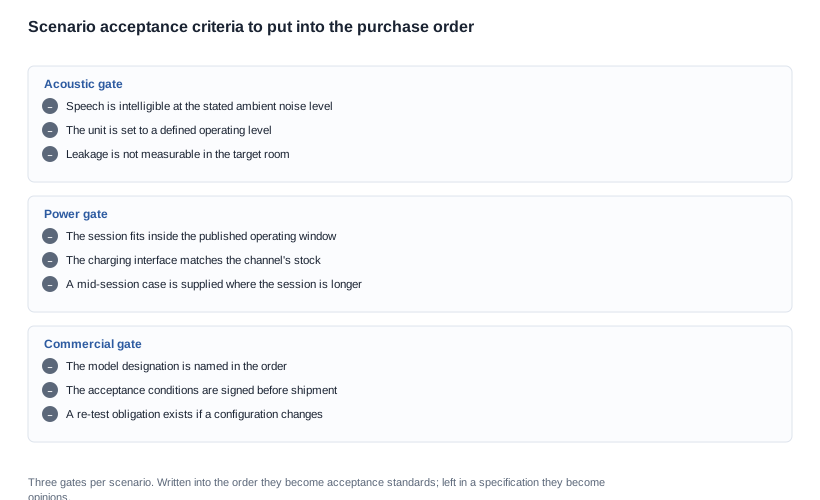
Who signs the acceptance and when. The acceptance condition should be signed before the first shipment rather than after the first complaint, and it should be signed by the party that owns the customer relationship rather than by the engineering party that owns the product, because the two parties usually hold different assumptions about what the audio is for. A buyer who accepts the condition late has already lost the leverage that makes it binding.
The case programme is a scenario decision, not an accessory
A session that crosses the published operating window does not create a small inconvenience. It creates a second line in the bill of materials, a second item in the customer's bag, a second item in the distributor's inventory, and a second set of quality-control checks on receipt. Because the case carries its own cell, it carries its own transport documentation and its own substance declaration, and a case that is added later to a programme that already shipped without one is a compliance change as well as an accessory change.
The three commercial questions follow directly from the scenario, and they are worth settling before the model is chosen rather than after. The first is whether the scenario permits a case at all, because a security or a hygiene rule that forbids a second object on the person removes the option and forces a shorter session or a different model. The second is whether the case is stocked as part of the shipment or sold as a separate line, since the two carry different packaging implications and different channel economics. The third is whether the case is the same for every model in the range, because a shared case across several models is a materially cheaper accessory programme than one case per model, and our catalogue publishes case capacities only for the camera-tier models.
What is negotiable here is the specification scope, the delivery structure and the case supply arrangement. What is not negotiable is the elapsed time of a certification exercise and the nature of a tooling charge once the tooling is cut, because both are quoted per configuration and per laboratory queue.
A hypothetical scenario walked through to a purchase order
The following is a hypothetical case rather than a client project, and it is included to show the decision sequence rather than to report an outcome.
Assume a regional distributor of warehouse equipment is sourcing a headset for a distribution centre, with two candidate sites, one a quiet cross-docking hall at 62 dB and the other a vehicle marshalling yard at 78 dB with variable traffic. The stated need is voice calls and a safety alert channel, the audio is public by design because the team works as a group, and the shift is eight hours with no shared charging point. The channel's existing accessory line is magnetic.
Running the three constraints produces a shortlist immediately. The privacy rule is permissive, so the architecture is not in question. The session length of eight hours removes the six-hour and seven-hour models and leaves the eight-hour group. The noise floor separates the two sites: at 62 dB a signal at a defined level is plausibly intelligible, and at 78 dB with variable traffic it is not, so the yard cannot be served by the same acceptance condition and the distributor is told so in writing. The accessory commitment then selects the magnetic models from the eight-hour group, which excludes the Type-C ZH12 and leaves four candidates.
The acceptance condition is then written once, with the site parameterised: a defined signal level, the stated floor at the listening position, three listeners, and a pass condition of three of three understood. The case is excluded by the session length and by the absence of a shared charging point, which means the eight-hour published window becomes a binding value rather than a screen. The purchase order then carries four things — the exact model designations, the acceptance condition, the notice obligation if a configuration changes, and the cost bearer for a lot that fails the condition — and the model list is left at four so that the certification workload stays proportional.
The decisive steps were all made from published rows and one written noise floor, and none of them required a sample order. The sample was needed for one thing only: confirming that the signal level in the condition is one the unit can produce in the marshalling yard, which is a measurement and not a selection.
Where our published rows stop and a scenario needs a test
We will set out what our catalogue supports for a scenario selection, and what it does not, because a scenario brief that assumes a published row exists is a brief that will fail at acceptance.
What the range supports. Every model in the open-ear tier publishes a radio version, a cell configuration, a charge window, an operating window and a charging method, and those five rows are enough to separate scenarios by session length and by accessory commitment. Feature rows name surround sound on the D11 and the YKC02, and the YK12 and the D17, stereo surround on the ZH12, remote control photography on the D17 and the ZH12, a slim temple on the YK12 and ultra-slim detachable temples on the G07. The camera tier publishes pixel configurations, charging case capacities and the two ingress markings in the whole catalogue. The background is at open-ear audio technology and the range is at bluetooth audio glasses.
What the range does not support. We publish no leakage figure, no frequency response, no driver size, no microphone pickup distance, no signal-to-noise ratio and no third-party acoustic measurement for any model. We publish no unit weight for any audio-tier model, and no bare frame weight for any model in the catalogue at all. We publish no ingress marking for any audio-tier model. And we publish no certificate numbers: the export-certification page carries ten patent certificates, eight appearance-design patents and two utility-model patents, and names no CE, FCC or RoHS marking, with the model-specific conformity documents still to be requested, which means a scenario that requires a document has to be sourced against that document rather than against our range statement — and a patent certificate, of either type, is not that document: an appearance-design patent records a shape and a utility-model patent records a technical solution, while a conformity document records the model string and the market it was issued for. The supporting pages are the certification checklist, the battery transport compliance page, the pricing reference and the contract terms reference.
The mechanism behind the requirement. If a scenario brief needs an acoustic argument rather than a configuration argument, the mechanism is set out at how open-ear audio works, and the selection comparison is at how to compare open-ear audio glasses.
What to send us when the scenario is settled. Give us the environment with its noise floor, the longest continuous session in hours, the privacy rule and the target market, and we will tell you which published configurations cover it, which of them need a case, and which of the acceptance conditions above will have to be settled with the factory in writing. We will also tell you when the scenario is one our audio tier cannot serve, because a channel that sources against a published row rather than against a test is the one that discovers the problem after the launch date.


