

Most of the regulatory burden on an open-ear audio product is not about the audio at all. It is about the radio, the battery, the chemicals, the labelling and the data — and the acoustic design, which is what makes this category distinctive, is almost unregulated. The one place where the acoustics do raise a question is where a product amplifies sound toward the ear, because that is where a hearing-related description can pull the product into a different framework. Open ear audio glasses smart glasses how regulations affect this is therefore best read as a procurement document rather than a legal one: it sets out which instruments bind the product, how each one narrows the set of models you are actually allowed to buy, what file your importer and your platform will each ask for, and where the elapsed time in a launch schedule actually sits.
The catalogue carries a company-level export certification page, and the text of that document contains no reference to CE, FCC or RoHS at all. There is no per-model certification row for any model in the range, and the applicable scope for a model and a market is written material to be requested and filed before the order. We publish no certificate numbers, and this article explains which instruments the rows sit inside and what that means for the models a buyer can put on a purchase order.
Open ear audio glasses: the instruments that bind the product
The radio framework, and everything that hangs from it. The European framework for radio equipment, Directive 2014/53/EU, is the instrument that makes every other European row necessary rather than optional. It covers three things — safety and health, electromagnetic compatibility, and efficient use of the radio spectrum — and every Bluetooth product falls inside it. Complying means a CE mark, a declaration of conformity and a technical file that describes the product. The critical property for a procurement team is that the declaration names a model. A family-level declaration is coverage for the family as described, and a private-label derivative with a different charging interface or a different enclosure is not automatically inside it.
The battery: transport, chemistry and the shipping document. A lithium cell inside the frame travels under the transport rules, and the test summary for the exact cell is the document that travels with it. Two properties of this category make the battery the most operationally significant line. The first is that the cell is inside a wearable, which means it is very likely to travel with its owner rather than with freight, and the rules for a cell carried by a passenger and a cell shipped as cargo are not the same. The second is that a charging case, where one is offered, is a second cell with a second transport document, its own substance declaration and its own compliance scope. Our catalogue publishes charging case capacities for the camera tier only, and the audio tier publishes no case capacity, which tells a buyer where the second battery is and where the second document will be.
Substance restrictions and the paperwork that multiplies by colour. Restricted-substance requirements apply to the finished unit rather than to the component, which means a colour, a finish or a plating that changes the bill of materials can change the declaration. This is the variant tax in the compliance context, and it is the reason a programme with four colourways in two finishes is a different compliance programme from one with four colourways in a single finish. The declaration has to cover the configuration that is actually shipped, and the practical question for a buyer is how many distinct declarations the range produces.
Market labelling and the per-market cost. What the packaging and the user manual must state is market-specific, and the cost is not the same as the cost of the certification itself. A label set per destination market is a set of artwork, a set of approvals and a set of revision cycles, and each revision cycle is a delay that sits on the buyer's own schedule rather than on the factory's. A channel served only from markets where the approvals and the label sets already exist is worth a materially better landed cost than one that requires new work, and that is a decision to make before the quotation rather than after it. The European cybersecurity requirements that attach to radio equipment are a related item in the same file, and they are covered on our compliance pages at the EN 18031 page.
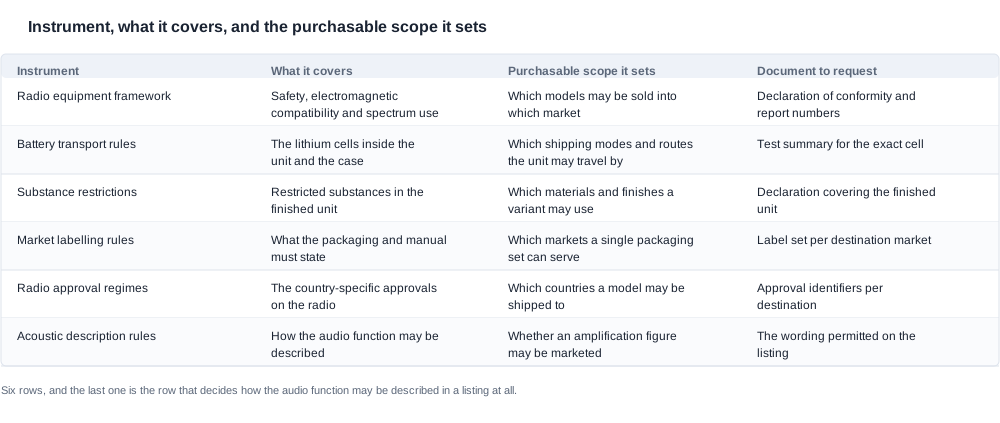
The descriptive boundary around an amplified audio function. This is the row that decides how the audio function may be described on a listing, and it is the one a marketing team is most likely to walk into. Our catalogue publishes a 35 dB amplification gain on the bone conduction entry. That is a technical figure describing what the circuit does to a signal. It is not a statement about a person's hearing, and a listing that turns it into one — describing the product as assisting, treating or improving hearing — moves the product into a regulatory framework that the audio range is not built for, with consequences for the technical file, the labelling and the market access of the whole range. The rule is simple and worth stating in the brand guidelines: describe what the circuit does, never what the product does for a person.

How certification narrows the range of models you can actually buy
This is the part of compliance that procurement teams routinely underestimate, because it does not appear on the quotation as a line item.
How a mismatched certificate narrows your range without warning. A certificate that names a different model does not reduce the price of the models it covers; it removes them from the set of models you may lawfully place on the market under your own brand. The narrowing happens in four ways that a buyer should write down. The model designation may differ from the model you are buying, which is the most common and the easiest to check. The tested configuration may differ, because a unit with an exposed charging contact where the tested sample had a cap is a different configuration. The variant may differ, because a private-label derivative with a different finish is not automatically the tested variant. And the market scope may differ, because an approval covers the destinations it names.
The variant tax, and why colour changes the compliance scope. Every colour, every logo and every private-label derivative is a configuration question. If the change touches the enclosure, the acoustic chamber, the interface or the materials, the published approval may no longer reach it, and the re-validation cost is per configuration, so it compounds with the range rather than with the order. The practical commercial consequence is that a range with four colourways carries four configurations, and each of them has to be covered before the first delivery — which is exactly the kind of item that turns a launch date into a delay without anybody deciding to delay it.
The purchasable scope a decision-maker should write down. Before a factory is contacted, four statements should exist in the programme file. Which models are in scope. Which destinations each model is in scope for. Which configurations of each model are in scope. And which document establishes each of those. If any of the four cannot be written down from the supplier's own documentation, it is an open item with a lead time attached, and it belongs on the schedule at the point the quotation is issued rather than at the point the artwork is approved.
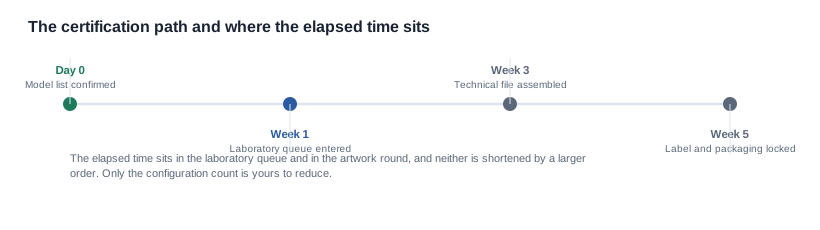
Why the configuration count is the number to negotiate. Nothing in the compliance chain rewards a larger order. A certification exercise is a fixed cost per configuration plus a queue at the laboratory, and the queue is set by the laboratory rather than by the order size. What a larger order changes is the amortisation of tooling and of the artwork. The conclusion is the same one the commercial negotiation reaches and it is worth stating once: the number of configurations is the lever, and the unit count is not.
The sequence that decides whether a launch date survives
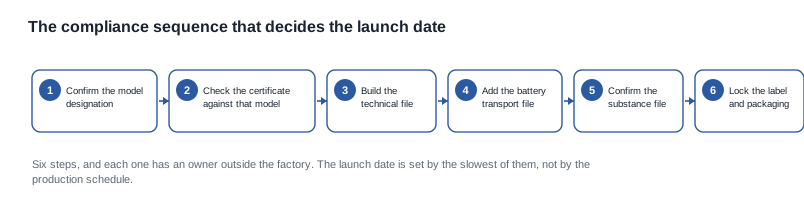
Six steps, and the owners are all outside the factory. The compliance sequence runs from the model list to the locked artwork, and at four of the six steps the clock is running on somebody else's queue.
- Confirm the model designation that will appear on the declaration and on the label, and freeze it. A model designation changed after artwork approval restarts the chain.
- Check the certificate against that model, character by character, including the configuration and the market scope. A mismatch is a stop condition rather than a query.
- Build the technical file — the description of the product, the radio, the cell and the materials — and confirm that the description on the listing is consistent with it.
- Add the battery transport file for the exact cell, and for the case if one is offered.
- Confirm the substance declaration for the finished unit and for each variant that changes the bill of materials.
- Lock the label and the packaging against the confirmed file, and only then release the artwork for print.
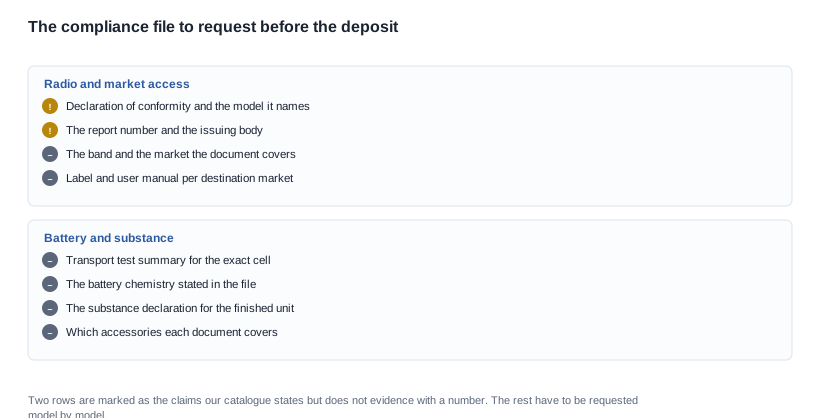
What to request, and when. The request has two halves and they belong to two different suppliers. From the factory: the declaration of conformity, the report numbers with the issuing bodies, the model list each document names, the tested configuration, the substance declaration for the finished unit, the battery transport summary for the exact cell, and the destination approvals per model. From the testing laboratory or the certification partner: the report itself, with its number, its issue date and its validity. The request should go out with the sample order rather than after it, because the answer changes the sample list.
The six items that most often hold up a programme. A certificate that names a different model. A variant that was added after the file was written. A battery document that covers a cell with the same capacity but from a different supplier. A label set for the wrong market. An artwork approval that happened before the file was confirmed. And a claim on the listing that the technical file does not describe. Every one of the six is cheap to close at the quotation stage and expensive to close after the print run.

A hypothetical compliance sequence, worked through
The following is a hypothetical case rather than a client project, and it is included to show the sequence rather than to report an outcome.
Assume a brand is launching a private-label open-ear audio frame into two markets, with one model in two colourways, and the factory's range documentation is a company-level statement the brand has taken at face value. The launch date is fixed because it is a retail season, and the packaging artwork has already been approved.
Step one, the model designation. The brand asks for the declaration and the report numbers and receives a document that names a model with a different designation from the one being ordered. This is a stop condition rather than a query, and it is caught here because the request went out with the sample order rather than after the artwork release. The brand puts the exact designation into the purchase order as a condition and asks for the file to be reissued against it.
Step two, the configuration. The factory confirms that the tested sample carried a capped charging contact and that the brand's unit is uncapped. That is a different configuration from the one on the document, and the brand now has three options: a capped build at a cost, a re-test with an elapsed time attached, or a narrower claim. Because the artwork is already approved, the brand takes the capped build and moves the artwork change to the front of the packaging schedule.
Step three, the two colourways. One colourway changes the frame finish. The factory confirms that the change touches the bill of materials and that the substance declaration covers the original finish only. The second colourway therefore becomes a second configuration with its own document, which changes the launch sequence: the first colourway ships with the original file, and the second waits for the reissued declaration.
Step four, the cell. The battery transport summary covers a cell with the same published capacity but from a different supplier. The brand asks for the summary against the fitted cell and receives it in a week, because the cell is a bought part with an existing document. This is the step that would have been the most expensive one to discover late, because a cell document is the one that follows the goods.
Step five, the artwork. The label and manual are re-issued against the confirmed file, with the exclusions printed rather than implied, and the packaging release moves behind that step. The launch date survives because the two decisions that moved it were made in steps one and two rather than at the artwork stage.
What the sequence shows. Every expensive step was a configuration question, and every configuration question was answerable from a document request that cost one email. The two decisions that changed the launch were both taken early, and both were about what was in scope rather than about what the product was. A buyer who reads the certificate chain as paperwork has the sequence backwards: the paperwork is the output of a configuration decision, and the configuration decision is where the time and the money are.

The file your importer and your platform will both ask for
Two different reviewers read the same programme, and they ask for overlapping but not identical evidence, and a buyer who treats them as one request gets surprised by whichever reviewer goes second.
The importer's questions. A customs enquiry asks about the product's description, its composition, the cell inside it and the value. The practical consequence is that the commercial invoice, the packing list and the technical description have to agree, and the description has to be specific enough to classify the goods. Where a charging case is shipped, the case and its cell appear as part of the same consignment and the documentation has to account for both. Where a unit is shipped with a lithium cell inside a wearable, the transport document has to reflect what the goods actually are, and this is a case where an accurate description is more valuable than a fast one.
The platform's questions. A marketplace or a retailer's technical team asks for the same evidence in a different form: the report numbers that can be resolved, the issuing bodies, the model designations, and a statement of what the marking covers and excludes. The retailer is asking a narrower question than the importer — not "is this legal to ship" but "can I defend this claim on a product page" — and the evidence that answers it is the same evidence, presented with the exclusions attached. A document set that includes the exclusions is what a platform reviewer wants; one without them invites a second round of questions.
What a supplier should hand over before the deposit. Eight items, and each one has a name and an owner rather than a description. The declaration of conformity for the exact model. The report numbers with the issuing bodies and the validity dates. The model list each report names. The tested configuration, with the interfaces and the contacts. The substance declaration for the finished unit. The battery transport summary for the exact cell. The destination approvals per model. And the label and manual sets per market. A supplier who can produce all eight has a documentation process; a supplier who produces three has a catalogue, and the remaining five will be bought later at a higher cost.
The four clauses to write into the purchase order. The exact model designation attached to the order. A notice obligation before any change to the enclosure, the acoustic chamber, the interface, the cell or the materials, because each of those invalidates the configuration. A per-variant confirmation that a new variant remains inside the covered configuration list. And the allocation of the cost of a lot that fails the acceptance criteria, which in a compliance-driven failure is usually a re-validation rather than a manufacturing rework.
What our catalogue claims, and what it does not evidence
We publish the export certification page and we publish the gaps, because a buyer who is going to check the evidence should be able to check ours first.
What we publish. The catalogue carries a company-level export certification page, and the text of the document names no CE, FCC or RoHS at all. We do not publish a per-model certification row, and a company-level capability is not a per-model approval: it cannot be read across to a particular private-label derivative, and it cannot be used to infer that any individual model carries a particular approval.
What we withhold. We publish no certificate numbers, because a number we cannot resolve is worse than no number at all. We publish no laboratory name, no standard edition, no test condition, no sample size and no report date for any acoustic or radio measurement. We publish no unit weight for any model in the audio tier. And we publish no ingress marking for any audio-tier model — only the V06 and the S7 carry one, both on the camera and sport pages, both marked IP54.
What we will not do. We will not state that a model is certified, approved or compliant as a standalone claim, because a compliance statement without a document behind it is the exact failure mode this article is about. We will not tell a buyer that a range-level claim covers a private-label derivative. And we will not describe an open-ear or bone conduction product in terms of what it does for a person's hearing, whatever the published gain figure says, because that description is the fastest route into a framework we are not built for.
Where the rest of the detail sits. The supporting pages are the compliance overview, the battery transport page, the FCC page and the certification checklist. The certification position our catalogue publishes and the limits of it are discussed at how the manufacturer describes this category, and the technical background behind the acoustic row is at open-ear audio technology.
The three requests to make this week. Ask every factory on your list for the eight items in the file list above, and treat the answer as the first criterion in the comparison rather than as a formality to be collected later. Write the four purchasable-scope statements for your own programme, so you know which models and which destinations are actually in scope before a purchase order is raised. And put the notice obligation into the contract, because it is the only clause in the chain that prevents the scope narrowing silently after the artwork is approved.


