
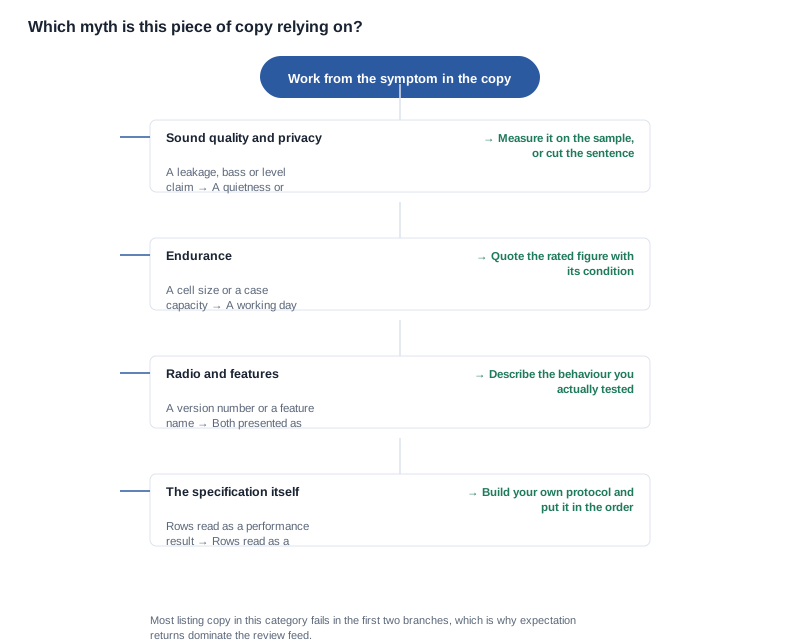
Eight beliefs travel with this category, and every one of them arrives with earphone vocabulary attached to a product that is not an earphone. Open ear audio glasses smart glasses myths is the dismantling of those eight, one at a time, with the reason each one does not hold and the published row or the measurement that replaces it. The commercially important thing about the list is that none of these beliefs describes a product fault. They describe expectations, and expectation failures arrive as returns, sit in your review feed beside genuine quality complaints, and quietly cost you the margin on every unit that comes back.
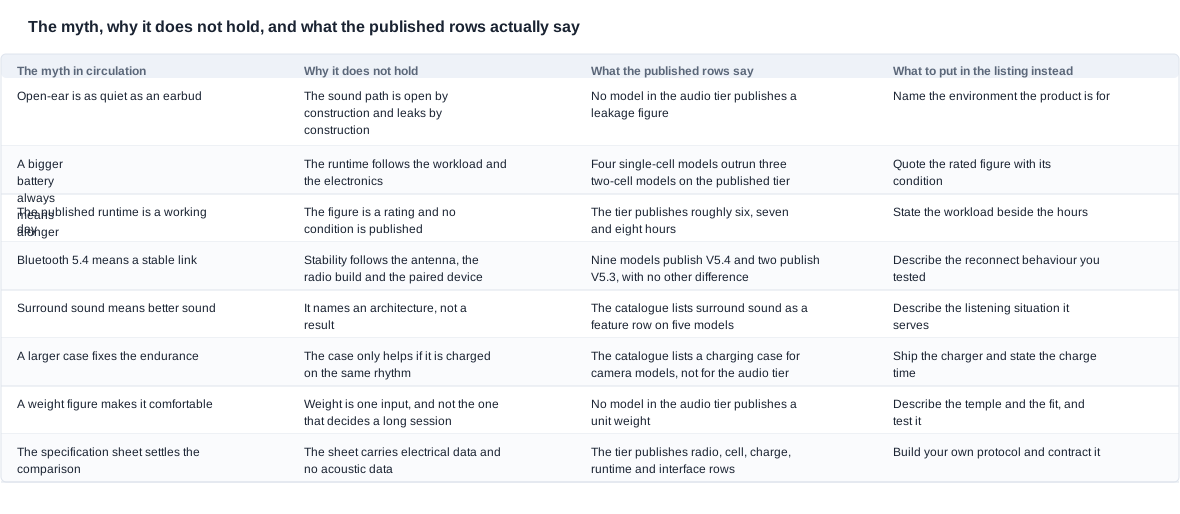
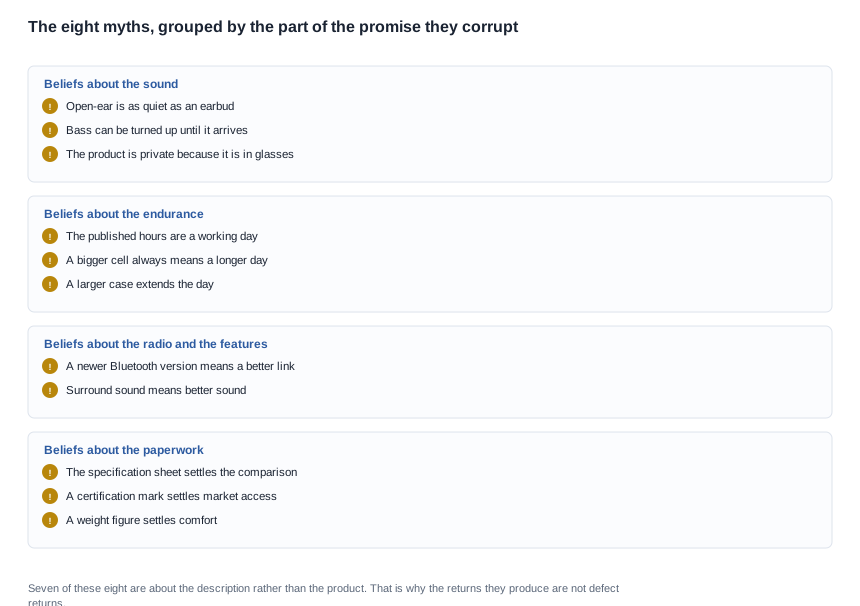
The rule that follows from the list is straightforward and slightly uncomfortable: the beliefs have to leave the listing before the artwork is approved, because the listing is where they enter a customer's expectations, and a return follows the expectation rather than the product.
Open ear audio glasses: eight beliefs, and their origin
The origin of the vocabulary
None of these beliefs started in this category. All of them arrived from sealed audio products, where they were true or nearly true, and they survived the transfer because the words travelled and the physics did not.
There is a structural reason the transfer was easy. This format has no published acoustic baseline — no model in our audio tier publishes a driver size, a frequency response, a leakage distance, a microphone pickup figure, a codec list or a latency — so there is no figure on any page for a customer to check a belief against. A belief with no reference point is not corrected by the market; it is corrected by whoever first runs a test.
And here is the part that makes it a procurement problem rather than a marketing one. A belief that reaches a customer does not stay in the review section. It becomes a return, a restocking cost, a channel margin loss, a rating that sits under your other products, and a support script your team has to run. Which is why the correct place to remove a belief is the copy, and the correct time is before the artwork.
The published position a buyer has to work with
The audio tier covers eight models. Bluetooth V5.3 is published on the K01 and the K02, V5.4 on the other six. The cell configurations are 55 mAh × 2 on the G07 and the YK12, and the LC-105-1 and the LC-105-2, 90 mAh × 2 on the K01 and the K02, and a single 100 mAh on the D11 and the D12. Charge time is published at or under two hours on all eight. Rated runtime is published at about eight hours on the K02 and the LC-105-1, and the K01 and the LC-105-2, about seven hours on the D11 and the D12, and about six hours on the G07 and the YK12. Charging is magnetic on six models and Type-C on the D11 and the D12. The sport models publish the same rows on their own terms: Bluetooth V5.4 on all three, 70 mAh × 2 on the YKC02, a single 115 mAh on the D17 and a single 100 mAh on the ZH12, a charge time at or under two hours on the YKC02 and at or under one hour on the D17 and the ZH12, about eight hours of rated runtime on the YKC02 and the ZH12 and about seven on the D17, and magnetic charging on the YKC02 against Type-C on the other two. Surround sound is listed as a feature row on five models across the two tiers, remote control photography on two, and a slim or detachable temple on two. No charging case is listed for any of them.
Hold that position in mind, because every one of the eight beliefs is contradicted by something in it or by something missing from it.
The four beliefs about the sound, and why each one fails
Sound is not a matter of volume
The belief. Turn the volume up and it sounds like an earbud. Or its softer cousin: the sound quality of open-ear glasses is fine, it just needs a bit more volume.
Why it does not hold. The level a listener receives is set by how the frame sits on the head and by the acoustic path itself, and the low-frequency end of that path is the part the design cannot engineer around — the sound reaches the ear around and beside the head rather than through a sealed coupling. Raising the volume raises everything together, including the amount that escapes into the room, and it does not recover what the path is not carrying. The result is a product that is simultaneously too quiet in the places you want to hear it and too loud in the places you do not.
What replaces it. Write the environment rather than the quality. "Designed for calls in places where you need to hear what is around you" is true, checkable and specific. "Immersive sound" is neither, and no measurement of this product will rescue it.
What to ask the supplier. What was the output measured at, on what head position, against what reference. If the answer names a reference and a method, the figure is usable. If the answer is a method name, the belief is still in the copy and the product is unchanged.
Open-ear is not private, and the test takes ten seconds
The belief. It is private because it is in your glasses rather than in your ear, so nobody else can hear it.
Why it does not hold. This is the belief most likely to be tested deliberately by a customer, a reviewer or a person sitting next to them, and it is falsified in about ten seconds in a quiet room at a volume a customer would plausibly use. The product leaks by construction — that is what makes the format work, because the ear canal stays completely clear.
What replaces it. State the privacy position accurately rather than implying one. A listing that says the audio is audible to a person nearby is more defensible than one that implies otherwise, because the first one cannot be falsified by a customer and the second one will be. The detail of the privacy question for a channel is worth setting out separately before the copy is written.
What to ask the supplier. The leakage, at what distance, at what playback level, in what environment. A figure with all three conditions is a number you can put in your own copy. A figure without them cannot be checked by anyone, including the person who published it.
The microphone is not the same as a headset microphone
The belief. The microphone on an open-ear frame is as good as the microphone on a good headset, because it is newer and it has noise reduction.
Why it does not hold. In a headset the microphone is ear-mounted, with a defined position relative to the mouth and a short, direct path to it. In an open-ear frame the microphone sits in the temple, the path to the mouth goes through the frame and through the air, and the wearer's own voice arrives by a completely different route. The capture path therefore degrades as the ambient level rises, and no amount of gain fixes a signal-to-noise ratio at the far end. The noise reduction is a method, and a method does not change the physics of the path.
What replaces it. Specify the environments the product is for, and test in them. A quiet office is where almost every microphone is acceptable, which is exactly why the quiet result is a sanity check and the noisy result is the decision.
What to ask the supplier. Intelligibility at the far end of a real call, on a real network rather than a local loopback, at a stated ambient level. The measurement procedure is set out in more detail on the microphone testing side of this site.
A feature name is not a result
The belief. Surround sound, or directional audio, means the sound is better than a plain frame.
Why it does not hold. It names an architecture and not an outcome. The catalogue lists surround sound as a feature row on the D11 and the YK12, the ZH12 and the YKC02, and the D17, and publishes no figure beside it for any of them — because in this format there is no reference method that would make such a figure comparable between products. The feature is real. The inference from the feature to a better result is not supported by anything published.
What replaces it. Describe the situation the feature is for. "A wider sound field for music in a group" is a positioning statement that a customer can check against their own use. "Surround sound" on its own is a row on a specification sheet that nothing corroborates.
What to ask the supplier. How many drivers, where they sit in the temple, and what was measured. If the supplier can describe the driver configuration but has no figure, that is a complete answer, and your copy should match its completeness.
The four beliefs about endurance and the specification sheet
A bigger case fixes the endurance
The belief. A larger charging case in the box extends the day and removes the recharge from the customer's routine.
Why it does not hold, twice over. First, a case only extends the day if it is charged on the same rhythm as the glasses, and a case that sits in a drawer does nothing at all — which is why the case's own charge cycle has to be part of the product's routine, not a box accessory. Second, and more concretely for this tier: no charging case is listed for any of the eight audio models in our catalogue. The case line belongs to camera models in a different part of the range. A buyer building an endurance story around a case is designing a product that does not exist in the catalogue.
What replaces it. Be explicit about what the customer does at the end of the day. If the model is a magnetic-charging one, the customer plugs into a magnetic interface; if it is one of the four Type-C models, the customer plugs a cable into the temple. The charge time is published at or under two hours on nine models and at or under one hour on the D17 and the ZH12, and that is the number the copy should carry.
The published runtime is a rating, not a working day
The belief. The catalogue says eight hours, so the product runs all day.
Why it does not hold. The published figure is a rated runtime, and no model in this tier publishes the workload behind it. The hours describe the electronics under the conditions the supplier chose, and the conditions a customer creates — a day of intermittent calls with the phone also handling other traffic — are a different load again. The tier publishes three bands, about six, seven and eight hours, and the difference between them is felt at the end of a shift.
What replaces it. Quote the rated figure as a rating, with the condition if the supplier has supplied one. If no condition is available, say that it is a rating. A customer who is told the truth about a rating will not be surprised by it.
What to ask the supplier. The workload, the volume and the codec behind the figure, and what happens at the moment the power expires. A device that dies silently in the middle of a call is a support ticket, and a warning is usually the whole of the fix.
A bigger cell does not mean a longer day
The belief. More milliamp-hours means more hours, so rank the models by capacity.
Why it does not hold. The tier's own published rows contradict it three times. The LC-105-1 and the LC-105-2 publish 55 mAh × 2 and about eight hours. The G07 and the YK12 publish the same 55 mAh × 2 and about six hours. The D17 publishes the largest single cell in the tier at 115 mAh and about seven hours, which is less than the smaller two-cell total on the LC-105 pair. The ZH12 publishes 100 mAh in one cell and about eight hours, while the D11 and the D12 publish the same 100 mAh and about seven hours.
So the capacity total is not a ranking signal, and a buyer who uses it as one will put the wrong model at the top of the shortlist. The cell configuration is still worth asking for, because it determines the charging interface and the mass distribution — but as a configuration question, not as a performance one.
What replaces it. Compare the runtime figures with their conditions, and treat a comparison of two unconditioned figures as a comparison of nothing. Ask what workload produced the figure and then measure a ratio on your own units.
The specification sheet settles the comparison
The belief. Two specification sheets side by side, and the lower unit price wins.
Why it does not hold. The sheet carries the radio generation, the charge time, the rated runtime, the cell configuration, the charging interface and the feature flags. It carries no acoustic figure at all, for any model, in any supplier's range. A comparison built on the sheet is a comparison of electrical platforms, and the thing your customer is actually going to judge — whether the product sounds right in their environment — is the part the sheet is silent about.
What replaces it. Build your own protocol and put it in the purchase order. In a category with no acoustic standard, the protocol is the standard, and it only works if it is contractual rather than a note in a meeting. The radio version of this belief is covered separately, and the supplier-side screening is covered on the red flags page.
What to ask the supplier. Four numbers in one message: the leakage with its three conditions, the microphone pickup at a stated distance, the runtime with its workload, and the output level on a fixture with a defined head position. If those four come back with their conditions, you can shortlist. If they come back without, you cannot.

Taking the beliefs out of the listing before the artwork
The rewrite, sentence by sentence

The rewrite is not a copy-editing exercise. It is a sequence where each step can send a sentence back to the supplier, and the order matters because the cheapest sentences to fix are the ones that cost nothing to change.
The three sentences that matter most in a listing are usually the first three in the description. They carry the product's promise, and they are usually written from the category's inherited vocabulary rather than from the product. If the first three sentences are the three that carry the beliefs, the rest of the page will be quietly contaminated by them, because the rest of the page describes the product those sentences imply.
The questions that replace a belief with a fact
- What is the level the listener receives, on what head position, against what reference? Replaces "turn it up".
- What is the leakage, at what distance, at what volume, in what environment? Replaces the privacy claim.
- What is the intelligibility at the far end, at a stated ambient level, on a real network? Replaces the headset comparison.
- What is the driver configuration, and what was measured on it? Replaces the feature inference.
- What does the box contain, and how does the unit recharge? Replaces the case belief.
- What workload, volume and codec produced the published runtime? Replaces the working-day claim.
- What are the cell configuration and the charging interface for the model designation? Replaces the capacity ranking.
- What do the specification rows not cover? Replaces the sheet comparison.
How to handle a belief you cannot remove
Sometimes the belief is load-bearing. If your channel's whole proposition is "you can hear your music and still hear the room", the belief about privacy is embedded in the proposition, and removing it removes the proposition.
In that case the answer is not to write a weaker promise but to write a specific one. Name the environment, name the volume at which the position holds, and name what the customer gives up. A proposition that survives its own conditions is defensible; a proposition that survives nothing is the belief itself, and it will be falsified by a customer rather than by a competitor.
The commercial cost of a myth reaching a customer
Why expectation returns are more expensive than defect returns
A defect return is a bounded cost: the unit, the freight, the inspection, the replacement. An expectation return is unbounded in a way that is hard to see from inside the business, because the cost sits in three places at once.
The first is direct. The unit comes back, and so does the freight and the packaging and the channel margin, and none of it is recoverable because the unit was fine.
The second is the rating. A review that describes the product as nothing like the page describes sits permanently under the listing, and it is indexed, searchable and visible to every future buyer. It also depresses the price a distributor will offer, because the distributor's own risk assessment reads the same feed you do.
The third is the operational one. Expectation returns are indistinguishable from defect returns in a review feed, so they get counted as quality problems. The consequence is that quality effort moves to the wrong place: a supplier gets asked to tighten a tolerance when the real problem was a sentence on a page.
The commercial answer is to treat the belief list as a costed item rather than as a copy detail, and to price the measurement work that replaces it. The measurements are cheap — a phone, a colleague, a quiet room and a written script — and the return avoidance is not.
Where the negotiation sits
The claim set is the negotiable document here, not the unit price. A supplier who will put in writing which claims are measured and which are design statements is giving you something that can be reused across every listing, every market and every rewrite of the page. The trade-off is worth naming: a narrower claim set costs you reach in the listing, and the usual business answer is to keep the measured claims in the product page and the aspirational language in campaign material that carries no specification.
The trade-offs in the measurement work are also worth naming. The acoustic work has to happen on a sample before the deposit rather than on production units after it, because a production unit is a much more expensive place to discover a problem. The second trade-off is between testing everything and testing what decides the programme: four measurements — leakage, microphone pickup at a stated distance, runtime on a stated workload and output level on a fixed fixture — settle most of the eight beliefs, and the rest are answered by the copy.
The documents that close the beliefs
Before the deposit, the file should contain the model designation table, the certificate register with numbers and validity dates, the packaging artwork proof showing exactly what ships in the box, the agreed incoming inspection criteria carrying the pass lines, and the battery transport documentation at battery transport. The certificate register procedure is at certification checklist, the clause language is at contract terms, and the commercial structure of a first order is at pricing.
What we publish, and which of these beliefs we refuse to repeat
Our own catalogue, read the same way
Applying the eight beliefs to our own pages is the fairest test of whether we believe them. Our position is that we publish the electrical and interface rows exactly as the catalogue states them, and we publish the absence of third-party acoustic measurement, of any leakage figure, of any runtime test condition and of any unit weight with the same prominence. We will not present a feature name as a performance result, and we will not quote a typical performance figure for the category.
We will also say which of these eight we could make if we published figures. We could make them if we had measured them, and the honest position is that we have not.
Three of the beliefs are ones we actively refuse to repeat in our own copy: that open-ear is private, that the published runtime is a working day, and that a feature name implies a result. The remaining five are beliefs we do not make in the first place, and a buyer who finds one of them on a page should treat it as a finding about that page rather than about the product.
The draft listing copy, and the claims in it
-
Send us the draft listing copy. We will mark every claim the published rows support, every claim that needs a measurement to stand up, and every claim that has to come out of the copy. That is the whole of the deliverable and it takes an hour.
-
Send us the use case and the session length. We will tell you which of the eight beliefs applies to that combination, and which of them have to be answered in the product rather than in the copy.
-
Send us the four measurement results. Leakage, microphone pickup, runtime on a stated workload and output level on a fixed fixture. We will tell you which of the eight beliefs each result closes.
-
Ask us which of our own rows are measured and which are design statements. We will answer for each one, and where the answer is that we do not measure it, we will say so.
The field behaviour behind several of these beliefs is set out in real-world performance, the supplier-side screen is in open-ear audio red flags, the technology background is under open-ear audio, and the range is at Bluetooth audio glasses.
Related reading
- The range covered — Bluetooth audio glasses
- The technology behind the claims — open-ear audio technology
- Field behaviour — real-world performance
- Warning signs in a supplier's claims — open-ear audio red flags
Send us the draft listing copy, and we will mark the claims the published rows support and the ones that have to come out.


