

An upgrade question in this category is asked when something about a product already in a range has stopped working. Usually it is the acoustic behaviour, usually it is measured against a competitor's product the customer has handled, and usually the published data cannot settle it, because the rows that would settle it are the rows nobody publishes. Open ear audio glasses smart glasses upgrade considerations is therefore less a product comparison than a decision framework: it separates the complaints that justify changing what you buy from the complaints that justify changing something else, and it puts the price of a change in the right currency, which is programme cost rather than unit price.
Our published position across the audio tier is Bluetooth 5.3 on the K01 and the K02 and 5.4 on the D11 and the G07, the YK12 and the LC-105-2, and the LC-105-1 and the D12; cell configurations at 55 mAh × 2, 90 mAh × 2 and 100 mAh; charge times of two hours or less; runtimes of roughly six to eight hours; magnetic or Type-C charging; no published touch control row; and features including surround sound and slim detachable temples. The three sport models publish the same kind of row, with Bluetooth 5.4 across the YKC02, the D17 and the ZH12, cell configurations at 70 mAh × 2 on the YKC02, 115 mAh on the D17 and 100 mAh on the ZH12, and charge times of around one hour on the D17 and the ZH12. On acoustic performance, no third-party measurement is published for any model.
Open ear audio glasses: when not to upgrade
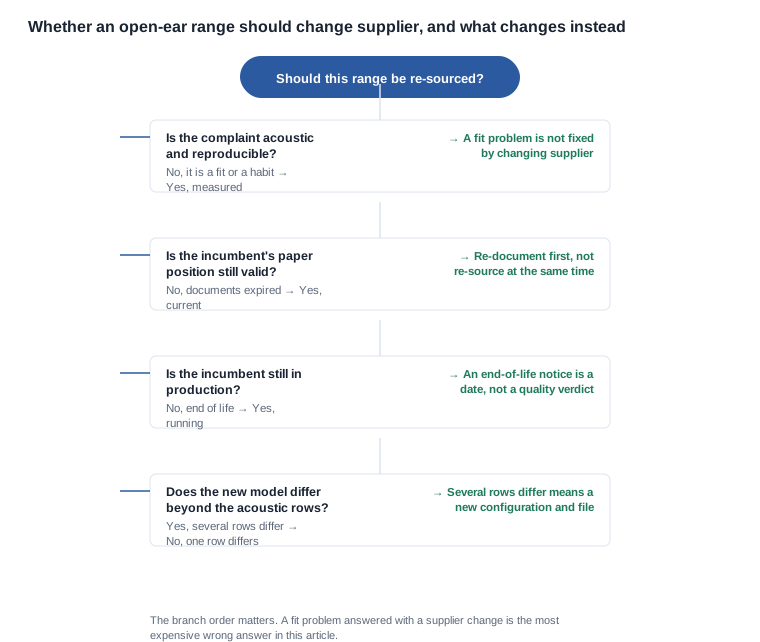
The most expensive upgrade decisions are the ones taken on a complaint that a different change would have fixed. In this category the usual sequence is that a customer describes the product as having poor sound, the description becomes a request for a better driver, and the driver change costs tooling and delivers nothing — because the complaint was about where the radiators sat relative to the ear, which is a geometry question rather than a transducer question.
The three complaints that do not justify a supplier change
"The sound is not good enough," with no environment attached. A complaint that does not name where it happened cannot be tested, and an untestable complaint cannot justify a change of product because it cannot justify anything. The first action is always to get the customer to complete the sentence with a place and a situation: the far end could not hear me on a busy street; the person beside me could hear my audio on the train; the call was fine indoors and unusable outdoors.
"The competitor sounds better," with no measurement on either side. In a category where no acoustic figure is published, a customer holding a competitor's product has an opinion and both sides have no evidence. The comparison has to be run, on a fixed script, in the environment where the complaint occurs, with the customer's own unit as the reference — because the customer's own unit is the only calibrated reference they have.
"People keep returning it." A high return rate is a symptom with several possible causes, and in this category one of them is geometry rather than electronics. Returns attributed to sound quality are frequently returns attributed to the frame sitting badly on the head, and the fix for that is a temple or a sizing change rather than a new platform. Before treating a return rate as an acoustic verdict, split the returns by stated reason and check whether the geometry rows were ever requested at all.
These three are worth separating before the money conversation, because each of them sends the programme in a different direction. A complaint with an environment attached sends you to a measurement. A competitor comparison sends you to a side-by-side test. A return rate sends you to a data split, and possibly to a fit row rather than a product change.

The four triggers that justify replacing a product already in your range
A replacement decision needs a trigger that is not a feeling about the product. There are four that survive scrutiny, and they are worth ordering by how often they actually appear.
Why the endpoint of the current product's life matters more than its age
Supply continuity. The incumbent has an end-of-life date, or the factory that built it has moved to a different model. This is the most common trigger and the least emotional one, because it arrives on a schedule rather than as a complaint. The relevant date is not the age of the product and not the length of time it has been on sale; it is the date on which the last lot can be produced, and the amount of stock the channel needs to cover that gap. A buyer who treats an end-of-life notice as a quality judgement will replace early and pay for it.
Documentation continuity. The certificate numbers behind the incumbent have expired, or the model has been removed from the model list on the documents, or the responsible person for the market has changed. This trigger is invisible until a customs query or a marketplace check, and it is cheap to establish early and expensive to discover late. The test is simple: does any document currently in the file name the exact model designation being sold?
A structural configuration change the range needs. The channel has moved and the incumbent's charging interface, its temple architecture or its accessory set no longer works for the new market. A move from a proprietary charging arrangement to Type-C is a genuine upgrade with nothing to do with acoustics, and it is one of the rare cases where a configuration change is worth the programme cost on its own.
A measurable gap that survives a side-by-side test. This is the trigger buyers most want and least often obtain. It requires that the complaint was turned into a testable statement, that the side-by-side was run with the customer's own unit, and that the difference was large enough to matter for the use case. Without all three, the gap is a preference, and a preference does not carry a documentation reissue.
What a swap actually costs beyond the unit price
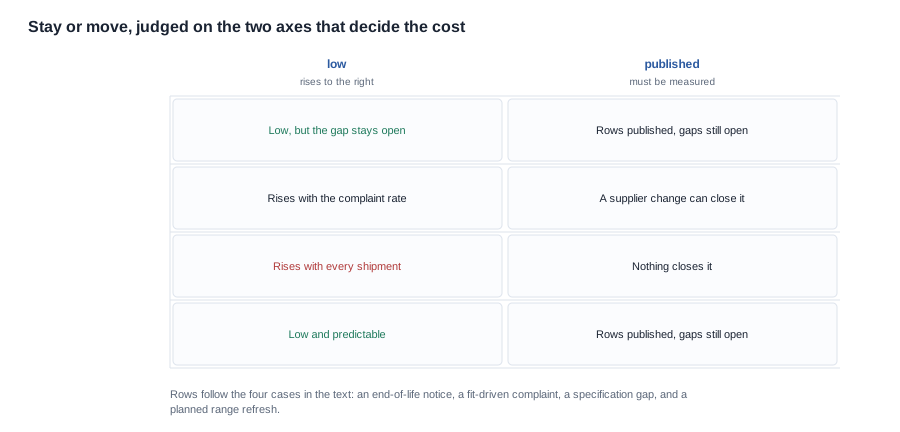
A swap is priced by most buyers as a unit price difference multiplied by a volume, and it is actually priced as a set of programme lines that recur on every future order until somebody closes them. Getting this wrong at the start is what makes an upgrade look cheap and turn out expensive.
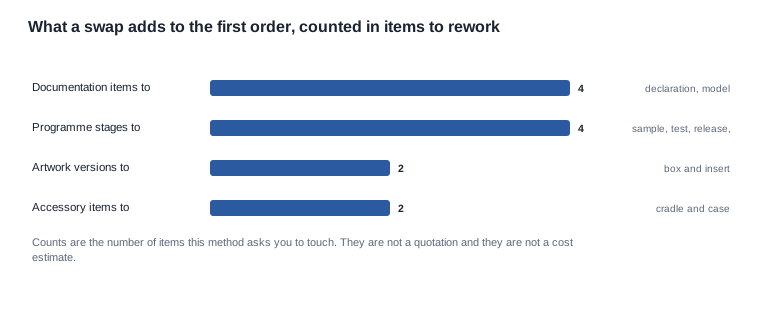
The four cost lines a swap adds to the first order
Documentation. The declaration of conformity, the model lists on the certificates, the battery transport summary for the fitted cell, the material declarations and the technical file behind them all name a model. A new model means a new set, or a written confirmation that the existing set covers it. This is not a formality; it is the file you will be asked for at the border, at the marketplace, and two years later during a warranty claim.
Repeated programme stages. The sample, the acceptance test, the release decision and the archiving step all happen again. They are cheap individually and they are on the critical path, because the artwork cannot be finalised and the launch date cannot be committed until the sample has been accepted.
Artwork and labelling. The box, the insert, the model label and the market-specific labels all carry the model designation. Each is a version, each a round of approval, and each round is a week. Moving the artwork approval earlier than the usual schedule is the cheapest lever available, and it works only if the model designation is fixed before the artwork starts.
Accessory redesign. A change of charging interface changes the cradle and possibly the case, and those are new items with their own tooling and their own minimum order quantities. This is the line most often missing from a swap budget because it does not appear on the product quotation at all.
Two further lines belong on the list even though they are not part of the first order. The minimum order quantity resets, because a new model starts again from the supplier's minimum rather than inheriting the volume the old model had. And the old model does not disappear: spare parts for the warranty period, the support script for the customers who still own one, and the listing that still names it all continue for as long as the old product is in the field.
There is a fifth line worth naming because buyers mistake it for a saving rather than a cost. The learning that is thrown away. If the incumbent has been in market for two years, the buyer has a return-rate history, a complaint set, a set of support scripts and an installed base of buyers who have calibrated to it. A swap resets that history to zero, and the new product begins with no known failure modes. Some of that is a genuine improvement. Some of it is a return to a blank page, and the trade-off is worth putting on the same page as the unit price before the decision is taken rather than discovering it in the first quarter of the new model.
The trade-off table that decides most upgrade arguments
| What the buyer is weighing | What it costs to change | What it costs to stay | Which measurement settles it |
|---|---|---|---|
| The acoustic result | A new sample, a new side-by-side, a new acceptance criterion | The complaint continues at the current rate | The side-by-side on a fixed script |
| The documentation position | A new file, a new model list, a new approval cycle | A customs query or a listing withdrawal later | The model list on each certificate |
| The supply continuity | A qualification cycle before the first lot | A stock-out when the last lot is exhausted | The end-of-life date in writing |
| The charging proposition | New tooling, new cradle, new case minimums | A customer who keeps buying the cable they already have | The interface row, compared against the accessory plan |
| The consistency of what ships | A retained unit and a golden sample to build | Whatever the factory does on the day | Two units of each candidate, in one sitting |
The last column is the reason this article is a framework rather than a recommendation. Every cell in it can be closed with evidence rather than opinion, and the buyer who fills in that column before the commercial conversation is in a different position from one who fills it in afterwards.

Migrating a live programme: documents, artwork, packaging and the file
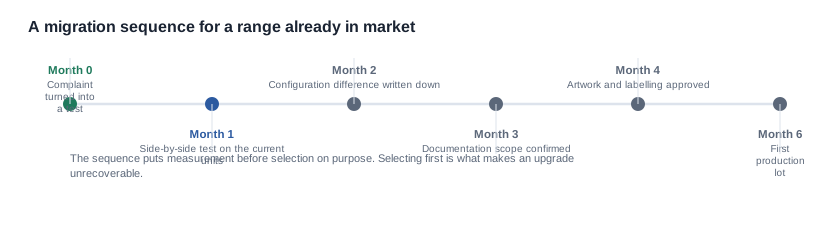
The migration is a sequence, and the order in it is the difference between a controlled change and a scramble. Each step depends on the previous one, and several of them cannot be run in parallel.
A worked sequence for a range already in market
First, convert the complaint into a statement that can be tested, and get the customer to confirm the wording. This is the step a buyer is most likely to skip because the customer seems to have made the point already, and skipping it means the side-by-side result will be disputed later.
Second, run the side-by-side with the current units, not against an abstract specification. Same script, same environment, same person judging, two units of each. The customer's own unit is the only calibrated reference available and it costs nothing to include.
Third, check the geometry before pricing the acoustics. A comparison on the same people, of how the frame sits and how the radiators line up with the ear, can remove the need for a transducer change entirely. It takes an hour and it is the highest-yield hour in the whole programme.
Fourth, write down the configuration difference. The cell configuration, the charging interface, the temple claim and the accessory scope, side by side. These are published rows and they decide what the swap actually is.
Fifth, establish the documentation position for the new model, including the model list on each certificate. A configuration change is a product change and this is where it surfaces.
Sixth, close the commercial structure. Per-configuration minimums against a committed combination count, artwork approval moved earlier, one additional artwork round for anything new in the box, and the acceptance criteria written into the purchase order with the script, the environment, the pass criterion and the sample size attached.
The questions to put to a supplier before the upgrade is scoped
The request to a prospective supplier should be short and it should be asked before any pricing conversation, because the answer determines whether the conversation is worth having.
Ask what the model designation is for the exact configuration, in writing, since a document has to name it. Ask what changed relative to the incumbent, by row, so the differences are a list rather than an impression. Ask whether the acoustic design changed at all, and if it did, what was measured and under what conditions. Ask whether the cell configuration, the charging interface and the temple construction are the same as the incumbent, since those three carry most of the programme consequences. Ask which model designations appear on the certificate documents, and whether the incumbent's designation appears there too. Ask what the charge time and the rated runtime conditions are, because a comparison against the incumbent's published figure is not possible without them. And ask what the runtime condition is on the incumbent side as well — a published runtime without a workload is not a baseline to improve on.
The one test that decides most upgrade arguments
If only one of these is done, it should be the side-by-side. Everything else in this article is framework; the side-by-side is the only thing that produces evidence, and evidence is what converts a preference into a decision, survives a returns discussion later, and protects the buyer if the change does not deliver.
A related point deserves emphasis. A buyer who skips the side-by-side because the customer is already convinced is making a decision on the customer's confidence rather than on the product, and the customer's confidence is a statement about their experience, not about the cause. The side-by-side is cheap relative to a swap and it is the only step in the sequence that cannot be reconstructed later.
The red flags that mean a swap is not ready to be scoped
Five signals show up repeatedly in an upgrade that is going to cost more than the buyer expected, and all five are visible before the order rather than after it.
The candidate is described as an upgrade without a row-level difference. If the supplier's quotation differs from the incumbent only in wording, there is no upgrade to scope; there is a re-order. A change of supplier, a change of factory or a change of acoustic tier all need at least one row that is genuinely different.
The comparison is being made on published runtimes. The published figures in this family are catalogue rows without conditions on either side, so a runtime comparison is not a comparison. It is a reading of two unrelated numbers, and it produces a decision that cannot be defended when the customer asks why.
The documentation question has been deferred to after the artwork. The model designation determines what goes on the box, so a programme that approves artwork before fixing the designation is guaranteed a second artwork round, and a second round is a week plus a translation cycle.
The new configuration is assumed to inherit the old paperwork. A different cell, a different interface or a different temple is a different product, and a document that names a family does not cover a model. This is the assumption that produces the customs query.
The accessory scope is still open. An open cradle and case scope at the point the upgrade is scoped means the unit price you are comparing against is not the unit price you will pay, and the difference appears in the first quotation rather than in the second.
The pitfalls worth naming sit alongside them. Scoping an upgrade before the complaint is testable. Comparing two candidates on a list of features rather than on a side-by-side. Treating a configuration change as a cosmetic change. And moving forward on a schedule argument — the launch date is derived from the acceptance of the sample and the model designation, not from the factory's capacity.
Where our own published rows stop, and what we will not estimate
We publish the electrical rows and the technical methods for the audio family, and we publish the acoustic measurements as open rather than filling them with typical values. No third-party acoustic measurement is published for any model in our range, and we will not tell a buyer that one of our products sounds better than another on the strength of the approach it uses. We will not estimate a chamber, a driver size, a leakage distance or a geometry dimension from elsewhere in the industry. On weight the published position across the catalogue is one figure: the MT6 glasses body at 158 g, including the fitted battery and the camera and excluding the folding charging case, which holds 1200 mAh and whose own weight is not published. No bare frame weight is published for any model, so a fit row for an audio product is a request rather than an expectation.
We will also be direct about four things not to do, because they are the four ways an upgrade programme in this category loses money. Upgrading on the published runtimes alone. Treating a new model as an upgrade when the difference is really the temple. Assuming the new configuration is covered by the current documentation. And skipping the side-by-side because the customer is already sure.
What we can do is take a specific configuration and tell you which of the upgrade questions our documentation answers and which need a test on a sample. The background is under open-ear audio, the published rows are in open-ear key specifications, the measurement protocol is in how to measure open ear audio, the supplier checks are in open-ear supplier verification, and the range is Bluetooth audio glasses.
Related reading
- The published figures — open-ear key specifications
- The supplier checks — open-ear supplier verification
- Bluetooth audio glasses range
Send us the complaint and the two configurations and we will tell you which of the questions decides it.


