

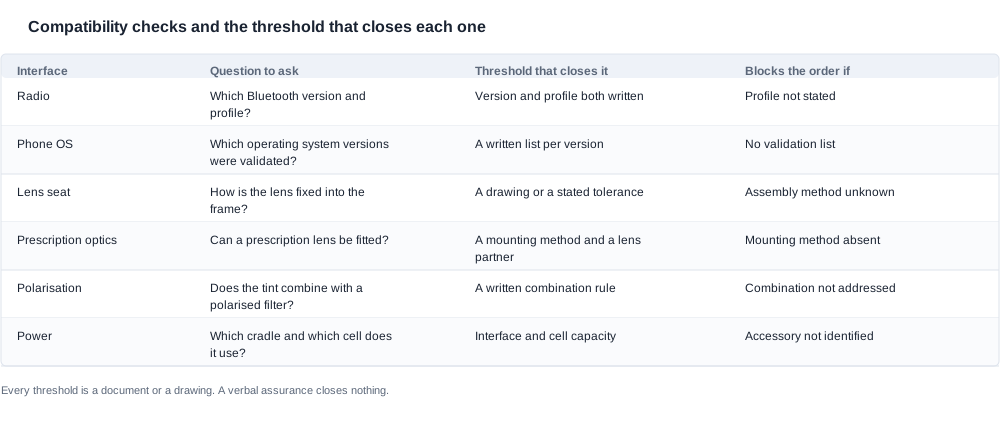
Compatibility in this category is not one question, it is six, and each one is settled by a different document. A buyer who treats "does it work with my phone" as the whole check will discover the remaining five in the order confirmation: the Bluetooth version is published for the dedicated colour-change entry but the profile is not; the catalogue does not publish a Bluetooth version for the camera models at all; the lens seat that holds a colour-change element has its own tolerance; a prescription lens needs a mounting method nobody in the transaction has yet named; and a tint that changes under glass behaves differently from a tint that changes in open air. This article sets out the six checks in the order they have to be run, the threshold that closes each one, and the dossier to hold on file before the purchase order is placed. Compatibility here means an interchangeability that can be demonstrated on a sample, not an assurance in an email.
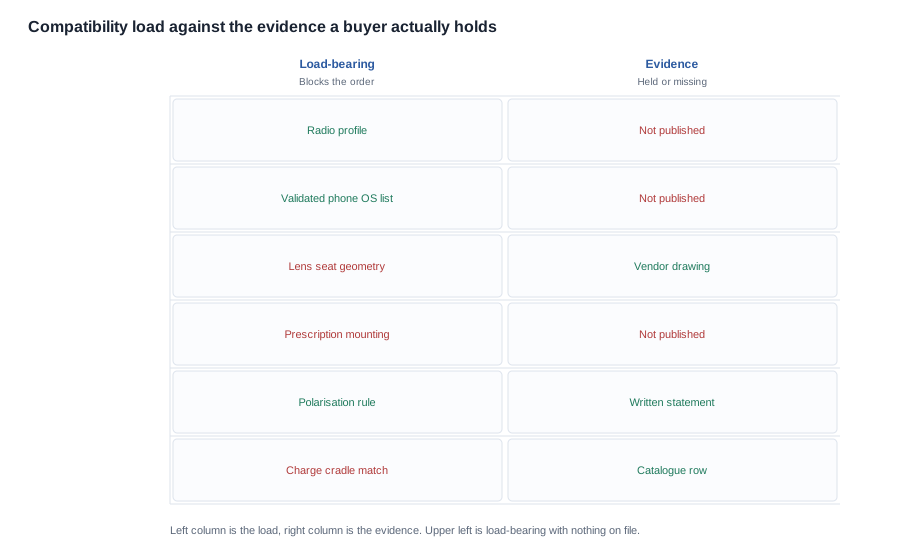
Photochromic: four interfaces a colour-change lens must satisfy
A colour-change lens does not sit on top of a product. It enters four interfaces at once, and each one has a different owner and a different failure mode.
Why compatibility is a set of separate checks
The radio interface is between the product and the customer's phone. It is governed by a Bluetooth version, a set of profiles, a codec, a multi-device limit and an operating system validation list, and only the first of those is a published row for one of the two routes in our catalogue.
The optical interface is between the lens and the frame. The element has to be located in the seat with a stated tolerance, sealed, and coated; the geometry of the seat is part of how the lens behaves, and the geometry belongs to the assembly step rather than to the lens supplier.
The prescription interface is between the customer's own corrective lens and the product. Almost nobody asks whether a prescription lens can be inserted, and where the answer is yes, the method, the lens partner and the extra cost all have to be named before the sample is ordered.
The accessory interface is between the product and the cradle, the cable and the case. It is the least interesting of the four and the one most often left to a warehouse.
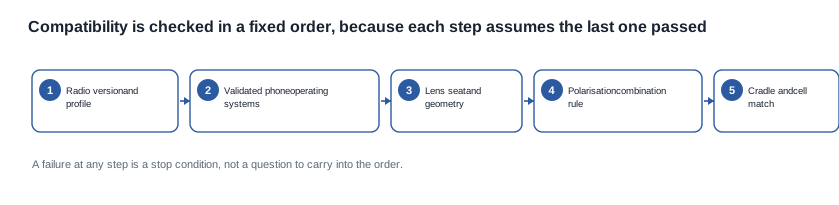
The ordering rule that follows is simple. The radio check is cheap and fast, the optical and prescription checks determine whether the product can exist in the configuration at all, and the accessory check determines whether the first shipment works. Run them in that order and a failure at any step is a stop condition rather than a question you carry into the order.
What the catalogue publishes and what it does not
For the camera platform with a colour-change lens configuration we publish an 8 MP sensor, a 220 mAh cell, a rated runtime of 5–8 hours, Type-C charging, charging in two hours or less, flexible temples and three published colour options. For the dedicated colour-change entry we publish Bluetooth V5.4, a 100 mAh cell, charging in two hours or less, a rated runtime of about seven hours, magnetic charging, and the lens technology described as electrochromic.
Everything else relevant to compatibility is unpublished. There is no published Bluetooth version for the camera models, no published profile list, no validated operating system list, no pairing-device limit, no lens seat drawing, no prescription mounting method, no polarisation combination rule, no coating specification, no lens switching time and no transmission range. That is not a criticism of the catalogue; it is the state of a category that has no published performance baseline. It does mean that the compatibility questions are not answered by reading a product page, and that they have to be put to the supplier in writing.
The radio side: version, profile and the phone you ship against
The radio is where most compatibility conversations start and where most of them stop too early. A Bluetooth version settles the generation of the radio. It does not settle what the product actually does over the air.
Bluetooth version is the published row, the profile is not
The dedicated colour-change entry publishes Bluetooth V5.4. That is the one radio row in this category we can put on paper. The camera models carry no published Bluetooth version in the catalogue, so for those the version has to be requested, and a request answered with "the latest" is an answer that cannot be filed — because "the latest" is a moving target and a moving target cannot be the basis of a technical file or a market access position.
The profile is a separate matter again. A version number says the radio is of a given generation; the profile says what happens when a call arrives, when audio plays, when a control signal is sent. If your programme involves a control path on the powered route — and a driven colour-change lens needs a control path — then the profile that carries that control is the profile that matters, and it has to be named.
The threshold to hold: a written statement naming the Bluetooth version, the profiles the product uses, and the codec, per model designation. Ask for it in the body of the email, not as an attachment, and check the model string character by character against the string on the quotation.
The phone operating system list nobody writes down
Almost no product page states which phone operating system versions were validated, and almost no supplier volunteers it. It matters because the pairing flow, the permission model and the background behaviour of a connected accessory all differ between operating system generations, and because a customer who updates their phone expects the product to keep working.
The threshold: a written list of the operating system versions the product was validated against, per model, with the date of the validation. A list that has not been updated in more than a year is a list you should treat as historical rather than current, and the question to ask at that point is not "is it accurate" but "what changed since".
Multi-device and reconnect behaviour
A buyer whose channel includes field technicians, warehouse staff or shared vehicles needs to know how many devices a unit holds, which of them it connects to when two are in range, and what happens after the customer phone is replaced. The reconnect behaviour is the row that generates support volume, because a product that does not re-establish its connection after a restart reads as a broken product rather than as a product with a particular protocol.
Ask for the pairing-device limit, the reconnection behaviour after a power cycle, and the behaviour when a second known device is within range. Those three answers take one email and they determine whether your channel needs an instruction card. Compare photochromic smart glasses key specifications against the radio row in any supplier quotation, and use the supplier verification method in photochromic smart glasses supplier verification before you accept a document that names a family rather than a model.
Prescription optics and the seat the lens sits in
This is the interface that most often ends a programme, because it is the one that is usually assumed rather than checked.
Can a prescription lens be fitted at all
A colour-change element and a corrective lens are two different pieces of glass occupying the same small volume in front of the eye. Depending on the frame, there are three possible answers: the corrective lens can be inserted in front of the colour-change element, the corrective lens can be integrated into the colour-change element itself, or the frame can be made in a single combined piece. Each of those is a different manufacturing route, a different cost, a different lead time and a different verification method.
The question to ask first is the blunt one: can a prescription lens be fitted to this configuration, and by which method. The answer that closes it is a drawing, a method statement and a named lens partner, not an assurance. If the answer is no, that is a product decision rather than a defect, and it should be made before the sample rather than after the first customer asks for a strong prescription.
The second question is what it does to the configuration count. If a prescription option is available only on some colourways, then the number of configurations multiplies by the number of prescription variants, and every one of those configurations carries its own artwork, labelling, sample and documentation line. This is where the minimum order quantity per configuration starts to matter, and it is the place where the total programme cost is usually decided.
The seat geometry and the tolerance around it
The colour-change element is located in a seat. The seat is a machined or moulded feature with a tolerance, a locating edge and a seal. Two consequences follow, and both are commercial rather than technical.
The first is that a change to the frame is a change to the seat, and therefore a change to the compatibility position. If the frame geometry moves, the element has to be re-qualified against it, and the buyer should ask what in the supplier's quotation assumes the current geometry.
The second is that the seat determines which lens suppliers are usable at all. A lens element that is within its dimensional tolerance but outside the supplier's coating and handling assumptions will behave differently in the frame than it did on the bench. Ask whether the lens arrives with the coating applied, who applies it, and what handling the coating tolerates before assembly.
Polymer against mineral substrate
The substrate matters commercially because of how it is worked. A mineral lens is cut and polished; a polymer lens is cast and finished. The implications for a buyer are threefold: the tooling and the change cost when a lens shape changes, the machining tolerance available, and the coating systems that can be applied to it.
The threshold to hold is a written statement of the substrate and the associated process, per configuration, with the coating system named alongside it. A supplier who answers "glass" without distinguishing mineral from polymer has not answered the question that affects your tooling exposure.
Polarisation, coatings and the combination that cannot work
A tint and a polarised filter are not the same mechanism
Polarisation and a colour-change lens are separate mechanisms that happen to operate on the same light, and stacking them creates behaviour nobody should promise in a listing. A colour-change lens reduces the overall light reaching the eye; a polarised filter selects a plane of that light. Put a driven tint behind a polarised filter and the visible result depends on the state of the tint, the angle of the filter and the light source, and it will not be predictable from a product page.
The threshold: a written combination rule from the supplier stating what the product does when a polarised filter is added, and in which direction the change is physically applied. If the answer is that the combination is not supported, that is a perfectly good answer and it belongs in your configuration list as an exclusion rather than in a footnote.
Note also the related case of the vehicle windscreen, where laminated glass filters some of the light that drives a passive reaction. The same requirement applies — a written statement, not an expectation. Both of these are spec-sheet details rather than shop-floor ones, and both are covered in how photochromic smart glasses work at the mechanism level.
Coating interactions with the camera path
Where the product carries a camera — and the camera platform in this category publishes an 8 MP sensor — the lens is on the imaging path as well as on the visual path. That creates a compatibility question that has no equivalent in an audio-only product: what does the camera do when the light transmission in front of it changes?
The questions are specific and none of them are answered by the catalogue. Does the camera re-expose as the tint changes, and how quickly. Does the automatic exposure behave differently in the clear and the dark state. Whether a frame or temple intrudes into the field of view in a way the tint makes more visible. Whether the coating on the lens is compatible with the imaging path in terms of flare and veiling reflections, which the coating is exactly where a supplier would add it.
The threshold to hold is a demonstration on a sample rather than a paragraph, because this is an interaction between two systems and it is best seen. The comparison protocol is in how to measure photochromic smart glasses, and the catalogue rows behind it are in photochromic smart glasses key specifications.
The compatibility dossier to file before the order
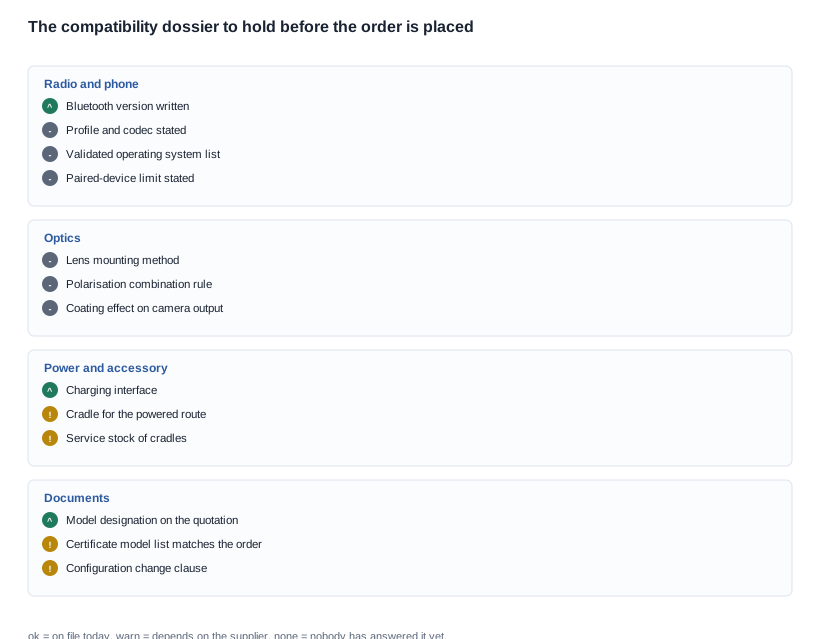
The dossier: five groups, one order
The compatibility work produces a dossier rather than a conversation, and the dossier has five groups. Keeping them together is what stops a check from being repeated by a different member of the buying team six weeks later.
- Radio and phone. Bluetooth version, profiles, codec, the validated operating system list, the pairing-device limit and the reconnection behaviour, each tied to a model designation.
- Optics. The seat geometry and its tolerance, the substrate, the coating system, the element's handling tolerance before assembly, and who applies the coating.
- Prescription. Whether a corrective lens can be fitted, the method, the lens partner, the additional cost, and the configuration count that the option creates.
- Power and accessory. The charging interface and the cell capacity, the cradle and case required, and the spare pool you need for service.
- Documents. The model designation on the quotation, the certificate model list matched against it, the configuration change clause, and the technical file location.
A checklist of the named artefacts, and how to verify each one
The questions that close the dossier fastest are the ones that ask for a named artefact rather than an opinion. Which drawing defines the lens seat. Which document states the validated operating system list. Which model string appears on the certificate model list. Which sample did the supplier test, on which unit, with which result recorded.
If the answers arrive as attachments rather than as identifiers, the dossier does not close. A file name can be renamed; a drawing number, a certificate number and a model designation can be looked up later by someone who was not in the conversation. That distinction is the difference between a compatibility position you can defend to a compliance team and one you can only defend to yourself.
Red flags that the answer was written for a different product
Compatibility answers fail in characteristic ways, and the pattern is recognisable before you have read the whole document. Knowing the pattern is what lets you evaluate a supplier's reply in one pass rather than three.
The family string. A certificate, a declaration or a compatibility statement that names a series rather than a model designation is covering something else. In this catalogue one route publishes no model designation at all, so a document that refers to "the photochromic model" may be referring to an entry that cannot be listed on a certificate in the first place.
The table of everything. A compatibility table listing every model in the range with identical values across all of them is a marketing summary, not a specification. It cannot be right, because the published rows for the two routes in this category already differ in charging interface, Bluetooth version and cell capacity.
The platform default. Where the answer restates the platform's connectivity rather than the configuration's, the answer was copied rather than checked. The red flag is the absence of any configuration-specific row for the lens.
The silence on the seat. An answer that covers the radio in detail and does not mention the seat or the coating is an answer from a different product family, because the radio is the easy part and the seat is the part that decides whether the lens can be assembled.
The unconditional polarity. A combination rule that applies to every tint state has not been thought through. Where the mechanism can hold a state, the combination rule has to be stated per state or it is not a rule.
Before you order, apply one test to the whole dossier: for every row, name the model designation it applies to. Any row you cannot attach to a model designation is a row that will not protect you when the first complaint arrives, and it should be removed from the comparison rather than carried into the order.
The boundary we hold: we publish the rows we hold, which in this category means the sensor class, the charging interfaces, the published colour options, the rated runtimes and the cell capacities and one Bluetooth version, and we mark everything else as unpublished rather than estimating it. We do not publish a lens seat tolerance, a profile list, a validated operating system list, a prescription mounting method, a polarisation combination rule or any lens performance figure, because we have not confirmed them and because each of those is exactly the kind of number that fails silently in the field.
The product entry for this route is at photochromic smart glasses and the underlying technology sits under photochromic lens technology.
If you are checking compatibility on a specific configuration, send us the model designations, the markets you intend to ship into and the prescription requirement, and we will tell you which of the six checks we can close from published rows and which have to go to the supplier in writing.


