

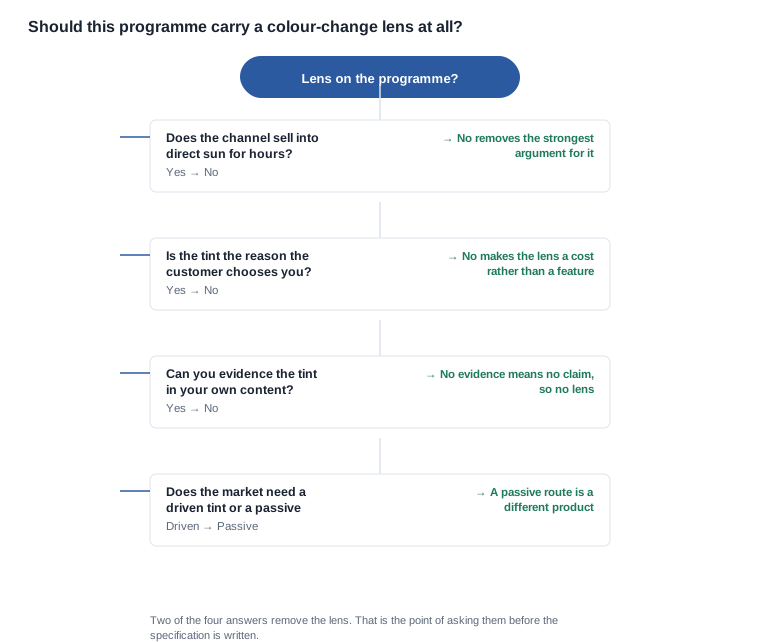
For most programmes the honest answer is no, and the expensive mistake is arriving at yes without having excluded the alternatives first. The reflex in this category is to compare the two available lens routes — a colour-change lens configuration on a camera platform, and a dedicated electrochromic entry — as though the only question is which lens. That question presumes you need a lens, and in most channels the requirement does not survive the first two questions. This guide is built the other way around: the exclusions that come before any comparison, the five programmes that should not carry a colour-change lens at all, what each catalogue route actually commits you to, what changes in the bill of materials and the documentation when the lens stays out, and a shortlist method for deciding with the information the catalogue genuinely holds.
Photochromic: the exclusions before the comparison
Why the comparison is the wrong first step
Comparing two lens routes is a decision about which lens. It is a real decision and it is worth doing properly — but it is the third decision in the sequence, and the sequence only works if the first two are answered first. The first is whether the channel has a light profile that makes a reactive lens useful at all, and the second is whether the feature can be evidenced and demonstrated. Answer no to either and the comparison is wasted effort, because the answer to both is already the answer to your question.
The reason this ordering matters commercially is that the cost of the lens is paid at the unit price and at the per-configuration cost simultaneously, while the benefit is realised only in a specific environment. A buyer who starts from the quotation has already accepted the cost, and a buyer who starts from the requirement has not.
The category is a specialist product with a general use
Almost every wearable category in this range has a general use and a specialist one, and the general use is where the volume is. A colour-change lens is a specialist addition. It does something in direct sun that a standard lens does not do, and it does nothing at all in the environments that make up most of the working day for most channels.
That does not make it a bad product. It makes it a product whose value is concentrated in a narrow band of environments, which is exactly the profile of a product that needs its channel identified before it needs its supplier selected. Retail floors, offices, warehouses, indoor inspection lines, showrooms and most indoor service work are all environments where the lens contributes nothing visible and costs something on every unit.
The test that follows is worth applying to any channel: count the hours in a typical week during which the change in the lens would actually be visible to a customer. If the answer is small, the feature is a cost. If the answer is large but the channel is also where your differentiation sits, the feature is an argument. If the answer is large and the channel is not where your differentiation sits, it is still a cost — it is simply being paid for by someone else's brand equity.
Five programmes that should not carry a colour-change lens
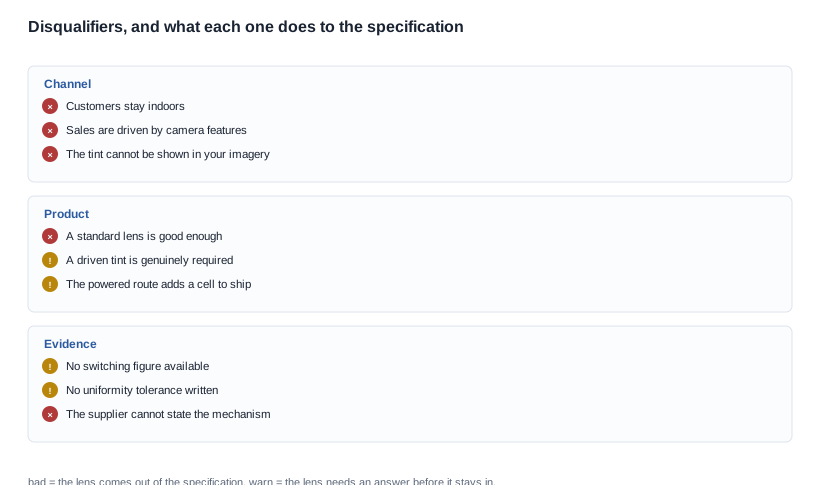
Each of the five disqualifiers below is sufficient on its own. A programme that hits any one of them should remove the lens from the specification and reconsider the requirement from the start, because the requirement that produced the lens was probably stated in terms of a feature rather than in terms of a problem.
The channel spends the day indoors
This is the most common disqualifier and the one most often overlooked, because the buyer hears "outdoor" in the product brief and stops asking. The question to put to the channel is not whether the product is used outdoors at all, but how much of a typical shift is spent in conditions where a reactive lens would change. Retail, hospitality, warehousing, indoor inspection, education and most field service work are dominated by artificial or filtered light.
Where the answer is that outdoor use is a small fraction, the lens adds cost, adds a measurement requirement and adds a documentation scope to a product whose channel will never see the feature. That combination is not worth any amount of premium positioning.
The tint is not what sells the product
The second disqualifier is about where the revenue comes from. If the channel buys your product for its camera, its AI features, its audio or its battery endurance, then the lens is an addition to a product the channel has already decided to buy, and it is being paid for twice: once in the unit price, and once in the attention it takes to explain and evidence something the customer was not asking for.
The test is whether the tint can be named in the first line of the listing. If the honest answer is that the customer would have to read the third paragraph before discovering why the product costs more, then the lens is not the reason the purchase happens, and the premium is being spent on the wrong line of the page.
The evidence cannot be produced
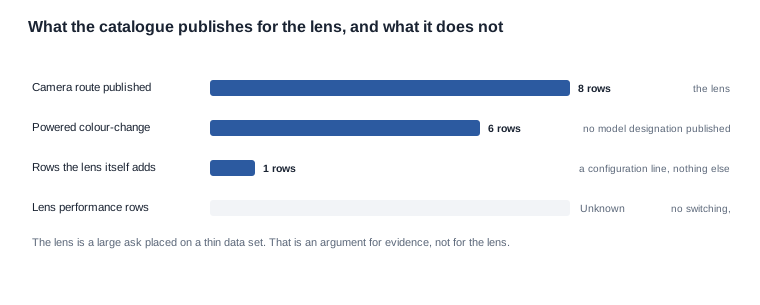
The third disqualifier is the one that most often turns out to be decisive, and it is a fact about the category rather than about your programme. Our catalogue publishes no photochromic performance figure for any model in the range: no switching time, no transmission range in either state, no uniformity tolerance, no temperature range, no cycle life and no coating specification. We publish the lens as a configuration and a lens technology, and nothing that would let you write a defensible claim about it.
If your channel cannot produce the evidence — because the supplier will not provide it, or because providing it costs money the programme cannot carry — then the feature cannot be claimed, and a feature that cannot be claimed is a feature that cannot be sold. The alternative, which is worse, is a listing that carries a claim the customer will test and fail.
The market has no way to show the feature
A product page, a demonstration video and a sales conversation all have to be able to show the feature, and the light environment in which the feature appears is not the light environment in which your content is made. This is a common and expensive discovery: the feature works, the claim is accurate, and there is no practical way to photograph or film it, so the money spent on the feature produces no revenue.
The check is simple and can be done before the order. Take one sample, put it in the strongest available daylight, and try to produce the image you would need. If the answer is that the demonstration is not possible in your content production setup, the feature is a cost.
The programme is too small to carry the configuration cost
The fifth disqualifier is arithmetic rather than behavioural. A colour-change lens is not one new SKU; it is one new configuration on every colourway, in every market, in every lens-bearing variant. Each of those carries its own artwork, labelling set, sample approval, documentation line and minimum order quantity. A programme too small to spread the per-configuration cost across enough units will find that the lens alone has doubled the setup cost of the launch.
The threshold here is not a minimum order quantity but a ratio: if the per-configuration cost is a significant share of the total programme cost, and the units per configuration are small, the lens is uneconomic at that scale. That calculation belongs before the quotation, not after it.
The disqualifier that is hardest to admit
One disqualifier never appears in a requirement document and it is the most common reason a colour-change lens ends up on a programme: a competitor has one. The channel asked for the feature because a competing product page mentions it, not because a customer asked for it.
Treating this honestly takes a specific step. Write down what the feature would be worth if the competitor did not have it, and compare that answer with the four questions above. If the value disappears when the competitor is removed from the comparison, the feature is defensive rather than commercial, and defensive features are evaluated on a different basis: how little you can spend to be present, not how much you can justify to spend.
That basis still has a threshold. The cheapest defensible position is usually not the full driven route with a full measurement programme; it is the passive route, or the standard build with an accurate listing that does not claim a feature the competitor has. The negotiating content follows from this, and it belongs in the request for quotation rather than in a later negotiation: a quotation for the configuration without the lens, alongside the quotation for the configuration with it, both at your volume and both with the documentation scope stated.

The two catalogue routes and the case for dropping both
The camera route with a lens configuration
Our catalogue publishes a camera platform whose lens appears as a configuration alongside a defined set of rows: an 8 MP sensor, a 220 mAh cell, a rated runtime of 5–8 hours, Type-C charging, charging in two hours or less, flexible temples, three published colour options, and the colour-change lens as a configuration rather than as a standard build. What that platform does not publish is any lens figure at all.
The commercial reading is straightforward. The lens here is an option on an existing platform, which means the platform's own economics — the unit price, the setup amortisation, the platform documentation — are already committed, and the lens adds to them rather than replacing them. A buyer who chooses this route is choosing to add a feature to a product it already sells.
The dedicated colour-change entry
The second route is a product in its own right, and the catalogue publishes a short set of rows for it: the lens technology described as electrochromic, Bluetooth V5.4, a 100 mAh cell, charging in two hours or less, a rated runtime of about seven hours, and magnetic charging. What the catalogue does not publish for it is a model designation.
The absence of a model designation is the most commercially significant row in this category, because a product without a formal identifier cannot be listed on a certificate as it stands, cannot be correctly packaged against a named model, and cannot be correctly described at customs. Fixing one is a condition of the order rather than an administrative detail, and it is a condition worth testing before the deposit rather than after.
What each route commits you to
The camera route commits you to a platform programme with an optional feature, which suits a buyer who already sells the platform and wants to extend it. The dedicated route commits you to a product whose specification is largely unpublished, which suits a buyer who wants a colour-change product as the proposition rather than as an accessory to a broader one.
Neither commitment is wrong. Both are commitments, and the disqualifiers above have to be tested against the route you would choose rather than against the category in the abstract.

What changes when the lens stays out of the specification
What the product looks like without the lens
Dropping the lens is not a cost-cutting exercise; it is a specification decision with consequences in five places, and it is worth understanding all five before it is made.
The bill of materials loses the reactive element, its coating and, on the driven route, the driver circuit, the control path, the firmware function, the charging arrangement and the cell. The documentation scope loses the lens specification and any optical description that refers to it. The artwork loses the lens demonstration, and with it a round of review. The sample and the acceptance criteria lose the lens tests. And the claim set loses whatever was going to be said about the light response.
That last one is worth a moment, because it is where a channel sometimes loses more than it expects. If the listing copy was written around the lens, removing the lens is a rewrite, not a deletion. A buyer who realises this after the copy is written has paid twice.
The cost that stays and the cost that disappears
The cost that disappears is the lens-related cost: the element, the coating, the electronics on the driven route, and the per-configuration documentation associated with the lens. The cost that stays is the platform: the cell, the charging interface, the rated runtime, the sensor, the case, the packaging, the freight, the platform documentation and the aftersales process. On the camera route, removing the lens leaves an 8 MP platform with a 220 mAh cell, a 5–8 hour rated runtime and Type-C charging, which is a normal product with normal economics.
The reason this matters is that the saving is often smaller than the buyer expects, because the per-configuration cost was never the biggest number and the platform cost was never on the negotiation table. What the lens adds is not a percentage of the unit price; it is a set of fixed costs spread across the units per configuration, and the arithmetic changes with volume.
What stays on the change-control list
Removing the lens from the specification does not remove it from the change-control list, because the frame, the camera path and the packaging were all designed around the possibility of the lens. The seat geometry, the coating specification on the camera path, the packaging drop and the label layout all retain the assumption. A programme that drops the lens and later wants it back will find a re-qualification cycle waiting, and the honest way to handle that is to say so in the specification rather than to discover it.
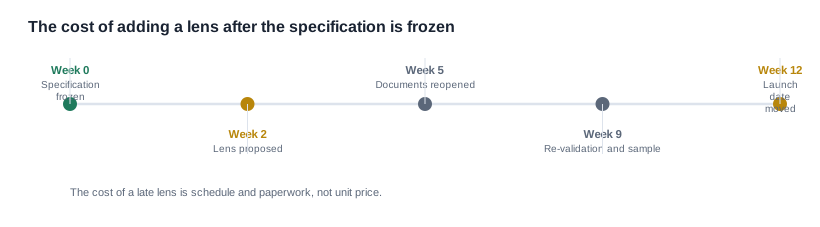
What to negotiate when the lens comes out
Dropping the lens is a negotiation with the supplier and, often, with your own channel, and it has a specific commercial shape. The supplier's position will usually be that the quotation was prepared on the assumption of the lens configuration, so the pricing, the minimum order quantity and the documentation scope were all set with it. The counter is straightforward and mostly factual: request a quotation for the configuration without the lens at the same volume and the same configuration count, and compare.
What changes in the terms. The unit price moves, and the price tier structure may move with it. The minimum order quantity per configuration usually falls, because the per-configuration cost of a lens-bearing build is higher. The tooling position needs checking rather than assuming: if the lens required a specific seat, a specific coating or a specific fixture, some of that setup may already be committed, and a supplier who absorbs it rather than invoicing it is making a commercial decision that belongs in the agreement rather than in goodwill.
What does not change is the platform commitment, and the warranty position has to be renegotiated deliberately. A warranty written around a reactive element's failure modes does not survive the removal of the element, and a warranty that has not been rewritten will be interpreted by whoever handles the first claim. It is worth asking the supplier for the revised warranty basis in writing at the same time as the revised quotation, so that the agreement and the specification arrive together.
The change-control clause matters more than any of them. A configuration change notice obligation, with a re-issue of the documentation package attached, is the clause that protects you when the lens comes back eighteen months later and the supplier's memory of the original programme has faded.
Where the real requirement behind the lens request is something else — where the channel actually wants audio, or camera endurance, or a camera in a headset at all — the more efficient answer is to specify that requirement directly. The open-ear audio route is a separate category with its own economics, and the camera platform route is covered at AI camera glasses.
Deciding with the information the catalogue actually holds
The four questions that settle it
Put these four to whoever requested the lens, in order, and the decision is usually made within one meeting.
- What problem does the lens solve that the standard product does not? A problem, not a feature. If the answer names a capability, the lens is a preference rather than a requirement and should be tested against the cost.
- In what proportion of a working week would the change be visible to the customer? If the answer is small, or if the answer is that the channel's customers are not the people who would see it, the feature has no route to revenue.
- Who produces the evidence, and at what cost? A claim needs a measured figure with its conditions. If nobody owns the measurement, the claim does not ship and the lens does not sell.
- What does the lens do to the configuration count? Multiply it by the colourways and the markets. If the result does not survive the per-configuration cost, the answer is in the arithmetic rather than in the negotiation.
What we can answer from the catalogue
It is worth being precise: we publish the rows we hold and mark the rest as open, and the most useful thing we can do for a buyer who is deciding whether to include this feature is to be blunt about what is not available.
For the camera platform with the colour-change lens configuration we publish the sensor class, the charging interface, the cell capacity, the rated runtime, the charging time, the temple design, the published colour options and the lens configuration itself. For the dedicated colour-change entry we publish the lens technology, the Bluetooth version, the cell capacity, the charging time, the rated runtime, the charging interface, and the absence of a model designation. We do not publish switching times, transmission ranges, uniformity tolerances, temperature ranges, cycle life figures, coating specifications, lens model designations, unit prices or availability dates for any model in this range, and we would rather say that than quote a figure you cannot verify.
The mechanism behind the two routes is set out in how photochromic smart glasses work, the measurement protocol that would close any of the open rows is in how to measure photochromic smart glasses, and the scenario-by-scenario requirement differences are in photochromic smart glasses for different use cases. The category background sits under photochromic lens technology.
If you are still deciding, send us the channel, the working environment and the configuration count, and we will tell you which of the four questions we can answer from published rows and which ones have to be tested on a sample.


