

Quality control on a photochromic product is structurally different from quality control elsewhere in the range, because the acceptance criteria do not exist in any published document. Our catalogue entry publishes Bluetooth 5.4, a 100 mAh battery, a charge time of two hours or less, about seven hours runtime and magnetic charging — and nothing at all about the lens.
That makes photochromic smart glasses quality control an exercise in establishing criteria first and then enforcing them, in that order. Enforcing criteria that were never agreed is how a programme ends up rejecting good lenses and accepting bad ones, and because the whole category runs this way, a buyer who treats the missing data as a reason to skip the criteria stage ends up with the weakest inspection position available.
The published position is worth restating because it shapes every stage below. There is no model designation for the electrochromic entry, no switching time, no transmission range, no temperature behaviour, no uniformity figure, no cycle durability and no coating detail. There is also no second light-responsive platform with published lens data to compare a lot against, because the V03 Pro carries a photochromic lens configuration and no lens figure of its own, so there is no peer to arbitrate a disagreement. Every reference the inspection process needs has to be created by the buyer.

The photochromic smart glasses quality control problem starts before the criteria exist
Why enforcing unwritten criteria is worse than having none
The instinct in a category with thin published data is to inspect "to the sample" — to hold the approved unit up and call anything that does not match it a defect. The problem is that "match the sample" is not a criterion, and the moment a disagreement arises it is a disagreement about which of two unstated things is the reference.
The three failure modes of an unwritten criterion are predictable. The first is false rejection: a lot is rejected for a difference that the criterion would have permitted, and the cost of that rejection is a schedule, a re-order and a supplier relationship. The second is false acceptance: a lot is accepted because it looked the same as the sample on a centre reading, and the failure surfaces in the field three months later. The third is unresolvable disagreement: the buyer and the supplier each believe the other has changed the specification, and neither can produce it, so the dispute runs until somebody concedes.
All three are avoided by the same action, and it is cheap: write the criterion down, attach the conditions, and agree it before the first unit is produced. In a category with no standard, that written document is the standard.
The weaker position you are in when nothing is published
The buyer's inspection position is weaker here than in almost any other category, and it is worth being clear about the nature of the weakness so that the right requests are made of a supplier.
A buyer with a published specification inspects against a document that describes every product in the market, so a reading can be compared with the market, a non-conformance can be escalated, and a supplier's refusal can be tested against an external reference. Here, the buyer inspects against criteria the manufacturer provides plus an approved reference unit the buyer retains. The manufacturer's figure is a statement of intent, and the reference unit is a single article.
That position is weaker in three specific ways, and each one produces a specific request. Because the manufacturer's figures are the only external reference, the buyer needs the conditions attached to every one of them. Because the reference is a single unit, the buyer needs a grid and a tolerance rather than a spot reading. And because there is no peer product, the buyer needs the tolerance written by itself rather than inferred from a market convention — which means the criteria request is not a formality to be delegated to the supplier, it is the work.

The five criteria that have to be written before inspection can run
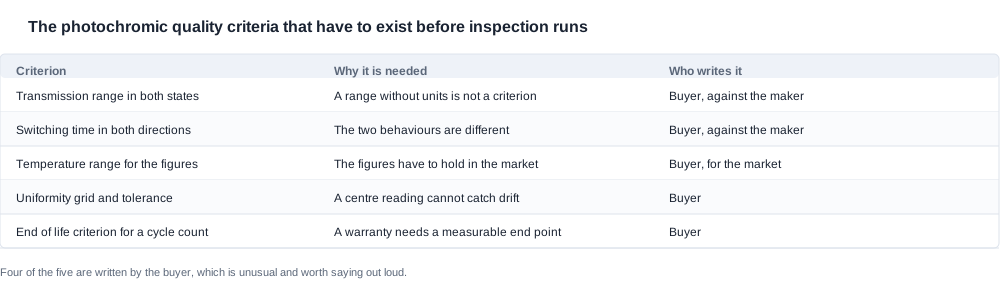
These five are the minimum set, and the third column matters more than it looks: four of the five are written by the buyer, which is unusual in manufacturing and worth saying out loud before the programme starts.
| Criterion | Why it is needed | Who writes it |
|---|---|---|
| Transmission range in both states | A range without units is not a criterion | Buyer, against the manufacturer's method |
| Switching time in both directions | Darkening and clearing are different behaviours | Buyer, against the manufacturer's method |
| Temperature range for those figures | The figures have to hold in the market the buyer sells into | Buyer, for the market |
| Uniformity grid and tolerance | A centre reading cannot catch drift | Buyer |
| End of life criterion for a cycle count | A durability warranty needs a measurable end point | Buyer |
The transmission range and why the units decide whether it is a criterion
The first criterion is the transmission range, and it is where most criteria requests fail. "What is the range?" is a question with a hundred answers, because a range without units is not a criterion at all — it is a sentence.
What has to be specified is a pair of figures in a stated unit, one in the clear state and one in the darkened state, with the measurement method attached. The pair together describes the range the lens actually works across, and the pair has to include the clear state, because a supplier quoting only the darkened figure has quoted the part that looks best on a beach. The buyer's own criterion should also state the tolerance around each figure, because a range with no tolerance is a centre point rather than a range.
The two switching times and the temperature the figures have to hold at
The second criterion is the switching time, and it has to be two figures rather than one, because darkening and clearing are separate behaviours. Each figure needs four conditions: the direction of travel, the initiating light level, the ending light level and the temperature.
The third criterion is the temperature range over which the stated figures hold. This is the one most often omitted, and it is the one that decides whether the product works in the market the buyer is selling into. A criterion written at room temperature is a criterion that has been tested in the easiest conditions available. If the channel sells into markets with cold winters, the criterion has to hold at the temperature the customer will experience, and the acceptance test has to include a cold run.
The uniformity grid and the end of life criterion
The fourth criterion is the uniformity tolerance, and it requires three things to be written: the grid, the viewing geometry and the maximum permitted difference between zones. A centre reading cannot catch the failure that this criterion exists to catch, because users notice edge-to-centre variation before they notice an average, and a lot can be within a good average and visibly banded.
The fifth criterion is the end of life definition for a cycle count. A cycle count without a failure criterion is not a test, and the criterion has to answer one specific question: at what transmission level is the lens considered failed. Without that answer, a durability warranty has no measurable end point and the first claim under it cannot be settled. It is worth writing that question into the criteria request verbatim, because a supplier who answers it has a warranty in mind and a supplier who does not has a marketing figure.

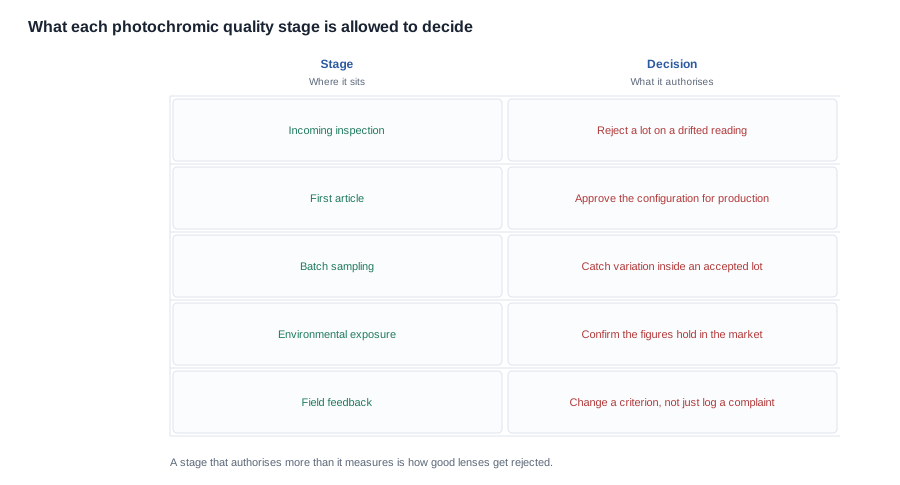
The five stages and what each stage is allowed to decide
Incoming inspection against a retained reference unit
Once the criteria exist, incoming inspection is straightforward in principle — check the transmission at a stated state and record it — and the value is catching lot-to-lot variation, which is normal in any optical production and becomes a problem when it is invisible.
In practice the reference is the retained approved unit, and that makes the handling of the reference part of the criterion. It needs a storage condition, a charging routine, a periodic re-check, and a rule for what happens if the reference itself drifts. A reference unit that has been handled differently from the units it is used to judge is a second source of false rejections, and the buyer who has not written a handling rule for the reference will eventually argue about the reference rather than about the product.
The first article is one unit, and it is not a sample
The first article should be assessed against the full behaviour in both directions, not a spot measurement. A spot reading confirms that the unit functions; a full assessment confirms that the unit functions the way the criteria describe.
The first article is also a single unit, and this is where most quality processes overreach. It is evidence that the process can produce a conforming unit. It is not evidence about lot behaviour, and a buyer who treats the first article as a sample will discover the difference at the worst possible moment, which is when the first complaint arrives.
What the buyer's own inspection team has to be able to do
The inspection is usually run by the buyer's team, and in this category the team is doing something it does not do elsewhere: it is the only party in the chain that holds a written criterion. That changes what the team has to be able to do, and it is worth spelling the capability out because it is often assumed rather than built.
Conditioning. The team has to bring a unit to a known state before reading it — charged to a known level, held at a known temperature, and observed from a known direction. Two inspectors who condition differently will produce two sets of numbers, and the argument that follows will be about the inspection rather than about the product.
Grid reading. The team has to read on the agreed grid rather than at the centre, because the centre reading cannot detect the variation the criterion exists to catch. In practice this is a fixture and a light source more than it is a skill, and the fixture is usually the thing that has to be bought.
Reference handling. The retained reference unit needs a storage condition, a charging routine, a periodic re-check and a rule for what happens if it drifts. Without that rule, a drifting reference becomes a new source of false rejections, and the argument about the reference replaces the argument about the lot.
Recording. Every reading has to be recorded with its conditions, because a reading without them cannot be compared with a reading taken three months later during a dispute. A log that records only the value is worthless as evidence and is expensive to maintain, because it appears to be evidence.
Escalation. The team has to know the difference between a reading outside the criterion and a reading that cannot be taken at all, and it has to know which of the two is a supplier conversation and which is an internal investigation. A missing reading is not a non-conformance, and treating it as one is how a good relationship ends.
None of these capabilities is difficult. All of them are absent by default, because in a category with a published specification none of them is needed — the number is on the datasheet, the grid is the manufacturer's, and the reference is the specification. The effort is the price of doing inspection in a category with no published performance data, and it is worth naming it before a buyer commits to a programme rather than after.
Batch sampling for drift inside a lot
Batch sampling catches drift within a lot, and drift is the failure mode that produces the customer complaint three months after a good first article. The two are related rather than separate: a first article is drawn from the beginning of production and a batch sample is drawn from within it, so a lot can begin conforming and end not conforming.
Sampling in this category is harder than it looks, because a unit has to be brought to a known state before it can be read — charged, held at a known temperature, and observed in a known direction. The sampling plan therefore has to specify the conditioning as well as the size, otherwise two inspectors will produce two sets of numbers and neither will be comparable.

Sampling, drift and the complaint that arrives three months later
Why the first article misses the failure that matters
The reason a good first article can coexist with a bad field complaint is that the failure is not in the unit that was inspected. It is in the units that were not, and in the conditions that were not reproduced. Three specific gaps account for most of it.
Drift within the lot. The units at the end of a production run behave differently from the units at the beginning, and only the beginning was inspected. This is the single most common cause.
Conditioning. A unit read at room temperature tells the buyer nothing about a unit that will be read in a cold market. If the criteria were written at one temperature and the product ships into another, the first complaint arrives from the cold market and the reading is worthless.
The unrecorded configuration. A unit built with a different lens module, a different cell or a different firmware build passes the same inspection and behaves differently. This is why a change-control list and a notice obligation are quality control instruments, not just paperwork.
Choosing a sample size as a commercial decision
Sample size is a commercial decision, and it is worth treating as one. Small samples catch gross failures — a unit that does not respond at all, a unit with an obvious defect. Large samples catch drift, which is the failure that actually costs money in the field. A buyer who sizes the sample to catch gross failures will have a programme that passes inspection and generates complaints.
The trade-off is direct and quantifiable in the buyer's own terms, even though the numbers belong to the buyer rather than to the manufacturer. A large sample costs inspection time and delays the release of the lot; a small sample releases the lot faster and moves the cost into the field, where it is paid in returns, in support time and in review scores. The right answer depends on the channel's tolerance for a field failure, and it is a question about the buyer's business rather than about the product.
The instruction that follows is simple: sample nothing but the first article, and rely on the first article, is not available as a strategy. The first article is one unit.
Environmental exposure and the temperature extremes
This is where photochromic products most often differ from expectations. Electrochromic behaviour is temperature-dependent, and a lens that performs correctly at room temperature may behave differently in a parked car in summer or outdoors in winter.
If the channel sells into markets with temperature extremes, add heat and cold cycling to the acceptance criteria before production rather than discovering the behaviour from returns. The condition of the test matters as much as its existence: a lens that has been in a hot car for an hour and a lens that has been moved from a cold store into a warm room are two different thermal histories, and only one of them resembles a customer's day.
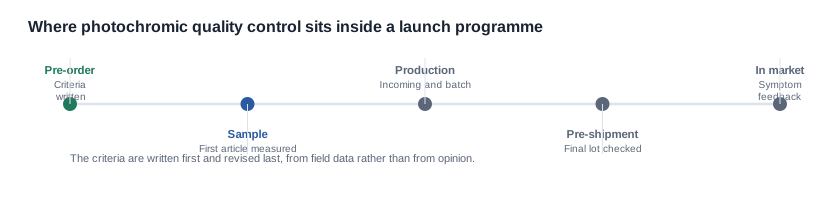
The field feedback loop that changes a criterion rather than just logging it
Categorising returns by symptom rather than by fault
Returns from a photochromic product should be categorised by symptom rather than by fault, because the symptom is what the customer reports: it does not darken, it darkens too slowly, it does not clear, it cleared and stayed dark, the colour is wrong, the product was fine until the battery was flat.
Each category points at a different cause, and none of them is visible to a customer service team without guidance. A symptom sheet converts a free-text complaint into a countable category, and a countable category is the only form in which a trend can be seen.
The categorisation sheet that beats a free-text returns form
A short categorisation sheet sent with the returns instructions will produce far better data than a free-text returns form, and it costs one page. The sheet needs five things: the symptom categories, the conditions the customer was in, the state of the battery, a request for photographs, and the model's serial number. The last two matter more than they look, because a photograph of the lens state is the closest thing to a measurement that a customer can supply, and a serial number is the only way to tie a complaint to a build.
The one thing worth insisting on is that the categorisation feeds back into the criteria. Otherwise the same complaint accumulates for a year while the process diligently records it and changes nothing. A quality process that only counts complaints is an archive, and the distinction between an archive and a control system is whether a number changes when a pattern appears.
What we publish, and what a criteria request should say
The short answer: we will not publish a lens performance figure, an acceptance criterion or a durability figure for the electrochromic entry, because none is published to us, and we will not invent one. A plausible-looking number in a lens product becomes a claim on a product page, and a claim that the inspection cannot reproduce becomes a dispute.
What we can do is tell you which criteria have to exist before quality control can run, and help you write the request to the manufacturer that asks for them. The request should ask, in this order: the transmission range in both states with its units and method, the two switching times with their four conditions, the temperature range over which those figures hold, the uniformity grid and tolerance, the end of life criterion for a cycle count, and the flat-battery lens state. If a manufacturer cannot supply a transmission range or a cycle end point, that is a finding about the product's readiness for a controlled programme rather than a gap in the request.
On the commercial side, the criteria and the inspection protocol are negotiable documents, and a supplier willing to sign the buyer's protocol is agreeing to be measured against the buyer's own threshold. Minimum order quantity, the number of configurations, the packaging and insert design, the artwork round count and the payment node structure are ordinary negotiation points. What is not negotiable is the cost and the elapsed time of a conformity route, the amortisation of tooling, or the existence of the criteria themselves.
The background is under photochromic lens technology, the mechanism is under photochromic lens technology, and the return-handling process sits with our after-sales support and quality claims team.
Tell us your market and your acceptance needs and we will help you write the criteria request.
Related reading
- Photochromic lens technology
- Photochromic manufacturer claims
- After-sales support and quality claims
Tell us your market and acceptance needs and we will help you write the criteria request.


