

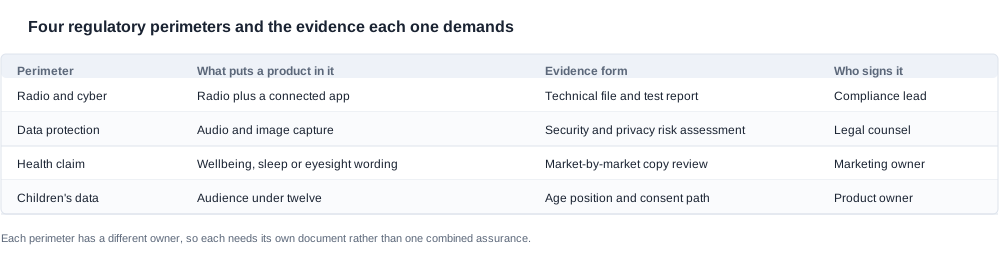
A voice assistant on a camera-equipped pair of glasses reaches into a regulatory system that the hardware alone would never enter. The radio already qualifies. The cell already has a transport test summary. What changes when the microphone starts transcribing, the camera starts uploading, and a language model starts answering is that the product begins handling personal data it did not create, and the obligations follow the data rather than the device. So smart glasses ai features smart glasses how regulations affect this is best answered as four boundaries that a feature has to respect, each with a different owner and a different document behind it. Get those four right and the AI feature stops being a marketing liability and becomes a specifiable feature. Get them wrong and the product is compliant as hardware and non-compliant as software, which is the hardest position to defend.
Smart glasses ai features: what a reviewer opens
The buyer behind this question
The reader here is usually a brand-side product manager with a compliance lead next to them, or a channel buyer who has been asked to clear a product for a market they have not sold into before. Both are holding a specification that says "AI voice assistant" and neither can turn it into a file. The question they bring is not technical. It is: what do I have to produce, and in what order, and who in my organisation owns each piece?
What they fear most is discovering the obligation late. A radio issue is visible early because it sits on the hardware schedule. A data issue arrives after the artwork is approved, because it depends on what the service does with a recording rather than on what the device contains. A claim issue arrives last of all, when a listing is live and a marketplace review or a customer complaint has already been made.
There is a second fear that shapes the whole conversation. Buyers in this category have been handed specifications by suppliers who treated the AI feature as a line item, and they have learned that a capability description is not a specification. The useful service a factory can offer is therefore not a compliance guarantee. It is an accurate map of what exists, what is blank, and what has to come from the platform owner. When a buyer asks which model to sign off for a compliance-led launch, the honest answer is that the model choice is secondary to the four answers below, and a supplier who leads with the model is answering a different question than the one that was asked.
Why the AI layer changes the weight of the file
A connected wearable already sits inside several regulatory frames before any AI capability is added. Radio equipment in the European Union is covered by the Radio Equipment Directive (EU) 2014/53/EU, whose cited harmonised standards including EN 18031 address the cybersecurity requirements for radio equipment. General market safety obligations arrive through the General Product Safety Regulation (EU) 2023/988, which applied from 13 December 2024 and layers on top of sector rules rather than replacing them. A cell travelling across a border needs a UN 38.3 test summary. Substance declarations for materials reach the market under the RoHS and REACH regimes.
All of those are hardware-shaped. They are answered by a test report, a declaration of conformity and a material file, and a factory can usually produce all three because the factory controls the bill of materials.
The AI layer is not hardware-shaped. A feature described as "AI voice interaction" implies, whether or not the catalogue says so, that audio leaves the frame. It implies a subscription or an account. It implies a language set, an accuracy position, a data path and a jurisdiction. None of those is in the factory's control, and all of them change what has to appear in the file. The practical consequence is that the AI feature multiplies the number of documents a launch depends on, while adding no new hardware to the factory's own test regime.
That is also why an AI feature that is treated as a feature — a line in a specification, a phrase in a listing — creates disproportionate risk. The hardware work has a natural owner. The software work has four.

The radio and cyber boundary a connected pair of glasses creates
What the radio framework and its cited standards ask for
Once a pair of glasses carries a radio and a connected application, it is a radio product and a connected product, and the file has to cover both. In the European Union that means conformity assessment against the Radio Equipment Directive, with the cybersecurity requirements addressed through the harmonised standards cited into it, and EN 18031 is the part a buyer will encounter most often because it is where software integrity, update mechanisms and data handling enter the picture.
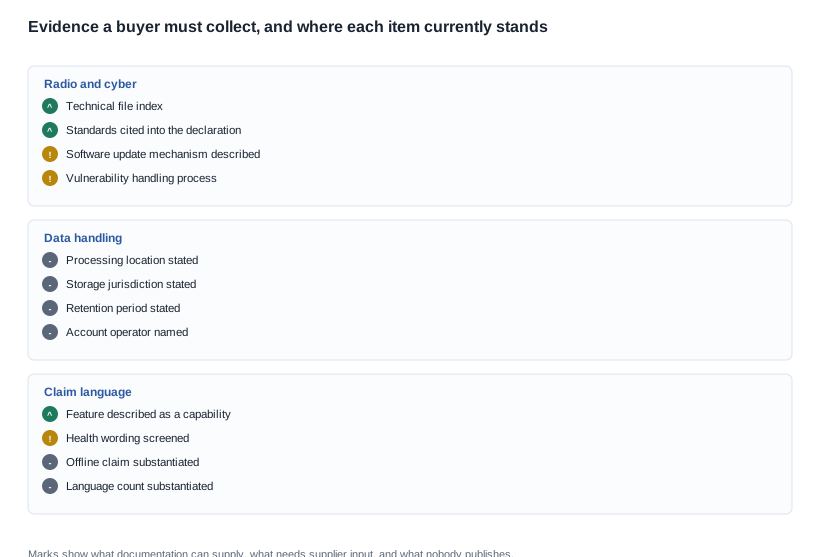
For an AI feature specifically, three items matter more than the rest, and a buyer should be able to name all three in a supplier questionnaire. The first is the software update mechanism: what is delivered, over which channel, signed in what way, and how a customer receives it. The second is the vulnerability handling process: how a security issue in the radio stack or the application is reported, tracked and communicated to the user. The third is the data the device holds or transmits, which is where the radio file and the data protection file meet.
For the United States, the Federal Communications Commission framework applies to the radio equipment itself, and the equivalent conformity routes apply in other markets. The commercial consequence for a buyer is that the radio evidence is per-model and per-market, so a variant that adds an application or a different module can require its own assessment.
What a radio file cannot settle
Here is the trap. A complete radio file can make a product lawful to place on a market, and the buyer still cannot answer the questions that an AI feature raises. The radio file settles the behaviour of the transmitter. It does not settle what the application does with a recording, where the recording is processed, who operates the service, how long it is retained, or what happens when the subscription lapses.
There is a second limit that catches people out. A technical file for radio equipment documents the product as it is shipped. If the application on that product changes behaviour after launch — a new model, a new data destination, a new consent flow — the file describes a product that no longer exists in the field. This is why a notice period for behaviour-changing updates is a compliance control and not only a commercial nicety.
The third limit is organisational. The radio file is assembled by an engineering and quality function. The AI answers come from a platform owner, a legal function and a marketing function. If a launch plan assumes one team can assemble all of it, the plan is wrong before it starts.
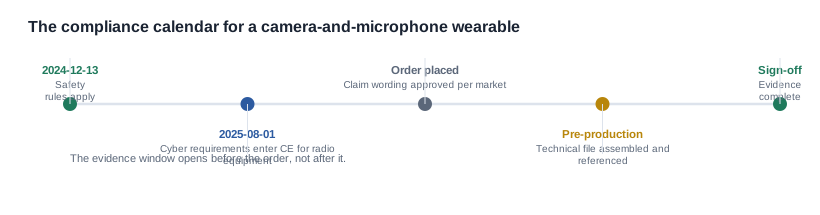
The calendar above is the useful part of this discussion for a buyer, because it shows when the evidence window opens. It opens before the order is placed, not after it, and it closes at sign-off rather than at shipment. A plan that treats the radio evidence as a precondition of shipping and the AI evidence as a by-product of the launch has the order of the two backwards.
The data boundary, which the microphone decides before the features do
The questions a data protection review opens
A microphone in a wearable is a data-processing device in the legal sense, and the questions that follow are standard: what is collected, on what lawful basis, where it is processed and stored, how long it is retained, what the user's rights are, and whether the flow is documented for the review. A camera adds image data, which typically carries a higher sensitivity expectation than audio.
For a buyer in this category, the review usually opens with three questions. Does the audio leave the device, and if it does, to which operator and in which jurisdiction. Is there an account, and what does the account identifier or the sign-up metadata reveal. Is there a retention period, and can the end user delete what has been stored.
These are not questions about the glasses. They are questions about a service, and the honest answer usually is that the service is owned by somebody else. That is entirely normal in this category — a brand buying a white-label product with a third-party assistant is buying a dependency — but it has to be documented as a dependency, in a technical file, with a named owner.
Why the answer has to come from the service
The reason this cannot be resolved from a datasheet is that the same hardware behaves differently under two different service arrangements. Identical firmware and identical optics can produce a completely different compliance position depending on whether inference runs on the phone, in a regional server, or on a device endpoint that the brand controls. The factory can tell you what the processor is capable of. It cannot tell you what the platform owner decided to do with it.
There is a practical consequence for procurement. The buyer should treat the data path as a condition of purchase rather than as a line to be confirmed later. A product whose data path is written down can be put into a file; a product whose data path is a blank cannot, and a blank in a regulatory file is a different kind of object from a blank in a specification sheet. It blocks.

The same reasoning applies to the retention question and to the deletion question. Neither can be inferred from the hardware, and both are the questions a data protection review will ask first because they are the ones with an answer in the product's own behaviour.

The claim boundary that catches listing copy by accident
Health, hearing and the line drawn at 21 CFR 800.30
Of the four boundaries, this is the one that is crossed by accident rather than by design. It happens in a headline, in a sub-heading, or in a translated listing page written by someone who was given a feature list and asked to make it sound valuable.
The medical and health claim boundary in this category is sharp. The guidance on bone conduction products not being sold as over-the-counter hearing aids in the United States under the air conduction definition at 21 CFR 800.30 shows how precisely these lines are drawn. A product that captures and processes sound is not thereby a hearing aid, and a product that describes itself as monitoring wellbeing, sleep, focus or eye strain is not thereby a wellness feature. In some markets that description moves the product into a regulated claim territory.
The vocabulary that creates the crossing is well defined, and it is worth giving a copywriter the list rather than a principle. The verbs are monitoring, detecting, diagnosing, measuring and protecting. The objects are sleep, hearing, eyesight, stress and blood pressure. The qualifiers are clinical, medical, therapeutic and protective. A phrase such as "protects your eyes from screen fatigue" contains an object, a claim and a benefit, and in most markets that combination is enough to trigger a regulatory question about a product that has no such evidence behind it.
A wording test a copywriter can run without a lawyer
There is a practical test that runs before a legal review and catches most of the accidental crossings. For every claim in the listing, ask three questions in order. Does the claim describe what the hardware does, or what the hardware achieves. Does it name a body function, a health outcome or a clinical effect. Does it imply a benefit to the user that is not measured.
A claim that passes all three — describes the hardware, names no body function, implies no unmeasured benefit — is a claim about capability. That is the category the catalogue in this range occupies: an AI voice assistant as a key technology, and AI translation noted on the K01 as an observation from our own independent site rather than as a published specification.
The reverse test is applied to the supplier's language as well. If a proposal describes the feature as providing "always accurate" translation or "seamless" recognition, those are claims, not descriptions, and they need the substantiation that the sections below describe.

Turning four boundaries into a supplier request and a contract clause
What to ask for, and in what order
The questions to ask a supplier are short, and the order matters more than the list. A buyer who sends twenty questions at once gets twenty answers in the order the supplier finds convenient. A buyer who sends four, in sequence, gets four answers in the order they unblock the next decision.
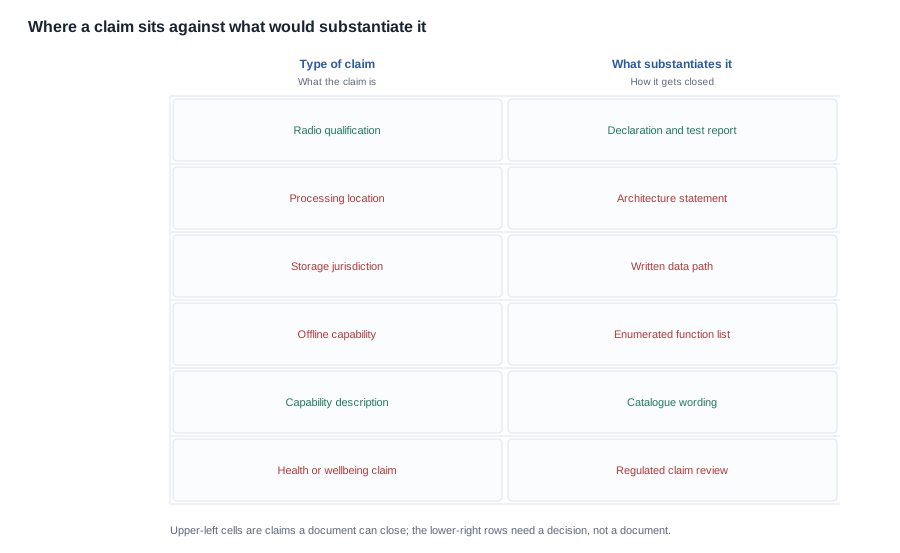
Before you order, it is worth setting the evaluation criteria for the answers themselves, because the answers arrive in three shapes. A document closes a question. A commitment closes a question for a period. A description does not close anything, and the most common pitfall in this category is treating a description as a commitment because it arrived in the same document as two others that were.
First: does the feature process data on the device, on the phone, or in a named service. This single answer determines the data position, the connectivity requirement, the latency expectation and the recurring cost. It is also the answer that is almost never printed, and it is the one everything else depends on.
Second: where is the data processed and stored, and in which jurisdiction, with what retention period and what deletion path. This is a document request rather than a question, because a verbal answer to a jurisdiction question is worth nothing in a file.
Third: is the feature, or any part of it, a medical or health claim in any market where the product will be sold. If there is any doubt the answer is yes, and a yes is a longer programme than the rest of the launch combined.
Fourth: how is the cyber requirement evidenced, and what is the update and vulnerability-handling commitment behind it. The route is the cited harmonised standard in the European Union and the equivalent in each other market, and the answer is a technical file rather than a claim.
Underneath those four sit the questions that decide the commercial shape of the feature: which models are supported, whether a subscription is required, what happens when a plan lapses, who owns the application and the customer account, and what the version policy is. None of these is regulatory, and all of them are more likely than not to stop a launch than the regulatory ones.
The trade-offs are worth naming, because buyers often avoid them and then pay for them. A narrow claim survives review and sells less. A broad claim sells more and creates a compliance item that has to be discharged before launch, at a cost that is usually larger than the launch itself. The right question is not how wide the claim can be but how wide it can be and still be evidenced, and for most of these models the evidenced width is narrower than the appealing width.
How to check what arrives
The verification step is short and it is procedural. For each answer, establish what form it took. A document is a document. A slide is a slide. A sentence in an email is an email. In a regulatory file only the first category survives, and the buyer should decide in advance which answers need to arrive as documents rather than discovering this during the review.
The method for checking is the same one used elsewhere in hardware procurement, applied to a software answer: state what you expect, look at what arrived, and write down the difference. A buyer who cannot describe how to verify an answer ends up accepting the answer, and that is how an unverifiable specification becomes a contractual problem six months later.
Three checks are worth making explicitly. The first is consistency across documents: the model named in the radio file, the model named in the technical file and the model in the order should be the same model. The second is currency: a data path described in a document dated before the current firmware release describes a product that no longer ships. The third is coverage: if a question was answered only for the market where the supplier already sells, the answer does not cover the market you are launching into.
There is a fourth check that buyers skip because it feels procedural, and it is the one that catches the most. Ask the supplier to state, in writing, which of the four boundaries they do not cover. A supplier who names the gap is giving you a usable map. A supplier who answers all four vaguely has told you nothing about any of them.
The four ways this programme fails after launch
These are the recurring failures, and each of them has a symptom that appears in a different department from the one that caused it.
The radio file describes the hardware but the launch adds a service. The symptom is a technical file that no longer matches the product in the field. The root cause is that the application was added after the file was assembled. The prevention is a change-control trigger tied to the application, not only to the hardware.
The data path was assumed rather than documented. The symptom is a procurement or compliance review that stalls weeks before launch. The root cause is that the answer was in an email from a sales contact rather than in a document from the platform owner. The prevention is to treat the data path as a purchase-order condition.
The claim crosses the health line in a translated listing. The symptom is a complaint framed as a safety issue, or a marketplace query. The root cause is that a localised listing was written from a feature list rather than from the approved wording. The prevention is a single approved claim set per market, with the localised copy checked against it.
The children position was inferred from the model. The symptom is a market enquiry about age suitability that nobody can answer. The root cause is that the certification position for the children's tier is not published to us, and a question of that kind was answered by assumption. The prevention is to mark it open and ask the supplier in writing rather than filling the row.
Where the request becomes a negotiable term
Certification cost and certification lead time are not commercial levers. The fee is per product family, the elapsed time is set by the test laboratory and its queue, and a buyer who negotiates hard on that line gains nothing and loses credibility. The same is true of the regulatory treatment itself, which follows from the functionality and from the wording rather than from the price.
What is genuinely negotiable is the evidence package. Whether the supplier funds a second evaluation round on the AI feature if the first one fails the acceptance criteria. Whether the documentation pack is delivered in the buyer's own format rather than the supplier's. Whether the platform owner will sign a data-processing position naming the jurisdiction and the retention period. Whether notice is given before a firmware or model change that alters the assistant's behaviour, and over what period. Whether the app can be rebranded for a channel that operates in more than one market. Whether a unit of the pilot tier can be retained against the run tier as a live reference rather than a display piece.
How payment is arranged is a standard area: a deposit on the order, a balance at the inspection before the shipment date, and a retention held against the file rather than against units. The reason to hold the retention against documentation is that documentation is the part of this programme most likely to arrive incomplete.
A worked example, and the position we will hold
A European channel launch, step by step
This is a hypothetical scenario rather than a client project, and it is here to show the sequence rather than to describe a customer.
Assume a consumer brand that sells through two national retailers in the European Union. It has selected a camera-equipped model with an AI voice assistant from our range, and the launch date is set by the retailers' autumn catalogue deadline. The brand's compliance lead has asked for a summary of what the product requires before the listing goes live. The brand's own team has not previously sold a connected wearable.
Step one: the four boundaries, in order. The brand sends the four questions rather than twenty. The supplier's answers establish that the assistant requires a network, that the application is operated by a third party, and that the data path is described in a document the supplier can provide. The health-claim question comes back clean, because the brand's intended wording is capability wording and the supplier's documentation shows the same.
Step two: the gap that matters. The one answer that is missing is the offline behaviour — what survives with no connection. That answer determines whether the product can be sold with a network requirement in the listing, and it also determines what the support script says. The brand asks for it specifically, in writing, and gets an enumeration rather than a yes or a no.
Step three: the wording. The brand's agency drafts the listing. The draft contains a phrase describing the assistant as understanding the user accurately at all times. The brand's compliance lead removes it, not because it is false but because nothing substantiates it and the marketplace risk is asymmetric: a true claim gains a little attention, an unsubstantiated one can cost the listing.
Step four: the commercial structure. The brand puts the enumerated offline behaviour, the notice period for behaviour-changing updates and the delivery of the data-path document into the purchase order. It negotiates the retention against the documentation package and accepts that the certification fee and its lead time are fixed.
Step five: the launch. The hardware arrives on time because the hardware schedule was never at risk. The feature arrives on time because the legal review was booked in step one rather than after the artwork was approved. The listing describes the degraded state, and the first support ticket about it is answered by a script that already contains it.
The decisive step was the first one. Four ordered questions cost a week and removed a review that would otherwise have landed three weeks before launch.
What our catalogue answers and what it does not
We publish the AI capability as the catalogue states it and mark the rest as open, and we would rather a buyer removes a claim than publishes one it cannot defend.
What we publish: an AI voice assistant named as a key technology across the camera tier, and AI translation noted for the K01, recorded as an observation from our own independent site rather than as a published specification. That is where our published position stops.
What we do not publish, and will not estimate for any model in the range: the inference architecture, the offline behaviour, the language list, the latency, the accuracy, the false activation rate, the subscription status, the data-flow detail, the app operator and the data-storage jurisdiction. We also publish no per-model certification rows. The export certification on our catalogue cover is a company-level capability, and a company-level capability does not tell you that a particular model carries a particular certification, so we do not present it as though it does.
We will also not write or endorse listing copy that describes an AI feature in a way that turns it into a medical or health claim, because in this category the boundary is a legal question before it is a marketing one.
What to send us before the compliance review is booked
Send us the feature, the target markets and the channel, and we will tell you which of the four boundaries is decisive for you, which questions our documentation answers today, and which have to be settled in writing by the platform owner before a purchase order is signed. The platform background is under AI features in smart glasses, the specification reading method is in how to read a datasheet, the radio route is covered at EN 18031 cybersecurity compliance, and the claim boundary is at medical boundary compliance.
Related reading
- AI features technology
- AI features datasheet reading method
- EN 18031 cybersecurity compliance
- Medical boundary compliance
- AI feature documentation obligations
- Supplier verification method
Tell us the feature, the markets and the channel and we will say which boundaries are decisive for you.


