

Most AI limitations are obvious once you hit them and invisible beforehand, which makes them a poor basis for a buying decision and a good basis for a design decision. Smart glasses ai features smart glasses limitations and drawbacks is therefore best treated as a list of things your product must not depend on, rather than a list of reasons not to buy. The commercial consequence of getting this wrong is not a disappointing feature. It is a product whose warranty budget, support load and refund rate are all determined by a dependency that nobody put in the requirements document. We can be unusually direct about ours, because we publish none of the implementation detail that would let a limitation be quantified.
Smart glasses ai features: the limits to document
The buyer, and the moment the limitation becomes expensive
The reader is a product manager or a sourcing buyer who has already decided to include an AI voice assistant in a product they are launching under their own brand. They are not deciding whether to buy AI. They are deciding what the product may rely on.
That distinction matters because the two decisions need different artefacts. A buying decision needs a comparison. A requirements decision needs a set of prohibitions, and prohibitions belong in the document that the engineering team works from and that the supplier works from. A risk register is the wrong home for them, because a risk register records something that might happen and assigns an owner, while a limitation is something that will happen under a known condition and needs a design response.
There is also a structural reason to write the limitations down before the sample arrives. Once a supplier has demonstrated a feature, the demonstration becomes the reference point, and every subsequent conversation is a negotiation about how far reality can be allowed to differ from the demonstration. A limitations document written beforehand is the only thing that keeps the conversation about behaviour rather than about the demo.
Why these limitations are unknown rather than documented
There is a distinction in this category that a buyer should insist on, because it changes what a supplier owes you. A documented limitation can be designed around: you know the boundary, you can position the copy, you can train the support team. An unknown limitation has to be tested for, and testing for it costs time and samples.
For our range, every one of the limitations below is an unknown rather than a documented weakness, and we would rather say so than publish a boundary we have not verified. Our catalogue names an AI voice assistant as a key technology across the camera tier and notes AI translation for the K01, recorded as an observation from our own independent site rather than as a published specification. It publishes no accuracy, no language list, no latency, no offline behaviour, no processing location, no subscription terms, no app operator and no data-storage jurisdiction.
So the practical consequence for a buyer is that the seven limitations below have to be converted into questions rather than quoted as properties of the product. That conversion is the work this article is for.

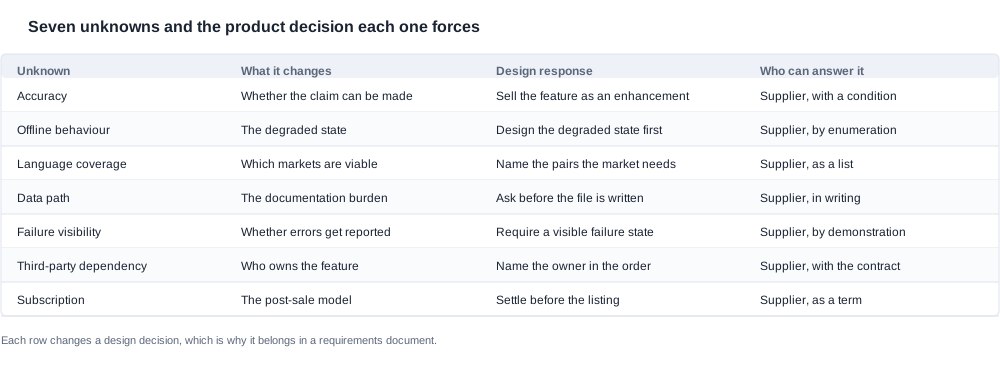
Seven unknowns and the product decision each one forces
The seven, and what each one changes
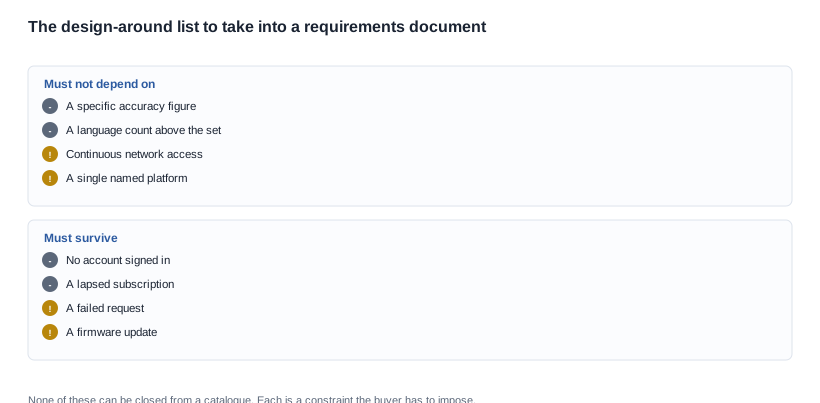
1. No accuracy data exists. Not ours, and on published evidence largely nobody else's. What it changes: you cannot claim accuracy, and you cannot design a product whose value proposition depends on it. The design response is to make the feature an enhancement rather than the reason to buy.
2. Offline behaviour is unknown. What it changes: the degraded state of the product is undefined, and the degraded state is what your customers will describe when they complain. The response is to design so that losing connectivity degrades rather than breaks.
3. Language coverage is nominal. A count of supported languages says nothing about which pairs work, in which direction, or at what quality. What it changes: which markets are viable, and therefore which languages the copy can name. The response is to define the pairs your market needs and ask whether those specific ones are covered.
4. The data path is unknown. Whether audio or text leaves the device determines your privacy exposure and your documentation obligations. What it changes: the size of the compliance task, and in most markets this is not a technical detail that can be deferred.
5. Failure modes are silent by default. A system that returns a confident wrong answer is worse than one that returns nothing, because the user acts on it. What it changes: the safety posture of any application built on the feature. The response is to require a visible failure state and to refuse any use case where a wrong answer could be acted upon without review.
6. Third-party dependency. AI features in this category are frequently delivered by a company other than the hardware manufacturer, which is normal and often better commercially. What it changes: who owns the feature, who you escalate to, and what happens to your product when that company changes direction. The response is to name the owner in the purchase order rather than discovering it in an incident.
7. A subscription may exist. What it changes: the post-sale relationship, permanently, and the cost model behind it. The response is to settle it before the listing rather than after the first lapse complaint.

The eighth one, which ends products
There is one limitation that is not in the catalogue and that has ended more products in this category than any of the seven: the feature being marketed more prominently than the hardware supports. A brand builds a listing around a demonstration, the demonstration used a favourable condition, and the product cannot deliver that condition in normal use. The defence is unglamorous and it is a rule rather than a strategy: do not put the AI feature in the headline until you have tested it yourself, under your own conditions, on more than one unit.
Designing the degraded state before designing the feature
The order of work
The practical method for turning an unknown into a design input is to design the failure case before the success case. Six steps, in this order.
- Name the feature the customer will actually use. Not the capability list. The one job.
- Assume the service is unreachable, because it will be, at some point, for reasons that have nothing to do with the product.
- List what still works without it.
- Decide what the customer is told in that state.
- Write that into the listing copy, so the description and the behaviour are the same thing.
- Test the offline case on a sample, because step three is an assumption until somebody runs it.
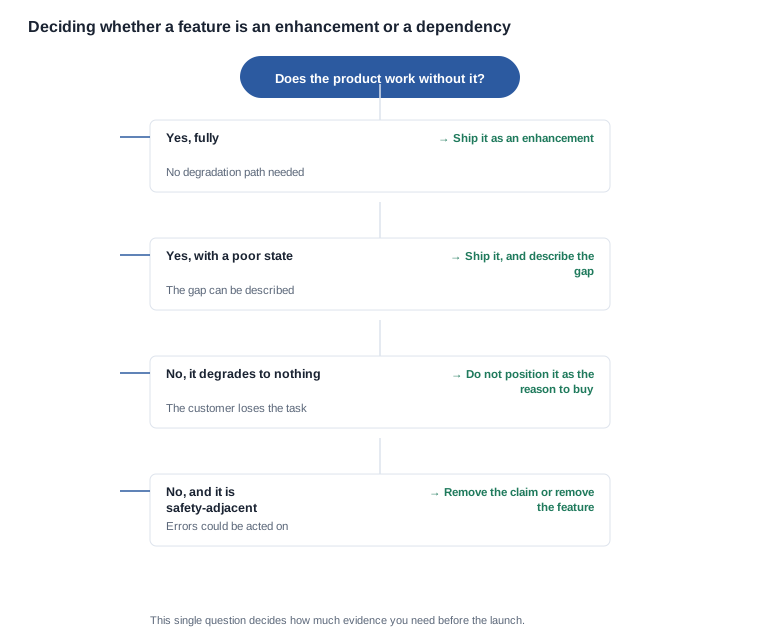
Step three is the decision point. If the list is empty, the feature is a dependency and not an enhancement, and the product has to be designed differently — either the dependency is removed, or the product's core job is moved to something that does not depend on it.
The enhancement and dependency test
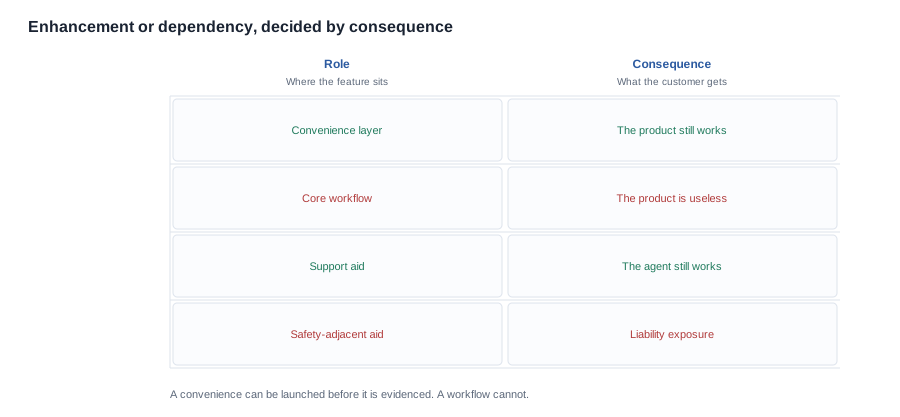
The distinction between an enhancement and a dependency is not about how good the feature is. It is about what happens to the product when it is unavailable, and the test is a single question: does the product still do its job.
A convenience layer fails and the product still works. A support aid fails and the agent still works, perhaps more slowly. A core workflow fails and the product is useless. A safety-adjacent aid fails and the brand carries a liability it has not priced.
The four cases have four different consequences for the launch, and this is where the limitation stops being an abstraction. A convenience can be launched before it is evidenced, with the copy narrowed. A workflow cannot, because a workflow is the reason the customer bought. A safety-adjacent use should be removed from the launch entirely, which is a decision that is much cheaper to make before the copy is written than after.
What the degradation case looks like in the listing
A degraded state has to be described, and describing it has a particular shape that is worth copying. Say what still works, say what does not, and say what the customer should do instead. That third element is what most copy omits, and it is the element that converts a limitation into a usable instruction.
The alternative is a euphemism, and euphemisms in this category are the direct cause of the complaint. A listing that says the feature "may require connectivity" invites a customer who expected the feature to work in a basement to feel misled, while a listing that says "capture and playback work without a connection; transcription and translation require a network" produces a customer who knows what they bought.
The failure that only appears in week three
The one that evades every test
There is a category of failure that survives a sample, survives a demonstration, survives an acceptance test and still arrives in the market. It shows up in the third week of use, and it has three causes.
The account state. A feature that requires a sign-up works for the tester, who signed up during the evaluation. It does not work for a customer who bought it in a shop and did not create an account, and it does not work for a customer whose trial has ended. Nothing in a sample test finds this, because the sample test includes the sign-up.
The update. The unit a brand tested is on a build from the evaluation period. The production unit is on a later build, and the later build has a changed behaviour. The failure is not a defect in either build; it is a gap in the test coverage between them.
The renewal. The feature worked on a plan that is now lapsed, and the customer is now on a plan that lapsed quietly in the background. There is no event in the customer's week to explain what happened, which is why it becomes a support ticket framed as a defect.
The three tests that do catch it
The first is to hand a unit to somebody who has not seen it, in the language they speak, with their own phone, and watch what happens without helping them. This is the most informative test in this category and it costs an afternoon. It is the only test that exercises the sign-up, the region and the configuration at the same time.
The second is to run the acceptance script on the shipped firmware version rather than on the version that came with the sample. Where the two differ, that difference is where the surprise lives.
The third is to test the failure state deliberately, and to test the failure the customer will actually experience. Feed the sample the input it should refuse: an ambiguous name, a number out of context, a phrase with two readings. Then turn the network off and run the same set again. A feature that flags uncertainty and a feature that answers confidently are different products, and the second one is the one that creates a liability.

What to insist on from a supplier before the limits can be quantified
The four things worth asking for
The questions to ask a supplier are not many, because a supplier that cannot answer them is a supplier whose limits will not be quantifiable at any price.
First, the architecture answer: what runs on the device, what runs on the phone, what runs in a service. This is the answer that converts limitation three and limitation four from unknowns into descriptions.
Second, the enumerated offline set: which functions survive with the network removed, as a list.
Third, the dependency answer: who operates the assistant, who owns the account, and what happens to the feature if that operator changes direction or stops.
Fourth, the commercial answer: whether a plan is required, what it covers, and what the product does for an existing customer when the plan ends.
Each of the four has an acceptable form and a postponing form, and the postponing forms are recognisable: "it depends on the configuration", "our partner handles that", "we can discuss it later". Those are not answers, and a buyer who accepts one of them is accepting an unknown limitation permanently.
Turning an answer into a testable criterion
An answer becomes useful when it is turned into a criterion with a condition and a threshold, and written into the purchase order where it can be failed. For the offline set, the criterion is the enumeration itself plus a test on two units with the network removed. For the dependency, the criterion is a named owner plus a notice period for behaviour-changing changes. For the commercial position, the criterion is a written term. For the architecture, the criterion is a statement that the brand can put into its own documentation.
The reason to do this conversion at the supplier stage rather than at the acceptance stage is that it changes who bears the cost. A criterion in the order is a standard; a criterion in an email is an opinion.
Where the buyer has to do the work
One limit cannot be transferred to the supplier, and it is the most consequential one. No supplier can tell you how the feature behaves in your market, with your users, in your conditions, on your network. That is the limit that has to be closed by testing, and it is the one a factory cannot close on the buyer's behalf.
The practical sequence is therefore fixed. Get the four answers in writing, turn them into criteria, test the script on two units of the shipped build, run the first-run test with a user who has never seen the product, and then write the description from what the results actually were. The copy is the last artefact in the process, not the first, and most of the failures in this category happen because that order was reversed.
Which of these limits can be written into the order
Not every limitation belongs in a contract, and choosing wrongly is expensive in both directions. A limitation that the supplier controls and that the buyer experiences as a defect belongs in the order as an acceptance criterion, because otherwise it becomes a warranty claim. A limitation that the supplier does not control — the state of a third-party service, the coverage of a national network — belongs in the order as a disclosure obligation, because the supplier can commit to telling the buyer, and cannot commit to the thing itself. A limitation that depends on the buyer's own conditions belongs in the buyer's requirements document and its own test plan, because the supplier cannot be held to a condition the buyer never disclosed.
Certification cost and lead time are not among the negotiable terms, for the same reason as everywhere else in this category: the fee is per product family and the elapsed time sits with the test laboratory. What is genuinely open is the evidence package — whether a second evaluation round is funded if the first one fails the acceptance criteria, whether the documentation is delivered in the buyer's format, and whether a retention is held against the documentation rather than against units. Since documentation is where this category's schedule problems actually live, that is where the retention should sit too.
The limits we publish, and the ones we cannot
Our position, stated as boundaries rather than as claims
Here, we publish the AI capability as the catalogue states it and mark the rest as open. We publish an AI voice assistant across the camera tier and AI translation noted for the K01 as an observation from our own independent site. We do not publish an accuracy figure, a language count, a latency, an offline claim, a processing location, a subscription position, an app operator or a data-storage jurisdiction for any model in the range, and we will not estimate them, because we have not measured them against a stated condition.
We also publish no per-model certification rows. The export certification on our catalogue cover is a company-level capability, and a company-level capability does not establish that a given model carries a given certification, so we do not present it as though it does.
There is a practical consequence of that position for a buyer comparing two suppliers. Our AI capabilities cannot currently be compared on paper against another supplier's, because the substantiating detail is absent. If your product concept depends on the AI feature, the useful request to us is not for a comparison; it is for the implementation detail behind a specific model, so that the limitations above can be quantified rather than assumed.
What we will do is tell you which of these seven limits our documentation already rules out for a given model, which require a written answer from the platform owner, and which can only be closed by a test on your own sample.
The dependency behind the feature
The feature background is under AI features in smart glasses, the documentation an AI feature obliges you to write is in ai features certification requirements, the comparison method is in how to compare ai features, and the establishing step is the ai features procurement checklist. Producing evidence on a sample is covered at sample evaluation.
Related reading
- Establishing what is actually available — ai features procurement checklist
- Comparing two suppliers on this axis — how to compare ai features
- Producing evidence on a sample — sample evaluation
- How to test before ordering
Tell us what your product depends on, and we will tell you whether it should be an enhancement or a dependency.


