

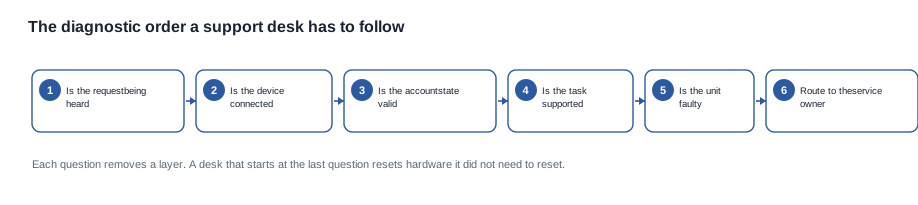
Smart glasses ai features: the order of questions
Five problems account for almost every AI feature complaint in this category, and the first of them is architectural rather than technical. The feature's implementation is not established in the published documentation, so a support agent cannot diagnose it and a buyer cannot specify it. The published position across the camera models is a capability description — AI voice interaction — with no quantification, no statement of whether the processing is on-device or in the cloud, no statement of who owns the application, no subscription model and no data-handling position. For a buyer, the practical conclusion is that an AI feature cannot be selected on a datasheet and cannot be supported with a generic script. Three questions have to be answered in writing before a purchase order, and they are the same three questions that resolve most of the five problems.
The buying task behind this article. The reader is a brand product manager, an after-sales lead or a sourcing buyer who is about to put a voice assistant under their own brand. The specific problem is that AI features generate the most emotionally loaded tickets in the range, because the customer expectation is formed by the name rather than by the architecture, and a feature that was described as an assistant behaves like a command parser. The buyer's task is to establish the architecture in writing, write the listing copy so that it matches, and design the support script around the failure modes rather than around the promise. The commercial risk is a launch in which the assistant is the headline of the listing, the reviews are about the assistant, and the assistant is a thin implementation that nobody internally documented.
Why the architecture comes first. The five problems below share a root cause: a feature whose processing location, network requirement and language coverage are not published. A support agent who does not know whether a request is processed on the device or by a remote service cannot tell a customer whether the problem is connectivity, account state, or the feature itself. That is why the diagnostic order matters more than the individual fixes.
Where the cost sits in the chain. The economics of this category make the AI ticket expensive in a way an ordinary hardware ticket is not. The hardware half of a smart glasses product is a comparable set of numbers — in our range the camera models run from 8MP to 13MP with cell capacities from 220 mAh to 290 mAh, charge ceilings at or under two hours and runtime bands from about five to eight hours — and a buyer can therefore hold two suppliers against each other on price and specification without any further information. The AI half cannot be compared at all, because the substantiating detail is absent from the published material on both sides. That asymmetry is why a single unresolved architecture question ends up sitting on the after-sales budget instead of on the procurement desk: it cannot be priced at selection, so it is discovered at cost.

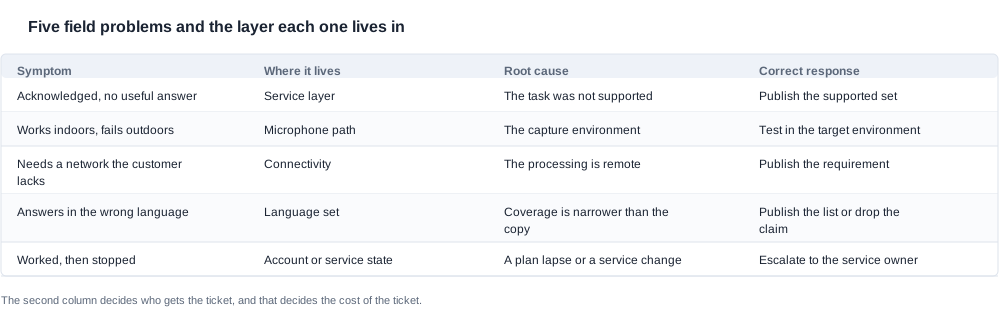
Five field problems and the layer each one lives in
| Problem | Symptom | Root cause | Correct response |
|---|---|---|---|
| It does not answer | The assistant acknowledges the request and produces nothing useful | The request was understood but the task was not supported | Do not promise a task list; promise a defined capability set |
| It works at the desk and not on the street | Recognition succeeds indoors and fails outdoors | The microphone path, not the assistant | Test in the target environment, not a quiet room |
| It needs a network the customer does not have | Works on Wi-Fi, fails on mobile data or with no signal | The processing is remote | Publish the requirement, or specify an offline path |
| It answers in the wrong language | The customer speaks one language and receives another | Language coverage is narrower than the listing implies | Publish the language list, or do not claim it |
| It worked and stopped | The feature degrades after weeks of use | Account state, subscription state or a service change | Escalate to the owner of the service, not to a hardware return |
The second column is the routing decision. Every one of the five problems lives in a different layer, and the layer determines who can fix it. A microphone path problem belongs to the hardware and can be closed by a replacement or a bench test. A remote-processing problem belongs to the service and cannot be closed by a unit swap, however many units the warranty budget absorbs. An account-state problem belongs to the commercial terms. A language-configuration problem belongs to the brand's market configuration. Only the first of the five is a hardware fault in the ordinary sense.
That distinction is the difference between a support cost and a support crisis. A brand whose desk treats every AI ticket as a hardware fault will spend its warranty budget on units that were never faulty, and will simultaneously fail to escalate the one ticket that actually needs escalating.
The four diagnostic questions, and why the order is the method
The order, and what each question eliminates
The four diagnostic questions, asked in order. First, is the request being heard at all — the microphone path, not the assistant. Second, does the device have the connectivity the feature requires. Third, is the account or subscription state valid. Fourth, is the specific task inside the supported set. Running them in this order means each question eliminates a layer, and it means the support team is not resetting a device when the problem is a service state.
The order is not arbitrary and it is not the order most desks use. Most desks start at the fourth question, because the fourth question is the one the customer asked. The customer says it did not do what they asked, so the agent checks whether the product supports it. That question cannot be answered without knowing the architecture, so the agent guesses, and the guess is usually wrong in a way that sends the unit back.
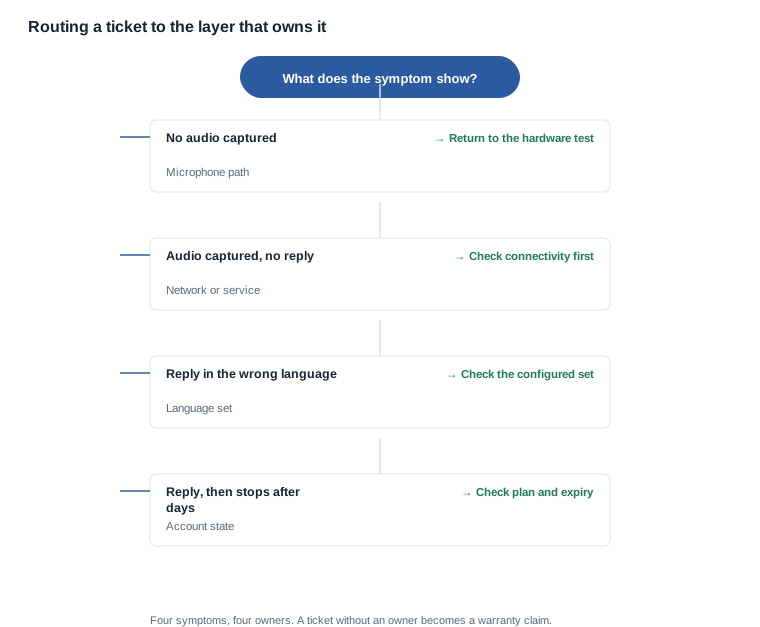
What each answer tells the agent to do next
The four questions work because each one has a decision attached rather than an observation.
The first question has two outcomes. If there is no audio captured at all, the unit is returned to the hardware test. If audio is captured and something responds, the microphone path is cleared and the ticket moves to the second question. That single branch removes the most common category of misrouted ticket, because "it did not hear me" and "it heard me and got it wrong" look identical from outside.
The second question has one meaningful outcome. If the device is offline and the feature requires a connection, the ticket is closed with an explanation, and the customer is given the specific instruction rather than a promise that it will work next time.
The third question catches the lapses. A plan that ended, an account that was never created, a password that was reset on a different platform. All three present as "it worked and then stopped", and all three are invisible to a unit swap.
The fourth question is the one that closes the ticket honestly. The task is either in the supported set or it is not, and the answer is delivered against the published list. If the list does not exist, this question cannot be answered and the agent is left improvising, which is where the emotional tickets come from.
The four questions to ask a supplier when the feature misbehaves
- Is the processing on-device or remote, and what happens to the request if the network is unavailable.
- Who owns the application and the account, and what happens to the customer's account if the brand changes supplier.
- Is there a subscription, who pays it, and what happens to the feature when it lapses. The published position in our documentation is that this is not established for our models, which is exactly the point: a buyer selling under their own brand needs the answer before launch, not after the first lapse complaint. The general question is at is there a subscription fee.
- What is the language list, stated as a list rather than as a capability. The published position is that AI voice interaction is described as a capability and is not quantified, and a buyer who needs a language list has to obtain it in writing.
A note on quantification. The rule for the listing copy is that an AI feature described as a capability can be described as a capability, and a number cannot be added that nobody has published. "Voice interaction" is a statement about a category. "Real-time translation across a stated number of languages" is a specification claim, and a claim of that kind needs a language list, a method and a performance figure behind it. This is a compliance point as much as a marketing one.

Building the support script before launch rather than after the first cluster
What the script has to contain
The script is the artefact that turns four diagnostic questions into a resolution, and it is written by the brand rather than by the factory, because only the brand knows what the customer was told.
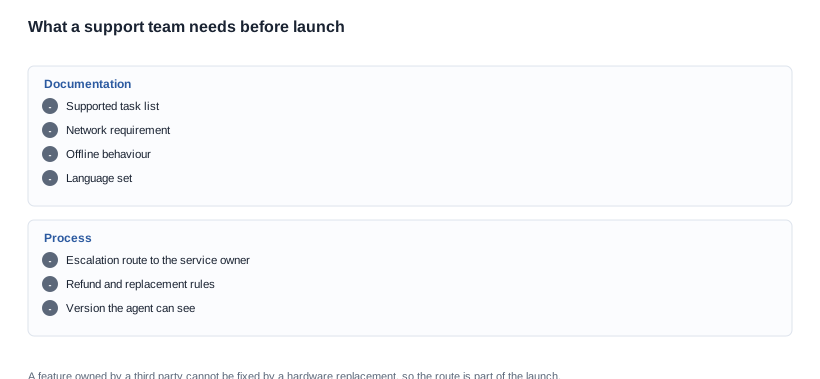
Four things belong in it. The supported task list, in writing, with the exact set of tasks that work. The network requirement, and what the product does without a connection. The account and subscription arrangement, including who owns the customer relationship after the brand changes supplier, since the connectivity question in general is covered at does the AI feature need internet. And the escalation route, because a feature owned by a third party cannot be fixed by a hardware replacement, and the script has to say so or the team will spend the warranty budget on units that were never faulty.
The two documents that make the script possible
The script depends on two documents that have to be requested rather than written.
The first is the written answer to the four supplier questions above. It is the difference between a script that resolves a ticket in one exchange and a script that escalates. The second is the quality control procedure for the feature in production, which is at AI feature quality control, because the procedure for the feature in production determines whether a returned unit is even a candidate for replacement.
Alongside them, the standard hardware pack is still required and still needs to be assembled at this stage: the model designation table, the certificate register at certification checklist, the packaging artwork proof, the agreed incoming inspection criteria, and the battery transport documentation at battery transport.
The failure mode this prevents
The characteristic failure in this category is a support cost that scales with the size of the launch rather than with the size of the defect. A ticket arrives, the agent cannot find a published capability list, and the agent does the only available thing: offers a replacement. Repeat across thousands of units and the brand is shipping hardware to fix a service problem, paying freight on units that were not faulty, and still not knowing whether the problem is solved, because the replacement will behave identically.
The prevention is entirely in the writing rather than in the process. Once the capability list and the network requirement are published internally, the same ticket becomes a two-minute answer. That is the whole difference, and it is why the script is a launch deliverable rather than an operations deliverable.

The commercial clauses that stop the recurrence
What is decided before the order, and what is open afterwards
The AI processing architecture, the account model and the language coverage are settled once the platform is chosen, and they are not commercial variables. Certification cost and certification lead time are also settled: the fee is per product family and the elapsed time sits with the test laboratory and its queue, so there is nothing to negotiate in either direction.
What is genuinely open is the structure around them. Minimum order quantity tiers, colour and temple configuration, logo, lens tint and retail packaging are the ordinary hardware levers and they apply here as they do everywhere else. Whether the supplier funds a second evaluation round on the AI feature is worth negotiating, because an AI feature is the part of the product most likely to fail an acceptance criterion the first time. Whether the application can be rebranded for a channel operating in more than one market is worth negotiating, because the language configuration and the account arrangement are per-market and a shared account is a support cost. And the size of the pilot tranche is worth negotiating, because a pilot tier is where the capability list gets established, and the run tier should not start before that list exists.
The clause language itself is at contract terms, and the commercial structure of a first order is at pricing.
Three clauses that do most of the work
A clause stating what the feature does when the service is unreachable or the subscription ends. Expressed as a behaviour rather than as an intention, because an intention cannot be tested.
A clause requiring notice before a firmware or model change that alters the assistant's behaviour, with a defined period. Without it, the capability list goes stale without anybody deciding to let it, and a stale capability list is a support incident rather than a change.
A clause requiring the marketing and label wording to match the manufacturer's stated capability list. This is the clause that prevents the drift between what the desk says and what the listing says, which is where the emotionally loaded tickets originate.
There is a fourth clause worth adding for private-label programmes: that the application, the developer accounts and the store listings are held in the brand's name. It costs nothing to agree and it is the difference between a brand that can change supplier and one that cannot.
A worked example: a translation-led tourism channel
This is a worked case rather than a live order. It exists to show the order.
Assume a tourism channel brand selling a camera-equipped model with an AI voice assistant into three markets, with a launch date set by a retail partner's catalogue cycle. The brand's after-sales lead has flagged a growing number of tickets of the "it worked and then stopped" type, and the brand has no published capability list.
Step one: the architecture question, asked first. The brand puts the four supplier questions in writing. The answers establish that the assistant requires a network, that the application is operated by a third party, that there is a plan tied to the customer's own account, and that the language set is narrower than the listing implies. None of this is in the catalogue, and all four answers change what the brand can write.
Step two: the capability list, written from the answers. The brand converts the answers into a list of tasks that work and a list that do not, and rewrites the listing so that the two match. The copy now states the network requirement explicitly and names the languages rather than implying coverage. The brand accepts a narrower claim because the alternative is a return rate it cannot forecast.
Step three: the diagnostic order, put into the script. The support team is given the four questions in order, with the branch logic. A ticket that reaches the third question and is found to be an expired plan is closed with an instruction rather than a replacement, which is where the cost was.
Step four: the clauses, written before the order. The brand puts the behaviour-when-offline clause, the notice period, the copy-match clause and the account-ownership clause into the purchase order, and holds the retention against the documentation package rather than against units.
Step five: the pilot tier. The brand takes a pilot tier rather than the full run, establishes the capability list on real units in the three markets, and only then commits to the run tier.
The decisive step was the first one, and it took a week. Everything after it was cheaper than it would have been, because the answers arrived before the tickets did.
What our published position rules out, and what it leaves open
The boundary we can and cannot draw
It is worth being precise: we publish AI voice interaction as a capability description, without quantification, and we publish the absence of the implementation details — the processing location, the application ownership, the subscription model, the language list and the data-handling position — with the same prominence as the capability itself. We will not add a language count or a response-time figure that nobody has published, and we will not describe a remote service as if it were an on-device feature.
What that position lets us rule out is limited, and it is worth being precise about the limit. From the published documentation a buyer can rule out the possibility of treating this as an offline product, because no offline capability is published. A buyer can rule out a per-model certification inference, because the catalogue carries no per-model certification rows and the export certification on the cover is a company-level capability. A buyer can rule out a quantified accuracy or latency claim, because none is published. What cannot be ruled out from the documentation is the behaviour of the feature, the architecture, the language coverage and the commercial position, and those are exactly the rows that have to be closed in writing.
Channel, markets and languages
Send us the channel, the target markets and the languages your customers need, and we will tell you which of the five problems the published position can already rule out, which of the four questions we can answer from our documentation today, and which have to be settled in writing before a purchase order is signed. The technology background is under AI features technology, the production-side procedure is at AI feature quality control, and the comparison method for two suppliers is in how to compare ai features.
Related reading
- The technology background — AI features technology
- The production-side procedure — AI feature quality control
- The connectivity question — does the AI feature need internet
- The commercial question — is there a subscription fee
- Certification checklist · Contract terms · Pricing
Send us the channel, the markets and the languages, and we will say which questions have to be settled in writing.


