

Smart glasses ai features smart glasses upgrade considerations are mostly not about the hardware, and that is the first thing to understand before spending a week comparing two units that differ only in firmware. The AI feature was never specified in the hardware in the first place, and the hardware across this range is remarkably similar between models.
The published position makes the point concrete. The AI assistant is a listed key technology across the camera tier, connectivity is low-power Bluetooth across the range, the camera tier publishes 8 MP or 13 MP, cell capacities from 220 mAh to 290 mAh, charge times of two hours or less and runtimes in the five-to-eight-hour band. The AI implementation itself is marked as not published for every model: no cloud provider, no model name, no language list, no latency figure, no data retention statement and no offline capability. There is also no published AI-specific processor, accelerator or memory figure anywhere in the range, which means there is no published basis for concluding that one model is better suited to an AI workload than another.
So the upgrade decision has to be made on the parts of the contract that sit outside the product, and on the cost of moving them. That is a less familiar exercise than comparing two datasheets, and it is the reason a buyer can spend a month and end up with a decision no better supported than the one they started with.
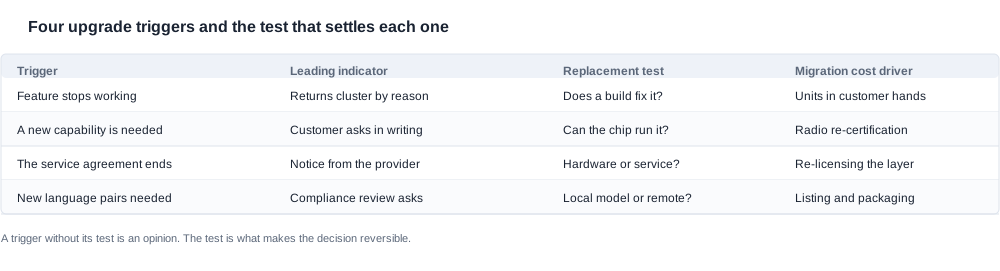
Smart glasses AI features: four upgrade triggers and the agenda each opens
An upgrade should never begin with a new product in mind. It should begin with a trigger that is observable and dated, because without one the discussion becomes a wish for something newer and the migration cost never appears on the page.
The feature stops working. The clearest trigger and the most common: returns cluster around one reason, a service provider changes its behaviour, or a model is withdrawn. The important discipline is to establish the cause before the response, because the same symptom has three different causes with three different costs. A firmware defect is a supplier fix and a firmware deployment. A withdrawn model is a service migration. A provider's commercial change is a renegotiation. The internet dependency discussion covers the case where the feature depends on a service that cannot be reached, which is the most common single cause in this category.
A new capability is required. A customer asks for something the current feature cannot do, in writing, and the request is credible rather than speculative. This trigger is worth taking seriously earlier than buyers usually do, because the cost of adding a capability later is not the capability, it is the re-testing, the re-documentation and the second listing copy.
The service agreement ends or changes. A notice arrives, a licence is repriced, or a provider changes what a published capability includes. This is the trigger that catches most programmes unprepared, because it arrives from outside the supply chain and lands on a team that was not expecting it.
A market requires something the current configuration cannot provide. New language pairs, a new data handling position, a new market-access obligation. The regulatory discussion covers why the data path determines what you are allowed to say about a product, and this trigger is the one where a market-access deadline sets the schedule rather than the other way round.

The retention test: when the installed hardware is still the right answer
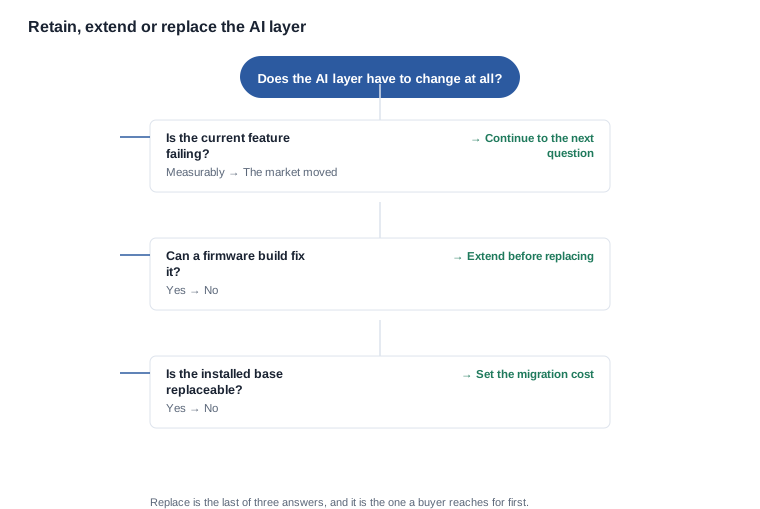
The most expensive outcome in an upgrade cycle is replacing a unit that was working. It is expensive in cash, in schedule, in the tooling that may have to be reopened, and in the customer relationship where a replacement is read as a defect. So the retention test has to be applied before the replacement option is discussed, and it has to be applied honestly rather than as a formality.
The test has three parts. Is the trigger about the feature or about the product? If the hardware meets the requirement and the trigger is about the service behind it, then the hardware is not the problem and replacing it is spending money to avoid a contract conversation. Is the requirement a capability or a performance level? A new capability may be achievable with a firmware change, a model change or an application change. A performance level — a latency target, an accuracy floor, a runtime — usually cannot, because the constraint is the power budget and the thermal envelope, and both are fixed at the design stage.
Is the installed base still identifiable? Units in customer hands can often be updated, provided the update path still reaches them and the build is known. That single fact decides more upgrade cases than any other, and it is exactly what a buyer loses if the programme was run without a build record. If the units cannot be identified, the upgrade is not a migration; it is a replacement with the addition of a much larger communication task.
The do you need it discussion reaches the same conclusion from a different direction: in a great many programmes the AI feature is not the deciding factor at all, and the decision really sits with the format of the capture or the call quality. An upgrade triggered by a desire for a better assistant, on hardware that already meets the requirement, is the most common version of buying twice.
The practical output of the retention test is a written decision with one of three words on it — retain, extend or replace — and a date. A decision without a date reopens itself every time a supplier shows something new.
Five criteria that decide retain against replace
The retention test above is a sequence, but a sequence still needs criteria at the point where it forks. These five are the ones we use, and they are deliberately ordered so that the cheapest answer wins. The first two usually settle the question, and a buyer who applies all five in order will rarely reach the third.
- Does the trigger survive a firmware or configuration change? If the trigger disappears when the change is made, the change is the answer and the upgrade is justified. If it survives, the trigger is a service or commercial problem and the units are not the variable.
- Can the installed base be identified and updated? If the build identifiers exist and the update path still reaches the units, the change can be applied to the fleet and the question becomes scheduling rather than replacement. This is the single criterion most often answered wrongly, because it depends on records the programme may never have kept.
- Is the new requirement a capability or a performance level? A capability can usually be delivered through software, a model change or an application change. A performance level usually cannot, because the binding constraint is the power budget and the thermal envelope, both of which are fixed at the design stage. When you cannot answer this, ask which model the requirement was measured on and under what load.
- Is there a cost difference that survives the whole programme? Compare the total cost of the change against the cost of doing nothing over the remaining life of the programme, including the operating cost of whatever you take on. The comparison is rarely close, and when it is close, the decision should default to retention because retention carries no migration risk.
- Can the change be reversed if it is wrong? A change applied to a pilot batch can be reversed. A change applied to the channel and to the listing cannot, in practice, be reversed within the timeframe that matters. If the answer to this is no, run a bigger pilot.
These five criteria are also the criteria by which how to choose between two upgrade paths is settled when both are plausible. They are not a scoring system, and turning them into weights does more harm than good: a programme that scores the options and picks the highest total has reintroduced exactly the ambiguity that the criteria exist to remove.
Migration cost: what actually moves when the AI layer changes
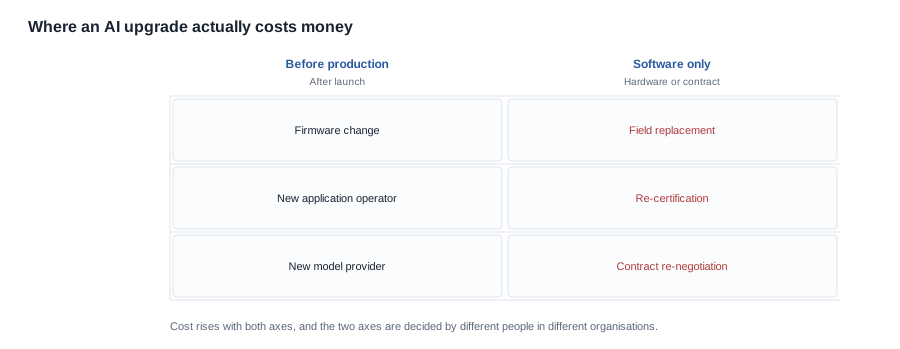
The cost of an AI upgrade is almost never in the unit price, and a programme that has not separated the one-off from the recurring has not finished its costing. There are four cost families, and they behave differently enough that they have to be tracked separately.
The direct replacement cost. The units themselves, plus any tooling or NRE where a new configuration is involved, plus the shipping and the channel handling of returns. This is the cost buyers model first and the one they are least likely to be surprised by.
The re-certification cost. Changing the radio, the firmware build or the configuration can invalidate part of the compliance file. This is the cost that arrives late and is almost always underestimated, because it is a schedule cost as much as a money cost: a test laboratory and a review queue are not something a buyer can accelerate with a purchase order. Note also that the cybersecurity requirements of the Radio Equipment Directive have been a mandatory part of CE marking since 1 August 2025 under the EN 18031 series of harmonised standards, so a file that predates that date needs review regardless of whether the hardware changed.
The documentation and listing cost. A changed feature set invalidates the technical file, the product page, the packaging, the manual and the training material for the channel. In a private-label programme this is the largest cost family and the least often budgeted, because it is paid in labour across several teams rather than in a single invoice. It also has a long tail: a listing that has been published for eighteen months has been copied into distributor systems, comparison sites and archived reviews, and it will not be consistent for months after the change.
The recurring operating cost. The service or licence behind the feature, the support burden of a new failure mode, and the operating cost of anything the brand now owns directly. The AI cost factors works through this in more detail, and the point to carry into an upgrade decision is that a capability whose price depends on a provider's own commercial arrangements cannot be modelled as a fixed margin item.
The four families behave differently under a delay, too. Direct cost is stable. Re-certification cost grows with elapsed time because the queue moves. Documentation cost grows with the size of the installed base, because the more units are in market the more places have to be corrected. That asymmetry is the strongest argument for deciding quickly once the trigger is confirmed.
The total cost figure that a buyer should carry forward is therefore not the replacement cost and not the one-off test cost. It is the sum of the four families, each amortised over the remaining programme life, plus the operating cost of whatever the brand owns directly after the change. Two upgrade paths that differ by a few per cent on the replacement line can differ by a factor of two on that total, and the difference is almost always in the documentation family and in the recurring column. Any comparison that stops at the unit price has not answered the question.
The negotiation position follows from that total rather than preceding it, and the order matters. A buyer who negotiates before the total is modelled negotiates about the smallest component of the cost and gets agreement on it. A buyer who has the total in hand can negotiate the components that actually move — the number of configurations committed, the volume tier on the licence, the payment structure and the retention held against the documentation package — and can also state clearly which parts of the cost are outside anyone's commercial leverage, such as the certification fee and the elapsed time of a test laboratory.

The compatibility ledger that has to exist before an upgrade is ordered
The single artefact that separates a managed upgrade from an expensive one is a compatibility ledger: a list of everything the current programme depends on, and what happens to each dependency under the proposed change. It is unglamorous, it takes a week to assemble, and no AI glasses programme in this category starts without it.
The ledger has one row per dependency, and five columns. What it is — the firmware build, the application version, the model provider, the licence, the data path, the account, the packaging artwork, the listing copy. Who owns it — your team, the supplier, or a third party, and those three have very different upgrade costs. What breaks if it changes — including the things that break quietly, such as a support script that describes a behaviour the new build no longer produces. What the change costs — in elapsed time, in money and in effort. Who has to say yes — the single most commonly missed column, because a dependency owned by somebody outside the programme is a dependency nobody is managing.
Three categories deserve special attention in the ledger. The build record. If the firmware builds in the field cannot be identified, the installed base cannot be updated and every migration decision has to assume the worst. The data path. If the processing location, the operator or the retention period changes, the privacy statement, the consent flow and possibly the market-access file all change with it. The channel assets. The listing copy, the packaging and the training material are the most expensive items to correct and the most likely to be missed, because they sit outside the engineering programme entirely.
The ledger also produces the answer to the question the upgrade was triggered by. Often the trigger is a single dependency, and the ledger shows that the other thirty are unaffected. That is the moment a migration stops being a programme and becomes a task, and it is worth taking deliberately rather than discovering it late.
Build the ledger before you order, not after the decision has been made in a meeting. A ledger assembled afterwards is a document that describes a decision already taken, and it will be written to support it. Assembled first, it frequently changes the decision — the questions to ask will not be the ones you expected, and in most programmes the number of dependencies nobody had thought about is the reason the migration takes longer than planned.
Two more practical points. Keep the ledger under version control with a named owner, because it is the document most likely to be consulted six months later by somebody who was not in the room. And put a date on it, because a ledger without a date is a list of things that were true when somebody last bothered to write it down.


Sequencing an upgrade against a programme that is already running
An upgrade rarely happens in a vacuum. There is usually a production programme running, a channel that has been told a date, and a stock position that has to land somewhere. The sequencing rules below come from that reality.
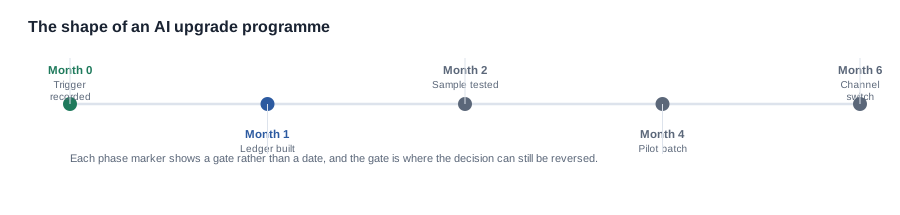
Do not switch the channel on the same date you switch the product. The pilot exists to absorb the difference between the sample and the field, and a channel switch removes the buffer. Run the pilot batch first, observe it for the full period your returns cycle requires, and switch only afterwards.
Decide what happens to existing stock before you order the new configuration. New units and old units will be in the market at the same time unless the stock position says otherwise, and two configurations with different feature behaviour need two support scripts. A buyer who discovers this after the channel has been briefed will brief them twice.
Keep one configuration alive as long as you possibly can. The moment you retire the old build, the units still in the field lose their update path. Retaining it costs a licence or a small amount of engineering time; retiring it early costs you the ability to fix a defect in the installed base at all.
Put the decision, the date and the open rows in one document. The failure mode of an upgrade programme is not a wrong decision; it is three teams holding three different versions of what was decided. One page, signed, with the open rows listed as open.
What we can tell you about an upgrade path and what we cannot
It is worth being precise: we will tell you what the hardware publishes and what it does not, and we will be clear that the AI implementation, the cloud provider, the language coverage, the latency and the data handling are not published for any model in this range, because they are determined by the service rather than by the product.
That is also the honest limit of what an upgrade path can be planned against. We can tell you which configurations exist, what the electrical rows are, what the connectivity is and what a new build would require on the hardware side. We cannot tell you what a future model provider will do with your programme, what the licence will cost at a higher volume, or when a service will change, because those are not our decisions and they are not published to us. Any upgrade plan that assumes otherwise is built on a number nobody has committed to.
What we will say is that a brand planning an AI upgrade should settle the service arrangement before the hardware, because the hardware in this range does not differentiate the AI feature and the service does. What we will not do is present an AI capability as a product differentiator on the strength of a catalogue line, because that is the line most likely to be challenged later.
Send us the trigger, the installed configuration and the volume, and we will tell you which parts of the upgrade the hardware can support and which parts have to be settled with a service provider.
Related reading
- What the AI capability covers — AI features in smart glasses
- When the feature is not the deciding factor — do you need it
- Where the running cost of a feature sits — AI cost factors
- What a data path change reaches — how regulations affect this
Tell us what the feature should do, the languages it has to cover and whether it has to work offline, and we will tell you which of that the hardware can support and which of it has to be settled with a service provider.


