

Smart glasses AI features: four questions, honest boundaries
Buyers ask four questions about the AI in smart glasses, and the order they ask them in is usually backwards. The first is what the AI actually does, and it is the least productive of the four, because "AI" in this category covers a chain of separate functions — capture, transcription, interpretation, retrieval and response — and a supplier who answers the question with a feature name has answered none of them. The second is which model in the range carries which of those functions, and this is the question that actually shortens a negotiation, because it separates a device with a function from a device that is a platform for one. The third is what happens when the network is not there, which decides whether the product can be sold into a market with patchy coverage, into a warehouse, onto a shop floor, or onto a vehicle. The fourth is what the feature costs to run, and it is the question most often deferred and most expensive to defer.
- What does the AI actually do? Not a feature label — a named function for each step in the chain, and a statement of which step runs on the device.
- Which model carries which function, and under what conditions? The table that tells a buyer whether the units on the shortlist can be ordered against the brief at all.
- What happens when the network is not there? The question that decides which markets, which channels and which environments the product can be sold into.
- What does the feature cost to run per unit per year? The number that is not on the quotation, and the one that decides the business case.
Our catalogue carries AI function entries for 20 of the 28 models it lists. What it does not publish, for any of them, is the substance behind the entry: the per-model function list, the compute platform, the on-device model, the language coverage, the latency, the network dependency, the transcription behaviour under background noise, and the cost of the service behind a feature that is quoted as hardware. That is not a shortcoming of the catalogue; it is the honest shape of what a hardware catalogue can state. The consequence for a buyer is that the AI entry tells you which products are positioned for it and tells you nothing about what you are buying when you place an order.
The reason this matters more in AI than in any other feature area is that the failure mode is silent. A camera with a lower resolution tier produces a slightly worse photograph, and the customer notices. An AI function that fails does not usually produce a visibly degraded product; it produces a product that a customer stops using, a support ticket about the feature rather than about the hardware, and a return that the supplier's own test data does not predict because the supplier's test ran on a good network with a quiet room and a supported language. The buyer who writes the AI requirement carefully is not over-specifying; they are closing the only failure mode in this catalogue that no amount of incoming quality control will catch.
The mechanism behind the positioning is set out on the AI features technology page, and the commercial consequences of the questions below are developed further in the AI feature cost factors article and the AI feature problems and fixes article. What follows is the procurement view: what to ask, what to hold, and where the real cost hides.
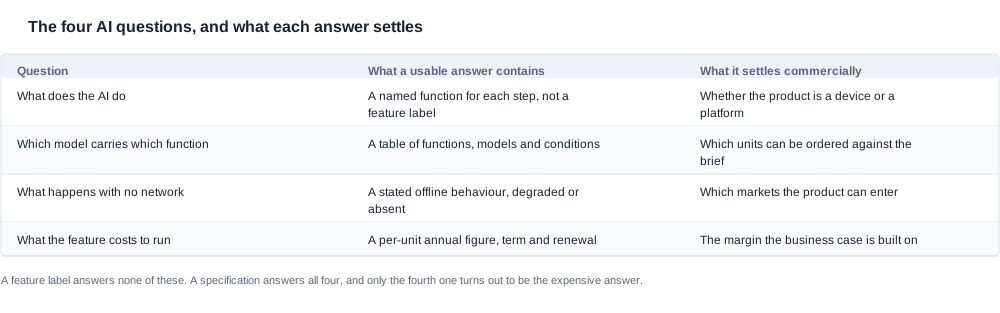
The question about which model does what
The most useful single question a buyer can ask a supplier is: which model in the range carries which AI functions, and which of them are the same function across models. The answer is usually a table, and the table usually has three columns that matter: the function, the models that carry it, and the condition under which it works. A column that says "requires a network connection" is worth more than a column that names the function, because it is the one that decides which markets the product can be sold into and which channels will generate support traffic in month two.
A second version of the same question is about the chain rather than the function. Ask where each step happens. Capture happens on the device, always. Whether the audio is transcribed on the device or sent to a service changes the privacy position, the latency, the cost structure and the behaviour when coverage fails. Interpretation and retrieval are increasingly service-side, and a buyer who does not ask will discover the architecture from a customer rather than from the supplier. The AI content creation solution page shows one application path in more detail, and the same architectural questions apply to it.
The third version is the one that catches substitutions. In a catalogue where several models share the same electrical rows, an AI function that is claimed for one model and not for another may be a firmware configuration rather than a hardware capability. Ask whether the function is enabled by hardware, by a firmware image, or by a service entitlement, because the answer determines whether the supplier can ship a different model against your order and still meet the specification.

Where an AI feature claim is won or lost at the quotation stage
The quotation is where an AI feature is either specified or decorated, and the difference is usually visible in one line. A specified feature comes with a condition, a method and a criterion. A decorated feature comes with a name. The test is simple: ask the supplier how they would know the feature had failed, and whether that test can be run by someone who is not the supplier. If the answer is a user survey, the feature is not specified.
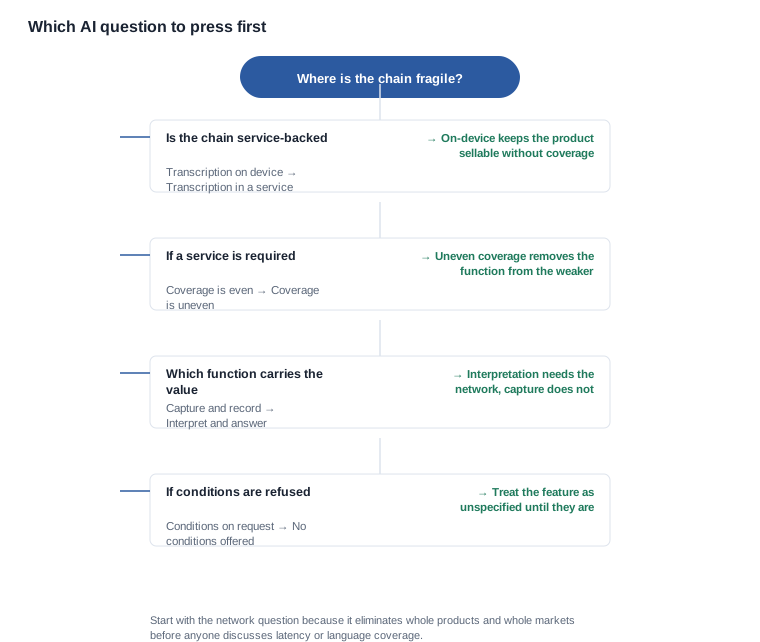
The decision tree above is a way of ordering the conversation. It starts from the question that is most often left unanswered — whether the chain needs a network — because that answer eliminates whole classes of product and whole classes of market before anyone discusses latency or language coverage. Only after the network position is settled do the questions about language, environment and failure behaviour have a meaning, because they are different questions for an offline-capable function and for a service-backed one.
Three commercial conditions belong in the same conversation as the technical ones, because a buyer who separates them usually pays for the gap later. The first is the service dependency: if the function requires a service, the buyer needs to know who holds the account, what the term is, what happens to the function when the term ends, and whether the product can be sold to a customer who has no relationship with that service. A hardware product that quietly depends on a subscription is a different commercial object from one that does not, and the difference becomes visible in a refund request and in a channel's own service commitment.
The second is the data question. A device that captures audio and a device that processes it on the device have different documentation, different privacy wording and different answers to give a customer who asks what is recorded and where it goes. This is not a legal question to be answered in a blog; it is a question whose answer has to arrive in the technical file, in the packaging and in the listing, and it has to be the same answer in all three.
The third is the claim question. The word "AI" on a product page is a claim, and like every other claim in this catalogue it is either narrower or wider than the evidence. A listing that says the device can transcribe speech is making a statement about a function, and it can be defended if the function is tested. A listing that implies the device understands a situation is making a statement about interpretation quality, which is a much harder thing to defend and a much easier thing to return against. Buyers in this category should ask their own copywriter to read the supplier's feature description and identify every sentence that asserts an outcome rather than a function.

Testing an AI feature set you did not specify
Verification of an AI feature is harder than verification of any other specification in the catalogue, because the function is a chain and the chain has a failure point in every link. The method that works is not a laboratory procedure but a fixed script, run on units the buyer controls, in conditions the buyer chooses, with the results written down. Four steps are enough to make the feature comparable between two suppliers and to expose the difference between a feature that works and a feature that works in a demonstration.
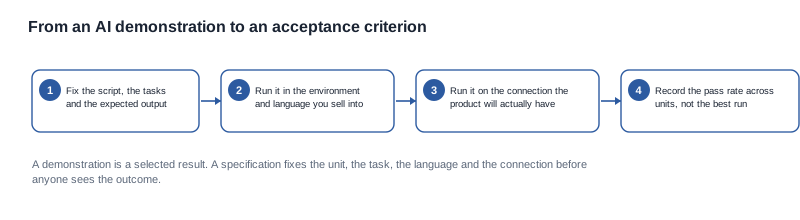
Step one: fix the script before the unit. Write the tasks, the inputs and the expected form of the output. A task with an expected output can be scored; a task described as a conversation cannot. A supplier who cannot produce a script for their own feature is telling you that the feature has no defined boundary, and that is a decision you need before the sample, not after it.
Step two: run it in the condition that produces the complaint. For audio, that is background noise, an accent, a named language, and a real environment rather than a quiet room. For anything that reads the environment, it is the environment itself: a bright room, a dark room, a busy room. The score that matters is the score in the condition the product is sold into, because the score in a quiet room tells you what the supplier's own test produced.
Step three: run it on the network the product will have. If the function is service-backed, test it on a constrained connection, because coverage problems are the most common field complaint in this category and they are almost never reproduced in a supplier's demonstration. A function that degrades gracefully and says so is a different commercial proposition from one that fails silently, and the difference is worth writing into the order.
Step four: record the failure rate, not the best run. One successful demonstration is not a rate. A buyer who has five units and a script can produce a pass rate, and a pass rate is the only form of this evidence that can be attached to a purchase order as an acceptance criterion.
Why a demonstration is not a specification
A demonstration is persuasive precisely because it is selected. It is run on a unit the supplier chose, on a task the supplier wrote, in a language the supplier's service handles well, on a network the supplier controls, by someone who knows which button to press. None of those are dishonest choices, and all of them shift the result. A specification is the opposite: it fixes the unit, the task, the language, the environment and the connection before the result is seen.
The practical consequence for procurement is that a demo should be used to generate the script, not to replace it. Watch the demonstration with a viewer's question list rather than a buyer's approval, write down what was demonstrated and under which conditions, then convert each element into a condition that a different unit, a different tester and a different network would have to satisfy. The most common failure in this category is not a supplier failing to deliver a function; it is a supplier delivering the function exactly as demonstrated while the buyer's customers experience a different outcome.
There is a second reason the demonstration is not a specification, and it is commercial rather than technical. A demonstration tells the buyer nothing about the failure path — who handles a support ticket when the function is wrong, what the return rate assumption is, and whether the supplier will accept a lot that fails the acceptance criteria. Those are contractual matters, and they are only visible in the documents that accompany a quotation.

The recurring cost hiding inside a hardware quotation
The most expensive number in an AI-enabled programme is usually the one that is not on the quotation. It arrives after the first year, it recurs per unit, and it is often attached to a service rather than to the product, which means it does not appear in the tooling estimate, the per-unit price or the landed cost calculation that the buyer built the business case on. Three cost lines behave this way: the service subscription behind a feature, the data and traffic cost behind a camera that records continuously, and the support cost behind a feature that customers will not use without a network.
The buyer's defence is not to argue the cost down, because in most cases the supplier does not control it. The defence is to make the cost structure visible before the order, so that the business case can be built on the real number rather than on the hardware price. That means asking three questions: what does the feature cost per unit per year, who pays it, and what happens to the product when it is not paid. The third question is the one that determines whether the product is sellable, because a feature that stops working when a customer stops paying a subscription is a feature the channel has to support, and the channel will not support it well.
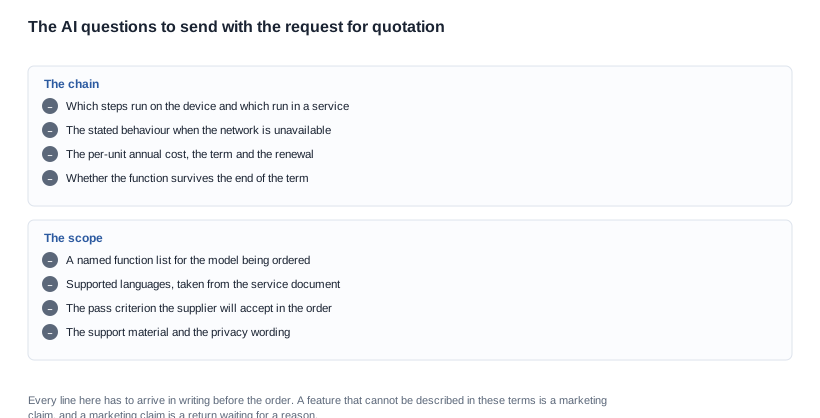
The checklist above is designed to be sent with the RFQ rather than after it. Every line on it is answerable by a supplier who is prepared to specify the feature, and every line on it is unanswerable by one who is not. That asymmetry is the point: the answers arrive in a form that can be written into the order, or they do not arrive at all.
The line item that arrives after the first year
It is worth being concrete about how this cost appears, because it is often disclosed in a place the buyer does not read. It can appear as a per-unit annual service fee in the commercial annex. It can appear as a minimum platform fee that has to be paid whether or not the feature is used, which is the most common form and the most damaging to a small order. It can appear as an assumption inside a business case the supplier offers, where the supplier models the service as free because the supplier's own volume makes it immaterial.
Each of these has a different consequence, and only the first is visible in a price list. The second is a fixed cost that a pilot order can make uneconomic, and the third is a disagreement about who owns the relationship with the end customer. The buyer's response to all three is the same: the cost has to be in the quotation, in writing, with the term, the renewal behaviour and the effect on the product's function stated. If it cannot be put in writing, it should be assumed to exist and priced into the case by the buyer.
There is a fourth line that is easier to overlook because it does not appear on any invoice: the cost of the returns that the feature generates. A product whose headline feature fails silently in a specific environment will produce returns that the hardware defect data does not predict, and the buyer who has built a margin on the hardware price alone will discover the difference in the warranty line, not in the production line.
The failure modes an AI programme inherits
The feature works in the demonstration and fails in the field because the network is not there. The symptom is a cluster of support contacts from one market, and returns that cite "it does not work" without a technical detail. The root cause is a chain that was never written down, so the network dependency was never a condition. The prevention is to require a stated offline behaviour, and to test it on a constrained connection before the order is placed.
The language coverage in the listing is wider than the language coverage of the service. The symptom is contacts from a market the buyer had not tested. The root cause is a claim assembled from the feature's capability rather than from the service's supported language list. The prevention is to name the languages in the copy from the same document the supplier's service provides, and to test each of them in the script.
The function is fine and the product is still returned, because the buyer is not the one who understands it. The symptom is a channel that cannot answer a question about the headline feature. The root cause is that no support material was written, because the feature was treated as a property of the device rather than as a behaviour that a channel has to explain. The prevention is to ask for the support material as part of the documentation package, and to treat its absence as a schedule item rather than a nice-to-have.
The product becomes a headset with an unexplained subscription. The symptom is a refund request that references a charge the customer did not agree to, or a channel that cannot answer why the feature stopped. The root cause is a service dependency that was never disclosed in the listing or the packaging. The prevention is to make the dependency a documented part of the product, including what happens when the term ends, which is a product decision and not only a commercial one.
Our reading of what an AI feature is worth
A walk-through of an AI-enabled channel programme
The sequence below is hypothetical and shows the order of the decisions rather than a result from a client engagement. Assume a channel buyer for a uniform and inspection supplier, selling into two markets, one with good coverage and one with patchy coverage in industrial areas. The buyer wants an AI capture and transcription feature because the inspection workflow produces a written record, and the target margin is thin enough that a recurring per-unit cost would change the business case.
Step one: the network question comes first. The buyer asks where each step of the chain happens before asking what the feature does. The answer is that capture is on the device and interpretation is service-backed. That single answer removes the feature from the patchy-coverage market for a voice-driven workflow, and the buyer does not spend a sample round discovering it in the field.
Step two: the shortlist is cut on the chain, not on the catalogue entry. The buyer selects models whose published rows suit the environment — a magnetic charging interface for a charging-crib deployment, a cell configuration and rated runtime that match a shift rather than a meeting — and then asks which AI functions each of them carries and under what conditions. The AI entry in the catalogue is used as a filter, not as a specification, and the specification is written by the buyer.
Step three: the script is written before the samples arrive. Four tasks, in the industrial environment, in the languages the second market uses, on a constrained connection. Five units from each of two shortlisted models. The pass rate is recorded, and the failing cases are recorded in full, because the failing cases are what the support material will have to answer.
Step four: the recurring cost is in the quotation. The supplier states the per-unit service cost, the minimum platform fee, the term, and what happens to the function at the end of the term. The buyer's business case is rebuilt on that number, and the decision to enter the second market is taken on the real figure. The buyer also asks for the support material and the privacy wording, and makes both a condition of the first order.
Step five: the claim is narrow. The listing describes a capture and transcription function with its language coverage stated, and makes no claim about interpretation quality. The channel has a support script that answers the question the customer is most likely to ask, and the warranty clause in the purchase order is tied to the pass rate that was actually measured.
The walk-through produced no particular product. It produced a shortlist built on a chain the supplier described, an acceptance criterion the buyer can enforce, a business case built on the real recurring cost, and a claim that the evidence supports.
What we do not claim about our own AI entries
We publish the fact that 20 of the 28 models in our catalogue carry AI function entries, and we publish the electrical rows for those models: cell configuration, rated runtime, charging method, Bluetooth generation, and the charge-time figure that comes with each entry. We do not publish a per-model AI feature list, a compute platform, an on-device model, a language coverage table, a latency figure or a service cost, because we do not hold verified figures for them. We would rather tell a buyer that than present a feature name as though it were a specification.
We also do not publish frame weights for the AI models in the catalogue, and the single weight we do publish belongs to a different product in a different family. A buyer who needs a weight for the model in front of them should ask for it directly and get the answer for that model, not an average and not a borrowed figure.
What we will do is tell a buyer which configurations exist, which do not, and what the published rows settle for each one. If the brief contains an AI requirement, the productive next step is to write it as a chain with conditions and a pass criterion, and to put it to a supplier who is willing to be measured against it. The AI feature specification sheet article sets out the electrical rows that can be read directly, and the AI features technology page covers the mechanism behind the positioning.


