

Smart glasses battery life smart glasses red flags are the small distortions in a runtime claim, and they are worth naming because every one of them makes the number more attractive than it is. The most common is not a lie; it is a rated figure presented as a typical one, with the conditions that produced it removed. Our own catalogue publishes a rated runtime for every model and a test condition for none of them, so this article is partly an account of our own position.
The value of a red-flag list is that it converts judgement into observation. Every signal below appears on a document you already hold — a datasheet, a quotation, a build sheet, a product page — and each one changes what you request next. That is the standard a buyer should hold: a runtime claim is not a number, it is a number plus three attachments, and the red flags are the attachments that are missing.
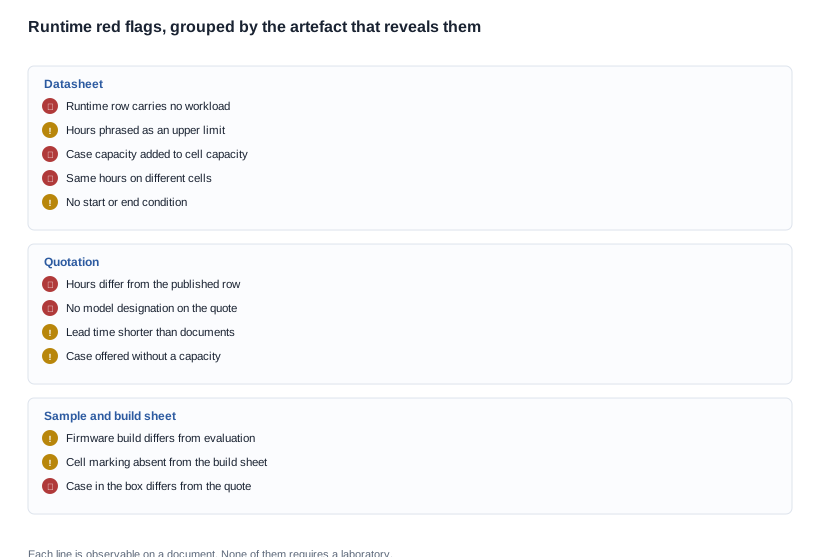
Smart glasses battery life: eight signals in the supplier's own documents
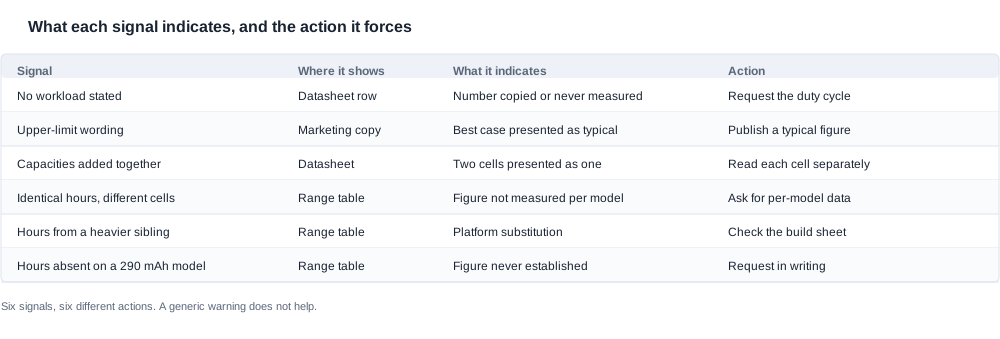
The runtime row carries no workload. This is the most important signal and the most commonly missing. Continuous playback, mixed use and continuous capture are three different workloads producing substantially different results from the same hardware. A runtime without a workload is a number without a meaning, and the only question is what the device was doing during it. The action it forces is narrow: ask for the duty cycle, and if the answer names one, the figure becomes usable.
The copy says "up to". The wording itself signals a best case. An upper-limit figure is the maximum observed, usually under favourable conditions, and it is not what a customer will experience on an ordinary day. A buyer comparing two products on upper-limit figures is comparing the best day of one against the best day of the other, while the customer will compare the worst day of one against the average of the other.
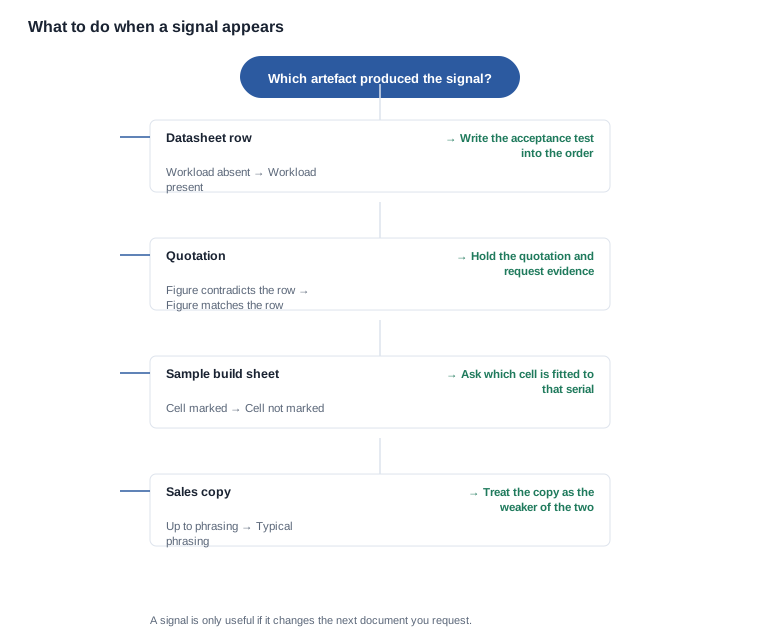
A case capacity has been added to a cell capacity. Two different numbers presented as one, and it is easy to do by accident because both are in milliampere-hours and both belong to the product. The frame's cell is what the customer's day depends on; the case's cell is what the customer's week depends on. A single total figure hides the number that matters, and it hides the cost of the case as a separate SKU with its own packaging, freight weight and transport paperwork.
One hours figure repeats across models with different cells. This is the copy-down signature, and it is worth explaining because the test is precise. If a figure does not vary with the cell architecture, the volume, or the feature set, it was not measured separately for each model. In our own range the capacity figures run 40, 55, 70, 90, 100, 115, 200, 220, 260, 265 and 290 mAh, so a range table where every row says the same number of hours deserves a question before it deserves a quotation.
A capacity figure is placed beside a duration with nothing between them. Milliampere-hours are not hours. Runtime is capacity divided by average power draw, and the controller, the camera module, the radio and the speaker chain all sit in that denominator. A specification that shows both numbers without the draw figure has left out the part that connects them, which means the two numbers cannot be checked against each other by anyone reading the page.
A runtime is quoted from a heavier sibling. The platform that shares a bill of materials but carries a different cell or a different camera tier. This is the substitution signal: the figure belongs to a product you are not buying. The action is to ask which cell is fitted to the serial number you will receive, and to check the answer against the published row for your own model.
There is no start state and no end condition. From what state, and to what end point. A charge from a partly depleted cell is not a full charge, and a device that becomes unusable at five per cent while still drawing power has run out before its own display says so. Both boundaries are the kind of detail that turns out to be the real difference between two suppliers.
A runtime is attached to an entry with no model designation. Three entries in our catalogue carry no formal model string. A product without a designation cannot be correctly listed on a certificate, correctly packaged, or correctly described at customs, and a runtime attached to it cannot be tied to a shipment. The traceability question is not administrative: it is the check that catches a substituted platform.
Turning those eight signals into a request is mechanical, and the request itself is short. A buyer needs to ask what workload produced the figure, on which units, from which start state to which end state, and whether the figure was measured per model or inherited from the platform. Those four questions fit in one email, and the answers either close the row or tell you that the row is unusable. The cost of the request is a paragraph of typing; the cost of skipping it is a return rate you cannot argue with later.
Five signals in a quotation that contradict the published rows
The document signals above live in the supplier's marketing material. The five below live in a quotation, and they are more serious because a quotation is a commercial instrument.
The quoted hours differ from the published row for that model. A supplier may quote a figure that is genuinely better than the catalogue — a newer cell, a different firmware, a different test condition — and that is a legitimate reason to talk. But it is also the most common way a substituted platform reaches a buyer, because the quoted figure is more attractive than the published one. The check is mechanical: write the published row next to the quoted row, and if they differ, ask which is which.
The quotation carries no model designation. This is the single most consequential item on a quotation in this category and it is invisible unless someone reads the line. A quotation that names a family, a platform or a photo instead of a model string cannot be tied to a conformity document, a customs entry or a warranty claim, and it cannot be compared against any published row.
The quotation offers a configuration the catalogue does not publish. An upgraded cell, a different firmware level, an alternative charge path or a new colour pairing — any of these may be perfectly real and entirely reasonable for a buyer to ask about. What matters is that the offer comes with its own basis: the measured figure, the build sheet reference and the documentation set that follows from it. An offer without a basis is a request for a specification you will have to reverse-engineer later.
A case is included in the quote without a capacity. The catalogue publishes case capacities for the CY03 and the L1 Pro, and the CY05 — each at 1400 mAh, for the L2 Utral at 900 or 1400 mAh as a configuration, and for the MT6 as a foldable 1200 mAh case. The KY06 and the MT5 are published with a case and no capacity, and the V03 and the V03 Pro are published without one. A quotation that adds a case where the published data has none shifts the freight weight, the packaging dimensions and the transport documentation, and those three lines have to move with it.
The lead time is shorter than the cell documentation cycle. A lithium cell inside a product that crosses a border carries a transport test summary under the United Nations Manual 38.3 test standard, and a product file under the portable lithium cell safety standard, IEC 62133. Neither document is created instantly, and a quotation promising a delivery date that leaves no room for them is describing a schedule that will move. The useful question is not when the units can be built but when the documents will exist.
There is a commercial dimension to the quotation signals as well, and it decides whether a quote is worth a second meeting. A quotation that contradicts the published rows, offers an unpublished configuration and carries no model designation has three open items, and each one is a document that has to exist before an order can be signed. That work is not free and it is not the supplier's problem; it lands in your schedule. Asking for those three documents before you ask for a price adjustment is the cheaper sequence, because the answer changes what you are negotiating about.
The copy-down signature across a range
A single copy-down figure is easy to miss. A range table is not, because the repetition is visible by counting.
In our published data the eight-hour figure appears on the LC-105-2 and the YKC02, the K02 and the K01, and the LC-105-1, the AR entry, the ZH12 and, as the top of a range, on the V03 Pro and the V03, and the V06 and the S7. Behind that single number sit six different cell architectures: 90 mAh on each side of two cells, 55 mAh on each side of two cells, 70 mAh on each side of two cells, a single 100 mAh cell on a magnetic charge path, a single 100 mAh cell on a Type-C path, and a 220 mAh single cell. The seven-hour figure appears on the D11, the D12, the D17, the MT6, the AI electrochromic entry, the bone conduction entry and the four 290 mAh camera platforms — the CY03 and the L2 Utral, and the L1 Pro and the CY05 — whose cells run from 100 mAh to 290 mAh.
None of that proves anything is wrong. Eight hours is a common design target, and platforms that converge on the same target will legitimately publish the same figure. But it is a signal in the precise sense that a buyer should test rather than assume, and the test is cheap: ask two of the models in the group for their measured figures under their own workloads, and ask whether they were measured separately or inherited from a shared reference design. A supplier who answers that question directly has nothing to hide; a supplier who cannot has given you a range table rather than a data set.
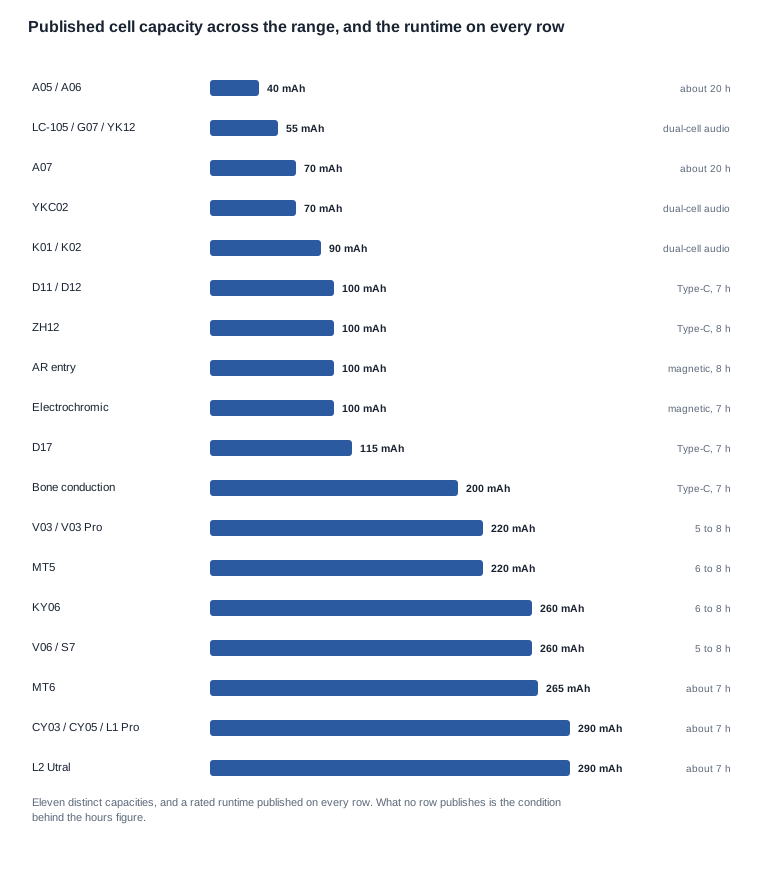
The same reasoning applies to the twenty-hour figure on the A05, the A06 and the A07, where two of the three carry 40 mAh cells and the third carries 70 mAh. That repetition is not a red flag — it is a duty cycle, and it is coherent because the sensing is light and the idle time is long. The diagnostic that separates the two cases is simple: does the figure move with the workload? A duty-cycle figure falls apart when you ask for continuous operation; a session figure stays roughly where it is. Ask for the continuous figure on one model and the answer tells you which kind of number you are holding.
This also gives a buyer a practical test for how to choose between two suppliers whose published tables look identical. Ask each of them which two models in their range were measured separately, and ask to see the raw protocol for one. The supplier who has measured per model will name two models and describe a protocol. The supplier who inherited a platform figure will describe a specification instead, because that is what they actually hold. A shortlist built on that answer is short for a stated reason, and the reason is written down.

What a defensible runtime claim carries with it
Three attachments, and none of them is onerous.
The workload. What the device was doing while the hours were counted: the capture duty or the playback state, the volume level, the radio condition, the ambient temperature, and the start and end conditions that bound the measurement.
The observation method. How the end was detected, and whether the device shut down cleanly or simply stopped working. These two sound like the same thing and they are not, because a device that degrades gracefully is a different product from one that dies mid-task, and the difference is exactly what a customer complains about.
The measurement unit. One unit, one figure, one condition. A figure that mixes models, or that reports a range without saying what moves it, cannot be defended in a customer dispute and cannot be compared with another supplier's figure.
With those attached, a runtime claim survives a review queue, a marketplace dispute and a warranty conversation. Without them it is a number that will be quoted back at you by a customer who is having a different day — and the reply that helps is the one where the figure and its conditions are on the same page as the complaint.
There is a related rule for the listing copy, and it is separate from the measurement: a claim should be no wider than the evidence. Where the best available figure is a range, publish the range. Where the figure is a duty cycle, say that it is a duty cycle. Where the condition is unknown, say that too. Publishing a lower but defensible number costs a little competitive ground and saves the returns, the reviews and the support hours that a wider claim generates.
Four claims should not survive a specification review in this category, whatever a supplier publishes: a runtime with no condition, an upper-limit figure presented as typical, a combined cell and case capacity, and a range or compatibility claim derived from a radio version number. Each of them can be produced by accident, which is why they belong in a checklist rather than in a list of things to remember. Removing them from the specification before it is issued costs nothing; removing them after launch costs a reprint.
The commercial cost of publishing a claim that raises these signals
A runtime claim is a customer expectation, and the cost of a wrong one is measurable in returns rather than in complaints.
The first cost is the return. A buyer who publishes the best case and a customer who experiences the typical case produces a refund and a review, and in a category where the margin is thin, the volume of those returns decides whether a platform is viable at all. The second cost is the warranty dispute, where a claim that cannot be defended cannot be settled and every case consumes engineering time that was budgeted for the next programme.
The third cost is quieter and larger: the erosion of a specification. When a runtime figure is unreliable, it stops being a specification and becomes decoration, and the rows around it — capacity, charge path, case capacity — stop being trusted in the same way. That is why the remedy is not to publish a lower number but to publish the number with its condition. A claim with conditions can be quoted by a customer who disagrees with it, because the conditions are what makes the disagreement specific. A claim without conditions can only be accepted or rejected, and rejection is what happens.
The trade-off that procurement teams should weigh is the same one that appears in every other specification dispute in this category: a narrower claim now against a cheaper platform later. The narrow claim costs a little at the quotation stage and saves a great deal at the returns stage, and the total cost of the gap is always larger than the cost of closing it.
Running this checklist against our own published rows
This checklist is worth applying to our own catalogue, and it does not produce a comfortable result. Our position is that we publish the rated runtimes exactly as the catalogue states them, and that we publish the fact that the catalogue states no test condition for any of them.
Applied honestly, the first signal fires on every row we publish: no model in the range states the workload behind its hours figure. The repetition signal fires too, for the reasons set out above. The capacity-beside-duration signal fires on every range table, because we publish no average power draw for any model. The traceability signal fires on the three entries that carry no model designation. The case-capacity signal fires on the KY06 and the MT5, where a case is published and its capacity is not. And the missing-figure signal is not a distortion but a fact a buyer has to plan around: the camera tier publishes an hours figure for every one of its eleven models and no test condition for any of them, so the largest cells in the range — the 290 mAh the L1 Pro and the CY05, and CY03 and the L2 Utral, all at roughly seven hours — carry a number that cannot be checked against anything.
We also hold one weight figure in the entire range, and it needs its scope quoted whenever it is used: 158 g for the MT6 glasses body, including the 265 mAh cell and the camera, excluding the foldable charging case. The case holds 1200 mAh and the case weight is not published. No bare frame weight is published for any model, so a weight quoted without that scope is not a number a buyer can use.
What we will not do is fill any of those gaps with plausible values. A converted figure with no measurement behind it is worse than an open row, because an open row gets requested and a converted figure gets quoted. What we will do is take a model and a workload and run the measurement with you, so that the number in your listing is one you produced and can defend. The measurement discipline sits under smart glasses battery life and power, the protocol is in how to measure battery life, and the cost side of the same argument is in battery life cost factors.
Related reading
- How to produce a defensible figure — how to measure battery life
- The cost structure behind it — battery life cost factors
- Matching the number to the scenario — battery life for different use cases
- The red flags on a supplier's own claim — battery life supplier verification
Send us a runtime claim and we will tell you which of these signals it raises.


