

How to read a datasheet smart glasses battery life: six rows, in order
A battery specification in this category is six rows, and the two that decide a purchase are the two most often read in the wrong order. How to read a datasheet smart glasses battery life smart glasses is less about the numbers than about what the numbers are attached to. A single 100 mAh cell and two 55 mAh cells are different products, not the same product described twice: the count tells you the internal layout, the balance across the frame, the number of components to test and the number of things that can fail.
The four published examples in our own range make the point better than any explanation. The K01 and the K02 publish 90 mAh × 2, which is 180 mAh in total, with a rated runtime of approximately eight hours. The G07 and the YK12 publish 55 mAh × 2, or 110 mAh, with approximately six hours. The LC-105-1 and the LC-105-2 publish the same 110 mAh with approximately eight hours. Identical cells, a two-hour spread, and that is a comparison failure in miniature — two numbers in the same catalogue that cannot sit in the same chart.
What this read has to settle
Three decisions, in this order.
Whether the two figures you are comparing were measured the same way. This comes first because every other decision depends on it, and because a comparison of unmatched figures is worse than no comparison at all: it publishes a conclusion you cannot defend.
Whether the cell architecture suits the product you are building. A dual-cell product and a single-cell product behave differently under load, balance differently across a frame, and carry different failure counts. The architecture is a design decision that was made before you arrived, and your programme inherits it whether you have opinions or not.
What you can honestly put in a listing. The figure you publish is the figure a customer will hold you to. Publishing a rated runtime without its condition is publishing a promise that a single customer can falsify on a single afternoon.
The buyer who has two sheets and a chart to build
A buyer reading a battery specification is usually comparing two models for a range, or building a product page, and holds the sheets, a target price, a channel plan and a deadline. What they rarely hold is the test condition behind any of the runtimes, and they will rarely ask for it, because the number looks authoritative and the condition is not printed on the sheet.
The most common buyer in this position is a channel buyer assembling a comparison chart for a marketplace listing, where the chart competes with other listings on the same page. Their exposure is a refund. A customer who reads "eight hours" and gets five has a product that looks like it was mis-sold, and the marketplace listing is where the mis-selling took place.
The second is a brand product manager building a range around a hero model, who needs to know whether a second configuration in the same family can carry the same runtime claim. Their exposure is the artwork and the launch date, because a runtime change between two colourways is a packaging reprint.
The third is a procurement manager who has been asked to reduce cost. The temptation here is to swap the cell, because the cell is a line item on the bill of materials, and a cell swap is the cheapest possible saving. That is also the change most likely to invalidate the transport documentation and quietly shorten the runtime, and it is exactly the change that needs a notice clause before the deposit rather than a quality conversation after the first shipment.

Why a capacity figure and a runtime figure are different products
Identical cells, a two-hour spread, and what it proves
The G07 and the YK12 publish 55 mAh × 2 and approximately six hours. The LC-105-1 and the LC-105-2 publish the same 55 mAh × 2 and approximately eight hours. Nothing on either sheet explains the difference, which means at least one of the two figures was measured under a different load, a different volume setting, a different pairing state, or on a different rig.
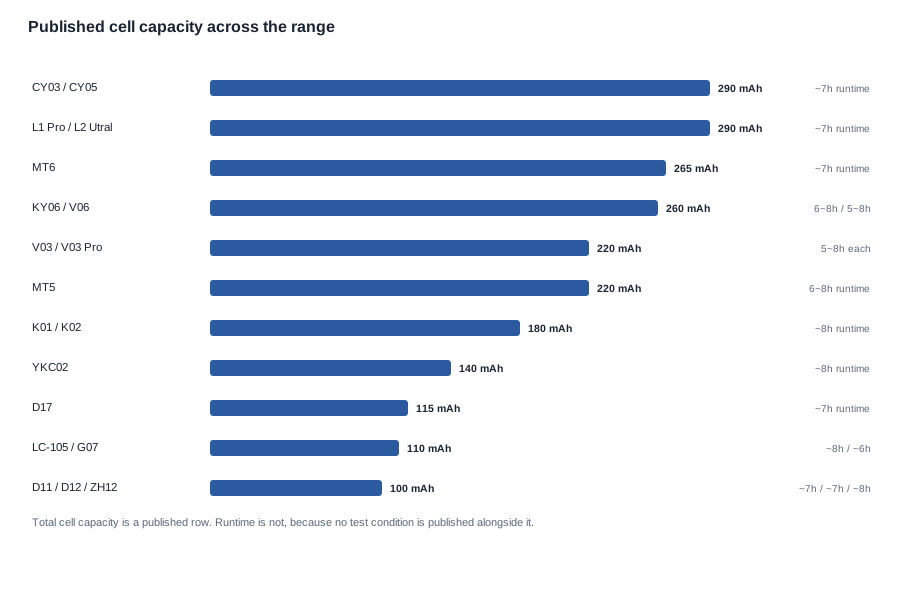
A buyer who puts these two numbers in one chart has published a comparison that is not one. The chart is not wrong in either cell; the chart is wrong as a comparison, and it is wrong in a way that a customer can disprove in a single evening.
The same pattern shows up across the range when you look at cell capacity against runtime. The D17 publishes 115 mAh with approximately seven hours, and the ZH12 publishes 100 mAh with approximately eight hours and a charge time of around one hour. The sport tier runs a different charge profile from the audio tier, and the audio tier runs a different workload from the camera tier. Capacity is a number; runtime is a number multiplied by a condition, and the condition is the part that is not printed.
The four things a runtime figure is made of
Any runtime figure, ours included, is the product of four things. If you cannot name all four, you cannot compare the figure with anything.
What was active during the measurement. For a camera product, whether the camera was running and whether it was recording. For an audio product, whether playback was continuous or calls were intermittent. For an open-ear frame, whether the transducers were driven at all, because a frame sitting idle on a desk with the radio connected is a very different load from a frame playing music for an afternoon.
At what level. Playback volume, for an audio product. Frame brightness, for a display product. Capture resolution and frame rate, for a camera product. A hundred per cent playback measurement and an office-volume measurement are two different products wearing the same model number.
Over how many units, and which statistic. A mean, a median, a best case and a worst case are four different things to publish. A best case is not a specification, because one customer can disprove it. A figure from one unit is a demonstration.
On what rig, and with what pairing state. A unit paired to one handset and streaming is not a unit paired to two handsets. Multipoint, if the product has it, changes the radio load, and nobody publishes whether the runtime figure was taken with one connection or two.
The last of these is the one buyers skip, because a spec sheet rarely states it and a supplier rarely volunteers it. It is also the one that determines whether your range supports a customer who switches between a phone and a laptop all day, and if you are building a business channel, that customer is most of your market.
The eight-row request that makes a battery specification comparable
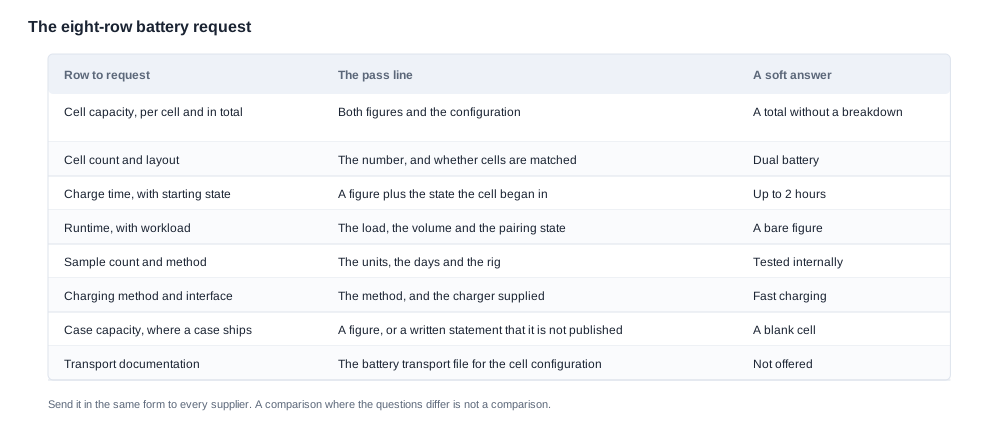
Use the table as the request and send it in the same form to every supplier, because a comparison where the questions differ is not a comparison. The right-hand column is the useful one: it separates a supplier who has measured the product from one who has copied a cell into a spreadsheet.
The thresholds in the language of the order
Read the cell count before the total. A single 100 mAh cell and two 55 mAh cells are different products. Two matched cells behave differently from one cell under load, because the two can share the draw, and a frame with two cells has two cells to age, two charge paths to test and two ways to fail asymmetrically. If a supplier says "dual battery" and stops, you do not yet know whether the cells are matched, whether they are in series or in parallel, or where they sit in the frame.
Read the charge time with its starting state. A cell at full and a cell at half produce different charge times, and "up to two hours" is a number with an unstated starting point rather than a fixed value. The threshold you want is a figure plus the state the cell began in, and ideally plus the ambient temperature, because a cell in a warm warehouse does not charge like a cell on a bench at twenty degrees.
Read the runtime condition as four separate questions. What was active, at what level, over how many units, and with what pairing state. A supplier who answers all four in writing has a test method. A supplier who answers one has a number they like.
Read the charging method as a commitment rather than a feature. Magnetic charging tells the customer what they need in the box and tells a buyer that the enclosure has a deliberate opening in it, which is a sealing decision and therefore an ingress question. Type-C is a cable ecosystem the customer already owns, and in a market where phones and laptops have converged on the same connector, that is a channel decision as much as a technical one.
Read the case row as a product, not as an accessory. A case is a second cell, and in our range the L1 Pro and the CY05, and the CY03 publish a 1400 mAh case, the L2 Utral publishes 900 mAh or 1400 mAh, and the MT6 publishes a 1200 mAh folding case. The KY06 and the MT5 are published as shipping with a charging case and state no capacity at all. No model in the Bluetooth audio range publishes a case. A customer with a 1400 mAh case lives a different day from one without, and a customer whose case capacity is unknown cannot be told anything useful about their endurance.
When two battery figures must never share a chart
Three failure conditions, and all three are silent, which is what makes them dangerous.
Different workloads. A figure measured with the camera recording and a figure measured with playback only are not comparable, because the camera is the dominant load in the tier where it exists. If your chart has an audio model and a camera model on it, the comparison is about categories rather than about products.
Different levels. Volume, brightness and capture resolution are the three level variables in this category, and each of them moves the number. Two suppliers quoting "eight hours" for models with different defaults are quoting different numbers.
Different statistics and sample counts. A best case from a demonstration unit against a mean from a production batch will produce a spread that looks like a product difference and is not one.
There is a fourth condition that is not about the numbers at all: different measurement dates. A figure measured a year before a firmware update and a figure measured after it describe different products, because the power management is part of the firmware. This is why the runtime figure should carry a build number, and why a supplier who cannot date their figure has not dated their test.
Converting a supplier's answer into your own measurement
The verification route is six steps, and each step assumes the one before it passed.
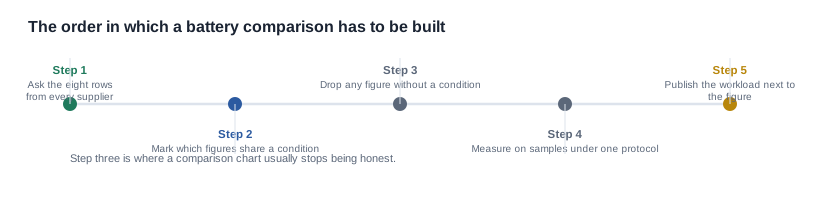
1. Ask the four condition questions in writing, for every figure in the comparison. What was active, at what level, over how many units, and with what pairing state. If the answers differ between suppliers, the figures do not belong in the same chart, and the correct action is to publish two charts rather than to average them.
2. Establish whether the runtime figure is a mean, a median or a best case. This is a cheap question and it disqualifies more figures than any other. A best case is not a specification, and publishing one is a claim a single customer can falsify.
3. Verify the cell configuration physically on the sample. Two matched cells in a frame, one cell, or one cell per temple — this is visible when the sample is opened or read from a teardown, and it is the fastest way to confirm that two datasheets describe the same product. It also catches the case where a supplier's literature has drifted from the build you received.
4. Check the case capacity against the box contents. A published case capacity that does not appear on the packing list, or a case in the box with no published capacity, is a finding before the first order rather than after. The case also affects the freight calculation and the packaging volume, so an unmeasured case is a costing error as well as a documentation error.
5. Check the battery transport documentation against the cell configuration. The transport test summary covers a specific cell, and a cell substitution invalidates it regardless of whether the finished product is unchanged. This is the row that catches a product at the freight forwarder rather than at the customer, and it is far cheaper to check than to fix.
6. Measure your own units on a fixed protocol if the comparison matters more than the datasheet does, and label the result as your measurement. Write the protocol down first: the state of charge at the start, the workload, the level, the ambient temperature, the number of units and the end condition. A protocol written afterwards is a description of what happened.
The file to assemble before the deposit
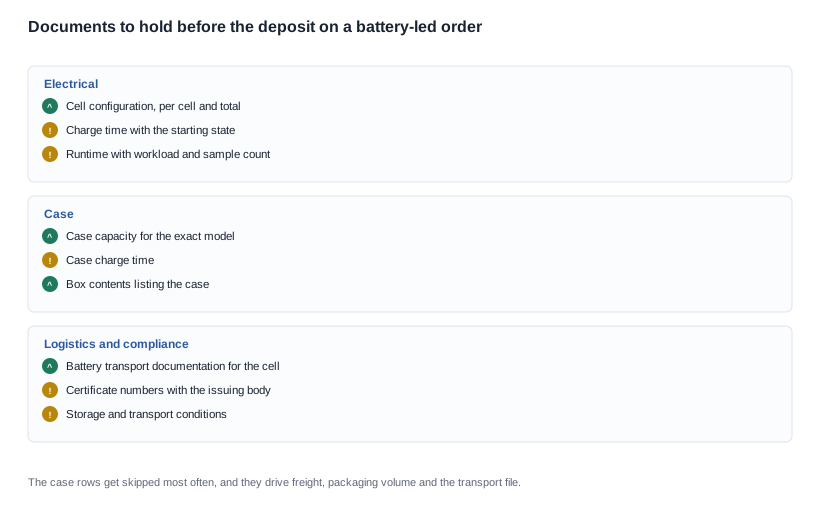
The case rows are the ones most often skipped, and they drive freight, packaging volume and the transport file at the same time, so a buyer who skips them is making a costing decision by accident.
Where a battery programme goes wrong, and where the terms still move
Five failure modes, and the fix that stops each
Two figures from different rigs go into one comparison chart. The symptom is a chart that appears later in a listing and cannot be reproduced by anyone, including the person who built it. The root cause is that the condition questions were never asked, so the spread looked like a product difference. The prevention is to ask the four condition questions for every figure before any of them is compared, and to drop the figures that do not survive.
A runtime is quoted in a listing with no workload attached. The symptom is a refund request that names a duration the customer did not get. The root cause is that the number was copied from a sheet where the condition is not printed. The prevention is to publish the workload next to the figure, or to publish the figure you measured on your own units.
A blank case capacity is filled in from a neighbouring model. The symptom is a freight and packaging problem that appears in the shipping quote, and a transport file that names the wrong cell. The root cause is that the blank looked like an oversight rather than a decision. The prevention is to leave it blank, say the capacity is not published, and ask the supplier for the case as a separate line in the quotation.
A product is compared with a bare one on runtime, and the case-equipped one looks worse. The symptom is a range decision taken on a chart that excluded the accessory that the product actually ships with. The root cause is that the case was treated as an accessory rather than as a power source. The prevention is to put the case into the picture before comparing, or to state explicitly in the chart that the comparison excludes it.
The battery is held at the distributor and the units arrive flat. The symptom is a channel that cannot demonstrate the product working on arrival, and a customer who concludes the unit is faulty. The root cause is that the transport documentation and the storage conditions were not part of the acceptance criteria. The prevention is to add the storage and transport conditions to the acceptance criteria, and to state the state of charge at delivery in the purchase order.
The commercial terms, separated into movable and fixed
On a battery-led order the negotiating room is largest where the charging case and the frame are negotiated apart, because the case is a second cell with its own minimum and its own lead time. The minimum order quantity is negotiable, and on a product with a case it is negotiable in a more interesting way, because the case is a separate supply item with its own minimum and its own lead time, and a buyer who negotiates them separately gets a better answer on both. Packaging and insert design, including the market labels and the language of the documentation pack, is a low-cost negotiation with no tooling implication. Delivery splitting against a sample-approval milestone is often granted more easily than a price concession, because it moves the risk onto the schedule where it belongs. Payment scheduling is the standard area: a deposit at the start of the production slot, a second payment against the inspection result, and a holdback against the documents protects you on the failure that costs most, which is a product that arrives with paperwork that does not cover it. And the price tier structure is worth reading carefully, because a supplier who prices the unit and a supplier who prices the configuration are making two different offers, and the second one is the one that determines your actual landed cost once the colour count and the case variants are in.
A cell configuration is not a commercial variable, and a buyer should settle that with the supplier before the quotation rather than discover it during a cost-reduction exercise. Certification cost and certification time are not a commercial lever; the cost is per product family and the elapsed time is set by the test laboratory and the review queue. Tooling normally rides on the first order as a one-off cost, and what a buyer should establish is the volume that carries it and how the supplier would treat the tool if the programme is discontinued. Also fixed is the cell and the charging path: a supplier who will not change the cell, the charging circuit or the power management is telling you the endurance is a property of the product rather than a variable in the negotiation, and the programme should be built around that fact.
The documents to request. The cell configuration, per cell and in total. The charge time with the starting state. The runtime with its workload, level and sample count, and the build number the figure belongs to. The case capacity and the case charge time for the exact model. The battery transport documentation for the cell configuration. The certificate numbers with the issuing body and the validity dates.
Four clauses carry a battery order, and the notice clause is the one that protects the runtime figure from a substitution nobody can see from outside the product. The cell configuration and the rated runtime as line items, with the workload attached. A clause requiring notice before any change of cell, charging circuit or power-management firmware, because a substitution changes the endurance without changing the electronics and is therefore invisible on the outside of the product. The acceptance criteria for the sample, referencing the workload and the end condition. A clause on who bears the cost when the sample does not meet the acceptance criteria, and a clause on who bears the cost of a re-delivery where the state of charge at delivery is below the agreed level.
A channel buyer building a battery comparison chart
The scenario, step by step
This is a hypothetical scenario, written to show the decision sequence rather than to report an outcome. No customer, project or order is being described.
Assume a channel buyer who is building a marketplace comparison for an open-ear audio range, with four candidate models from two suppliers and a launch date six weeks away. The binding constraint is not the product; it is the chart, because the chart is the listing and the listing is the only thing the customer sees.
Step one, the conditions. The buyer sends the four condition questions to both suppliers for every figure. One supplier answers all four for three of the four models and answers two for the fourth. The other supplier answers with a single number and the phrase "tested internally" for every model. The buyer now knows that only three of the four models can appear in a comparison with a stated condition, and the fourth has to be published as a single figure with no condition, which is a different listing decision.
Step two, the drop. One of the returned figures turns out to be a best case from a single unit. The buyer drops it rather than reconciling it, because a best case mixed into a mean column is a chart that can be disproved by one customer. The listing loses a model and keeps its credibility, which is the correct trade at this stage.
Step three, the case. The buyer's own range includes a model with a published 1400 mAh case and a model that ships with a case of no published capacity. The buyer asks the supplier for the capacity of the second, and gets a written statement that it is not published. That statement goes into the chart as a note rather than a number, and the freight model is rebuilt with the case treated as an unknown until it is measured.
Step four, the protocol. The buyer writes a short protocol: one unit per model, radio connected, playback at a stated level, no camera, ambient temperature recorded, end condition at a defined state of charge, and the firmware build recorded. It takes an afternoon per unit and it is now the only measurement in the programme the buyer controls.
Step five, the commercial structure. The buyer negotiates the case minimum separately from the frame minimum, because the case is a separate supply item with a different lead time and the two have never been negotiated apart. The buyer also asks for the price tier to be restated per configuration rather than per unit, because the colour count and the case variant are what actually determine the landed cost.
Step six, the claim. The listing publishes the runtime with the workload printed next to it, and the one model whose condition is unknown is described in words rather than numbers. The buyer has a smaller chart than they planned and a chart that will still be true in six months.
The result is a listing that survives a customer test. The decisive decisions were all made in the first week, and none of them was about the size of the cell.
What our range publishes about cells, runtimes and cases
We publish the rated runtimes exactly as the catalogue states them, and we publish the fact that the catalogue states no test condition for any of them. We will not invent a condition, and we will not apply a derating factor to a figure we have not measured under your workload, because a derating factor is a commercial decision about your own return rate rather than a technical constant.
We will also not fill a blank case capacity. The KY06 and the MT5 are published as shipping with a charging case and state no capacity at all, and the honest entry is an empty one with a note, because that figure drives the freight, the packaging volume and the battery transport documentation.
Where we can be precise, we are. The published cell configurations across the range run from 40 mAh in the children's lens products, through 55 mAh × 2 and 70 mAh × 2 in the audio tier, 90 mAh × 2 in the K01 and K02, and 100 mAh in several entries, up to 220 mAh, 260 mAh, 265 mAh and 290 mAh in the camera tier. The published runtimes run from approximately six hours to approximately eight hours in the audio tier, approximately five to eight hours in the camera tier, and roughly seven hours for the electrochromic and bone conduction entries. Every one of those figures is a rated value published without a test condition, and every one of them is accurate as we hold it.
What we can do is check your measurement against the published rows for that model and tell you which of the six rows the catalogue already fixes and which it leaves open. The rows themselves are under smart glasses battery life and power, the cost side is in battery life cost factors, the scenario mapping is in battery life for different use cases, the ranges behind these rows are AI camera glasses and Bluetooth audio glasses, the comparison method is in how to compare battery life, and the supplier-side questions are in open-ear audio supplier questions.
Send the rows, not the conclusion
Send the rows, not the conclusion. The cell configuration, the charge time, the runtime, the case and the interface for each of two products, as they appear on the sheets. We will tell you which of them can be compared with each other, and which have to be measured separately before they go anywhere near a listing.
Send the conditions you can obtain. If a supplier has already told you the workload or the level behind a figure, send that with the figure. It is the single most useful thing you can put in the request, and it costs nothing.
Send us the market and the channel. The unit price comparison changes shape once you add the case, the colour count and the destination market, and we can tell you which published rows change the landed cost most in that specific combination.
Related reading
- The six rows in detail — smart glasses battery life and power
- The method used to compare — how to compare battery life
- The questions to ask a supplier — open-ear audio supplier questions
Send us the six rows for two products and we will tell you which of them can be compared.


