

What to ask supplier to know about smart glasses battery life: the runtime questions that decide the programme
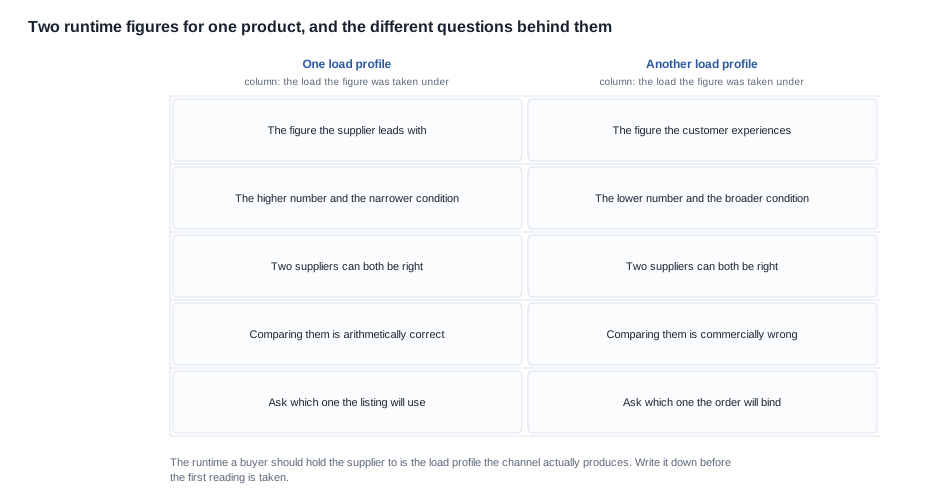
A runtime figure without its test condition is not a specification. It is a claim, and the distance between two quoted runtimes can be a factor of two for products that are otherwise comparable. The reason is that runtime is a function of load, not of capacity, and a quoted number almost always hides the load it was measured under. Two suppliers quoting "eight hours" can be describing a device idling and a device playing audio continuously, and neither is wrong.
The consequence for a buyer is that the runtime figure cannot be compared across quotations until the load profile is written down. That is the first decision, and it is a decision about your own product rather than about the supplier: what is the device doing for the whole of the working day? Playback, calls, camera use, an assistant running, a display lit — each combination produces a different figure, and the right answer is the combination your customer actually produces.
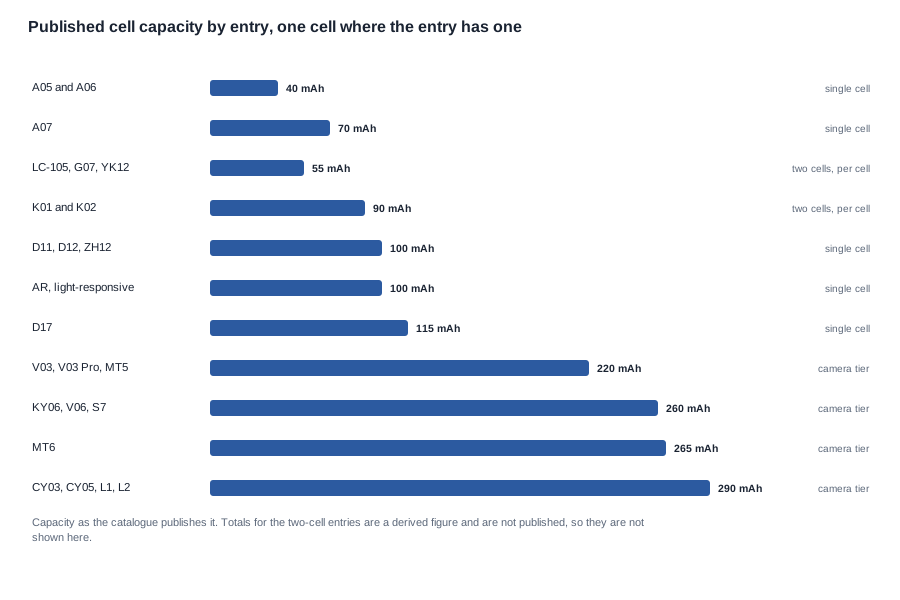
The second decision is what the cell arrangement is. Our catalogue publishes cell configurations as the cell value and the number of cells, and the two-cell entries need to be read as two numbers rather than as a total. The audio tier runs at 55 mAh times two, 70 mAh times two, 90 mAh times two and a single 100 mAh; the camera tier runs from 220 mAh on the V03 and the V03 Pro, and the MT5 up to 290 mAh on the CY03 and the L2 Utral, and the L1 Pro and the CY05; the MT6 sits between them at 265 mAh; and the D17 carries a single 115 mAh cell. A buyer who does not know which arrangement they are buying cannot plan a spare-parts line, cannot compare two quotations that quote different arrangements, and cannot read a runtime figure.
The third decision is the one that gets missed most often, and it is about the charging figure. Charge time is published across our whole range: two hours or less on twenty-six of the twenty-eight entries, and about one hour on the D17 and the ZH12. What is not published alongside it is the starting charge state and the termination criterion. Without those, a charge time cannot be converted into an interruption, and it cannot be used to plan a shift changeover or a warehouse turnaround, because the figure says how long a full charge takes from somewhere unspecified to somewhere unspecified.
What our published rows settle, and what they leave open
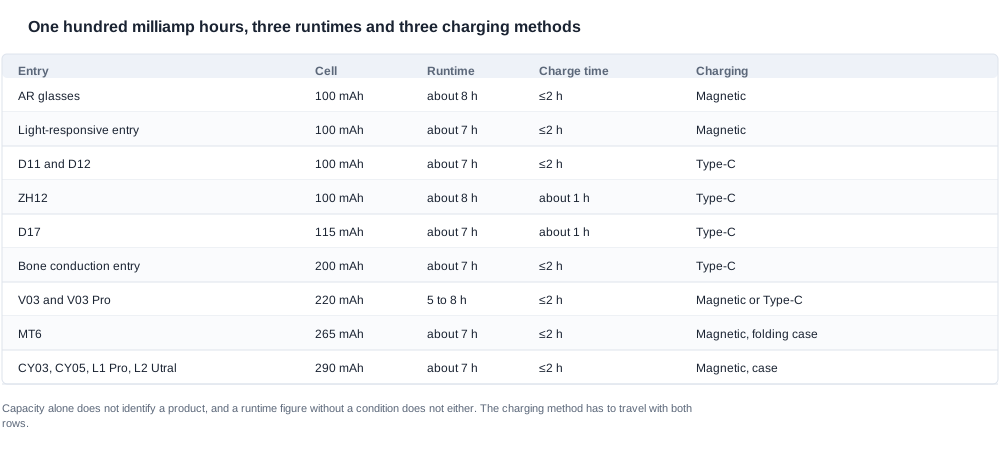
The published rows are more complete than buyers expect, and it is worth knowing exactly what they are. Every entry in our catalogue publishes a battery capacity, a charge time and a rated runtime. That is a real and useful set, and a buyer should use it rather than reaching for a competitor's datasheet.
What the published rows do not settle is what the runtime was measured under. There is no test condition attached to any of them, and there is no service-life expectation attached to any of them either, which is why a programme with a two-year replacement cycle and a programme with a five-year one cannot both be served by a figure quoted for a new unit.
There is also a structural point that catches buyers out. One hundred milliamp hours appears in the range four times, with three different runtimes and three different charging methods: the AR glasses entry publishes about eight hours with magnetic charging; the dedicated light-responsive entry publishes about seven hours with magnetic charging; the D11 and the D12 publish about seven hours with Type-C charging; and the ZH12 publishes about eight hours with Type-C charging. Capacity alone does not identify a product, and the charging method has to travel with both rows whenever a comparison is made.
The last structural point is about the case. Several camera models ship with a charging case, and the case has its own capacity: 1400 mAh on the CY05, the CY03 and the L1 Pro; 900 or 1400 mAh on the L2 Utral; 1200 mAh in the folding case on the MT6; and an unpublished capacity on the KY06 and the MT5. The V03 Pro has no case at all. A case changes the packaging, the shipping weight and the battery transport paperwork, and a buyer who has not decided whether the case is part of the product has not finished the specification.
Who owns the runtime claim once the product is in the channel
The reader here is a brand-side product owner working with a procurement manager, a channel buyer building a private-label range, or a category manager who has inherited a listing with a runtime figure on it. The situation is one of three: comparing quotations that quote runtimes under different loads, opening a new material number for a channel with a defined working pattern, or fixing a listing whose runtime claim a marketplace reviewer has questioned.
The claim is where this category actually fails, and the failure is structural rather than technical. A runtime figure quoted by the factory, copied into a listing by the brand and repeated by the retailer is a claim made three times and evidenced once. If the evidence was a laboratory figure at a playback volume and an ambient condition, then every channel that repeats it has repeated a laboratory figure, and the first customer who uses the product in a real environment has a legitimate complaint that nobody can resolve because the original condition was never written down anywhere.
That is why the buyer's obligation extends past the purchase order. The conditions behind the figure should be published in the listing, in the same way the conditions behind a technical figure in any other category are published. If the figure is "about seven hours at continuous playback", the listing should say that, because a customer who reads "seven hours" and gets seven hours of mixed use has been helped, and a customer who reads "seven hours" and gets four has been harmed.
There is a second risk holder that is easy to overlook in this category, and that is the buyer who plans the spare-parts and the returns. A device that runs out during a shift does not return as a defect. It returns as a battery complaint, which in most systems is classified separately from a defect and which therefore never appears in the defect rate. Nobody fixes the cause, because the data that would show it is being filed somewhere else. A programme that publishes the load profile and checks the incoming cell specification against it will find its own problem before the channel does.
There is also a channel-dependency worth flagging for anyone whose customer is a business rather than a consumer. Many work environments have a charging point and many do not. The same product, with the same cell, is a seven-hour product in one and a product that has to be recharged at a specific point in the day in the other. The runtime requirement in the second case is not the runtime figure; it is the availability of the charger. A buyer who asks the factory for the runtime figure without asking the customer about the charging point has asked the wrong question.
Where the cost of a battery programme actually sits
The battery is where smart glasses programmes most often lose money, and the reason is almost always a specification gap rather than a supplier failure. A cell quoted by capacity alone, without the chemistry, the tolerance band or the retention expectation, is a cell whose replacement cost is unknown and whose behaviour at the cold end is unquantified.
The first cost is the cell itself, and the line item a buyer compares. This is also the line where the two-cell entries are most often mishandled. When a quotation lists "55 mAh x 2" and another lists "110 mAh", the second number is a derived total rather than a published row, and the two are not interchangeable in a specification: one is a chemistry and a count, the other is a sum. Ask for the arrangement to be quoted the way the catalogue states it, and make sure the spare-parts line, the tooling and the cell ordering all refer to the same thing.
The second cost is the case, and it is larger than the cell in several of our camera configurations. A case adds a second cell, packaging volume, shipping weight, a charging interface and a battery transport obligation. Two of the five case configurations in our catalogue publish a case capacity of 1400 mAh, one publishes 900 or 1400 mAh, the MT6 publishes 1200 mAh in a folding case, and two entries publish a case with no capacity at all. A buyer who has not fixed the case configuration has not fixed the packaging, and packaging is one of the slowest-moving parts of a launch.
The third cost is the transport obligation, which is not optional and which has a lead time of its own. A battery-equipped product carries a transport documentation set that travels with the goods, and the relevant battery transport test is UN38.3. The obligation attaches to the fitted cell and to the case, and a configuration change that alters either of them can require the documentation to be reissued. That belongs in the schedule as an item with an owner, and the owner should be named at quotation stage rather than discovered by a freight forwarder.
The fourth cost never appears on a quotation and is usually the largest: the cost of a runtime claim that the channel cannot support. It shows up as returns that are not defects, as support contacts that are not faults, and as a listing that a reviewer eventually questions. The only defence is to agree the condition behind the figure and to publish it.
So the buyer's negotiating space sits in the cell arrangement, the case configuration, the transport documentation and the acceptance criteria. It is not in the capacity figure.

Agreeing a runtime measurement protocol before the order
Verification in this category is a short physical protocol, and it is worth more than anything else in this article. The order below assumes each step passed the one before it.
Step one: write the load profile down before the first reading is taken. This is the single most valuable sentence in the article. The profile names what the device does, at what volume, for how long, with the network in what state, with the camera in what state and with the assistant in what state. A protocol designed after the result is in hand is a description, and a description cannot be used as an acceptance criterion.
Step two: fix the starting charge state and the ambient temperature. A runtime measured from a full charge at room temperature and one measured from a partial charge in a cold vehicle are different measurements of the same product. Where the channel includes unheated vehicles or outdoor winter conditions, the cold figure is the one that matters, and it should be in the protocol rather than a surprise in January.
Step three: run the profile on a unit from the production configuration. An engineering sample with a different cell or a different firmware is a different product. Ask which firmware the figure was taken on, and require the sample unit to carry the production firmware.
Step four: repeat on a unit from the middle of the lot. This gives the spread rather than a single number, and the spread is what tells you how much margin the acceptance criterion needs. A cell quoted at a typical capacity behaves at the low end of the tolerance band in a unit that happens to land there, and the capacity variation and the runtime variation are two different things.
Step five: check the cell specification, not only the runtime. Ask for the minimum cell capacity, not a typical value. A typical capacity is a production average, and a unit at the bottom of the tolerance band is a unit that misses a runtime criterion written against the average.
Step six: ask for the retention expectation over the service life you intend to sell. This is the number most often missing and the one that determines year-two behaviour. It is also the number that decides whether a two-year or a five-year programme is the right one, and it is a different conversation from the one about new units.
Step seven: record the result against the acceptance criterion in the purchase order. The load profile, the starting state, the temperature, the number of units, the minimum cell capacity and the criterion itself. Then write the transport documentation set, the cell replacement rule and the battery defect remedy into the same order.

How battery programmes fail
The runtime quoted without a condition. A target figure was compared against a measured figure from another supplier, and the comparison was published internally as a result. The root cause is that a number without a condition is treated as a number. The control is to require the condition in the quotation and to use the same condition as the acceptance basis for incoming inspection.
The mixed-use figure sold as continuous. The listing implies a continuous runtime the product does not deliver. The root cause is that the load profile was never written. The control is to publish the condition in your own listing rather than the bare number, and to align the wording with the supplier's data so that the two never drift apart.
The typical cell treated as a minimum. A production unit at the low end of the tolerance band failed an internal check and was written off. The root cause is that capacity was quoted as typical. The control is to ask for the minimum cell capacity and write it into the acceptance criteria.
The charge time used as a changeover time. A shift was planned around a two-hour charge figure that assumed a full discharge to a full charge from an unspecified start. The root cause is that the starting state and the termination criterion were never published. The control is to ask for both, and to treat the charge figure as an upper bound rather than as a planning number.
The year-two behaviour nobody planned. The programme had a long service life and no expectation of capacity retention. The root cause is that the service life was decided after the specification was written. The control is to set the service life first, then ask for the retention figure that supports it.
The case that changed the packaging. A case configuration was added after the artwork was approved, and the battery transport documentation had to be reissued. The root cause is that the case was treated as an accessory rather than as a part of the battery configuration. The control is to put the case on the change-control list alongside the cell.
No item in this list is out of the ordinary, and none of them is grounds for walking away from a supplier. They are reasons to write the protocol and put it in the order.

The commercial terms a battery programme can move, and the ones it cannot
The battery programme has one genuinely live commercial lever, and it is the one buyers under-use. Everything else is either a small concession or a fixed cost.
The cell arrangement and the case configuration are the live numbers. Where a programme spans several cell arrangements, ask whether they are separate orderable configurations with their own part numbers and their own minimum order quantities, because a spare-parts line, a packaging line and a documentation scope all follow from them. Committing to a configuration count rather than a unit count is what moves the per-configuration minimum.
The cell standard part versus the custom cell is the question worth asking. A custom cell inherits the supplier's minimum order quantity and its lead time, and both of them land in the schedule. A standard catalogue cell inherits a lead time the factory controls, which is a materially different schedule risk. This single question is worth more than several rounds of unit-price negotiation.
Sample cost, evaluation unit quantities and first-article inspection allowances are negotiable and frequently given away. Under pressure on a first order these are easy to obtain and cost the supplier very little. A battery programme in particular benefits from more evaluation units rather than fewer, because the cell tolerance band is what the evaluation is measuring.
The warranty position on the battery is worth taking at face value and putting in the agreement. A supplier who offers a battery warranty beyond the product warranty has made a specific commitment about a component that is the most common cause of a year-two return. That offer should be written down with its own terms, because a general warranty statement will not survive the question "what about the cell".
Certification cost and certification time are fixed, and the battery transport documentation is a separate obligation with its own queue. The UN38.3 transport test attaches to the fitted cell and to the case. A configuration change that alters either of them can require the documentation to be reissued, and that reissue is charged per configuration, which makes it the line that compounds across a range.
The cell chemistry and the retention curve are not commercial variables. If the requirement needs a defined retention over a defined service life, no negotiation produces a retention curve. What negotiation can do is change the number of configurations, the size of the first order, the standard versus custom cell decision, the documentation obligations and the acceptance criteria that bind them.
The clauses worth having in the agreement are these. The cell arrangement written into the order, as the catalogue states it rather than as a derived total. The minimum cell capacity. The retention expectation for the stated service life. The load profile, starting state, temperature, sample size and acceptance criterion. The transport documentation set that travels with the goods, with the owner named. A change-notification clause covering the cell, the case, the charging interface and the firmware. And the cell-specific warranty position.
A worked example: a distributor extending a warranty on a camera line
This is a worked case rather than a live order. It offers a view of the order.
Assume a distributor selling an AI camera glasses line into a business channel, with a customer who writes a two-year replacement cycle into its own procurement policy. The constraint that matters is not the factory. It is that the distributor's customer wants a battery figure it can put in a tender, and the distributor's existing listing quotes a bare number copied from a catalogue row.
The first move is to stop quoting the bare number. The distributor asks the supplier for the condition behind the runtime figure for the specific configuration it sells: an 8 MP camera model with a 220 mAh cell, magnetic charging and a rated runtime of five to eight hours. The supplier answers with the load profile used for the measurement, which is a mixed profile with periodic capture. The distributor now has a sentence it can put in a tender, and it is a narrower sentence than the one it had.
The second move is the case. The distributor learns that the model it sells can be quoted with a charging case, that the case has its own capacity and its own transport documentation, and that adding the case changes the packaging and the shipping weight. It also learns that one of the camera models in the same family has no case at all. Rather than deciding on price, the distributor decides on the channel: the business customer charges devices at the end of a shift, so a case is not a convenience, it is the difference between a device that is available and one that is not, and the case configuration becomes part of the product rather than an accessory.
The third move is the protocol. Before the next order, the distributor writes a runtime protocol with the supplier: the load profile, a full start, a stated ambient temperature, three units, and a minimum criterion. It also asks for the minimum cell capacity rather than a typical one, because it has learned that a unit at the low end of the band is the unit that generates a complaint.
The fourth move is the retention question, and it is the one that changes the programme. The customer has a two-year replacement cycle, and the supplier's answer is that the retention expectation for a stated period is available but is not a published row. The distributor asks for it in writing as part of the next order, and negotiates the battery warranty position as a separate clause with its own terms, because a general warranty statement will not answer the question the customer will actually ask.
The result is a listing with a defensible runtime sentence, a case configuration chosen for the channel's charging behaviour rather than for the price, a protocol that turns the runtime into an acceptance criterion, and a warranty position written down before the customer asked for it.
What our catalogue publishes about cell and runtime, and what it leaves open
The published material on cell and runtime is the part of the specification we can stand behind, and the rest is a question for the supplier's own file. We publish the rows our catalogue states, we mark the open rows as open, and we will not fill an open row with a typical figure from a general data sheet.
These are the rows we do not publish:
- The test condition behind every rated runtime is not published, for any entry.
- The starting charge state and the termination criterion behind every charge time are not published.
- The minimum cell capacity and the tolerance band are not published; only the published cell value is.
- The capacity retention expectation over a defined service life is not published.
- The case capacity on the KY06 and the MT5 is not published, and neither is the cell chemistry for any entry.
These are the rows our published data does settle:
- Charge time is published for every entry in the range: two hours or less on twenty-six entries, and about one hour on the D17 and the ZH12.
- Cell configurations are published as the cell value and the number of cells: 40 mAh on the A05 and the A06; 70 mAh on the A07; 55 mAh × 2 on the LC-105-1, the LC-105-2, the G07 and the YK12; 70 mAh × 2 on the YKC02; 90 mAh × 2 on the K01 and the K02; 100 mAh on the AR entry, the D11, the D12, the ZH12 and the light-responsive entry; 115 mAh on the D17; 200 mAh on the bone conduction entry; and across the camera tier 220 mAh on the V03, the V03 Pro and the MT5, 260 mAh on the KY06, the V06 and the S7, 265 mAh on the MT6, and 290 mAh on the CY03, the CY05, the L1 Pro and the L2 Utral.
- Charging method is published per entry: magnetic on the audio tier and on the AR, light-responsive and most camera entries, and Type-C on the D11, the D12, the D17, the ZH12, the V03 Pro, the L2 Utral and the bone conduction entry.
- Charging case capacities are published where the catalogue states them: 1400 mAh on the CY03, the CY05 and the L1 Pro; 900 or 1400 mAh on the L2 Utral; 1200 mAh in the folding case on the MT6. The V03 Pro has no charging case.
One point about reading those rows. A total for a two-cell entry is a derived figure and not a published one, so the catalogue states the cell value and the cell count and a buyer should compare on that basis. And a runtime figure is a rated figure under stated conditions rather than a working day, which is the subject of the battery life guidance. The datasheet reading guide covers how the rows are arranged, the open-ear supplier questions covers the same discipline for the audio tier, and the charging options covers the interface side.
The action to take this week
Write the load profile down before you ask any supplier for a runtime figure. Name what the device does for the whole of the working day, at what volume, with the network, the camera and the assistant in what state. That paragraph is what converts a rated figure into a comparable one, and it is what makes the acceptance criterion possible later.
Then put five rows in the request for quotation: the cell arrangement as the catalogue states it, the minimum cell capacity, the charge time with its starting state and termination criterion, the retention expectation for the service life you intend to sell, and the case configuration with its capacity where a case is fitted.
Finally, decide the case question early, because a case changes the packaging, the shipping weight and the battery transport documentation, and a configuration change after the artwork costs more than the case saves. Send us the model, the quantity, the target market and the working pattern and we will tell you which of the published rows apply and which questions are the ones we would put to the factory ourselves.
Related reading
- How to read the rows on a datasheet — how to read a datasheet
- The broader supplier questionnaire — open-ear supplier questions
- The two-hour figure in practice — charging options
- battery specification guidance
- AI camera glasses
Send the configuration, the quantity and the working pattern, and we will say which parts of the runtime specification are settled and which are yours.


