

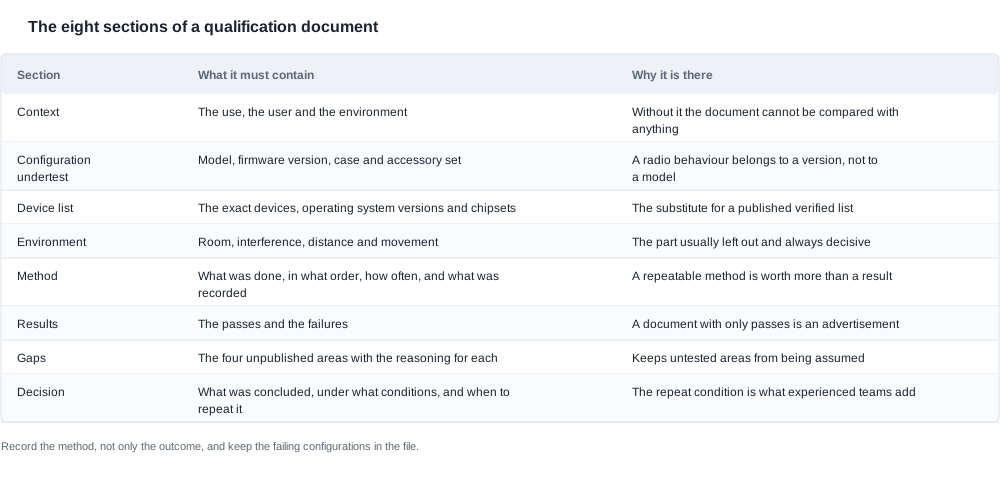
Smart glasses bluetooth version smart glasses case study template is a document you can copy, and the reason we publish it is that a Bluetooth qualification is one of the few programmes in this category where a good record is genuinely worth more than a good product. Anyone can quote a version number. The record shows what was tested, in what conditions, and what was found.
Our published position is the fixed part of the template. The K01 and the K02 publish Bluetooth 5.3; the D11, the LC-105-1, the D12, the LC-105-2, the YK12, the G07, the YKC02, the D17, the ZH12, the A07, the AR glasses entry and the AI electrochromic entry publish 5.4. Fourteen of the twenty-eight models publish no version, and eleven of those are camera models. The verified device list, the simultaneous connection count, the coexistence behaviour of the case and the update path are not published for any model, and those four gaps are exactly what a case study is designed to close.
Smart glasses Bluetooth version: eleven columns that make a radio record reusable
A record is reusable when the next programme can use it without repeating the work, and the test of that is simple: can someone else read the document, repeat the method and reach the same conclusion? A record that only describes outcomes fails that test, because an outcome cannot be repeated.
The eleven columns below are the structure. They are not a template for prose; they are the fields that a record has to carry, and the first thing to notice about them is that four of them exist to record something that is not known.
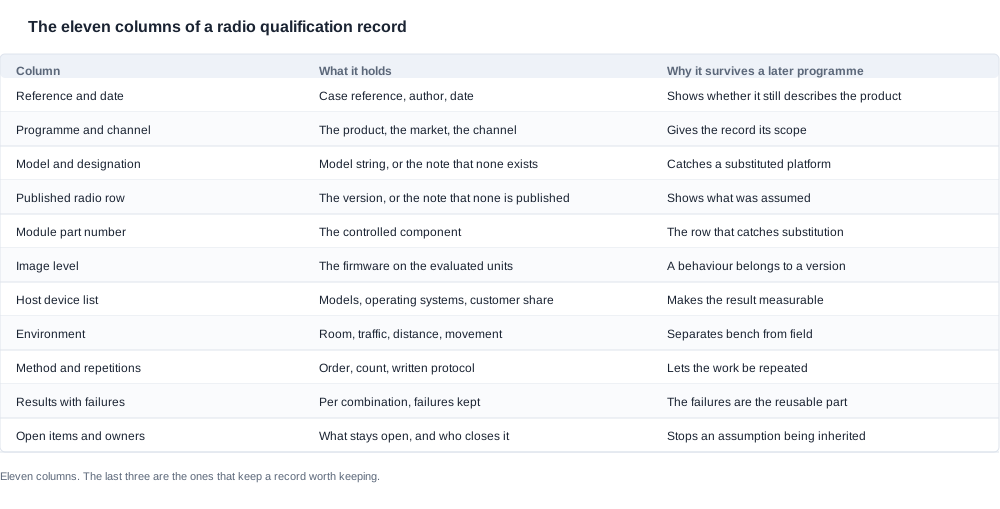
Reference and date. The case reference, the author and the date. This column does almost no work and decides everything, because a radio record without a date is a record that cannot be compared with anything. The Bluetooth versioning discussion covers what happens to the same facts once the fleet grows, and the growth is what makes an undated record worthless.
Programme and channel. The product, the market, the channel and the size of the population it serves. A qualification result is scoped, not universal, and the scope has to be written into the record rather than implied by it.
Model and designation. The exact model string, or an explicit note that the model carries no designation. In our catalogue three entries have no model designation at all, and a record that covers one of them has to say so, because a result attached to an unnamed product cannot be transferred to a named one.
Published radio row. The version where one is published, and where one is not, the note that says so. Fourteen models carry no version, eleven of them camera models, and the honest way to record that is as a row that was requested rather than as a row that was skipped.
Module part number. The controlled component. This is the column that catches a substitution later, and it is the reason a record built around a version number alone is weaker than it appears.
Image level. The firmware running on the evaluated units. A radio behaviour is a property of an image rather than of a model, and a record that omits this cannot be compared with a later test on the same product.
Host device list. The models tested, their operating system versions, and the share of the customer base each represents. The share is what turns a technical list into a commercial decision.
Environment. The room, the 2.4 GHz traffic, the distance and the movement of the test. A connect sequence that succeeds on a bench says nothing about a shop floor, and the environment is the part that is usually left out and always matters.
Method and repetitions. What was done, in what order, how many times, against a protocol written before the first reading. A method another buyer can repeat is worth several times a result that cannot be.
Results, including the failures. The outcome per combination, with the failures kept in the document. A record that contains only the passes is an advertisement.
Open items and their owners. What stayed open, why, and who is going to close it. This column is the difference between a qualification and a claim.
Eleven is more than most teams will fill on the first attempt, and it is worth knowing which columns can be dropped without damaging the record. The four that cannot be dropped are the reference and date, the model and designation, the method, and the results with the failures — those four make the document usable at all. The host device list and the environment are what make it transferable to another programme. The remaining four — the published radio row, the module part number, the image level and the open items — can be added as the programme matures, and a record that starts with seven columns and grows is a better outcome than a record that waits for eleven columns before it is written.
The order in which the columns are filled also matters more than it looks. The early columns are cheap to fill and they change the cost of everything after them: a model designation found to be wrong at the start costs an afternoon, and the same problem found in column ten costs the whole programme.
Filling the columns from the published rows
The second half of the template's usefulness is that most of the columns can be filled before a single test is run, which shortens the programme and makes the gaps visible early.
The reference and date are administrative. The programme and channel come from the brief. The model and designation column can be filled from the order and the build sheet, and the check it enables is the one that matters: if the designation on the unit differs from the designation on the order, the record is written about the wrong product. The published radio row is a lookup for fourteen models and a documented request for the other fourteen.
The module part number is a request to the factory, and it is the request that has the longest lead time, because it is the one that determines whether a change can be detected at all. The image level is read from the units in front of you. The host device list is a negotiation with the channel, and the share figures are the part the channel rarely has to hand.
The environment is decided before the samples arrive, and it should be the environment the product will actually occupy. This is the column that decides whether the record is worth anything later: a qualification run in a quiet room produces a result that cannot be cited for a busy retail floor, and citing it anyway is worse than having no result.
The method, the results and the open items are the three columns that only the test can fill, and they are the reason the record is written as the work runs rather than reconstructed afterwards. A record assembled at the end from notes and memory loses exactly the two things a later programme needs: the sequence, and the failures.
Who fills each column is a practical question that a template should answer, because an unassigned column is an unfilled column. The reference, the programme scope and the environment are the buyer's. The model and designation, the module part number and the image level are the supplier's, and they are the three that usually require a request. The host device list is shared: the customer base comes from the channel and the operating system versions come from the support data. The method is negotiated between the two, and it should be agreed in writing before the first unit is powered on. The results belong to whoever ran the test, and the open items belong to named individuals with dates against them. Six parties, and a template that does not say which party owns which column will be filled by the party with the least other work.
A worked example makes the mechanism concrete. Take the K01, which publishes Bluetooth 5.3, a 90 mAh dual-cell architecture, magnetic charging and a rated runtime of about eight hours. Its record opens with the designation and the date; the published radio row is filled from the catalogue; the module part number and the image level are requested from the factory; the host device list comes from the channel's support data; and the environment is set to the retail floor the product will sit in rather than the bench. The customer share column immediately raises a question the buyer has to answer before the test: the K01's hosts are two generations old, so a meaningful part of the base may be on an operating system that no current phone uses. That question is worth asking, and it is a question the template produced rather than a question the buyer happened to think of. The same record for one of the camera models starts with a request instead of a lookup, because no camera model publishes a radio version at all — which is exactly the kind of difference a reusable structure should make visible on the first page.

The compatibility ledger, one row per host device
The host device list deserves its own structure, because it is the part of the record that gets reused most often and the part that is most often collapsed into a single sentence.
The ledger has one row per host device, and each row carries the host model, the operating system version, the customer share, the units tested, the image level, the outcome, the repetitions, and the date. Eight fields, one row, and the row is the unit of evidence.
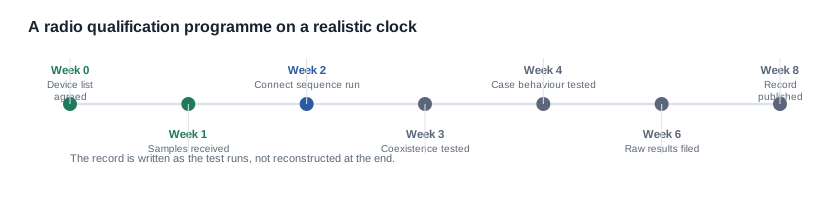
Three rules make the ledger usable. First, a row is only complete when it names the units and the image level, because an outcome without those cannot be reproduced. Second, the repetition count belongs in the row rather than in a footnote, because two successful attempts and one are different results and a reader should not have to infer which they are looking at. Third, a failure row is not an embarrassment; it is the highest-value row in the ledger, because it is the one that saves the next programme a week and gives the factory something specific to fix.
The ledger also has a natural boundary condition, and it is worth writing it into the record rather than leaving it implicit. When a new host device appears in the customer base at a share worth caring about, the ledger is out of date and the record has to say so. A qualification is a statement about a population at a point in time, and the population moves. The buyer checklist is a useful companion, and the buying guide covers the surrounding selection.
One convention makes the ledger much easier to audit: every combination that was not tested gets its own row, marked untested, rather than being omitted. An omission is invisible to a reader, because an absent row and a passing row look the same in a summary. An explicit untested row is a statement, and it is the statement that a later programme needs most — because the combination nobody tested is the combination that surfaces as a customer complaint six months later, and an explicit row turns that complaint into a lookup instead of an investigation. The same convention applies to the model side: a model that was in scope but not tested appears as an untested row for the same reason.
The customer share column deserves a note about how it changes the meaning of the whole ledger. A failure on a host device covering two per cent of the base is a support line and a documentation fix. A failure on a host device covering thirty per cent is a stop-ship decision. The ledger is the same document in both cases, and the share column is what tells a reader which of the two they are looking at.
Recording the gaps without filling them in
The four unpublished areas in our position — the verified device list, the simultaneous connection count, the case coexistence behaviour and the update path — are the reason a record like this exists. Each of them is a row somebody has to fill, and each of them is a row that is usually filled with an assumption.
The rule for the open items column is that a gap is recorded as a gap, with a reason and an owner. Not "unknown", which reads like an oversight. Not a typical value from the industry, which reads like a measurement. A sentence that says what was not tested, why it was not tested, and what would have to happen for it to be tested.
There is a reason this rule is stricter here than elsewhere. In a radio qualification, an assumption that is written down as a fact tends to survive. It gets copied into the next specification, then into the next listing, and it acquires a history of having been written down, which is a kind of credibility that no measurement carries. The case study template in the adjacent battery work follows the same discipline on the power side, and the quality assurance discussion covers the manufacturing side of the same question.
The second reason is commercial. An open item that is recorded as open can be priced, scheduled and closed. An open item that has been filled with a plausible figure cannot be discovered later, which means the risk it represented is now invisible in every document that cites it.
Open items should also be reviewed on a cadence rather than at the end, and the review should be short. Take the open items column, ask for each one whether it has been closed, whether it is still relevant, and whether the assumption it replaced has now been written into a specification somewhere. That last question is the one that catches the failure mode: an open item that was quietly filled in by a colleague who had to make a decision, and whose value is now in three specification sheets and one listing. A quarterly pass over the open items column, fifteen minutes each, is enough to stop it.
How the completed record gets used again
A qualification record earns its cost the second time it is read, and that is where most of them fail. The first read happens the week it is published, when the team that ran it is still in the room. The second read happens a year later, from a different team, on a different programme, and it is the one that decides whether the record was worth writing.
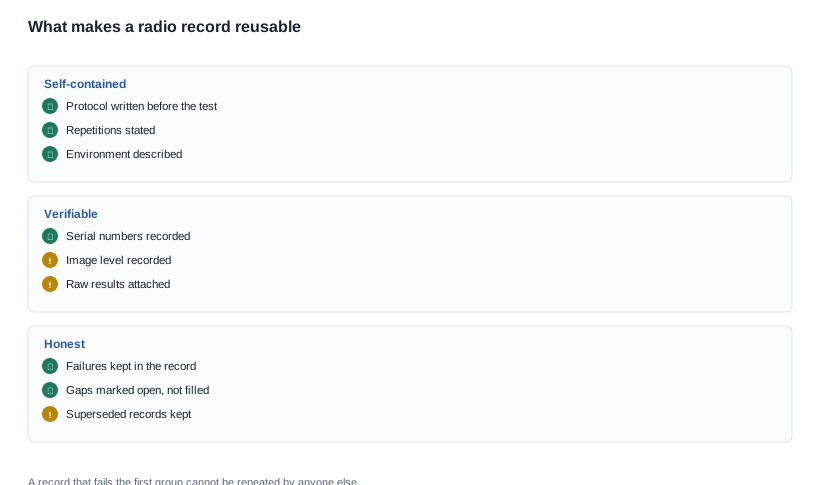
Four things determine whether the second read works. The record is self-contained, so a reader does not have to reconstruct the method from a colleague's memory. It is verifiable, so the reader can check the raw results rather than trusting the summary. It is honest, so the failures and the open items are visible rather than buried. And it is versioned, so that a reader can tell whether it still describes the product in front of them — a record that has been superseded should be marked as superseded, not deleted, because the fact that a product changed is itself a finding.
Publish it where the supplier can see it. A qualification document that stays inside the buyer's team changes nothing about the next programme, and the supplier is the party best placed to fix the failures in it. The failure rows are the most valuable part of the document for exactly that reason: they are the shared work queue between the two organisations.
The reuse scenarios are worth naming, because they are what the record is bought for. A new programme on the same platform finds the ledger and extends it with one row per new host device instead of running the whole sequence again. A new programme on a different platform finds the method and the environment and copies them, saving the two weeks it would otherwise spend designing a test from scratch. A supplier audit finds the results and the failures and knows exactly which questions to expect. A channel review finds the untested rows and knows what it may and may not claim. And a change of project manager inherits a document instead of inheriting a set of questions.
The total cost of the record is a day or two of the team's time plus the test itself, and the return is the avoidance of one repeated qualification cycle and one compatibility dispute. That is a good ratio for a document that also happens to be the evidence a customer dispute is settled with.
The short answer: a qualification record is a deliverable, not an internal note, and we will support one for any programme. We will also be direct about the four gaps in our published position, because a template that pretends they are closed produces a case study that cannot be defended later.
We will not fill an untested area with a plausible figure, and we will not sign off a result that was not reproduced. What we will do is help you build the document, run the test and give you the raw record, including the parts that did not work.
Send your device list and environment, and we will return the completed document with the four gaps marked as open where they remain open.
Related reading
- A companion checklist for the same work — SIG certification buyer checklist
- The surrounding selection work — bluetooth audio glasses buying guide
- The same discipline on the power side — battery life case study template
- The manufacturing side of the question — quality assurance for consumer electronics brands
- What happens to the same facts at fleet scale — advanced considerations
Send your device list and environment, and we will return the completed document with the gaps marked as open where they remain open.


