

Smart glasses bluetooth version smart glasses do you need it is a question with a commercial answer rather than a technical one, and the honest answer is that in most programmes the version is the last thing that should decide the model. Two models in our range publish Bluetooth 5.3, the K01 and the K02, and twelve entries publish 5.4 — the A07, the D11, the D12, the LC-105-1, the LC-105-2, the G07, the YK12, the YKC02, the D17, the ZH12, the AR entry and the light-responsive entry — and that split is the entire published technical difference between the versions for us. The remaining fourteen models, which include every camera platform, publish no version at all.
The reason the version feels more consequential than it is comes from the features buyers associate with it. Newer Bluetooth versions are commonly expected to bring longer range, faster connection, better power efficiency, multi-device connections and, more recently, the newer shared-audio and broadcast profiles. In our range none of those is published for any model. The radio version is published. The feature set on top of it is not. So a decision made on the version number alone is a decision made on a label.
There is a third answer that is more useful than either, and it is the one this article is organised around. When a generation difference is not attached to a feature, it is not a technical upgrade at all — it is a merchandising decision, and it should be costed, stocked and defended like one.
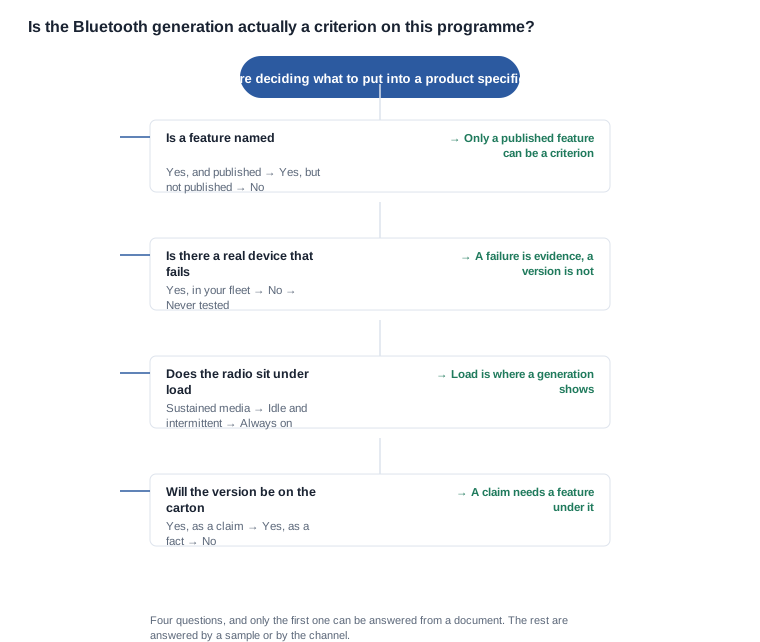
Smart glasses Bluetooth version: the four situations where a generation counts
There are four situations in which a generation can be a criterion, and each of them needs its own evidence rather than a general argument about generations being better.
1. When a specific device in the fleet will not connect. This is real and it is worth checking early, because it is a device-list problem rather than a version problem. The published position is that no verified device list exists for any model in our range, so this has to be tested on a sample with the actual devices rather than argued from a generation. The advanced considerations covers the fleet-scale view, where a single old device in a large fleet behaves very differently from a fleet of new ones.
2. When the product sits in an environment with a lot of other 2.4 GHz equipment. A generation number does not fix coexistence, and the practical mitigation is fewer radios in the environment rather than a newer number in the chip. A warehouse, a plant room and a trade show floor are three different interference environments, and a product that works in one of them has not been shown to work in the other two.
3. When a feature you actually want depends on the generation. This is the legitimate case, and it requires the feature to be published and evidenced. The newer shared-audio and broadcast profiles are separate claims with separate evidence, and neither is published for our models. The SIG certification discussion is the right place to understand why a qualification and a radio approval are two different things, because the distinction matters here: the feature has to be evidenced, not inferred from the generation that could support it.
4. When the programme is a two-model range and the generation is the only thing that separates them. Sometimes this is a legitimate merchandising decision, and the right question then becomes whether the difference is worth the extra stock. That is a question about inventory, minimum order quantities and channel price tiers, and it is answered in the section on stock policy below rather than in a technical argument.
Notice what is common to all four. In each case the generation is not doing the deciding on its own. In the first three it points at a specific thing to test; in the fourth it is being treated explicitly as a commercial choice. What none of the four does is justify a version on the grounds that it is newer.
The evidence each of the four cases actually needs
Each of the four cases has a different kind of evidence behind it, and a buyer who asks for the wrong kind will get a document that does not resolve the question.
The old-device case needs a sample test on the specific devices, with the result recorded against the firmware build on the unit and the operating system version on the host. A verbal assurance that the product "pairs with older phones" is not evidence, because the failure is device-specific and the assurance is not.
The dense-environment case needs a measurement in the target environment with the method named, and a quality control position from the factory on what happens when the interference is severe enough to be reported. If the factory's quality control process has no defined response for a link-quality complaint, then the environment is not being managed and a newer generation will not manage it either.
The feature case needs a document. A feature that is claimed on a product page has to be evidenced on a sample, with the conditions stated, and the evidence has to be reproducible by somebody who was not in the room. A technical file for the relevant market has to cover the configuration in which the feature is claimed, and the qualification record has to cover the implementation the feature sits on.
The two-model case needs commercial documents rather than technical ones: the minimum order quantity per model, the quoted lead time per model, the price tier for each, the packaging specification for each, and a written position on the production end date for the model that will be retired. Those five items are what turn a range from a technical description into a plan the factory can quote against and the channel can order from.
The four situations where it is a label on the carton
When the use case is a call in a quiet room. The determining factors there are the microphone and the profile the product negotiates, and the microphone specification is not published for any model in our range. The calls use case covers what that means in practice, and the short version is that the radio generation is not on the list of rows that decide this one.
When the deciding factor is battery. The published cell configurations, charge times and runtimes differ far more between models than the radio version does, and they are published. The buying guide works through the tier: 55 mAh × 2 on the G07 and the YK12, and the LC-105-1 and the LC-105-2, 70 mAh × 2 on the YKC02, 90 mAh × 2 on the K01 and the K02, 100 mAh on the D11, the D12 and the ZH12, and 115 mAh on the D17. A buyer comparing two models on runtime is comparing something published and consequential. A buyer comparing them on generation is comparing something published and inert.
When the deciding factor is the product line itself. The entry level options discussion is the right one when the question is which product to start a line with rather than which version to insist on. The first model in a range is chosen on price, form factor and channel fit, and the generation is not one of the criteria that has ever survived a channel conversation.
When the deciding factor is a feature the generation does not deliver. A newer radio number with no published feature on top of it is a marketing position rather than a product advantage, and a marketing position is a cost, because it has to be maintained across every listing, every carton and every support script for as long as the product is in the channel.
There is a fifth situation that is worth naming because it is the most common: when the deciding factor is the price. A generation difference with no feature under it will be used to justify a price difference, and the justification will not survive the first serious question from a channel partner. A buyer who cannot state the feature under the price difference is not selling a better product; they are running two price tiers and calling one of them an upgrade, which is a perfectly legitimate commercial structure with a different name.
A stock policy that treats a generation difference as a merchandising decision
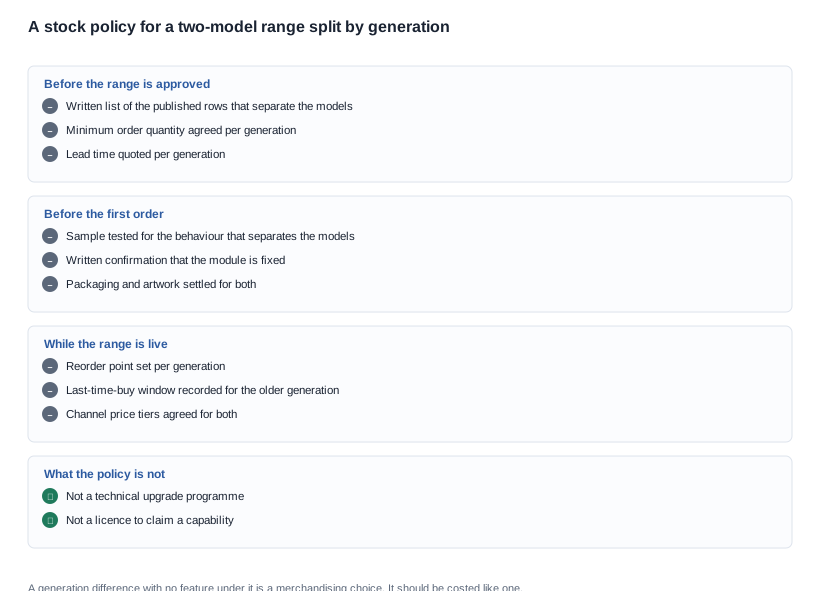
If the generation difference is not attached to a published feature, then the two models are two price tiers, and the commercial consequences of that are specific and manageable. Treating them as an upgrade instead is what turns a manageable structure into a problem.
Set a minimum order quantity per generation, and understand what it does. Every additional configuration in a range carries its own minimum order quantity, its own packaging, its own artwork, its own firmware build and its own share of the inspection cost. Two generations means two of all of those. The commercial test is whether the incremental volume in the second generation exceeds the cost of holding it, and that is a calculation the buyer can do — provided the factory gives the minimum quantities in writing rather than as a range.
Agree the lead time per generation separately. Two generations with different lead times produce a range where one is reliably available and the other is not, and that is a supply problem for the channel rather than a product problem. Ask for the lead time on each model, the factory's current capacity for each, and what happens to the schedule if both are in production at once.
Plan the exit. The model that carries the older generation will be retired at some point, and the exit is cheaper if it is planned. A last-time-buy window, a stated date for the end of production, and a written position on spare parts and firmware support for the period after production ends are the three things to secure while the factory still wants the order.
Price the tiers against each other deliberately. If the two models are two price tiers, then the price gap has to be a commercial decision with a number attached to it, and it should be set by what the customer gets — the published cell configuration, the runtime, the case — rather than by what the radio says. The buying guide and the entry level options discussions both come back to this: the customer-facing difference is the row that justifies the price.
Keep the claim out of the copy. If the tier is a stock decision, the product page should describe what the customer gets and should not promise a capability the generation does not deliver. This is the point where the cost of the decision reappears, because a claim that is made has to be defended for the life of the listing.
What a stock policy is not, and it is worth stating because programmes have tried to argue otherwise, is a technical upgrade programme. There is no upgrade path between two radios on two platforms, and a customer who buys the older model and later expects the newer model's behaviour has been misled.
How to negotiate a two-generation structure with a factory
The negotiation is not about the radio, and it is worth being clear about that before the first meeting, because a buyer who opens on the version will negotiate the version and get a small number.
Negotiate the configuration count first. The number of distinct configurations drives the minimum order quantity per model, the packaging tooling, the firmware build count, the inspection burden and the number of test cycles. A range that spans two generations, two charging interfaces and two case configurations is a range with more combinations than anyone intended, and it is usually cheaper to reduce the count than to order around it. Ask the supplier to state the number of configurations their quote assumes, because a quote that does not state it is a quote that will move later.
Negotiate the minimum order quantity per model, not per range. A single minimum across a two-model range forces the buyer to hold the unwanted model. Two minimums, one per model, sized against the demand plan for each, are what make a two-generation range workable, and they are a much better use of negotiating capital than a discount on the unit price.
Negotiate the payment and delivery structure around the retirement, not around the launch. A deposit, a balance on inspection before shipment, and a retention held against the documentation package is the conventional shape, and in a two-generation structure it is worth adding one term: the payment schedule for the final order of the model that will be retired, and a commitment on the date production ends. The cost of that term is close to zero for the factory and the value of it is a whole production cycle.
Put the documentation in the contract rather than in the quotation. A quotation is a statement of intent; a contract is an obligation. The model list on the conformity documents, the model list on the qualification, the firmware build on the units supplied, and the position on the version row for the models where it is not published, are all things that should appear in the agreement rather than in a supplier's email.
Ask what the defect and warranty position is on a generation split. If the two models share a platform, a defect in the shared platform affects both, and the warranty treatment should be uniform. If they do not share a platform, the spare part and firmware support position for the retired model has to be settled, because a product that has been withdrawn from production but is still in the field needs a support path for as long as the channel is selling it.

The five-step method we would use before a version enters a specification

Step one: write down what the customer will actually do with the product, in one sentence, and mark which published rows bear on it. This is a discipline rather than an insight, and it is the step that stops a version from entering a specification with no argument behind it.
Step two: check the device list against a sample, because the version claim only matters if a real device fails, and a real device failing is a fact while a version is a hypothesis. Test the two or three models that carry most of the volume, not the newest one available.
Step three: list the features that a newer generation would imply, and ask for each of them to be published. The ones that cannot be published are not available to you, whatever the chip says. This step is where a programme discovers that it is paying a premium for something it cannot describe on a product page.
Step four: compare the models on the rows that are published, which are cell configuration, rated runtime, charging method, case capacity and, in the camera class, the resolution tier and the cell capacity. If a difference between two candidates cannot be expressed in one of those rows, it is not a difference you can sell.
Step five: treat a version difference as a stock decision, with a minimum per generation and a planned exit, rather than as a technical upgrade you are paying a premium for. And if the version is the only difference between two models, that is the finding — not a problem to be solved, but a structure to be costed.
The method is deliberately ordered so that the cheapest steps come first. Step one costs nothing and can be done at the specification stage, before anyone has spent money. Step two costs a sample. Step three costs an email. Steps four and five cost a meeting. A programme that runs the steps in the reverse order spends the money first and discovers the answer last, which is why the version survives into so many specifications.

How to evaluate the question: what to ask, and what a soft answer looks like
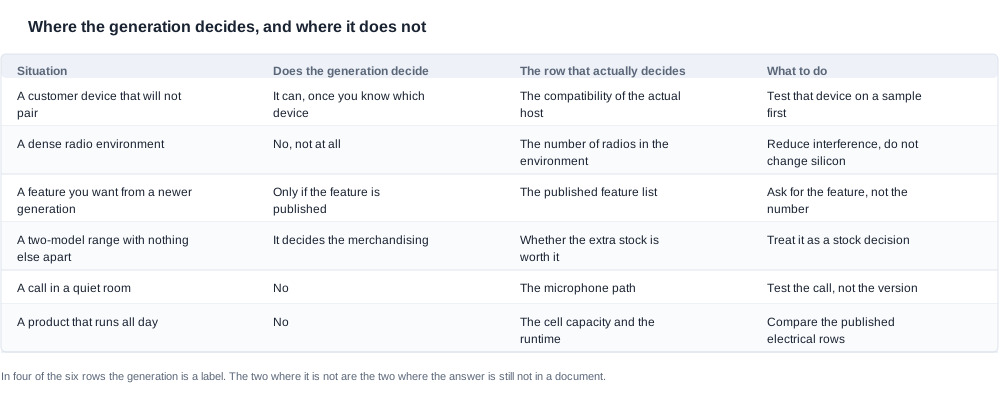
The table below puts the six situations side by side with the row that actually decides each one, because the most common failure is not a technical error but a misfiled question. A buyer asking about the generation when the deciding row is the microphone path will get an answer that is correct and useless.
The soft answers are worth naming explicitly, because they are usually delivered confidently. "It has the latest Bluetooth" is not an answer to a question about a feature. "It will connect to any phone" is an answer about the link and nothing else. "Full Bluetooth 5.4 support" is a claim about a protocol generation being read as a claim about a product. "Up to 20 hours of playback" is a figure that needs its condition attached before it can be compared with anything.
A better set of questions for a supplier who is offering a generation as an advantage is: which features does that generation enable on this product; can each of them be evidenced on a sample; what is the default profile and codec; how many devices are held at once; and what is the measured range in the environment we sell into. If the supplier answers those, the generation has done its job and can be recorded. If the supplier cannot, the generation is a label, and the programme should be costed accordingly.
Two further red flags are worth naming. The first is a supplier who uses the generation to explain a range rather than a product — if the reasoning is that the newer model is better because of the radio, the question to ask is what the customer is supposed to notice. The second is a price difference justified by the generation with no feature named, which is a price tier wearing a technical explanation.
What we will not do with a version number
The working rule we apply: the Bluetooth version is a fact about the radio and not a feature, and we publish it per model because it is durable, while we do not publish any of the features a buyer might expect a version to bring, because we do not hold them for any model.
We will also say that a buyer who wants the newer shared-audio or broadcast profiles, or multi-device connections, should ask for those to be evidenced directly, and that if they cannot be evidenced then the version number is a label on the package rather than a capability. What we will not do is use a version number to justify a price difference we cannot substantiate with a published feature, because that is the one place where the version actively creates a commercial problem rather than merely failing to be useful.
We will also not infer a version for a model whose published row is blank. The eleven camera platforms, the A05, the A06 and the bone conduction entry publish no version, and the correct answer to "what version is the camera model" is that our documentation does not state it, which is a different answer from "it is 5.4" and a more useful one.
Tell us the devices, the use case and the features you need, and we will tell you which of them the version actually delivers, which of them need a test on your own units, and which of the two models in a two-model range is a technical choice and which is a stock decision.
Related reading
- Bluetooth connectivity and versions
- Advanced fleet-scale considerations
- Bluetooth SIG certification, and how it differs from a radio approval
- Bluetooth audio glasses for calls
Tell us the devices, the use case and the features you need, and we will tell you which of them the version actually delivers.


