

Smart glasses Bluetooth version: who carries the obligation
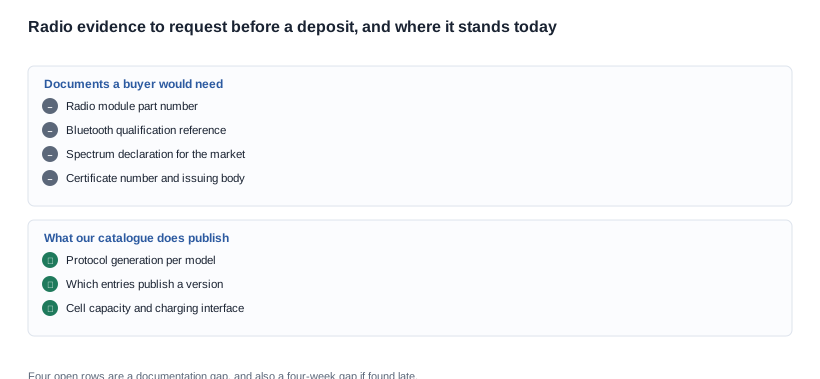
A Bluetooth version number is not a radio approval, and the paperwork behind one does not transfer to you. The radio inside a smart glasses product is the only component in the product that carries a formal qualification process regardless of what else the product does, and that is what makes the regulatory question narrower than most compliance topics — and harder, because the obligation attaches to the economic operator placing the product on the market, which in an import programme is you. Our own documentation carries an export-certification page showing ten patent certificates — eight appearance-design patents and two utility-model patents — and it names no CE, FCC or RoHS marking anywhere, so it publishes no certificate number, no issuing body and no validity period for any of them, and we publish no module part number, no Bluetooth qualification reference and no spectrum declaration for any model. That is a real limitation on our side and it is worth stating at the start rather than at a market surveillance question. It does not mean the product cannot be sold into a regulated market; it means you should not plan on inheriting the radio file from us. What you should plan on is this: four separate obligations, held by four different parties, of which the factory typically holds one, and the version number appears in none of them.
The four parties in the chain, and who holds what
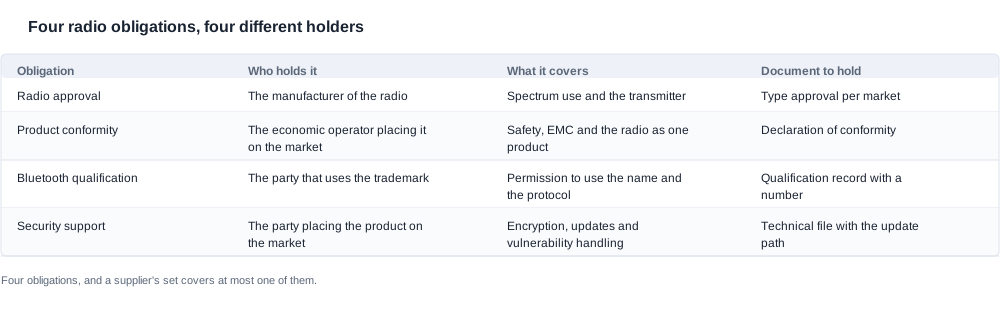
The first thing to get straight is that the radio, the product, the trademark and the security support are four different obligations, and merging them is the root of nearly every problem in this area.
The radio itself is subject to spectrum and qualification requirements wherever it is sold. A Bluetooth Low Energy radio does not become compliant because the rest of the product is well made, and it does not become non-compliant because the product carries someone else's brand. This obligation sits with the manufacturer of the radio, and its evidence is a type approval record held against a module and a market.
The product as placed on the market carries the general conformity obligations — safety, electromagnetic compatibility and the radio assessed together as one product rather than as parts. This obligation sits with the economic operator placing it on the market. In an import programme that is your company, not the factory, and no amount of documentation in the factory's possession discharges it.
The Bluetooth trademark and qualification is a separate system entirely. It is a legal permission to use the name and to implement the protocol, issued as a Declaration ID and now formally called a Design Number, and it is held by whichever party qualified. A product can comply with radio rules without being listed for Bluetooth, and the reverse is equally true.
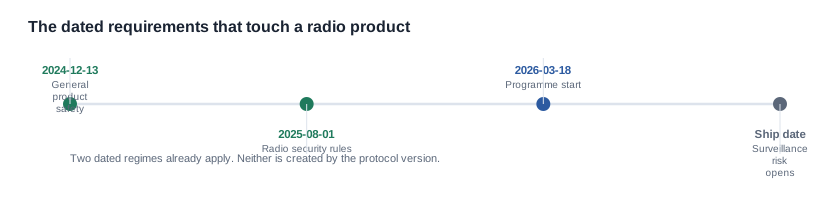
The security support obligation sits with the party placing the product on the market. It covers secure communication, encryption, secure storage, user consent and a process for handling identified vulnerabilities — the subject matter of the EN 18031 series of harmonised standards, whose requirements became a mandatory part of CE marking on 1 August 2025.
The practical consequence of holding these four apart is that a supplier's documentation set covers at most one of them, and a buyer who requests "the certificates" in a single email receives whichever one the supplier happens to hold. Splitting the request into four named items, and being explicit about which one you are asking for, is the first step in finding out whether the answer exists.
The four obligations, and the single document that evidences each:
- Radio approval — a type approval reference, the issuing authority and the validity period.
- Product conformity — a declaration that names the model designations it covers.
- Trademark and qualification — a Design Number and the entity that holds it.
- Security and update support — a technical file describing the update path and the vulnerability handling process.
The buyer who is doing this, and the fear underneath the request
The person running this is normally a compliance or product lead inside a brand, a channel business importing into an EU or US market, or a product manager who has just been told by a market surveillance letter that the product cannot be sold until a document appears. He is not reading a datasheet for pleasure. He is trying to answer a specific question: which document do I have to produce, to whom, and by when, and can I get it from the factory or do I have to commission it myself?
The version number sits in the middle of this conversation because everyone believes it is the answer. A supplier sheet says Bluetooth 5.4 and the buyer records "version 5.4" in the compliance file, and the file is then two years later found to contain a number where a record was required. The version names a generation of protocol. It does not identify the module, does not tell you which profiles the product implements, does not tell you what the radio transmits, and is not a qualification reference. It is the one piece of radio information with no verification value, and it is the one everybody records.
What the buyer is actually afraid of is not a fine. It is a launch date. The scenario that keeps him awake is a launch that slips because a document was commissioned in week six instead of week one, and a second shipment that is held at the border because the record on file names a different model from the units in the container.
The four regimes a radio product passes through, and what each one costs
Regulatory work in this category is expensive in time rather than in fee, and the reason is queues. The laboratory that runs radio testing operates on a slot. The qualification body operates on a queue. The notified or approved body that assesses a product operates on a queue. Pressing harder on any of these produces a later date, not an earlier one, and that is why the sequencing of the programme matters more than the choice of supplier.

The first regime is the radio approval route for the destination market. It is market-specific, and it is the regime with the longest lead because the test laboratory slot is the constraint. For a European launch it runs through the Radio Equipment Directive 2014/53/EU, which brings the radio within a product-level framework covering safety and electromagnetic compatibility as well as the radio itself. For a United States launch it is a separate equipment authorisation with its own labelling conditions. For most other markets it is a national approval, frequently with a local representative involved, and that turns a single launch into a sequence of launches.
The second regime is the product conformity assessment, which covers the product as one object. This is where a change to the housing, the antenna or the charging interface becomes a compliance question rather than a design preference, and it is the regime that makes the frame part of the radio environment in a literal sense: the frame is an RF structure, and a different material or a different internal layout can change the assessment outcome.
The third regime is the cybersecurity obligation, which is the newest of the four and the one that catches teams out. It applies from 1 August 2025, it is written in terms of the product's behaviour rather than its construction, and a supplier who cannot describe the update path, the consent model and the vulnerability handling process cannot complete the technical file. A radio generation that supports modern encryption starts a buyer closer to this requirement, which is the one commercially useful thing the version number tells you.
The fourth regime is the trademark and qualification system. For a private-label buyer this is the layer that matters first, because it decides what may appear on the box, in the listing and in the manual. A brand that has not qualified cannot use the name, and a supplier who applies the logo to your artwork before asking is creating a problem for you.
The cost picture that follows from this is worth stating plainly. Regulatory work in a Bluetooth smart glasses programme is a fixed cost per product family, multiplied by the number of markets and by the number of configurations. It is not a line you can negotiate down by ordering more units, and it does not amortise across a range the way tooling does. The number that a buyer should therefore optimise is not the unit price and not the radio version, but the number of configurations and the number of markets the programme actually needs — because that is the multiplier on everything in this section.
What a radio document has to say, and the thresholds to hold
Four obligations, four evidence sets, and for each one a specific set of thresholds: what the document must identify, what it must cover, and what a defective one looks like. These thresholds are not ours — they are the ordinary contents of radio and conformity records in this category, and they are what a buyer should insist on before a deposit.
Threshold one — the radio approval record
How it is identified. A type approval reference, the issuing authority, the approval date and the validity period. The reference number is the part that matters: it is the only element that a broker, a marketplace or your own compliance team can look up later.
What it must cover. The model or the module, the frequency band, the transmit power class, and the market it was approved for. An approval that covers a module is not automatically an approval covering a finished product, and an approval covering one band does not cover another.
What a defective record looks like. A certificate with a number but no issuing body; a number that resolves to a different product; a certificate whose validity date has passed; a family-level document used to cover a specific branded configuration. In a family where several models share the same electrical rows, the model string comparison is the check that catches a substitution, and a mismatch there is a stop condition rather than a query.
Threshold two — the product conformity declaration
How it is identified. The declaration itself, the model designations it lists, the standards it cites and the date. A declaration that lists several models is fine; a declaration that lists none is not usable, because you cannot show which unit it covers.
What it must cover. The product as a whole, including the radio, and it must name the product that the units in your container actually are. Where the product carries a camera, the assessment must cover the camera as part of the product rather than as an accessory.
What a defective record looks like. A declaration naming a model designation you have never ordered; a declaration issued by a party who is not the economic operator placing the product on the market; a declaration whose cited standards do not cover the radio band you are shipping into.
Threshold three — the qualification record
How it is identified. A Design Number, or the Declaration ID that preceded it, plus the entity that holds it.
What it must cover. The question that decides it is inheritance. A factory that qualified earlier usually holds the record, and whether that record can be inherited by a brand that is not the qualifying entity saves both testing time and money. Ask directly. The answer is a document or a clear no.
What a defective record looks like. A record held by a legal entity with no relationship to your business, with no route to inheritance stated; a record whose scope does not include the model you are ordering; or a claim of "certified" with no number at all, which is the most common form and the least useful.
Threshold four — the security and update evidence
How it is identified. The technical file itself, the update method, the support window and the vulnerability handling process, each with a version and a date.
What it must cover. Secure communication, encryption, secure storage, user consent and the handling of identified vulnerabilities. In practice this means the file has to describe how a unit in the field is updated, how long builds are kept, and what happens when a vulnerability is found.
What a defective record looks like. A file with a radio specification and no update path. A radio with no update path cannot be brought into line with a strengthened requirement later, and a buyer who discovers that after the first shipment has a product it can neither patch nor defend.
The threshold that applies across all four
None of these four documents is directly comparable across suppliers, and the reason is scope rather than quality. A record that covers a module, a record that covers a finished product and a record that covers a product in one market are three different instruments, and a supplier holding two of them has not held three. When you compare quotations, compare what each document covers and what it is valid for — not whether one exists, because in this category at least one exists at every supplier.
The shortlist criteria a compliance lead can actually apply, in the order they should be evaluated:
- Can each of the four obligations be traced to a record number? If not, the gap is known and can be budgeted.
- Does each record name the model designation you are ordering? A record that names a family is not a record that names your unit.
- Does the qualification record transfer to your brand? This is the one with a commercial answer attached.
- Can the technical file be produced from the supplier's own records? If it cannot, it has to be commissioned.
- Which of the four is on the critical path? The one that is determines the launch date, not the one that is hardest.
These five questions are what to ask before you order, and the answers together tell you whether the programme is a documentation exercise or a laboratory project.

How to assemble the radio evidence yourself
Where a supplier will not or cannot provide the four documents, the buyer's task changes from collecting to commissioning. This is normal in this category and it should be planned as a workstream with its own cost and its own lead time, not as an email that might work.
Step one: decide which market list you are actually shipping into, and write it down. Every radio document is market-scoped, so the market list determines how many approval routes you need. This is the point at which a buyer discovers that the programme needs three national approvals and a European conformity route rather than one approval, and it is much cheaper to discover it here than at the artwork stage.
Step two: ask the factory for the four items separately. Module part number, radio approval reference, qualification reference, and the technical file with the update path. Four separate sentences. If the answer to all four is a version number, you now know the factory's documentation stops at the spec sheet and you can plan accordingly.
Step three: check the numbers yourself in the issuing body's public register. Confirm the model string, the scope, the market and the validity date. This takes an hour per record and it is the only check that a third party can repeat, which is what makes it evidence rather than assurance.
Step four: identify the gap precisely, and name who will close it. For each of the four obligations, record one of three states: held with a number you can verify, held but not transferable to your brand, or open. The third state is the one that needs a plan. It might be a qualification you commission, a route to inherit an existing record, or an approach to a notified body with the product. Each has a different cost and a different lead time.
Step five: write the open items into the purchase order as conditions. A radio approval reference that does not yet exist but is required before the first shipment is a condition precedent, not a wish. Attaching it to the payment schedule is the mechanism that makes it real: the deposit is smaller, the balance is released on delivery of the named records.
Step six: fix the configuration, because a configuration change invalidates the file. Any change to the radio module, the frame material, the antenna, the charging interface or the firmware baseline can change the conformity position. The order needs a notice obligation on those changes, and a re-issue obligation on the documentation pack.

Where a radio programme fails on paperwork rather than on hardware
The file names a different model. The symptom is a customs query, a marketplace rejection or a warranty claim that cannot be settled. The root cause is that a family-level document was treated as coverage for a branded configuration. The prevention is to make the exact model designation a condition of the order and to check the string on the units at receipt.
The qualification cannot be inherited. The symptom is a launch that stops after the artwork is approved, because the brand discovers it may not use the trademark. The root cause is that the question was never asked in writing, and the supplier assumed the buyer had qualified. The prevention is to ask in the first email and to treat "we cannot transfer it" as a procurement problem to solve early, not a detail to note.
A configuration change was made after the assessment. The symptom is units that are technically different from the assessed product, and a document that no longer describes what is being shipped. The root cause is a change control rule that lists the battery and the colour but not the radio module or the firmware baseline. The prevention is to name the controlled items explicitly.
The security evidence was assembled after launch. The symptom is a technical file that cannot answer a straightforward question about how a unit is updated in the field. The root cause is that the file was treated as a certificate rather than as a living document. The prevention is to ask for the update path at the same time as the approval reference, because the two travel together.
The version was recorded instead of the reference. The symptom is a compliance file with a version number where a record was required, discovered by someone who read the file properly. The root cause is that the version is easy to copy and the reference is hard to obtain. The prevention is a one-line rule in the documentation procedure: if a cell in the compliance file holds a version, it is incomplete.
Which of these costs can move and which cannot
Certification cost and certification time are fixed in character per product family and per market, and they carry a queue in front of them; pressing produces a longer schedule rather than a shorter one. The same is true of the laboratory slots behind the radio approval route. The tooling cost is a one-off item usually amortised across the first order, so the questions worth asking are over what volume it is amortised and what happens to it if the programme is discontinued.
What does move is the number of documents you commission yourself, the number of markets you enter, the number of configurations in the first order, and the schedule on which you commission them. A buyer who enters one market with one configuration and inherits an existing qualification will have a shorter programme than a buyer who enters four markets with three configurations, and the difference is entirely in decisions rather than in supplier behaviour. The negotiation that matters is therefore about scope discipline and about the order in which work is commissioned, not about the price of the certification itself.
A worked case, our own limits, and the request we can answer
What follows is a worked example rather than a client project, and it is here to set out the sequence a buyer would follow rather than to describe a result.
Assume a distributor in the European Union that already sells audio products and is adding a smart glasses line from an overseas factory. The distributor's compliance lead has one file, one product, and a launch date set by the channel's promotional calendar. The factory's sheet states Bluetooth 5.4, and nothing else about the radio.
Step one: the market list. The distributor confirms it is selling into two member states with the same conformity route, so one European route is required and no national approval is needed for those two. This immediately removes a workstream that a distributor selling into a third country would have had to fund.
Step two: the four-part request. The distributor asks the factory for the module part number, the radio approval reference, the qualification reference and the technical file with the update path. The factory answers two of the four: it holds a radio approval reference for the module it uses, and it holds a qualification record from an earlier programme. It cannot supply a module part number beyond the trade name, and it has no technical file because it has never sold directly into this market.
Step three: the two questions that matter. The distributor asks whether the qualification record can be inherited by a brand the factory does not own, and whether the radio approval reference covers the finished unit or only the module. The first answer is yes, with a written confirmation. The second answer is that the reference covers the module only, which means the finished product needs its own conformity assessment — the most expensive of the four obligations, and one that is now in the plan rather than a surprise.
Step four: the plan. The distributor prices the conformity assessment and the file assembly as a fixed cost, attaches the radio approval reference and the qualification number to the purchase order as conditions precedent, and reduces the first order to one configuration. The launch date moves by the assessment period, and the promotional calendar is renegotiated rather than the compliance work being compressed.
Step five: what the listing says. The distributor's product page states the protocol version because it is a meaningful consumer specification, and does not imply that the version constitutes an approval. The packaging carries the model designation that appears on the conformity document, so the record and the unit can be matched.
The decisive decision in this walk-through was the four-part request in week one. Everything after it was cost that had to be budgeted, rather than risk that had to be absorbed.
What we publish, and what we cannot supply
It is worth being precise: we publish the protocol generation our documentation states, we mark the models where none is given, and we do not attach a module or a qualification reference to anything, because we do not hold them. Across our 28 catalogue entries we publish a version for 14: V5.3 on the K01 and the K02, and V5.4 on the D11, the LC-105-1, the LC-105-2, the YK12, the D12, the G07, the YKC02, the D17, the ZH12, the A07, the electrochromic entry and the AR entry. The camera family, the bone conduction entry, the A05 and the A06 carry no published version.
We cannot supply, from our documentation today, a radio module part number, a Bluetooth qualification reference, a spectrum declaration, a certificate number with an issuing body, or a technical file. What our source material carries is an export-certification page of ten patent certificates, eight of them appearance-design patents and two utility-model patents; it names no CE, FCC or RoHS marking and publishes no certificate number, issuing body or validity period for any of them. We would rather say that plainly than present a version number in place of a record.
The same discipline applies to a row as ordinary as weight. Our catalogue publishes a weight for one entry only: 158 g for the MT6 glasses unit, excluding its foldable charging case, whose capacity is 1200 mAh. Nothing else in the range publishes a weight, and we will not estimate one. For a file that has to describe the product accurately at customs and at incoming inspection, an accurate statement about what is not published is worth more than a plausible figure. We make no vision, health or eye-protection efficacy claim for any product in any market.
The request that would let us answer properly
If your programme needs radio evidence, the request worth making is for the module detail and the qualification reference for a specific model, not for a version number, because a version number would not settle it. Send us the model, the destination market and the brand arrangement, and we will tell you which of the four obligations we can evidence today, which one the factory can supply, and which one has to be commissioned separately.
The technical background is under bluetooth connectivity, the general framework is in product compliance, the configuration-change problem is covered under smart glasses oem risk factors, and the cost of a configuration change is set out under customization cost factors. Where the radio documentation stops is covered in the bluetooth version glossary, and the evidence a shipped product needs is collected in the certification checklist.
Ask us for the module and qualification reference on a specific model, and we will tell you whether we can supply it.


