

Smart glasses Bluetooth version: rarely the critical path
A Bluetooth version on a smart glasses programme is one of the least likely things to set the delivery date, and a schedule built around it will be wrong. The radio generation is a stable fact once a platform is chosen — Bluetooth V5.3 on the K01 and the K02 in our range, V5.4 across twelve further entries — and it does not change while the order is being produced. What sets the date are the two external approval routes, the upstream component lead, the charging case, the firmware and app work, the laboratory queue for device-list testing, and the packaging. None of those is a version number, and none of them shortens because you chose the newer protocol. The practical consequence for a procurement lead is that the first question to put to a supplier is not "which Bluetooth version" but "which of these seven factors binds on my specific programme, and what is the range of the date". Our published position on production lead times is that they are confirmed per enquiry rather than published on this site, because a lead time without its starting event, its market list and its configuration is not a number a buyer can plan against.
The buyer who needs a date, and the two dates he actually needs
The reader is a sourcing manager or a product lead who has a launch date set by something outside his control — a retail window, a trade show, a channel contract, a marketing budget cycle. He has a supplier's quotation in front of him carrying a lead time, and he has to decide whether to accept it.
Two questions about the date are usually conflated, and separating them is the first useful thing a buyer can do. The first is the production lead time: how long the factory needs to build the units once everything it needs is in hand. The second is the programme lead time: how long from the decision to take the order to a shippable, documented, compliant unit in the customer's market. The second is always the longer one, and it is the one that decides whether a launch date is realistic. A supplier quoting a production lead time of six weeks is quoting the first number, and a buyer who plans on it has quietly assumed that the approval routes, the documentation, the firmware and the packaging all take zero time.
What he fears is a specific and common failure: the factory says the units are ready, and the programme cannot ship because a document, a firmware build or a packaging approval is not in place. That failure is not visible in any production schedule, because it sits entirely in the work that happens before the build.

Where the time actually goes, and what it costs to wait
Programme time in this category divides into three kinds, and the three behave differently under pressure.
Queued work is work that waits for a third party: a test laboratory, a qualification body, a notified body, a laboratory queue for device-list testing. This is the part that cannot be shortened by spending money, because the constraint is a slot. The only two things that affect it are how early you book and how few queues you need. A programme that needs one European route and one inherited qualification has two queues in it. A programme that needs four national approvals, a fresh qualification and a fresh conformity assessment has six, and no amount of pressure moves the fourth one forward.
Supplied work is work that waits for the supply chain: the radio module, the controller, the cell, the camera module and its sensor, and the charging case with its own tooling. This part is compressed by commitment. A factory with an allocation and a forecast gets a different queue position from one without, and the difference is often several weeks. The buyer's leverage here is volume visibility and forecast accuracy, not pressure.
Programmed work is the work the buyer and the factory control: firmware baselines, the companion app, the packaging artwork, the documentation pack, the internal approval process and the artwork rounds. This part compresses with discipline. Artwork rounds in particular are the most commonly underestimated item in a consumer electronics programme, because each round is a calendar event rather than an effort estimate, and a round that is missing a dimension from the supplier's side is a round that has to happen again.

The cost of getting this wrong is asymmetric, which is why a programme that runs late is worse than one that runs slightly long. A launch that slips by two weeks costs a marketing slot and possibly a channel relationship. A launch that ships without the documentation for the destination market stops at the border or at the marketplace review, and the units become inventory you cannot move. Buying in the right order — approvals and documentation before the build rather than after it — costs weeks of elapsed time and saves months.
There is a fourth cost that rarely appears in a schedule and always appears in a margin calculation: the cost of a configuration change. Every re-work of artwork, every re-issue of a document and every re-test of a sample is paid for in calendar time. A programme that fixes its configurations early is not merely faster; it is cheaper per unit, because the setup work is amortised over a larger committed volume.
The seven schedule factors, and the threshold to hold on each
Seven factors set the date in a Bluetooth smart glasses programme. The version is not one of them, which is the point of this section: it is a fixed attribute of the platform, and the seven below are the variables. For each one, the threshold is what a supplier has to state before the factor can be planned rather than absorbed.
One: the radio approval route. This is external and long, and it is the factor most often left unopened until the product is otherwise finished. The threshold is that the route is identified per destination market in the first week, together with the current stage of the work and who holds it. A supplier who says "that is handled" has not told you whether the route is inherited or new, and the difference is a queue.
Two: the Bluetooth qualification. This is a separate path from the radio approval, with a different duration and a different queue. The threshold is whether a record can be inherited. A factory that qualified earlier usually holds a Design Number, and whether your brand can inherit it removes an entire queue from the programme. The SIG certification checklist covers the qualification side, and the marking and labelling discussion covers the product marking that follows it.
Three: the chipset and the component lead. Our published range splits across two radio generations, and a configuration built on a different radio than the rest of the range is a different supply path rather than merely a different number. The threshold is a written statement of the allocation and the forecast, and a confirmation of which part number sits behind the published version.
Four: the charging case. A case is a second product with its own tooling, its own lead and its own qualification exposure. In our range the cases are 1400 mAh on the CY03, the CY05 and the L1 Pro, 900 or 1400 mAh on the L2 Utral, and a 1200 mAh foldable case on the MT6, while the KY06 and the MT5 have a case of unstated capacity and the V03 Pro has none. The threshold is that the case configuration is named in the order and its tooling ownership and timing are stated. The available configurations are set out under charging case options.
Five: the firmware and the app. A new radio behaviour means a new firmware baseline, a new app build, an update path and a support script, and none of it appears in a component lead time. The threshold is a date for the frozen baseline, not a description of the work. The phase structure is covered in the development timeline, and what happens once the units exist is covered in delivery and support.
Six: the device-list testing. Qualifying against a customer's actual device list takes a sample set and a laboratory slot, and the slot is the constraint rather than the work. The threshold is a booked date, agreed when the samples exist rather than when the programme feels ready.
Seven: the naming and the pairing identity. A changed Bluetooth name is a firmware change with a test cycle attached, and it is the kind of change that gets made late because it looks cosmetic. It is not: the name a customer sees when connecting a device has to match the name on the packaging, on the manual and on the technical file, and a mismatch is a documentation defect rather than a cosmetic one. The threshold is that the name is part of the approved specification before the artwork is released, and the engineering side is covered under Bluetooth naming.
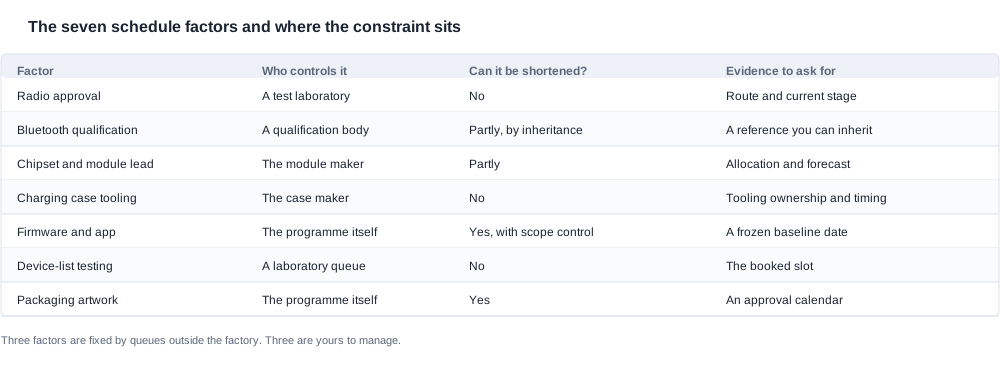
The seven factors, and which one binds
The factors a buyer can act on directly, and the threshold that applies to each:
- Radio approval route — identified per market, with the current stage named, because it is the longest queue.
- Qualification inheritance — a written yes or no, because it either removes a queue or adds one.
- Component allocation — allocation and forecast in writing, because it sets the build date.
- Case configuration — named in the order with its tooling timing, because it is a separate product.
- Firmware baseline — a freeze date rather than a scope, because scope moves and dates do not.
- Device-list slot — a booked date, because a queue does not move on request.
- Bluetooth name — fixed before artwork release, because it appears on the packaging and in the file.
Which of these binds depends on the programme, and the honest answer is that it has to be established per programme rather than asserted in general. What a buyer can do is refuse to accept a date that names no binding constraint, because a date without a named constraint cannot be monitored and cannot be renegotiated when it slips.

How to build a schedule that survives contact with a factory
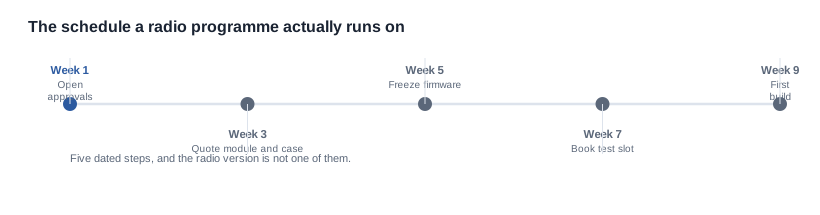
Open both approval routes in week one. They are the only items with an external queue that cannot be shortened, and every other date in the programme sits downstream of them.
Bring the case into the programme as a product. Its own tooling, its own qualification exposure, its own date. A case added at the artwork stage adds a cycle to the whole programme.
Plan the firmware and the app as a schedule line with a date. A radio change is a software change with hardware consequences, and the scope of the app work is the variable most often left open.
Book the device-list test slot as soon as the samples exist. Not when the programme feels ready. The slot is the constraint and the booking is the action.
Treat the lead time as a range and ask for the binding constraint. Our published position is that production lead times are not published on this site and are confirmed per enquiry; the inputs we work from are set out under OEM ready platforms and lead time. A range with a named constraint behind it is useful; a single number is a guess.
State the version split early. A range programme covering both the K01 and the K02 and the V5.4 entries has two qualification paths rather than one, and that has to be visible in the plan rather than discovered in the second quarter.
Write the schedule backwards from the launch date. From the launch date, count back the transit, the receiving and inspection time, the artwork approval, the document pack, the build, the sample round and the approval routes. A schedule built forwards from today produces a date that arrives too late; a schedule built backwards produces the order of work, which is what a buyer needs.
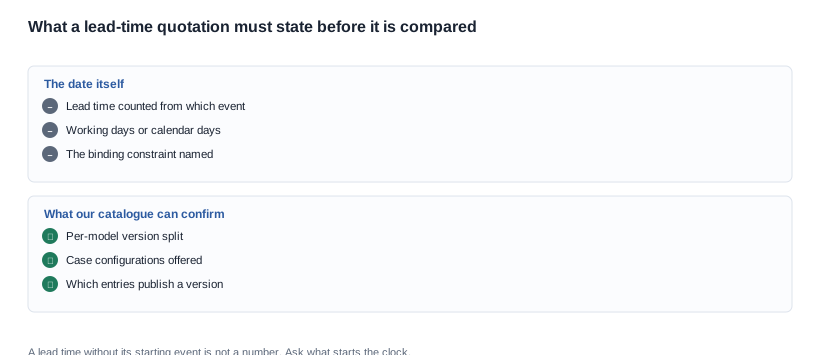
The final discipline is to record the date with its starting event every time it is quoted. A lead time counted from the deposit, a lead time counted from the artwork approval, and a lead time counted from the arrival of the components are three different numbers that are routinely presented with the same label. Asking which event starts the clock is the cheapest question in this article and it is the one that most often reveals that the quoted date was never going to work.

Where lead-time programmes slip, and what can still be moved
The approvals were opened after the product was finished. The symptom is a launch date that slips by weeks while the factory reports the units as complete. The root cause is that the approval route was treated as a paperwork task rather than as a queue. The prevention is to open it in week one and to put it on the critical path diagram.
The case was added late. The symptom is a build that is delayed by a component nobody put on the schedule. The root cause is that the case was treated as an accessory rather than as a moulded product with tooling. The prevention is to name the case configuration on the order.
The device-list slot was booked late. The symptom is samples sitting in a drawer for two weeks while a programme waits. The root cause is that the slot was treated as a task rather than as a queue. The prevention is to book it on the day the samples exist.
The Bluetooth name changed after the artwork was released. The symptom is packaging that shows one name and a technical file that shows another, and a re-issue of both. The root cause is that the name was treated as cosmetic. The prevention is to fix it before artwork approval and to treat a later change as a configuration change.
The schedule was quoted as one number. The symptom is a supplier that cannot say why the date moved when it moved. The root cause is that the range was presented without the binding constraint behind it. The prevention is to require the constraint to be named in every revision of the schedule.
The commercial structure that follows from this
The items with room in a schedule-led negotiation are the ones the buyer controls: the number of configurations in the first order, the number of markets, the artwork round count, whether the first run is split into two deliveries against a staged payment, and the share of units taken at a pilot tier rather than the run tier. The items without room are the approval costs and the laboratory time behind them, which are fixed per family and per market and which are queues rather than prices.
What moves the date most is often not the commercial terms at all but the configuration discipline: fewer markets, fewer configurations, and an earlier decision on the Bluetooth name. A buyer who reduces the first order to one configuration and one market will usually find a shorter programme than one who negotiates a better unit price, and the programme is what the launch date depends on.
A worked schedule, and how we handle the same question
This is a hypothetical case rather than a real engagement, and it exists to make the order of decisions visible rather than to report a result.
Assume a distributor that has committed to a spring category launch for a Bluetooth audio product in three markets, and a factory quotation carrying a production lead time of six weeks. The distributor's marketing team has built the campaign around a launch date eleven weeks after the order is placed.
Step one: build the schedule backwards. From the launch date, the distributor counts back transit and receiving, artwork approval, the documentation pack, the sample round, the build and the approval routes. It finds that the eleven-week figure already includes the build and nothing else, and that the realistic figure is closer to eighteen.
Step two: name the binding constraint. The distributor asks the factory which of the seven factors binds. The answer is the device-list testing queue, not the component lead — a result that would not have been guessed from the six-week production figure, and one that redirects the whole conversation.
Step three: act on the binding constraint. The distributor books the laboratory slot as soon as the samples are built rather than after the artwork is approved, which removes three weeks from the sequence. It also asks about qualification inheritance, which the factory confirms in writing, removing a second queue.
Step four: reduce the scope deliberately. The distributor moves the third market to a later phase and holds the first order to one configuration, on the basis that the campaign date is set by the first market's launch and the third market's contribution is smaller than the four weeks it would cost. The unit price per configuration is negotiated on the basis of a committed configuration count rather than a unit count.
Step five: write the schedule down with its starting event. Every date in the plan now names what starts the clock, and the binding constraint is named on the sheet. When the factory revises the build date in month two, the distributor can see immediately whether the binding constraint has changed or whether the plan has simply been reshuffled, and the conversation stays on the schedule rather than on the forecast.
The decisive decision was step two. The distributor did not negotiate a better price; it found out which queue it was standing in.
Our published position on schedule, and its limits
The short answer: the radio version is a stable fact rather than a schedule driver, and we publish it per model so that a programme can plan against it. Across our range the K01 and the K02 carry V5.3, and the D11, the LC-105-1, the LC-105-2, the YK12, the D12, the G07, the YKC02, the D17, the ZH12, the A07, the electrochromic entry and the AR entry carry V5.4.
We do not publish a chipset lead time, a radio approval duration, a qualification duration, a laboratory slot or a production lead time, because each of those depends on the destination market, the configuration and the current schedule, and a published figure would be a number we could not stand behind. Our published position is that production lead times are confirmed per enquiry. We will say which of the seven factors binds on your specific programme rather than listing them and leaving you to infer the date.
We also publish no frame weight for most models in the range; the only weight published anywhere in the catalogue is 158 g for the MT6 glasses unit, excluding its foldable charging case, and the case capacity there is 1200 mAh. Our position is that no claim about eye protection, vision or health applies to anything we quote.
The request that produces a usable date
Send the models, the destination markets, the case configuration, the quantity and the launch date, and we will tell you which of the seven factors binds on that programme, what the rest of the schedule looks like around it, and which items in it are fixed in character rather than negotiable. That answer will not be a single number, because a single number is not what a schedule is.
Send us the models, the markets, the configuration and the date, and we will tell you which factor binds.


