
The camera is the most expensive single line in a smart-glasses bill of materials and the one with the most consequences downstream, because it sets the image quality, the file format, the storage policy, the bandwidth and the privacy story all at once. Two resolution tiers are published in our catalogue and nothing else on the imaging side is: the sensor model, the field of view, the video resolution and frame rate, the stabilisation, the low-light behaviour, the storage format, the capture latency and the exposure behaviour are all unstated. That is not a defect in the document. It is a description of where the commercial decision actually sits, and a buyer who expects a spec sheet to settle the camera is looking in the wrong place.
Smart glasses camera technology: what the tier sets, from price to privacy
Why the camera is the largest line in the bill of materials
A camera assembly carries the sensor, the lens, the image pipeline, the storage and the software that ties them together, and in a device that has to pass through a distribution channel, it also carries the obligation to make the presence of the camera visible. That last point is not a feature. It is a condition of sale in several markets, and it is enforced at the point of sale and occasionally at the point of use.
The tier decision therefore settles three things at once. It settles the price, because the camera is the line that moves the unit cost most. It settles the file format, which decides what a customer's downstream system has to read. And it settles the claim, because a marketing page that promises a recording characteristic has to name a configuration, and a claim written for one tier and shipped on another is a dispute the brand's own marketing created.
The buying task behind the camera question
The reader is usually a brand-side product owner or a category manager who has to open a camera line, or a channel buyer taking on a camera product for the first time. The comparison in front of them is between quotations that print a megapixel figure, and the question underneath is which of them will produce files that the customer's system can actually use.
What they are afraid of is specific. The first is a listing that promises a resolution the recorded file does not deliver, because the quoted figure was a sensor capability and the output is an interpolation. The second is a file format that only one platform reads, which turns a product decision into a support obligation that belongs to the brand. The third is a camera whose presence is not externally visible, which is the failure that ends a listing rather than merely disappointing a customer.
All three are answerable before the order, and two of them are answerable on a sample in an afternoon.
Two resolution tiers, eleven models, and the model list behind each
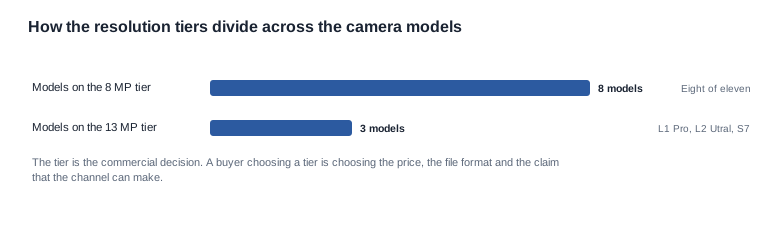
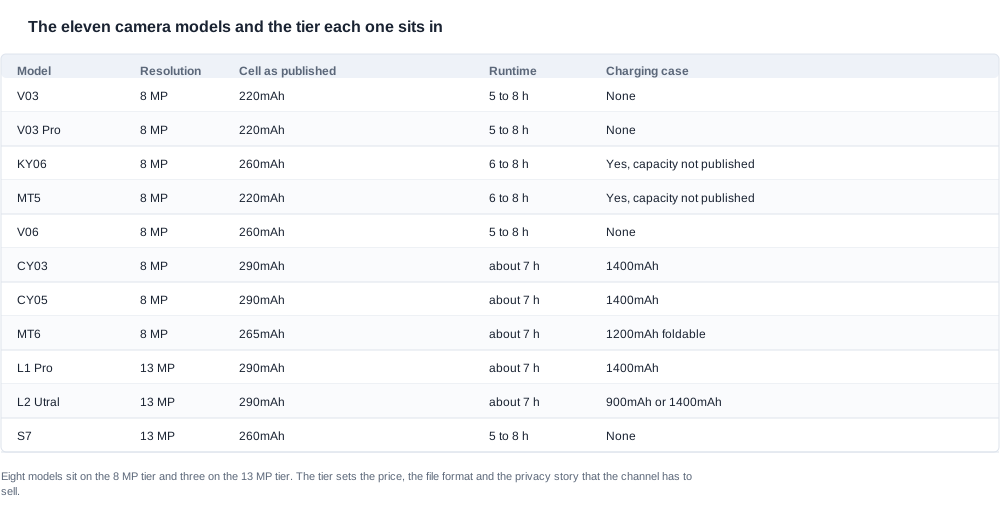
Our catalogue publishes two resolution tiers for the camera models, and that is the whole of the imaging record. Eight of the eleven camera models sit on the 8 MP tier: the V06 and the MT5, the MT6 and the V03 Pro, and the V03 and the CY03, and the KY06 and the CY05. Three sit on the 13 MP tier: the S7 and the L1 Pro, and the L2 Utral. The chart above is the commercially important version of that sentence, because it shows that the 8 MP tier is the volume tier and the 13 MP tier is the option tier, and a buyer who is building a range is choosing how much of the range sits on each.
A quotation that names a tier is comparable with another quotation that names a tier. A quotation that names a megapixel figure without naming a tier is not, because the figure may be an interpolated output rather than a captured one, and a comparison written in those terms is a comparison of two different kinds of number.
What a resolution figure does not tell you
A resolution figure is a count, and it is the one imaging row our catalogue states. It does not tell you the size of the pixel, and pixel size governs how much light each one gathers, which is what decides whether a product performs in a dim interior or at dusk. It does not tell you the field of view, so two products with the same count can frame completely differently. It does not tell you whether the product records video, at what resolution and at what frame rate. It does not tell you the sensor, and therefore it does not tell you what the manufacturer intends the tier to mean.
The general rule extends past the camera. Any single number that appears without a condition attached to it is a summary, and summaries are the part of a document written for a reader who already knows the product. A buyer who has a resolution figure and nothing else should treat the figure as the entry point to a due-diligence request, not as the answer to it.
How to choose between the two tiers without a sample
The two published tiers are a price band and an image band at the same time, and a buyer who is deciding between them is usually deciding between two different commercial strategies rather than between two qualities.
Choose on the number of configurations, not on the tier. The tier you pick determines how many colour, logo and private-label derivatives the conformity file has to carry, and the file work scales with the range. A brand that expects to run six colourways has a different answer from a brand that expects to run one, and neither answer is about the sensor.
Choose on where the file has to land. If the recorded file ends up inside a customer's business system, the format question dominates the tier question, because the integration cost of a format is fixed per system and the tier only changes the payload. If the file ends up in a social channel, the tier matters less and the transfer reliability matters more.
Choose on the claim you intend to make. A tier you cannot describe in one sentence is a tier you will describe in three, and three sentences on a product page become three commitments. The tier that can be described honestly in one sentence is usually the right one, whatever the number is.
Decide the colour range before the tier. The derivative question and the tier question are the same question in a camera programme, and deciding them together is what prevents a re-validation cycle six weeks after launch.
The rows that decide whether the capture path works in your channel
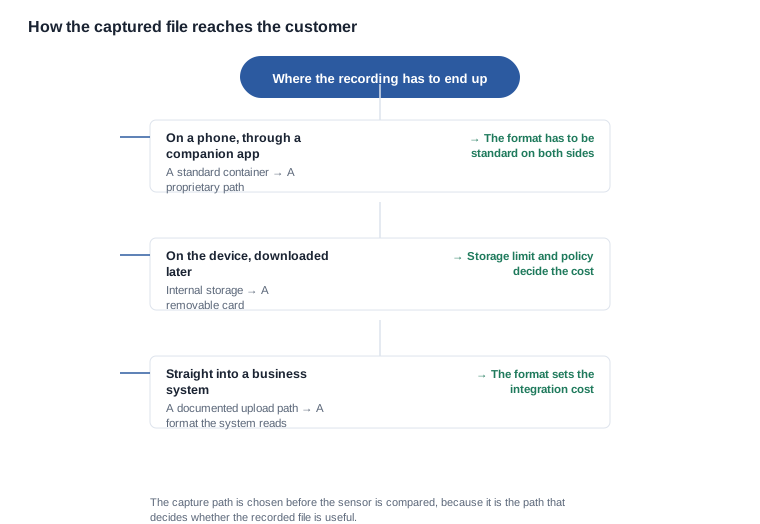
The capture path is chosen before the sensor is compared, because it is the path that decides whether the recorded file is useful. A product that records to internal storage and a product that streams to a paired device are not the same product with a different feature, and a product that uploads directly to a business system is a different product again with a different integration cost and a different privacy exposure.
The commercial consequence of that choice is larger than the camera line. The transfer path determines whether the customer's software has to be built, adapted or bought, and that cost is frequently larger than the difference between two camera tiers. It also determines how many support contacts a brand receives, because a transfer that works on one platform and not another is a support obligation rather than a defect.
The rows that make the path work are the container and codec of the recorded file, the storage limit and the transfer policy, the fallback when the companion application is not present, and the behaviour of the product when storage is full. None of them is published for any model in the range, and all four of them are questions the supplier can answer with a document.
The privacy indicator is an acceptance criterion, not a feature
The requirement that the presence of the camera be externally visible is worth separating from the imaging discussion, because it is the one imaging-adjacent row that can be checked by looking at the device. A buyer can verify an indicator on a sample in seconds, which makes it the cheapest acceptance criterion in the camera category.
The commercial reason to verify it is that the obligation is enforced by the channel rather than by the customer. A marketplace listing that fails on an unobservable camera is a listing that is taken down, and a listing that is taken down is a packaging reprint and a lost sales window, both of which sit at the end of the schedule.
Testing the camera on a sample rather than on the specification

The protocol is short and it is written before the samples arrive, because a protocol written afterwards will confirm whatever has already been decided.
- Set the scenes your channel will actually produce. A product photography studio, a warehouse aisle and an evening street are three different lighting environments, and a camera that performs in one of them tells you nothing about the other two.
- Shoot the same scene with every candidate model. Identical scenes, identical distances, identical movement, so that the comparison is between products rather than between afternoons.
- Check the recorded file on the device, not only on the phone. A file that transfers cleanly to one handset and plays badly on another is a format problem, and it is invisible until the file is examined where it lives.
- Test the transfer on every platform the channel supports. Where a platform is not supported, the fallback has to be documented, because the alternative is that the customer discovers it.
- Verify the indicator and the capture behaviour in the hand. The indicator is a visual check. The capture behaviour — when the recording starts, whether it stops, whether the user can tell — is a functional check and it belongs in the sample evaluation sheet.
- Write the format, the path and the limits into the order. A format in a purchase order is an acceptance standard. A format in an email is a preference.
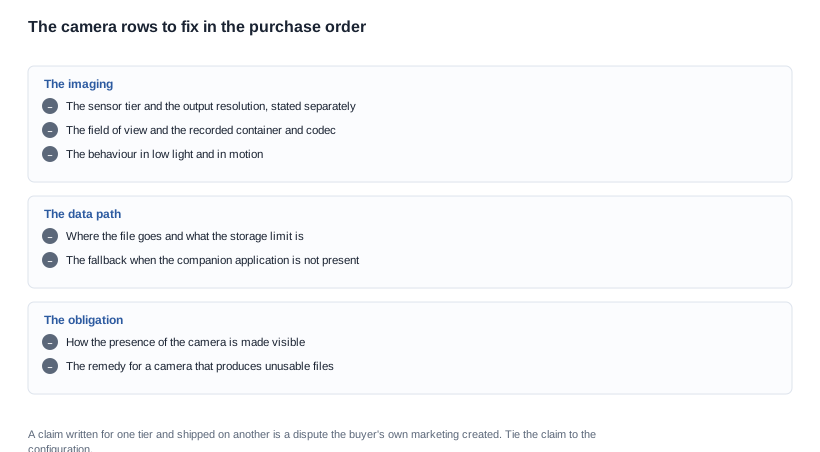
The checklist is the same six rows in a form that can be sent to a supplier. A supplier who answers all six has a documentation habit, and one who answers two is telling you something you need to know before the deposit.
Put the request in a fixed order, because the order determines how long it takes: the sensor tier and the output resolution first, then the recorded format and the transfer path, then the field of view and the low-light behaviour, then the storage limit and the fallback, and the indicator behaviour last. The first two decide whether the product is comparable with another quotation at all. The last one takes ten seconds to answer and is the one most often left to a phone call in the week before the sample.
What a camera tier costs in non-recurring terms
The unit price is the line everybody compares, and in a camera programme it is the least informative line on the quotation. The non-recurring costs are where the money actually sits.
The software that implements the capture path. The capture behaviour, the file handling, the transfer and the application that the customer uses are development work, and a buyer who assumes they are included will discover them in a separate quotation. They belong in the quotation as separate lines, and a supplier who itemises them is easier to compare with a supplier who does not.
The per-variant work. Every colour, every logo and every private-label derivative that touches the camera assembly is a configuration question, and the configuration has to be added to the conformity file. A camera tier with a wide colour range multiplies that work in proportion to the range rather than to the order size.
The claim work. A listing that promises a recording characteristic has to be tied to a configuration, and the marketing work of writing that claim is cheap compared with the cost of a dispute created by shipping a different tier behind it.
The clauses worth having in the agreement are the sensor tier and the output resolution as configuration attributes, the file format and the transfer path, the storage policy and its limits, the privacy indicator behaviour, and the defect remedy for a camera that produces unusable files. The total cost of a camera programme is the unit price plus the non-recurring work plus the integration cost in the customer's system plus the returns reserve, and the trade-offs between those are settled in the quotation rather than after the first shipment.
A worked example: a brand opening a first camera line for a marketplace channel
This is a synthetic scenario rather than a client project, and its purpose is to show the sequence in which the decisions are made.
Assume a brand with no camera product, selling through a marketplace that requires a recorded file the customer's own system can read. The binding constraint is that the marketplace has a returns policy which is unforgiving, and the brand has no way to test a camera before it buys tooling.
The tier is chosen against the volume, not the headline. The brand selects the 8 MP tier, because eight of the eleven camera models sit there and the non-recurring work scales with the range rather than with the order. The 13 MP tier is not rejected on quality; it is rejected on the number of configurations it would create.
The capture path is decided first. Because the customer's system has to read the file, the brand asks for the container and the codec for each candidate, and the answer determines which models remain in the shortlist.
The documentation request goes out with the quotation. The sensor tier, the output resolution, the field of view, the recorded format, the storage limit, the transfer path, the fallback and the indicator behaviour. Three of the eight come back with figures, and the rest come back as open rows, which the brand now knows to ask about rather than to assume.
The sample protocol is set before the units arrive. Three scenes, two candidates, the same distances, and the files examined on the device and on the customer's platform rather than on the brand's own.
The claim is written against the configuration. The listing states the tier and the file format, and it does not promise a resolution the recorded file does not deliver.
The indicator is an acceptance criterion. Checked on the sample, written into the order, and referenced in the packaging artwork.
The result is a listing that a marketplace can approve and a customer whose system can read. The decisive decision was the capture path, and it was made before any sample was ordered.
What our catalogue publishes on the imaging side
Here, we publish the resolution tier and the electrical rows so that the gaps can be read honestly, and we will not fill the empty camera rows with a plausible image quality statement, because the measurements that would justify one are not published to us.
The rows our published data does settle are these. Two resolution tiers, 8 MP and 13 MP, and nothing else on the camera side — that is the whole of the camera tier's published imaging record. Eleven models carry a camera, with eight on the 8 MP tier and three on the 13 MP tier. The electrical rows for each of those models are published, including the cell configuration, the rated runtime, the charge time and the charging method, together with the charging case where one is listed: the CY03 and the L1 Pro, and the CY05 — each at 1400 mAh, the L2 Utral at 900 mAh or 1400 mAh, the MT6 with its foldable case at 1200 mAh, and the KY06 and the MT5 with a case whose capacity is not published. The MT6 also carries the only published weight in the range, 158 g for the glasses unit, excluding the foldable case.
The rows we do not publish are these. The sensor model, the field of view, the video resolution and frame rate, the stabilisation, the low-light behaviour, the storage format, the capture latency and the exposure behaviour are all not published, and these gaps sit in the middle of the chain rather than at its ends. The interaction with the AI features is not published either, so the imaging pipeline as a whole is undescribed. We will not present the tier as a quality statement, because a tier without the figures behind it is a price band and not a specification.
What we will do is take a shortlist, work through the sample protocol with you, and report what the recorded files actually do in the scenes you specify. If you are evaluating this category, send us the models, the scenes, the platform the file has to reach and the target market, and we will tell you which configurations exist, which rows of the imaging data are settled, and which of the open rows a sample could close. The background is under AI camera glasses imaging, the specification rows are set out in Camera key specifications, and the cost structure is covered in Camera cost factors.
Related reading
- Camera key specifications
- Camera cost factors
- What to ask a supplier about camera
- Camera myths to avoid
Send the configuration, the quantity and the market, and we will say which parts of the camera specification are settled and which are yours.


