
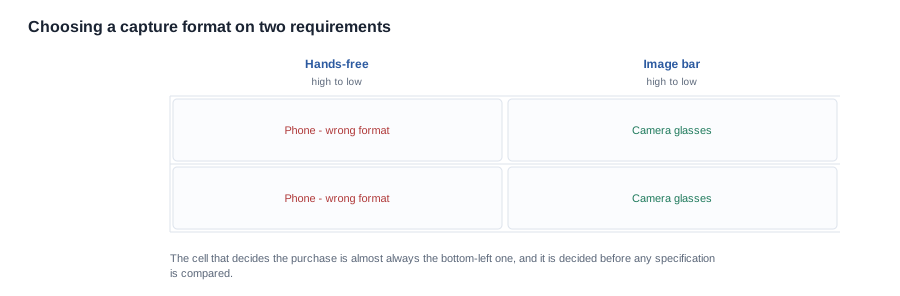
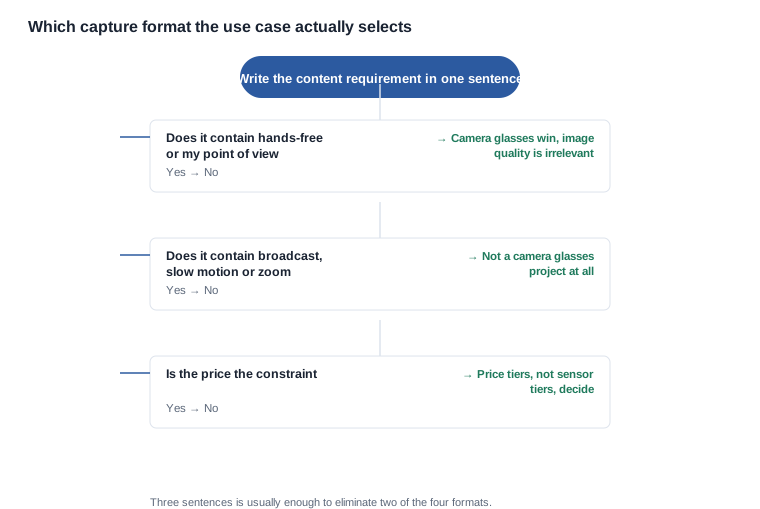
If the content your customer buys is captured while both hands are busy, camera glasses win the comparison outright and the image quality argument never gets opened. If the content is broadcast-grade, slow motion, or zoom, camera glasses lose before a specification is read, and the real project is sourcing a different product. Between those two outcomes sits a third, which is the one most camera programmes actually reach: the buyer needs a hands-free capture device, and the comparison that decides the purchase is the total cost of a capture session, not the megapixel count.
The published camera rows in our range will not settle that comparison on their own, and the reason is structural rather than a gap in our documentation. We publish two resolution tiers across eleven camera models and the electrical rows that travel with them. We do not publish a sensor part number, a field of view, a video frame rate, a stabilisation method, a storage capacity or a low-light figure for any of them, because none of those has been published to us. So the buyer has two routes: compare the formats on the axes that are genuinely decisive and accept the open rows, or close the open rows on samples before a purchase order is signed. This article walks the first route and shows where the second one starts.
Smart glasses camera technology: where it sits against three alternatives
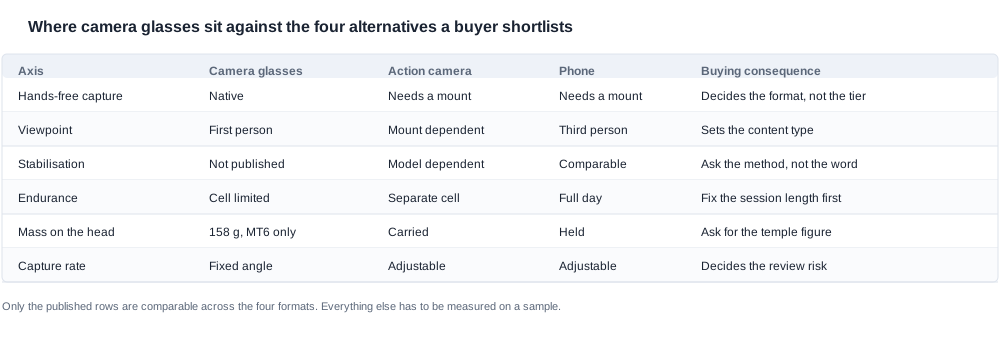
A buyer who puts these four products in one table usually ends up with a spreadsheet that compares the wrong things, because each product is described by its own strongest row. The phone is described by its sensor, the action camera by its stabilisation, camera glasses by their hands-free capture, and the body camera by its battery life. A table built that way has no winner, because no product is being measured on the axis it is bad at.
The three genuine strengths of the camera-glasses form factor
Hands-free capture with nothing mounted on anything. No bracket, no adhesive pad, no cage, no operator appearing in frame. For a channel whose content is recorded during a task rather than staged for it, this is not a convenience; it is the reason the format exists. It is also the reason a small sensor is acceptable: the alternative to a slightly worse picture taken hands-free is no picture at all.
A first-person viewpoint that no other device produces natively. The camera sits where the eyes sit, so the frame is the scene as the operator saw it. An action camera can be mounted on a helmet and approximate this, but the mount enters the shot and the viewpoint is approximate rather than exact. For a channel selling participation rather than production quality, that difference is the whole proposition.
Presence at the moment of capture. The device is on the head, so it is available when the content happens. The alternative is a phone that has to be retrieved, unlocked and aimed, and content that requires the operator to stop doing their task is content that gets lost. For a brand, this is a channel argument as much as a product one: the format only sells to the people for whom the footage is the point.
The three structural losses
Image quality against a dedicated camera. The sensor is small and the lens is short because the assembly has to fit inside a temple. A dedicated camera puts a much larger sensor behind a much longer lens, and the gap in low light is the gap a customer sees on a screen in a dim room. No amount of resolution tiering changes this, because resolution is not a light-gathering figure.
Stabilisation. A wearable camera moves with the operator, and its movement pattern is head movement, which is slower and less regular than hand movement but considerably larger in amplitude. Optical, electronic and software stabilisation all behave differently against that motion, and the published rows in our range specify none of them.
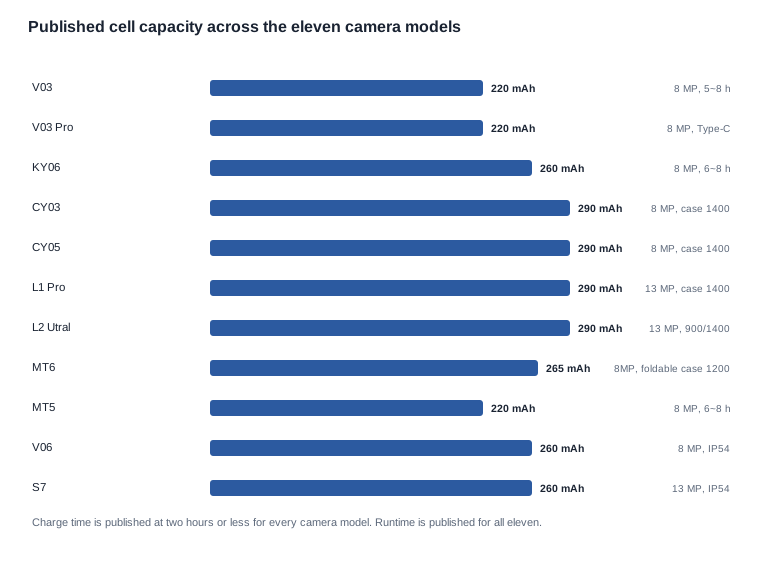
Endurance. The cell is constrained by where it can physically sit. The published runtimes across the eleven camera models in our range run from roughly five to eight hours, and the camera is the dominant load in that budget. A phone with a larger cell and a phone's own power management is simply not comparable on this axis.
Where a body camera enters and what it settles
Body cameras are the fourth candidate a buyer puts on the table and the one most often mis-handled. Their advantage is a recording model built around continuous capture into a managed store rather than a device that runs out of space, and their disadvantage is the size and weight of that store. In a procurement comparison, a body camera is a different compliance object as well as a different product: the footage is a matter for internal policy and for the people recorded rather than for the channel's customers.
Where a phone still wins and should be told so
A phone produces a better image than camera glasses for less money, and it is the right answer for anything scripted, controlled or reviewed before it is published. The honest commercial position for a brand is that camera glasses serve the part of the content plan a phone cannot reach. A range page that presents the two as substitutes invites a comparison the product loses.
The four axes that decide a camera-platform purchase
Four axes survive scrutiny, and they are worth writing down before any quotation is opened, because they convert a vague preference into a shortlist with a reason attached.
Axis one: the capture requirement, written as a single sentence
Write the customer's content requirement as one sentence and test each candidate against it. If it contains hands-free, my point of view, or without stopping what I am doing, the camera-glasses format wins and the image comparison is irrelevant. If it contains broadcast quality, slow motion, long zoom, or under a specific unit price, camera glasses lose and the procurement exercise becomes a search for another product. This sentence is the first item on the shortlist, because it eliminates candidates faster than any specification sheet.
Axis two: session length, and the two numbers that size it
Two runtimes decide whether a device survives a working shift: the runtime with the sensor active continuously, and the runtime with it active intermittently. The published figure in our catalogue is a rated runtime, and it does not state the duty cycle behind it. Our catalogue publishes charge time and rated runtime for every camera model, and the charge time is two hours or less across all eleven of them, but there is no published starting state of charge and no published termination criterion, so the published charge time cannot be converted into an interruption length or a case turnaround. A buyer who plans a shift from the rated runtime alone is planning from a number whose conditions are not stated.
Axis three: the capture angle and the consequence of a wrong guess
The field of view determines whether the product works for first-person video, and it has to be stated as diagonal, horizontal or vertical, because the three are not interchangeable. A horizontal 90 degrees is a diagonal of roughly 110 degrees, so an angle quoted without its convention cannot be compared with anything, including with another manufacturer's angle. We do not publish a field of view for any camera model, and the frame's own geometry occludes part of the scene, which means a component figure is not a product figure. A wide angle shrinks the subject at the centre and bends the edges; a narrow one leaves the operator out of shot.
Axis four: the total cost of one capture session
The unit price is the smallest number in this comparison and the least useful. A camera-glasses programme also carries a charging case, a spare cell, a second cell to declare under the transport rules, a replacement path, a return rate and a support cost per unit. When a comparison is run on landed cost alone, a platform that needs a case and a spare battery appears more expensive than it is, and a platform that needs neither appears cheaper than it is. The right measure is the cost of one capture session including the accessories and the failures.
| Axis | What to compare | What to ask the supplier | Published in our range |
|---|---|---|---|
| Capture requirement | The sentence the customer buys | Whether the use case is hands-free by nature | Not a specification row |
| Session length | Runtime active and intermittent | The duty cycle behind the rated runtime | Rated runtime only, all 11 models |
| Capture angle | Field of view and its convention | Angle, convention and focal length | Not published |
| Session cost | Unit price plus accessories and returns | Total cost per session, not per unit | Unit price on request |
| Physical load | Mass and where it sits | The temple figure, not the total | 158 g for the MT6 only |
| Endurance | Charge time and its conditions | Starting state and termination criterion | Two hours or less, all 11 models |
The physical load is a procurement row, not a comfort note
Mass matters commercially because it drives returns, and returns are a cost line that a procurement manager owns. A camera module at the front of a temple is a mass concentration at the end of a lever, and it loads the hinge in a way a balanced product does not. The catalogue publishes a unit weight for exactly one model in the whole range, the MT6 at 158 g, and that figure is the weight of the glasses body including the battery and the camera and excluding the foldable charging case, whose capacity is published at 1200 mAh and whose weight is not published. For every other model the weight is not published and has to be requested. A buyer who accepts a plausible-sounding figure from a supplier without checking the method is importing a liability into the returns budget.
What the published camera rows can and cannot settle
It is worth being precise about this, because a buyer who knows which rows are trustworthy can spend the sampling budget on the rows that are not.
The rows that carry a decision on their own
The resolution tier carries a commercial decision even though it carries no imaging decision. Two tiers across eleven models let a brand build a price ladder on a single platform without changing supplier: eight megapixels on the V06 and the MT6, the V03 and the CY03, and the CY05 and the KY06, and the MT5 and the V03 Pro, and thirteen megapixels on the S7 and the L1 Pro, and the L2 Utral. A price ladder is a real commercial objective and the tier is the right way to build one. The electrical rows carry a second decision: cell capacity, rated runtime and charge time are published for every camera model, the charging interface for seven of the eleven and the case capacity for five, so the buyer can build a case strategy and a shift plan without opening a single sample.
The rows that carry nothing on their own
A pixel count is a quantity. It says how many pixels the sensor can record and nothing about how much light each one gathers, so it cannot rank an eight-megapixel platform above a thirteen-megapixel one. The correct use of the tier in a listing is to describe the generation, and the correct use of it in a purchasing decision is to build a ladder. The moment it is used as a proxy for image quality, the buyer has made a decision on a number that does not carry it, and the customer will make a different decision on a number that does.
The rows that have to leave the sheet entirely
The sensor part number, the field of view and its convention, the video resolution and frame rate, the audio path, the stabilisation method, the low-light behaviour, the storage capacity and overwrite rule, the capture latency, the transfer time to the phone and the microphone specification are not published for any camera model in our range. A document that carries none of these is not a poor document. It is an accurate one, and the rows it omits are the rows a buyer has to obtain in writing from the factory before a purchase order is signed. The camera spec sheet explained page sets out the same list from the reader's side, and the how to choose a camera platform page turns the shortlist into a decision.
A hypothetical selection exercise: 1,500 units for a trade channel
This is a worked case rather than a live order. It shows how decisions fall. It is included to show how the four axes operate in sequence, and the figures in it are illustrative rather than published specifications.
A brand is planning a camera-glasses line for a trade channel: 1,500 units in the first year, sold to technicians and installers who record their own work for customer reports. The content requirement, written as one sentence, is that the operator records while both hands are occupied and the footage goes into a customer-facing report. That sentence eliminates the phone immediately and confirms the format.
The session length is an eight-hour working day with intermittent capture, so the question is not the continuous runtime but how the product behaves across a day of intermittent use. The rated runtimes in our range run from roughly five to eight hours, and the buyer asks each candidate for the runtime with the sensor active intermittently and for the duty cycle behind the published figure. The case configuration follows from that answer rather than from a preference.
The capture angle becomes the decisive technical row, because a report that shows the panel the technician is working on has to hold both hands and the wall. The buyer asks for the field of view in a stated convention and then tests it against a printed grid on the sample, because an angle quoted without a convention is not usable and a component figure does not account for the frame's occlusion.
The session cost is worked out with the accessories in it: the case, the spare cell, the second cell to declare under the transport rules, and a returns allowance sized from the mass-at-the-temple problem. The published weight exists for only one model, so the buyer requests the figure for every candidate rather than assuming parity across the range.
The shortlist ends with the price ladder built on the two published resolution tiers, which is a legitimate commercial use of the only published camera figure we hold.
Where the comparison goes wrong commercially
Comparing on resolution and calling it image quality
A tier ladder is a commercial decision and resolution is its proxy. A buyer who uses the tier as a quality proxy ships a product that gets reviewed on its footage and criticised on a comparison made in a spreadsheet. The cost lands in the return rate and in the review pages of the channel, and it is avoidable by writing the listing from the rows that were actually measured.
Comparing the unit price and ignoring the session
A camera platform that needs a case, a spare cell and a replacement path has a total cost the unit price does not show, and the case is a second lithium cell with its own declaration, its own packaging and its own shipping treatment. The comparison that flatters the wrong product is the one that leaves the accessories out of the table.
Comparing products built for different jobs
The most common version of this error puts camera glasses and an action camera in the same table, concludes that the action camera wins on image quality, and stops. The conclusion is true and irrelevant, because the customer wanted a hands-free first-person product and the action camera loses the requirement it was never built to meet. A comparison that does not start from the requirement produces a result that cannot be acted on.
Treating a capability feature as a differentiator
A voice assistant, a live preview and a continuous recording mode all draw from the same cell as the camera. Adding one shortens the session, and the addition is a bill of materials decision that should be made with the session length in view rather than presented to the channel as a feature advantage. Our catalogue names an AI voice assistant as a key technology of the camera tier and publishes nothing about the models it runs or whether the processing is on the device, so the buyer cannot quantify the cost from the sheet either.
Forgetting that the content is the product
The footage is what the customer buys the device for. A buyer who optimises the device and ignores the format ends up with a good device producing content nobody wants, which is the most expensive failure in this list because it is discovered after the tooling is paid for.
What we will and will not put in a camera comparison
Concretely, we will publish the rows we hold and mark the ones we do not, and we will not convert a resolution tier into an image quality statement in a comparison, a quotation or a listing, because the evidence that would rank the two tiers is not published to us.
We publish the two resolution tiers across the eleven camera models, and for each of them the cell capacity, the charge time and the rated runtime, with the charging interface on seven of them and the case capacity on five. We publish no sensor model, no field of view, no video resolution or frame rate, no aperture, no stabilisation method, no storage capacity or overwrite behaviour, no low-light figure and no transfer time for any camera model. We publish no model-level certificate numbers and no test report numbers, and the minimum order quantities, the production capacity and the lead times stay open internally.
What we will do is take two candidate camera models and a use case and run a fixed measurement session with you, so that the comparison lands on the picture rather than on the paperwork. The evaluation procedure is at how to test camera technology, the sample-stage procedure is at sample evaluation, the certificate register is at certification checklist, the transport documentation for any model with a case is at battery transport, the clause language is at contract terms and the commercial structure of a first order is at pricing. The range itself is at AI camera glasses, the imaging background is at AI camera glasses imaging, and the content applications are at content creation.
Send the two formats you are comparing, the content the customer is expected to record and the session length, and we will tell you which axis decides it and which rows have to be closed before the order.
Related reading
- The imaging rows and what they mean — camera and imaging
- The models in the range — AI camera glasses
- Building the shortlist — how to choose a camera platform
- Establishing the behaviour on a sample — how to test camera technology


