
Camera lead time is one of the places where this category's thin published data creates a practical problem rather than only an analytical one, because the component a buyer is most likely to be asked about — the camera module — is the one with the longest queue behind it and the one with the least information available to plan against. A buyer who cannot name the part cannot ask for its date, and a buyer who asks for a total date without the constraint named cannot plan against the answer either.
Our published position in the camera tier is what a buyer can plan on. The published resolution tiers are eight and thirteen megapixels, with the thirteen-megapixel tier on the L2 Utral and the L1 Pro, and the S7 and the eight-megapixel tier on the MT5 and the V03 Pro, the KY06 and the CY05, and the MT6 and the V06, and the CY03 and the V03. The cell capacity, the rated runtime and the charge time are published for each of the eleven camera models, the charging interface for seven of them and the case capacity for five. The sensor model, the field of view, the video resolution and frame rate, the stabilisation, the low-light behaviour and the storage format are all Not published, and so is the camera's own lead time.
So smart glasses camera technology smart glasses lead time factors is a question about which part of the programme actually determines the date, and the answer is that the date is set by whichever queue is longest and external, and that the buyer's best lever is knowing which queue that is before the programme starts rather than after.
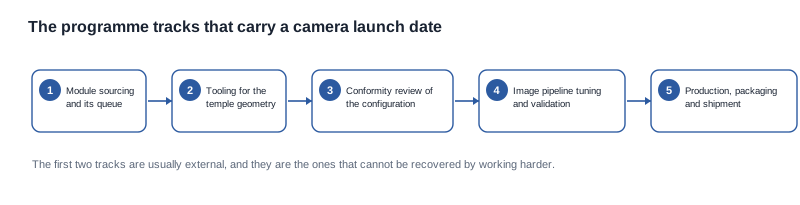
Smart glasses camera technology: which part of a programme binds the date
A camera launch date is the output of five tracks running in parallel, and only one of them is usually the constraint. A procurement manager who has the constraint named can negotiate against it; one who has a single total date cannot.
Track one, the camera module
The longest external item in the category, and the one with the least information available, because the sensor model is Not published in our range. The module sits with a small number of suppliers whose queues are set by their own allocation, not by the buyer's order size. Three things follow. A buyer who needs a specific camera cannot even name the part, so the question cannot be asked precisely. A buyer who names the part can be quoted a date, but a quoted date from a module supplier is a forecast rather than a commitment and moves. And a buyer who changes the camera configuration after the order is placed restarts this queue from whatever position the new part sits in.
Track two, the tooling
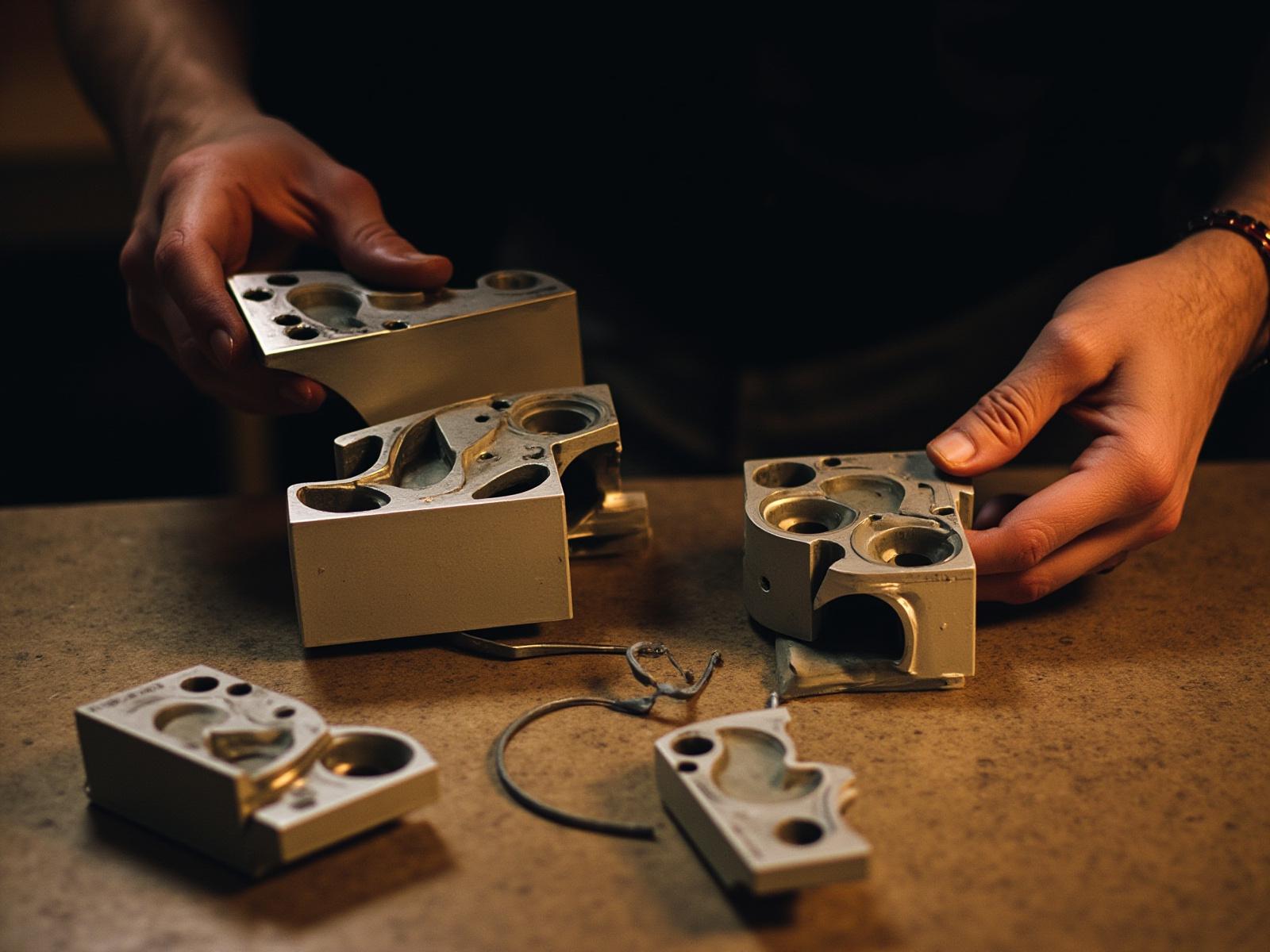
A camera module at the front of a temple changes the section thickness, the front's geometry and the mould, and a new mould is a lead time that a buyer does not control. The tooling requirements page sets out what that involves and why the camera position in the frame is a tooling decision rather than an assembly decision. Two programme failures follow from this track. Quoting the tooling date and the module date as one number hides which one binds. And freezing the camera geometry late, after the mould has been cut, turns a module question into a mould question, which is the most expensive change available in this category.
Track three, the conformity review
A camera is a component whose change is a change to the product, so a new camera variant means a review against the conformity position rather than an assumption that it carries over. In the European Union the radio equipment route under Directive 2014/53/EU applies with the EN 18031 series cited into it, and the general product safety framework under Regulation (EU) 2023/988 applies from 13 December 2024. A variant that is not named on the existing model list does not inherit the coverage, and the testing behind it sits in an external laboratory queue.
Track four, the image pipeline and the tuning
The image pipeline, the exposure behaviour, the encoding and the tuning of the module to the product's optics are a per-configuration engineering task, and they are easy to forget in a schedule because they feel internal. The tuning is not a fixed cost either: it is small when the rows were fixed before the sample and large when they were not, because a changed exposure behaviour or a changed encoding invalidates the validation that came before it.
Track five, production, packaging and shipment
Assembly is the shortest of the five and the least likely to bind. Packaging is a real cycle — artwork, print, and the lead time for the case and the box — but it runs in parallel with the rest of the programme and can be started early, which is exactly why it so often becomes the date that surprises everybody. The mass production stage page covers how the production track is usually structured.

The four external queues behind a camera launch date
Everything that actually binds is external, which is why effort on the buyer's side has a limited effect on the date. There are four queues to identify.
The module supplier's allocation queue. The longest and the least controllable. The only levers a buyer has are choosing a module with availability, ordering earlier, and accepting an alternative that is available. What a buyer must not do is treat a module lead time quoted in weeks as a delivery date.
The tooling shop's queue. Bounded by the shop, and influenced by how much of the geometry is new. A camera that changes an existing temple profile is a different tooling conversation from a camera that introduces a new front, and the difference shows up in the date before it shows up in the price.
The laboratory's queue. The conformity review sits in a testing queue that the buyer does not control and cannot accelerate by asking. The one thing a buyer can do is avoid creating work: a configuration that is already named on the model list does not need to be reviewed again.
The logistics queue. Shipping a product with a case means shipping a second lithium cell with its own declaration, and the freight and paperwork for that is a real schedule item rather than an administrative afterthought.
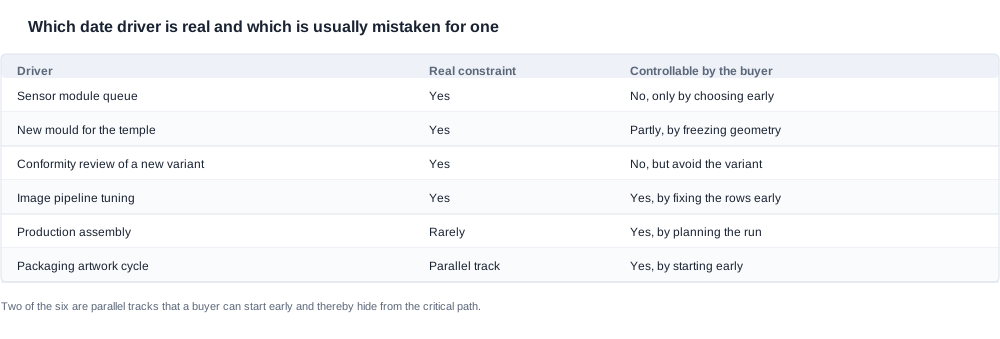
The lead-time items that are usually mistaken for the constraint
Four items get quoted as lead time drivers when they are not, and mistaking them for the constraint sends the buyer's attention in the wrong direction.
The production time. Assembly of a camera product is a small part of the programme, and the production lead time is not published on our site and is confirmed per enquiry because it depends on the configuration, the quantity and the schedule.
The electronics development. In a configuration programme on an existing platform it is close to zero, because the platform already exists. The design phase discussion sets out which requirements force a development rather than a configuration, and a camera that is already integrated on the platform is usually a configuration unless the geometry changes.
The packaging cycle. Real, but parallel, and startable early. A buyer who starts the artwork before the electronics are frozen has removed it from the critical path.
The camera's contribution to the runtime. This is a specification question rather than a schedule question. The camera is the dominant load in this tier, and a change in the module changes the power budget and therefore the published runtime figure. It is worth asking about, but it does not move the date.
The item that is usually missed entirely
The tuning and validation effort is per configuration, not per programme. A buyer who expects one validation pass for a platform and then adds a second camera configuration discovers that a second pass is required, and that the pass has to wait for the unit to be built. This is the scheduling mistake that turns a two-week variation into a two-month variation.
The order in which the tracks should be asked about
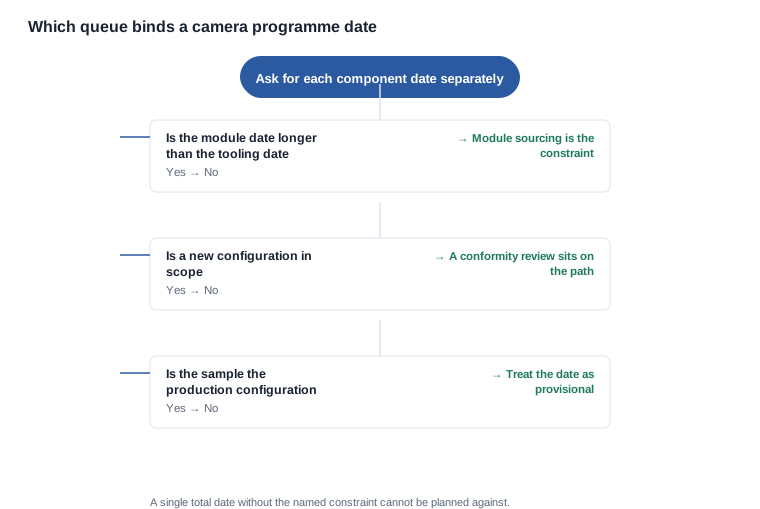
The four questions in the section above are not equally urgent, and the order they are asked in determines how quickly the constraint emerges. Ask about the module first, because it is normally the longest queue and it is the one that a configuration change restarts from scratch. Ask about the tooling second, because it is the one that a camera position in the frame can make worse and that a frozen geometry can protect. Ask about the conformity position third, because a configuration that is already named on the model list does not need to be reviewed and that answer can remove a queue entirely. Ask about the tuning last, because it is the shortest and the easiest to influence by fixing the rows before the sample arrives.
A buyer who asks in this order reaches the constraint within a week of enquiries. A buyer who asks for a total date first and the components afterwards reaches the same answer, but only after the programme has been planned around a number that turns out to be the wrong one.
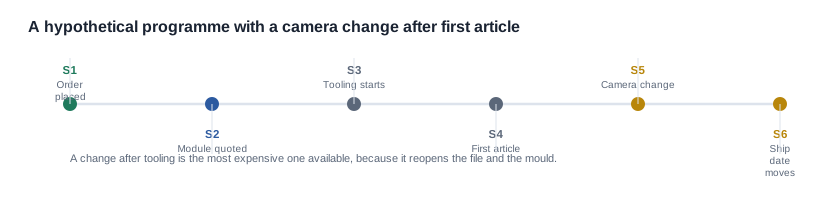

A hypothetical programme schedule with a camera change after first article
This is a hypothetical case rather than a client project, and it is included because the failure it describes is common and entirely avoidable.
A brand has scheduled a camera programme and has asked for a single date. The supplier has given one, and the brand has built a launch plan around it. The programme is progressing normally through tooling and the first article, and then the brand asks for a second camera configuration for a different market.
The change is not large in engineering terms. It is a different module in the same position, with the same form factor. In schedule terms it is severe, for four reasons that the brand had not separated when it approved the change.
The module queue restarts, because the new part has a different allocation position. The mould may restart, because a different module can change the front's geometry, and a mould is not a part that gets re-cut cheaply. The conformity review restarts, because the new configuration is not on the model list and cannot inherit the coverage. And the validation restarts, because the tuning is per configuration.
The supplier's single date does not move, because it was a total and not a constraint. The brand discovers at that point that it does not actually know which of the four tracks bound the original date, which means it cannot work out which one dominates the new one.
The recovery is unglamorous and effective. The brand asks for the four component dates separately, identifies that the module queue was the binding constraint even though the mould felt like it because the mould was the part the team was managing. It then moves the new configuration to a later wave rather than trying to pull it into the current one, which trades launch speed for schedule certainty. The second outcome is better because a programme with a known constraint and a plan built around it can absorb a change, and a programme with a single total date cannot.
What to ask a supplier about dates before a purchase order
- What is the sensor module, and what is its current lead time? And what happens to that date if the configuration changes. The first half is often unavailable, because the part is not published, which is itself an answer about the programme.
- Does this camera configuration need new tooling, and what is the tooling lead time separately? The two dates are frequently quoted as one, and separating them is what identifies the constraint.
- What is the conformity position for this camera configuration, and does the model list on the document cover it.
- What is the tuning and validation effort, and is it per configuration? This is the question that reveals whether a second variant is a configuration or a new programme.
- What is the longest external queue on this programme, and which party controls it.
- What is the sample date, and is the sample the production configuration? A sample that is not the production configuration makes the whole schedule provisional.
- What happens to the date if the camera configuration changes after the first article? A supplier who answers this question concretely is a supplier who has seen it happen.
- Which phase is the constraint, and is it visible in advance? The stage by stage discussion sets out the four tracks in the wider programme structure.
The criteria for judging a date you have been given
A date is usable if it names its constraint. A date that arrives as a single figure, with no component behind it, cannot be planned against because it cannot be moved, split or negotiated — and the first thing it will be asked to do is move, because programmes always move. A component date, by contrast, tells you which party to call and what would have to change for it to change.
The second test is whether the date is conditional. A module date is conditional on allocation and on the configuration remaining fixed. A tooling date is conditional on the geometry. A laboratory date is conditional on the configuration being named. A date with no conditions attached has usually been manufactured by averaging, and averaging is the opposite of planning.
The third test is whether it names the configuration it applies to. A date quoted against a family rather than against a named configuration is a forecast, because the moment the configuration is fixed the date may not hold. This matters more in a camera programme than in most, because the camera is precisely the element that tends to move.
The commercial terms that a camera date actually turns on
A programme schedule is only as good as the commercial structure underneath it, and four clauses do most of the work in a camera programme.
The configuration named in the agreement. If the agreement names a camera configuration and its model designation, then a substitution during the run is a documented change with a price and a date. If it names a platform, a substitution is an interpretation dispute, and the date becomes whatever the supplier says it is.
The date stated per component rather than in total. A clause that commits to a total date commits the supplier to the longest queue while leaving the buyer unable to see it. A clause that commits to a module date, a tooling date and a sample date commits to three things the buyer can monitor separately, and it lets the buyer see a slip in week three instead of in week ten.
The cost of a post-tooling change. This is the term that is usually absent and always needed. If the price and the schedule consequence of changing the camera configuration after the mould is cut are not stated, the change will be agreed verbally under deadline pressure, and the cost of it will land in the sample date and the certification budget rather than in the change order.
The schedule on which the sample reaches the buyer's laboratory. A supplier that delivers a sample in ten days is not the same as a supplier that delivers a sample in ten days from the date the configuration was frozen. The second clause is the one that matters, and it is the one that is usually written the other way round.
Certification cost and the testing body's own schedule are not terms that move in a negotiation, and it is worth separating them clearly from the ones that do, so that the negotiation effort goes where it can change something.
How we quote programme dates
It is worth being precise: we will tell you the date of each component of a camera programme separately rather than as a total, because a total without the constraint named is a number you cannot plan against, and we will tell you which of them is the constraint on a specific programme.
We will also be direct that the published position in our range does not include the sensor model or the camera's lead time, so a precise question about the camera schedule has to be asked in a programme conversation rather than answered from a catalogue. What we publish for the camera tier — the case capacities, the cell capacities, the charging interfaces, the resolution tiers, the rated runtimes and the charge times for eleven models, plus the unit weight for the MT6 — is the part that can be planned on today, and the rest is what we will establish with the engineering team and put in writing for a specific order.
The trade-offs beyond this tier are at camera advanced considerations, the programme structure is at development process stage by stage and mass production, the tooling side is at standard OEM tooling requirements, the design-phase question is at ODM development design phase, and the imaging background is at camera imaging.
One boundary is worth stating here, because it is where camera programmes are most often disappointed. We will tell a buyer which queue binds a date, and we will put a component date in writing once the configuration is fixed. We will not commit to a total date before the configuration is fixed, because a total date for a configuration that is still moving is not a commitment but a guess with a date attached, and a buyer who plans against a guess has planned against nothing. The minimum order quantity, the production capacity and the lead time for a specific camera configuration are confirmed per enquiry, because they depend on the configuration, the quantity and the schedule.
If you tell us the configuration, the quantity and the target date, we will tell you which part of the camera programme binds it, what we will have to confirm before that answer becomes a commitment, and which of the four external queues is the one to watch.
Related reading


